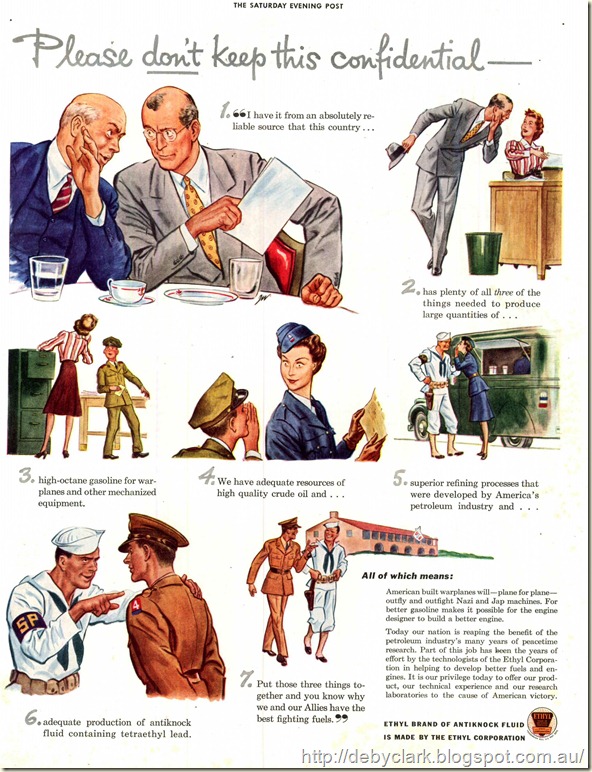
Wednesday, 27 June 2012

Second Chorus, 1940

 
It’s school holiday time here, and coincidently I have the flu, which means it s a great chance to curl up on the sofa with a cup of cocoa and watch old movies.  Luckily I just picked up a bundle at the op shop last weekend, for around a $1.50 each, including today’s viewing highlight, the musical comedy Second Chorus (1940).


Second Chorus stars Fred Astaire, Burgess Meredith as two trumpet players competing for the attentions of the gorgeous Paulette Goddard, Artie Shaw as a band leader who they try and impress and Charles Butterworth a rich, would-be musician and concert backer.    Astaire’s trumpet ‘playing’ was obviously fake, but Artie Shaw’s clarinet playing was sublime, and has inspired my daughter to do a bit more practice on hers.  
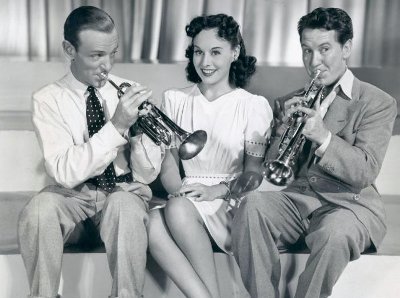
Second Chorus stars Fred Astaire, Burgess Meredith as two trumpet players competing for the attentions of the gorgeous Paulette Goddard 
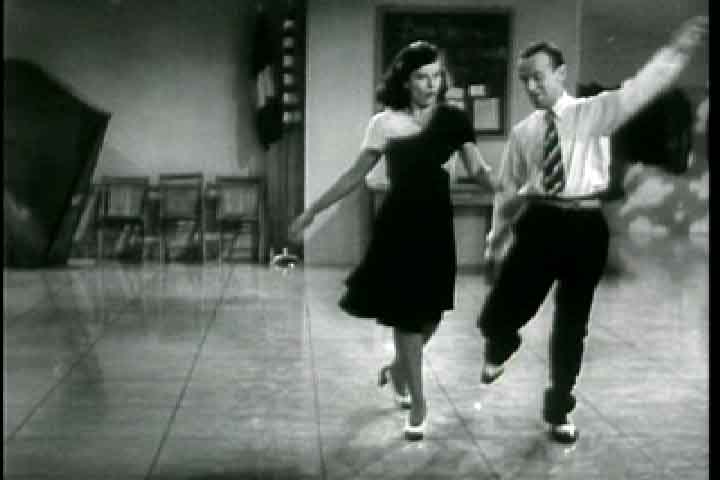
The swing music of Artie Shaw’s orchestra was fantastic – it rally made you want to get up and dance, and the swing dance between Astaire and his co-star, Paulette Goddard was lovely.  Her dress in this scene was a simple two tone number, which swung beautifully during the dance.

Here are some of the other memorable outfits in the movie.


Paulette Goddard was definitely our favourite in this move, and her different personas as she tried to hook different gigs for the band were very clever.  I definitely want to find more of her movies to watch, including The Cat and the Canary with Bob Hope, and The Great Dictator, with Charlie Chaplin.  Goddard was married to  Chaplin at the time this movie was made, but obviously Burgess Meredith made a deep impression as he became her third husband in 1944.

Meredith holds the mirror for wife Paulette Goddard. January, 1946
Meredith holds the mirror for wife Paulette Goddard. January, 1946 source

Astaire described Second Chorus as "the worst film I ever made", but my ten year old daughter and I thought it wasn’t too bad, with some wonderful musical numbers.  My daughter had never heard of Fred Astaire (what a slack mother I have been!), and the movie didn’t really show him as the brilliant dancer I had told her of, but she was still impressed.  Astaire (41) and Meredith (32) were also a little too old to be believed as college chums, no matter how many times they had failed, but all in all the movie was enjoyable and the music great.  There wasn’t a lot of dancing, but the few numbers included were pretty good - mind you the final number with Astaire as the tap dancing conductor was a little bit much. 

The film's copyright lapsed in 1967 and there are some seriously degraded prints around.  If you can find it restored on DVD like I did, it’s worth the watch.

Deb xx


Friday, 22 June 2012

20 June 1942 - Woman at Dude Ranch


I have been waiting for 20 June so I could post this cover - and of course I missed it!
Anyway, here it is, the cover of The Saturday Evening Post Magazine, 20 June 1942, titled "Woman at Dude Ranch".

 cover of The Saturday Evening Post Magazine, 20 June 1942, titled "Woman at Dude Ranch".

I just love it.  I tried to get on my horse like this yesterday - bareback - but we still need a little practice.  I certainly wouldn't want to practice in front of a group of cowboys!

The cover was designed by Fred Ludekens (you can just see his name in the bottom right on the fence). Born in California in 1900, Fred had no formal training in art, but began as a billboard painter for Foster and Kleiser after wroking for a few years on a fishing boat.  He joined the advertising agency of Lord & Thomas in 1931, and transferred to the company's New York City office in 1939, which is where he would have been when this cover was produced.  He worked in a variety of media, and often depicted rural scenes such as fruit ranches, coastal scenes, and the Indians of the Southwest. As well as the  The Saturday Evening Post,  he produced work for The American MagazineGood HousekeepingThe Country GentlemanFortune and True, and also illustrated many books. Here is an example of one of his war time posters.

Fred Ludekens

You can see more of his work here, and even buy a copy of the Post cover.

Deb xx

Wednesday, 13 June 2012

A slight distraction & a Chevrolet


Our new family member has arrived.  Her name, after much negotiation, is Diva.  She sings well and is beautiful, and that is what the vet said when she saw her- “aren’t you a little diva”.  She is an 8 week old border collie.  Here she is curled up in my arms.

021

Border collies have a reputation of being very intelligent.  After less than one day, Diva had worked out how to get on the roof of her crate and escape her ‘puppy play pen.” The next day she worked out how to climb the puppy playpen itself, and then do a back flip and escape.

031

The first work day we left her home in the bathroom.  I worried all day. I had hoped to get home at lunch time, but things went crazy and I couldn't.  So she was alone for 6 hours.  Today I decided to take her to work with me.  What is the point of working for yourself if you can’t take your pet to work , right?!  My husband/boss thought I was mad – at first.  But she was soooo good.  I looped the lead around her neck (she’s too small for a collar yet) so I could keep her under watch. She had only one accident on the ancient carpet, slept a lot, and comforted some anxious clients.  She also met at least five new people, which is great for her socialisation.  Apparently puppies need to meet 100 people by the time they are 3 months old.   She is well on the way.

Today’s ode to vintage, a Chevrolet ad from Post, June 1942.

chevrolet ad

Imagine one in red!

Deb xx

Monday, 11 June 2012

Puppy Love Vintage Style

It’s a  long weekend here, as we all celebrate the Queen’s birthday.   Extra time to do housework, and because the Queen is such a horse lover, it’s only fair to do a bit of horse- riding too!  Before I head off again, here are some vintage favourites on another theme.


source

Little Girl and Border Collie Dog Large Refrigerator Magnet - FREE US SHIPPING

source

Boy Playing Harmonica Dog Howling Refrigerator Magnet - FREE US SHIPPING

source

dog food ad

1959 dog food ad source

CarlBradford02.jpg

Carl Bradford , American breeder, with three of his Border Collies in about 1940 source

LukePascoHeatherJean.jpg

Luke Pasco with dogs after winning the 1937 American Championship source

Can you guess what it is?!

We have a new addition to the family arriving soon.  Really soon. So apologies in advance for the less frequent blogs and blogs that may feature cute photos instead of vintage news and pics.  If you have ever had the patter of four little feet in your home you will understand why!  Update soon…..

Deb xx

Saturday, 9 June 2012

8 & 9 June 1942–Sydney Harbour is bombed


time     source

Lord Louis Mountbatten on the cover of Time Magazine, 8 June 1942.

Just after midnight on 8 June 1942, Japanese submarine I-24 surfaced and pointed its deck gun towards Sydney, with orders to aim directly at the Sydney Harbour Bridge. As they travelled in a north west direction towards the coast, 10 shells were fired within 4 minutes at Sydney’s Eastern suburbs including Rose Bay and Woollahra. Only one of I-24's shells actually exploded, demolishing part of a house outside Yallambie Flats where a woman sleeping on an enclosed veranda was slightly injured by flying glass. The Australian authorities believed that the Japanese may have been using armour-piercing rounds intended to hit steel plated ships.

harbour bridge   source

Sydney Harbour in 1942

Of the other unexploded shells, one went through the double brick wall just below the gutter line in Grantham Flats in Rose Bay, the home of Mr Ernest Hirsch and his family. The shell skidded across the floor of Mr Hirsch’s mother's room and went through another 2 internal walls, coming to rest on the stairs where it was discovered by Air Raid Warden Harry Woodward. Mrs Hirsch was covered in broken bricks and her bed was broken by falling debris, but she escaped unharmed, as did Mr Hirsch’s wife and 18 month old son in the next room. Mr Hirsch suffered a fractured foot when he was buried under a pile of broken masonry. The unexploded shell was carried by Harry Woodward and two others to a nearby park where they temporarily buried it. The Navy demolition team recovered it later for detonation.

Another shell landed in Bradley Avenue, Bellevue Hill destroying the back rooms of a house and damaging the house next door, and another shell hit the gutter outside a small two-storey grocery store in Woollahra. It shattered all the windows in the building, and the occupants, including a mother and her two children, hid under the bed. When they eventually came down stairs they found their shop was wrecked. Warning sirens eventually sounded about 10 minutes after the last shell had been fired. The air raid sirens sent people rushing to their shelters, but may people didn’t realise what the sirens meant, and many turned on their lights to see what was happening. Not the best strategy when under attack!

damage   source

Damage caused to a Sydney Eastern suburbs home on 8 June 1942

At about 2am, just after the shelling of Sydney’s eastern suburbs, there was a short bombardment off Newcastle, 160 kilometres north of Sydney. Another Japanese had been ordered to attack the Newcastle shipyards. 34 shells were fired from a position at the mouth of the Hunter Rive, with most of the shells landing in the vicinity of Customs House and the power station. All but one failed to explode but there was still some damage to buildings and houses. The attack lasted about 20 minutes, until just after fortress gunners fired in reply.

Although neither attack caused death, they did scare people, and prompted a few more Sydneysiders to depart for the Blue Mountains and the interior country-side.

As a salute to the Royal Jubilee, here is a lovely photo of Queen Elizabeth visiting the Blue Mountains in 1954.

queen 1954  source

Deb xxx

Technorati Tags: ,,,

Wednesday, 6 June 2012

4- 7 June 1942 The Battle of Midway


Perhaps the most important naval battle of the Pacific Campaign of World War II, the Battle of Midway, took place between 4 and 7 June 1942. The United States Navy positively defeated an Imperial Japanese Navy attack against Midway Atoll, inflicting irrevocable damage on the Japanese fleet. The Japanese had sought to eliminate the United States as a strategic power in the Pacific, and planned to lure the United States' aircraft carriers into a trap, partly as retaliation for the Doolittle Raid on Japan's home islands in April and at the Battle of Coral Sea in early May. Japan intended to occupy the strategic Midway Atoll, which would help in their planned attacks against Australia, Fiji and Samoa. Thankfully American codebreakers were able to determine the date and place of the attack, and the US Navy was able to set up an ambush of its own. The U.S. was badly outnumbered and its pilots less experienced than Japan's. Even so, it sank four Japanese aircraft carriers the first day of the three-day battle and put Japan on the defensive, greatly diminishing its ability to project air power as it had in the attack on Pearl harbour six months earlier . The U.S. lost one carrier, 145 planes and 307 men, while Japan lost four aircraft carriers, a heavy cruiser, 291 planes and 4,800 men. After Midway, the two opposing fleets were essentially equals, and the United States soon took the offensive, with Japan's shipbuilding and pilot training programs unable to keep pace in replacing their losses .

george

source

Ensign George H. Gay at Pearl Harbour Naval Hospital, with a nurse and a copy of the "Honolulu Star-Bulletin" newspaper featuring accounts of the battle, on about 7 June 1942. He was the only survivor of the 4 June 1942 Torpedo Squadron Eight (VT-8) TBD torpedo plane attack on the Japanese carrier force.

Deb

Sunday, 3 June 2012

2 June 1942–Japanese raid on Sydney Harbour


The Mercury newspaper in Tasmania (among others) reported on 2 June 1942 that the “JAPANESE RAID ON SYDNEY HARBOUR FAILS”. You can read the article here. The attack itself had begun on the evening of 31 May and concluded at about 8.30am on 1 June, which was too late for the morning papers on the day. The Melbourne Age also reported a statement on the attack,

‘In an attempted submarine raid on Sydney three enemy submarines are believed to have been destroyed, one by gunfire, two by depth charges. The enemy’s attack was completely unsuccessful. Damage was confined to one small harbour vessel of no military value.’

You can also see a short newsreel article about the attack here.

A lovely war themed blog today, continued with some great war ads, from the Post Magazine, June 1942:

Ge ad

ethol ad

philco ad

Have a happy vintage day,

Deb

Saturday, 2 June 2012

1 June 1942 and Hair


I finally had my haircut at the hairdressers! After 18 months of trimming it myself, I lashed out. I now have a wavy bob, that I quite like.  Miss 6 said I looked just like Miss Fisher (from Miss Fisher investigates) – I wish.   I am in between cameras at the moment (slight accident involving a horse jump), so no photo yet.

On the subject of hair, I found this ad in the June 1942 issue of Post. I love the faces, don’t you?

dandruff

Listerine to treat dandruff does sound a bit mad, but I have heard people use it to treat rain scald on horses so it probably works.

On a more sombre note, on this day in 1942 a Warsaw underground newspaper, the Liberty Brigade, was the first public newspaper to tell the world about the death camps in Poland—almost seven months after extermination of prisoners began. It featured a story off a young Jew, Emanuel Ringelblum, who had escaped from the Chelmno death camp after being forced to bury bodies as they were thrown out of the gas vans.  The gas vans in Chelmno were used to kill up to 1,000 Jews a day, and involved gas fumes being funnelled back into a van used to transport them around the village.  This "gas van" was the death chamber for a total of 360,000 Jews from more than 200 communities in Poland.

A horrible subject I know, but I think it’s important not to forget what happened.

Deb