Thursday, 31 January 2013

Summer at the Beach


Having some technical difficulties today, so instead of my prepared post, just some Summer images.

I have been walking the dogs on the beach each morning and afternoon, as I build up my strength before returning to work.  The afternoons are busy, for here anyway, but in the mornings I am the only human on the beach. Despite the grey clouds, it is very hot, and humid - perfect swimming weather if it weren't for the jelly fish, and possible sharks and crocodiles.

Our busy local beach, Lambert's Beach, Mackay
I love to remember my time in Sydney at the popular Bondi or Manly beaches, or even Melbourne's St Kilda Beach, and compare the amount of people!  Even one hundred years ago Sydney's beaches were crowded - but isn't it a lovely painting.
Manly Beach — Summer Is Here, 1913, by Ethel Carrick Fox. Manly Art Gallery, Sydney.

Here is another Sydney beach scene by Fox.
On Balmoral Beach, 1913, by Ethel Carrick Fox. source

Born in, Sussex in 1872, Ethel Carrick was the daughter of an English draper. She was trained at the Slade School of Art, London, under Henry Tonks (1862-1937) and Frederick Brown (1851-1941) between 1899-1903. Carrick first exhibited her work in London in 1903, and in 1904 commenced exhibiting in Paris, which she continued to do for many years. She married my other favourite artist  Emanuel Phillips Fox, in London in 1905. They travelled extensively, visiting Europe, Africa and Australia.

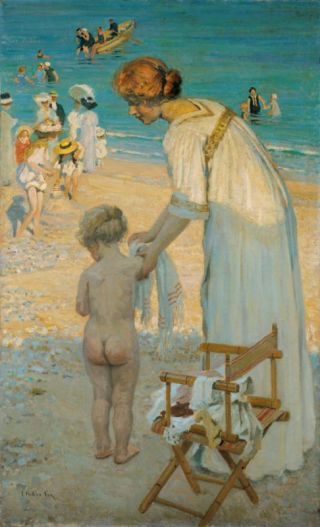
Mr Fox painted my all time favourite painting in 1909, Bathing hour (L'Heure de Bain), which is thought to depict a beach on France's Channel Coast. Luckily it's owned by the Queensland art gallery, and I am able to visit it every time I go to Brisbane (I do own a small print of it to).

E. Phillips Fox | Australia/France 1865-1915 | Bathing hour (L'Heure de Bain) c.1909 Queensland Art Gallery

So even if it's cold where you are, I hope I brought you some summer cheer!

Deb xxx

Wednesday, 30 January 2013

A brief history of the telegraph in Australia

 
If you’ve read or seen Terry Pratchett’s Disc World series, and Going Postal in particular, you will understand what a shutter semaphore tower is.  Semaphore lines, or optical telegraphs, that sent messages to a distant observer through line-of-sight signals existed in Europe from as early as 1792, and there were also instruments such as the heliograph used from the 19th century, that use the suns rays for signalling.
Heliograph-2
Signalling with heliograph near Monument 92. Alaska - Canada border c. 1910
 In the early 1850s businesses were pressing the government to find a quicker method of communication in Victoria.  Finally in 1853 a decision was made to investigate the possibilities of the electric telegraph,  and coincidently at the same time a young Irish-Canadian engineer named Samuel Walker McGowan landed in Melbourne.  McGowan had studied and worked in the USA with Samuel Morse, the inventor of the Morse electric telegraph who had made his first successful trial of the technology in the US in May 1844 with his famous message, "What hath God wrought."   Morse, a professor of arts and design at the University of the City of New York, had been inspired to develop his telegraph by the electrical work of Professor Joseph Henry of the Albany Academy in New York and the first electric telegraph invented by Schilling in 1832.  In the US by 1854 there was already 23,000 miles of line.  Morse encouraged McGowan to head for Australia to try to establish the telegraph there, as the Victorian Gold Rush saw great wealth and expansion, in that colony sending with him an experienced telegraphist and a quantity of telegraph equipment.
History_Samuel_B._Morse_Telegraph      reciever
Morse and his telegraph c. 1844 , and his receiver used for the demonstration

How did it work? From Museum Victoria:
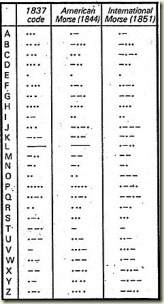
Telegraph signals were transmitted by an operator who depressed a key to complete an electric circuit and transmit current along the telegraph line. Releasing the key broke the circuit and cut off the current. Letters and numbers were represented by a sequence of short current pulses ('dots') and long current pulses ('dashes'), transmitted according to a defined code. The most widely used code was generally known as "Morse code".
At the receiving end of the telegraph line, the incoming current pulses passed to the receiving instrument, or 'sounder'. Two vertical wire coils were energised by the received pulses, causing the metal arm across the top of the coils to move up and down. The movement of the arm could be heard as a succession of metallic clicks. The interval between the clicks was short in response to the short current pulse representing a 'dot', or long in response to the long current pulse representing 'dash'. A skilled operator could interpret the succession of clicks as a pattern of dots and dashes and immediately decode the letters and numbers in the received message.

sounder   s2
Telegraph Sounder – c. 1860s

Hugh Childers, the Collector of Customs, who had been pressing for the introduction of the electric telegraph arranged for McGowan to demonstrate his equipment in Melbourne. McGowan then won the contract to erect 'a line of electric telegraph between Melbourne and Williamstown' and the first electric telegraph line in Victoria (and the first in Australia) opened for business in March, 1854, funded by the government but privately constructed.  
code  TelegraphTable3
How Morse code developed.

The telegraph network made it possible to communicate quickly - something that is taken for granted today – rather than sending messages by coach, pigeon, pony express or rail, but it was slow to catch on, as not everyone trusted information which had arrived via cable.  Some newspapers, for example, refused to print news which had arrived via cable as they doubted its truth, relying instead on pigeon post and human delivery. Reuters changed all this by setting up his "Submarine Telegraph" office in  1851 getting the ‘scoop’ on all international news.  One of the early important messages transmitted by telegraph in Australia was the first account to reach Melbourne of the Eureka rebellion on the gold fields at Ballarat in 1854.  The following year the line from Melbourne to Queenscliff was completed and the more shipping information and European news was made available.
cloncurry
The post telegraph office at Cloncurry, Queensland, c. 1912. There is a man up the telegraph pole in the centre of the photograph. source
 In 1856 Victoria, NSW and South Australia agreed to collaborate on establishment of an intercolonial telegraph network, as messages going across colonial borders initially involved operators in one colony  transcribing a message which was then physically handed to a counterpart in the second colony for transmission over that colonies wire.  South Australia also installed its first line in Adelaide.
post
Murtoa Court House and Post Office building, Victoria, c. 1890. Five men stand outside the post office while a sixth man, a woman and a small girl stand at the right. source

In Tasmania Hobart and Launceston were linked in 1857.  Adelaide and Melbourne were linked in 1858, the year in which the first NSW line was activated, and a Sydney-Melbourne link was in place by November 1858. The first line in Queensland was activated in April 1861, with a connection to Sydney in November of that year. The first transcontinental line in the US dates from the same year.
tas office
Scottsdale Post and Telegraph Office, Victoira 1906

By 1867 there were 1,676 miles of line within Victoria, handling 122,138 messages (compared to around 7.92 million in the US and 5.78 million in the UK that year).  Western Australia did not have its first line until 1869, but by 1875 a link between Adelaide and Perth was established. In 1872 the 2,900 kilometre Adelaide to Port Darwin link (the Overland Telegraph Line or OTL) was installed at a cost of £300,000.  This allowed fast communication between Australia and the rest of the world, via Singapore, and was one of the great engineering feats of 19th century Australia.The Batavia (Jakarta) to Broome link was completed in 1889, with a link to Perth via the Cocos-Keeling Islands in 1901.
Overland_Telegraph_Darwin
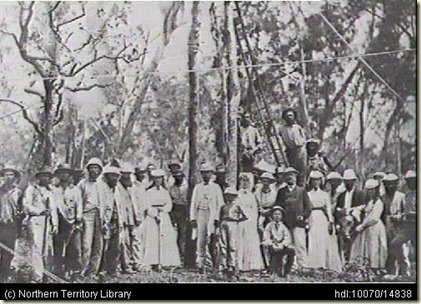
Planting the first telegraph pole, for the OTL, near Palmerston (Darwin) on 15 September 1870, source

By 1876 there were over 8,000 miles of line in Queensland alone. By 1900 virtually everyone in Australia had access to the telegraph, but they were still expensive (the cost per word for a message from London was at that time equivalent to the average weekly wage) and usually kept for special occasions such as births and deaths.  These telegraph messages sent by an electrical telegraph operator or telegrapher using Morse code  was known as a telegram.  A cablegram was a message sent by a submarine telegraph cable, often shortened to a cable or a wire, and I’ll look at these next time.
telegram
Telegram sent from Doncaster to Heidelberg in 1900 by J. W. Jenvey to S. W. Chambers giving information about wireless transmission experiments.


Deb xx


Tuesday, 29 January 2013

A land of droughts & flooding rains

I’m back from my week in Melbourne, where despite it being hot and dry we had a lovely visit.  As well as visiting family in Melbourne and country Victoria, we went to the museum and the z00 – and saw the baby elephant!   This is as close as I could get.
251
At Mansfield we were only a 100km from bushfires in the alps, and when I left there were more fires along the Hume Highway, the major road from Melbourne to Sydney.  I returned home to Mackay on Sunday to news of floods just to the south in Rockhampton, and further to Bundaberg.  The Lockyer Valley 80 km west of Brisbane, which suffered horribly in the floods of two years ago, is again flooding. The tropical cyclone which skirted Mackay while I was away and brought lots of rain, then moved down the coast and dumped rain all the way down to Sydney.  There is now a state of emergency from Bundaberg all the way down to Grafton in NSW.  Four people have already died.
creek
Lover's Bend at Palm Creek, Ingham, QLD,  in flood from bank to bank 1913 source


Floods have been as much a part of Australian history as bushfire.  Maitland, on the Hunter River in NSW, seems to have suffered more floods than any other town in Australia. Here is a link to a list of notable floods in Australian history (Mackay had a big flood in 2008). Maitland had a large flood in 1913, but also flooded in 1806, 1820, 1832 (7 people died) 1893 (when Brisbane also flooded) , 1930, 1931, 1949, 1950, 1951, 1952, 1955 (when all southern states flooded in August), 1970, 1971, 1996 and 2007 – over 200 altogether since European settlement and 13 higher than the river's normal peak limit of 10.7 metres (35.1 ft) which caused severe devastation.  The 1955 Maitland Flood, or Hunter Valley floods, was the first Australian natural disaster to be broadcast by the media on an international scale and was considered to be one of Australia’s worst floods, until 2011 at least.  Seven thousand buildings and homes were damaged and the flood claimed the lives of 25 people.
Maitland_Flood_1955
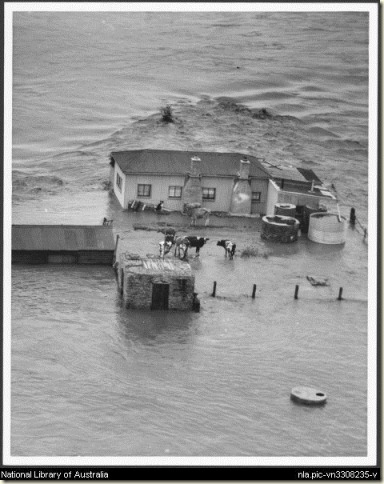
A deserted farmhouse in Maitland, during the 1955 flood, source
Here is a Brief Synopsis of the 1913 Flood, from a Souvenir of the Maitland Flood 1913. Rain began on the Tuesday of the preceding week, and continued for several days, being very heavy all along the Hunter Valley. There had been a fresh in the river a week or so before this heavy downpour, and much of the low-lying portions of the district were inundated. Owing to this, the river began to rise almost immediately at Maitland. On Thursday night, word was received from Singleton that the river had attained a height of 47 feet there, and the inhabitants of the lower parts of Maitland began to prepare for the worst. The water rose quickly on Thursday night, and early on Friday Morning, May 16th, had reached 36 feet, and was still rising. The official record says 36 feet 6 inches as the height of the flood, but there are many who claim that the water reached a higher point than that. It is difficult to say, however, as the gauge was washed away. Early on Friday morning, the water began to pour into High Street through a laneway near the Hustlers, as well as through several shops in the vicinity. It rushed down the street at a great rate, and soon had the lower portion submerged.
It also began to trickle over the embankment near the Belmore Bridge, at the rear of Marsh's stables, but, luckily, was discovered in time, and blocked by sand-bags. At about 6.15 a.m., the river overflowed the bank at Oakhampton, and the fire bell was rung to warn those living in the direction the water was traveling. Considerable damage was wrought at Oakhampton.

maitlandwebmedia
From the original held in Cultural Collections, Auchmuty Library, the University of Newcastle, Australia.
Floods are why traditional Queensland houses are built highset.  Unfortunately the fashion now is for low-set brick veneer houses – small air-conditioned boxes, often with carpet – and highset houses are built in underneath.
houses
Mrs Bridge's and Mrs Anthony's houses in floodwaters, West Ingham, during the Flood of 1913 1913 also saw floods in America.
OHdayton-flood1913-4thst
4th Street of Dayton, OH, USA during Great Miami Flood in 1913.
Here's wikipedia:
The Great Dayton Flood of March 1913 flooded Dayton, Ohio, and the surrounding area with water from the Great Miami River, causing the greatest natural disaster in Ohio history. In response, Ohio passed the Vonderheide Act to allow the Ohio state government to form the Miami Conservancy District, one of the first major flood control districts in Ohio and the United States.
fremont-flood
This photograph, taken looking west on State Street in Fremont, shows several men standing in the flooded downtown area.   The Sandusky River rose to 6 feet higher than they had ever been recorded. Some 550 homes were flooded, and approximately 50 of these homes were rendered uninhabitable or were totally destroyed, and four of five bridges washed away.
I hope you are not being affected by flood, or fire, at present.  If you want or are able to help people affected, you can donate here.
As usual, heaps more photos on tumblr.
Stay safe, Deb xx


Saturday, 19 January 2013

Saturday night movie–Dr. Jekyll and Mr. Hyde

 
Tomorrow I leave for Melbourne for a week, so I will probably not be blogging.  I will, however, be taking photos, which I will post on tumblr, so check that out if you're interested.  I will try and take shots of vintage Melbourne if I can, and maybe elephants. So anyway, this week a movie with no elephants, but it is vintage.

Motion pictures in 1913 were shorter than today, without sound and in black-and-white, of course, but they were sometimes presented as part of a set of vaudeville performances, with live musical accompaniment, or sometimes as a set of several short films.  In the days before movie palaces, movies were shown in normal theatres, which often gave them a special feel.  I quite like them, but they are definitely better with music than without.  My kids are not so impressed with my ‘old day movies’, but as they are short they try and put up with them just for me!

This 1913 dramatization of Robert Louis Stephenson’s classic horror story The Strange Case of Dr. Jekyll and Mr. Hyde (1886) was written and directed by Herbert Brenon and stars the ‘king’ of the silent films, William King Baggot. 
KingBaggot(1879-1948)
Baggot (November 7, 1879 – July 11, 1948) was also known as  "The Most Photographed Man in the World" and "The Man Whose Face Is As Familiar As The Man In The Moon," and he appeared in at least 269 motion pictures from 1909 to 1947; wrote 18 screenplays; and directed 45 movies from 1912 to 1928.
The most notable difference from the original written story is probably the addition of a love interest for the doctor, Alice (played by Jane Gail) , and while her presence adds little to the story, it is nice to see some feminine 1913 fashions.
vlcsnap-2012-12-27-17h13m19s145
Baggot’s portrayal of the metamorphosis sequences, from the upright Dr Jekyll to the crouched, evil Mr Hyde, are very good and show his excellence in the craft of acting – there are no special effects here apart from some stop motion photography while King applies his own makeup!
vlcsnap-2012-12-27-17h14m38s112  vlcsnap-2012-12-27-17h16m01s235
The film is only twenty-six minutes long and well worth a watch if you have time.


You can read more about the movie here, or find the movie for  free download here.  The above photos are stills I have taken from this version of the movie.  If you are not keen on silent movies, there are over 20 other version of the movie available, the latest a series made in 2008, and there was even a musical version, which will be played again on Broadway from April this year. 

comics_strange_case_mr_hyde
There are also rumours of a new movie by Dark Horse Entertainment, based on  the comic book by Cole Haddon, The Strange Case of Hyde , as well as Waterfoot Films' independent Strange Case of Dr. Jekyll, set in modern times and Jekyll, with Keanu Reeves and finally Guillermo Del Toro ‘s  own vision for Dr. Jekyll and Mr. Hyde.  As long as he doesn’t turn into a woman, I’m happy.

Enjoy, Deb xxx


Friday, 18 January 2013

18 January 1913- Rescued from Antarctica


On 18 January 1913, the ship that had delivered the British Antarctic Expedition in June 1910, The Terra Nova, was finally able to break through the ice outside of Antarctica's McMurdo Sound to pick up the Northern Party, the remaining members of the expedition that had set out to locate the Southern Party that had been led by Robert Falcon Scott.
Scott’s expedition had attempted to be the first to reach the geographical South Pole, but when they reached it on 17 January 1912, they found that a Norwegian team led by Roald Amundsen had beaten them by 33 days.
newyorktimes
Breaking news in the New York Times March 8, 1911, “Amundsen reaches the South Pole” source
Scott's entire party died on the return journey from the pole; some of their bodies, journals, and photographs were discovered by a search party eight months later.
Scottgroup
Scott's party at the South Pole, 18 January 1912. L to R: (standing) Wilson, Scott, Oates; (seated) Bowers, Edgar Evans  source
Victor  Campbell was Scott’s second in command and head of the  Northern party that had sailed north and  put ashore at Robertson's Bay, near Cape Adare, where they were forced to spend the winter.  In January 1912 the Terra Nova took them 250 miles (400 km) south of Cape Adare and 200 miles (320 km) northwest of Cape Evans.   They spent another miserable winter with limited rations, supplemented by the occasional penguin and seal, as the ship could not reach them because of heavy pack ice. They built an ice cave on Inexpressible Island and finally on 30 September 1912, they set off for Cape Evans, arriving on 7 November after crossing more than 200 miles (320 km) of sea ice.
ice
Evans and Nelson making ice-cave. Jan. 12th 1911.
After learning of the death of Scott and the entire Polar party, as the senior remaining Naval officer, Campbell assumed command of the Terra Nova expedition for its final weeks, after reporting to the  crew that Scott's party had reached the South Pole on January 17, 1912, but had all died on the return journey.
terranova
The Terra Nova  source
The Amundsen-Scott South Pole Station was established in 1956-57 for scientific research, and has been staffed ever since by researchers and support personnel. During the Australian summer, from about November to March, about 250 scientists live at the station. That number drops to between 50 and 60 when the winter season descends, with its constant darkness and extreme temperatures.
Antarctica is now a popular tourist destination, during those summer months when the sun never sets, for those willing to spend big. Tourists pay tens of thousands of dollars for the trip, mostly to see penguins and icebergs, but you are able to actually travel to the Geographic South Pole, the southernmost point on the planet,  like the early explorers.  – it’s marked by a small sign and a tall stake driven into the ice, which is moved about 10 meters per year to compensate for the movement of the ice.
Ceremonial_South_Pole
The ceremonial south pole is used for photography purposes - the shiny metallic sphere atop a small red-and-white striped pole is located a short distance from the Geographic South Pole, and is surrounded by flags of the Antarctic Treaty countries.
I don’t think it’s in my top five places to visit.  What about you?
Deb xx
as usual, more photos on tumblr and ignore the underlining it won’t turn off

17 January 1913–A French President


Prime Minister Raymond Poincaré was elected as the new President of France on this day in 1913.  A conservative leader,  who was vocally anti-German, but committed to political and social stability, he  served five times as Prime Minister, and as President from 1913 to 1920.

poincarepresid

Poincare, the son of an engineer and meteorologist, was born in Bar-le-Duc, France, on 20th August, 1860. After graduating from the University of Paris he became a lawyer in 1882 and was for some time law editor of the Voltaire.

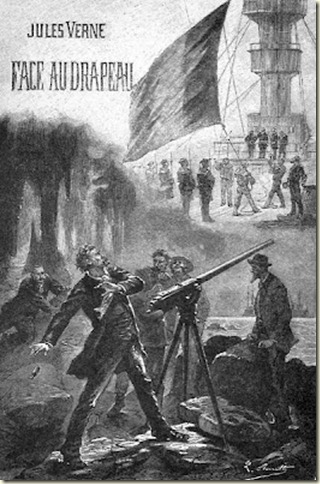
His most famous moment as a lawyer was probably in his defence of author Jules Verne in 1897, when  chemist Eugène Turpin, inventor of the explosive melinite, claimed that the "mad scientist/professor Roch" character in Verne's book Facing the Flag was based on him.  The court decreed that even if that were so “a novelist cannot be forbidden to  draw inspiration from notorious facts and well known personalities”, otherwise it “would be necessary to forbid the publication of novels and close all theatres.”
facingtheflag

Facing the Flag, by Jules Verne, source

Poincare was elected to the Chamber of Deputies in 1887 and six years later became France's youngest ever minister when he was placed in charge of education (1893-94). He also served as minister of finance (1894-95) before once again becoming minister of education (1895). In 1902, he co-founded the Democratic Republican Alliance, and was appointed head of a coalition government in January 1912.  He pursued hardline anti-German policy, as he was concerned about the growth of German militarism , while trying to restore close ties with Russia, going there for a State visit in August 1912.

Caricature-Of-Raymond-Poincare-1860-1934-Moving-To-The-Elysee-Palace,-February-1913

Caricature of Raymond Poincare 1860-1934 moving to the Elysee Palace, February 1913, source

In January 1913, Poincare defeated Georges Clemenceau to become president of France, and he attempted to make that office into a site of power for the first time since the 1870s and continued to dominate foreign policy. He went to Russia, for the second time (but for the first time as president) to reinforce the Franco-Russian Alliance in July 1914.    The office of president is France’s most senior office, and outranks all other politicians, with significant authority in foreign policy and national security, although the Prime Minister of France and parliament oversee much of the nation's actual day-to-day. 
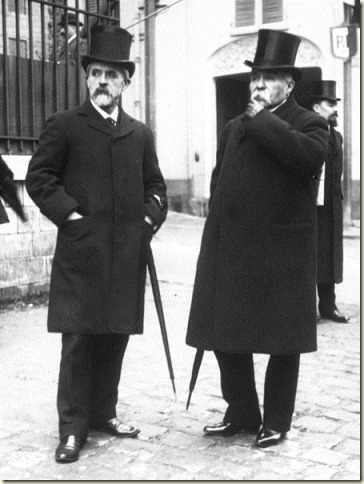
Louis_Lépine_&_Georges_Clémenceau_1908

 French préfet de police and inventor Louis Lépine (1846-1933) with Prime Minister Georges Clémenceau (1841-1929) at Choisy-le-Roi in 1908  source

During WWI Poincare tried hard to preserve national unity, however he found it difficult working with Clemenceau who became prime minister in 1917. Poincare believed the Armistice after WWI happened too soon and that the French Army should have penetrated Germany far more , taking control of the Rhineland. 

Poincare returned to the Senate after his presidential term came to an end in February 1920. A supporter of the war guilt clause in the Versailles Peace Treaty he served as chairman of the reparations commission, before returning to power as prime minister in January 1922. He refused to accept a delay in reparation payments and in January 1923 ordered the French Army into the Ruhr,the main centre of Germany's coal, iron and steel production.

In the 1924 elections Poincare was replaced by Edouard Herriot as prime minister, but he was once again brought back to power in July 1926 and served as both prime minister and minister of finance, until ill-health forced him to resign in July 1929.  It appears that Poincare never married or had children.  He died in Paris on 15 October, 1934.

Golly, I am getting so educated with these posts – I hope you are too.

Deb xx 

Wednesday, 16 January 2013

16 January 1913 - Russia's Grand Duke


On this day in 1913 Russia's Grand Duke Michael Alexandrovich was stripped of his rank as officer in the Russian Army by his brother, the Tsar Nicholas II.
Mihail_II
Grand Duke Michael Alexandrovich of Russia
Michael [22 November 1878 – 13 June 1918) was the youngest son of Emperor Alexander III of Russia. His paternal grandfather, Emperor Alexander II of Russia, was assassinated on 1 March 1881, and as a result Michael's parents became Emperor and Empress of All the Russias before his third birthday. When Michael was 15 his father fell fatally ill, and died and Michael's eldest brother, Nicholas, became Tsar.
Like most members of his family, Michael was enrolled in the military, completing training at a gunnery school and joining the Horse Guards Artillery. In November 1898, he attained legal adulthood, and just eight months later became heir presumptive to Nicholas as the middle brother, George, was killed in a motorcycle accident, and Nicholas did not yet have a son and his three daughters were ineligible.
1913
Nicholas II, Alexandra, and their children. c. 1910
In 1901 Michael represented Russia at the funeral of Queen Victoria, and was given the Order of the Bath. The following year he was made a Knight of the Garter in King Edward VII's coronation honours, and transferred to the Blue Cuirassier Regiment in Gatchina.
Michael’s assets at the time included the largest sugar refinery in the country, capital amounting to millions of roubles, a collection of motor vehicles, and country estates .  When Nicholas and Alexandra had a baby boy in August 1904, Michael again became second-in-line to the throne.

Princess Beatrice of Saxe-Coburg and Gotha
In 1902, Michael met and fell in love with Princess Beatrice of Saxe-Coburg and Gotha, but both the  Orthodox Church and Nicholas refused to allow the marriage as they were first cousins.  She alter married into the Spanish royal family.
Michael then looked at marrying Alexandra Kossikovskaya, “Dina” who was his sister Olga's lady-in-waiting and wrote to his brother in July 1906 for permission, as she was a commoner. According to Russian house law any royal that married outside of royalty was removed from the line of succession, and  Nicholas also threatened to revoke Michael's army commission and exile him from Russia if he married without his permission.  Michael was sent to Denmark until mid-September, and when he returned it was announced that he was to marry Princess Patricia of Connaught,  but it appeared to be a plot by his mother to marry someone suitable, and did not eventuate.  Dina, who was under surveillance by the Tzars secret police, finally went to live abroad, but never married.Three-quarter length portrait photograph of Natalia wearing an Edwardian-style dress and hat with furs
Natalia Brasova
In early December 1907, Michael began a relationship with the wife of a fellow officer, Natalia Sergeyevna Wulfert, and when she separated from her second husband Michael organised an apartment for her and her daughter in Moscow.  Their son and only child George was born in July 1910, before her divorce from her second husband was finalised, but Nicholas issued a decree giving the boy the surname "Brasov", taken from Michael's estate at Brasovo, acknowledging Michael as the father.  Natalia was allowed to move to the estate in May 1911, and granted the surname "Brasova" by Nicholas.  After months of travel under the constant watch of the secret police, they were finally married in Vienna on 16 October 1912.  .
brass2
Natalia Brassova and Grand Duke Michael Aleksandrovich of Russia.  source
Two weeks after the marriage Michael wrote to his mother and brother to inform them, and they were   both horrified,   and his brother was shocked that his brother had "broken his word ... that he would not marry her’.  Nicholas was particularly upset because his heir and son, Alexei, was gravely ill with haemophilia. Michael had feared that he would become heir presumptive again on Alexei's death, and would never be able to marry Natalia, so he married her and took himself out of the line of succession.
In a series of shocking and severe decrees over December 1912 and January 1913, Nicholas relieved Michael of his command, banished him from Russia, froze all his assets in Russia, seized control of his estates, and removed him from the Regency.   The couple lived in hotels in France and Switzerland for six months before moving to Knebworth House near London.
Knebworth_W_front
West facade of Knebworth House, Hertfordshire, England source
With the start of WWI, the couple returned to Russia and Michael was promoted from his previous rank of colonel to major-general, and given command of a newly formed division: the Caucasian Native Cavalry, which became known as the "Savage Division".  For his actions commanding his troops in the Carpathian mountains in January 1915, Michael earned the military's highest honour, the Cross of St. George, although he hated the horrific nature of the war and felt guilty and ashamed that he had failed to prevent the war and protect his country. 
Classically handsome Michael in wearing military uniform
Michael in military uniform
In 1915 Michael regained control of his estates and assets from Nicholas, who agreed to legitimize Micheal’s son George, with the title “Count Brossov”.  In February 1916 Michael was given command of the 2nd Cavalry Corps, which included the Savage Division, a Cossack division, and a Don Cossack division, and they fought in the Brusilov Offensive, earning Michael a second gallantry medal, the Order of St. Vladimir with Swords, for his part in actions against the enemy, and promoting him to adjutant-general.

Despite his active participation in the war, Michael knew his brother was facing a loss of loyalty from the people – there was growing public unrest, and people felt that Nicholas was unduly influenced by his German-born wife Alexandra and the self-styled holy man Rasputin.  Rasputin was killed in December 1916, and an attempt was made to assassinate Alexandra shortly after.  Public unrest grew, and in February 1917 soldiers joined demonstrators and revolutionaries patrolled the streets, rounding up people connected with the Tzar.
On 1 March Michael signed a document proposing the creation of a constitutional monarchy, which was rejected by the newly formed Petrograd Soviet .  Nicholas then abdicated, in favour of his son, Alexei, with Michael as Regent, but then amended that to make Michael emperor, as Alexi was gravely ill. The new government did not agree, and after much discussion it was agreed that Michael would defer to the will of the people and acknowledged the Provisional Government as the de facto executive, but neither abdicate nor refused to accept the throne.  This marked the end of the Tsarist regime in Russia.
Head and shoulders black-and-white portrait of an elderly Lvov with pale eyes and a large grey beard
Prince Lvov, Prime Minister of Russia, March – July 1917
Michael returned to Gatchina, and discharged from military service.   In August Michael and Natalia were placed under house arrest by the new prime minister, Alexander Kerensky, who also ordered ex-Emperor Nicholas sent to the remote Urals.  Michael and Natalia were given permission to return to England, but the British were not prepared to accept them as the people had little sympathy for the Romanovs.
Head and shoulders black-and-white photograph of a clean-shaven Kerensky in his late-thirties/early-forties with dark eyes and hair
Alexander Kerensky, Prime Minister of Russia from July – October 1917
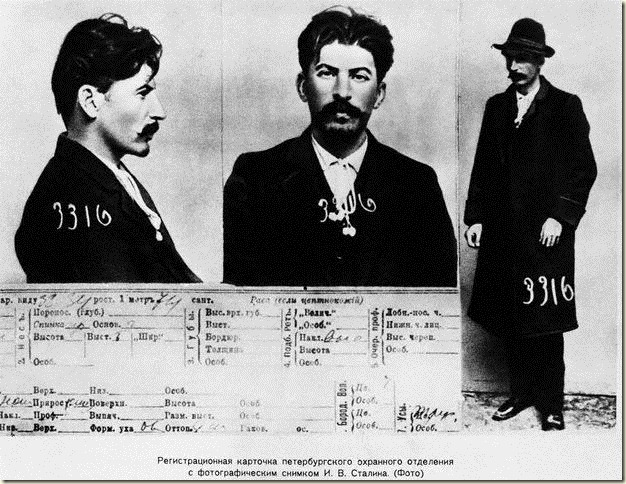
On 1 September 1917, Kerensky declared Russia a republic, and two weeks later, Michael's house arrest was lifted briefly  until the Bolsheviks seized power from Kerensky.  On 3 March 1918 the Bolshevik government signed the Treaty of Brest-Litovsk, which effectively ceded vast areas of the former Russian Empire to the Central Powers of Germany, Austria-Hungary and the Ottoman Empire.  On 7 March 1918, Michael and his secretary Nicholas Johnson were re-arrested and imprisoned at the Bolshevik headquarters, before being sent to Perm, a thousand miles to the east.  This was done on the order of the Council of the People's Commissars, which included both Vladimir Lenin and Joseph Stalin.
HU002891
The information card on Joseph Stalin, from the files of the Tsarist secret police in St. Petersburg, c. 1905  source
Meanwhile Natalia arranged for Michael's son George to be smuggled out of Russia by his nanny with the help of Danish diplomats.  In May, Natalia was granted a travel permit to join Michael at Perm , and they spent about a week together. 
On 12 June 1918 a team of former prisoners of the Tsarist regime lead by Gavril Myasnikov and approved by Lenin,  took Michael and his secretary into the forest outside Perm and shot them.  Michael was the first of the Romanovs to be executed by the Bolsheviks, but he would not be the last.  Neither Michael's nor Johnson's remains were ever found.
The Perm authorities distributed a concocted cover story that Michael was abducted by unidentified men and had disappeared.   The Germans, hoping that when he returned Michael would side with Germany,  arranged for Natalia and her daughter to escape to Kiev in German-controlled Ukraine. On the collapse of the Germans in November 1918, Natalia fled to the coast, and she and her daughter were evacuated by the British Royal Navy.
Michael's son George, Count Brasov, died in a car crash shortly before his 21st birthday in 1931.  Natalia died penniless in a Parisian charity hospital in 1952. His stepdaughter Natalia Mamontova married three times, and wrote a book about her life entitled Stepdaughter to Imperial Russia, published in 1940.
On 8 June 2009, four days short of the 91st anniversary of their murders, Russian State Prosecutors stated, "The analysis of the archive material shows that these individuals were subject to repression through arrest, exile and scrutiny ... without being charged of committing concrete class and social-related crimes."


Cheery stuff, Deb xx


15 January 1913 - Royal Geographical Society

sign
source
 The Royal Geographical Society is a British society founded in 1830 by the learned gentlemen of London mainly as a debating and dining society.  It also aimed to promote geographic awareness and to work out ways of exploring a world that was still largely a mystery.  The Society began as the Geographical Society, but was awarded a Royal Charter in 1859.   In it’s  earlier years the society was concerned mainly with  ‘colonial’ exploration in Africa, the Indian subcontinent, the polar regions, and central Asia , with famous names such as Livingstone, Stanley, Scott, Shackleton, Hunt and Hillary.
map room
The Royal Geographical Society map room in 1912.

On this day in 1913 the members  voted overwhelmingly to admit women, after 82 years as an all-male organization.  However, the society did occasionally let women in before 1913.  In 1882 Isabella Lucy Bird (1831–1904), arguably the greatest Victorian lady traveller, was inducted as the first woman Fellow of the Royal Geographic Society.  While the British Empire swept across continents, Bird migrated to far-flung places, many of which barely register on a traveller’s radar even today.  She documented her journeys in detailed books with matter-of-fact titles such as Six Months in the Sandwich Islands (1875), A Lady’s Life in the Rocky Mountains(1879), Unbeaten Tracks in Japan (1880), and Korea and Her Neighbors(1898).

Archive_NOV12
A Mantzu family, Sichuan, China, 1895, by Isabella (Bird) Bishop

Another fellow was  Mary Kingsley (1862-1900), a British explorer who made two pioneering trips to West and Central Africa and was the first European to enter remote parts of Gabon.
kingsley.191143401
Mary Kingsley source

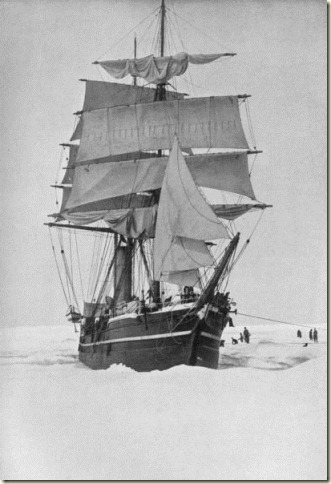
The Royal Research Ship Discovery was commissioned by the Royal Geographical Society in 1900 and built by the Dundee Ship Building Company. Discovery was the first ship built in Britain for scientific research and one of the last wooden three masted sailing ships to be constructed. It was launched on 21 March 1901 at a cost of £44,322.

Antartic
Discovery
In 1933, the Institute of British Geographers was formed by some Society fellows, as a sister body to the Society.  They merged in January 1995 to create the new Royal Geographical Society (with the Institute of British Geographers), and today has 15,000 members, aiming to advance geography through supporting geographical research, education and outdoor learning, public engagement and policy. You can read more about the society here.

Happy exploring,

Deb xxx