Tuesday, 30 April 2013

Scott sets flight record - April 1932


On 28 April 1932 Flight Lieutenant Charles William Anderson Scott landed his Gipsy Moth in Darwin, Australia with the statement that he had succeeded in achieving his object—to better Butler's time for the flight of 9 days 2 hr. 29 min. and so regain the " record " previously held by him. Scott accomplished the journey, nearly 10,000 miles, in 8 days 20 hr. 47 min., and thus bettered Butler's time by 5 hr. 42 min.

Scott in 1932
Scott had also broken many speed records across Australia including the Brisbane - Cairns record and the Brisbane - Melbourne speed record in 1930. He had escorted Amy Johnson across Australia following her record England - Australia flight and was also inspired by Bert Hinkler, who he had also met following his record breaking England - Australia flight in 1928.  Hinkler died on 7 January 7, 1933, during an attempt to beat Scott's 1932 record. Although Hinkler was seen over the Alps on the same day as he began his flight, nothing was heard of him for about four months. Then his crashed aircraft was found on the slopes of the Pratango Mountains in the Apennines.


Scott's success in April 1932 was the first of three England-Australia records, the next one being a record breaking flight back to England in 1931 in another DH Moth, and another record England - Australia flight in 1932.

On 30 June 1931 the London Gazette announce that "The King has been graciously pleased to approve of the award of the Air Force Cross to Mr. Charles William Anderson Scott in recognition of the distinguished services rendered to aviation by his recent flights between England and Australia."

Scott with his wife shaking hands with Lord Amulree. 1931
Scott was born in England in 1903, and learned to fly with the RAF in 1922.  He was a musician, poet and yachtsman, but also became he RAF's heavyweight boxing champion. What a man!  In 1926 he left the RAF and emigrated to Australia, where he took up a post as a commercial pilot for QANTAS, still in her infancy.  After a terrible crash that he only just survived, he was basically sacked, and decided to concentrate on setting records instead.  He also got married, the first time of three.


His greatest moment was probably winning the MacRobertson Air Race in 1934, which flew from Melbourne to London (and I will do a post on, one day!)

Scott in 1934
He won another race in 1936, and then served for a time as an ARP ambulance driver during WWII.  He then spent a brief period as an Atlantic ferry pilot, but found obscurity hard to accept.  After the glamour of winning and being wined and dined his life became normal.  He turned to drink and divorced for the third time.  He hardly saw his only daughter, who was in Australia, while he was in Europe. On 15 April 1946, whilst posted at the UNRRA headquarters in Germany, Scott committed suicide by fatally shooting himself with his army issue revolver. A sad end, but an interesting life -it would really make a great movie.  You can read more about him here.

Deb xx

Monday, 29 April 2013

Wardrobe Update - Organizing, Planning, Budgeting


It's time to clean out my wardrobe, again. It's the end of April and although we are still having hot days, I am sure the weather will cool down soon.  I am also planning a trip to colder Victoria in June, so it's time to put away the sandals and get out a cardigan or two. I am also back at work three full days a week, and helping out at school the other two days, so I need to look a bit stylish and not just wear my favourite 'house dresses."

Mary Mirota, private secretary, circa 1940
This is what I have at present.  Horrible I know, I am being brave showing it (there's more on the other side too). Time to list everything on ebay I think.


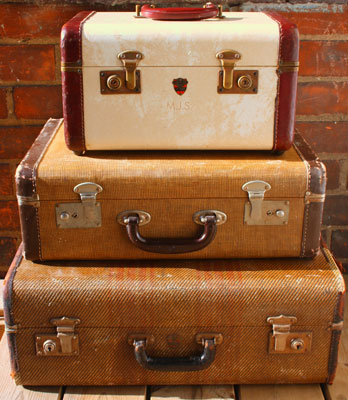
But what do I need? What do I need to keep, and what can I get rid of?  Ideally I would love to have a wardrobe that fits into two suitcases. Shoes included.  And a smaller 'beauty case' for makeup, perfume etc.  Makes it much  easier to pack that way, and I would actually wear everything I own, rather than having it sit in the wardrobe for months on end.


What would the wardrobe of a working woman in the 1930s have looked like?  Of course she would have been young, as most married women did not work in the 30s, especially those in the middle or upper classes.  I imagine though, that my life would have been similar to now - working with my husband a few days a week to answer phones, book clients, do the books and make tea, while the children are at school.  I probably would have had a maid, or at least a girl to come in and clean and do the laundry, and even cook,  so I would have had more free time than now.

A maid could even clean the children (1930)
In 1935 Australia  a male manager, clerk or teacher would have earned about £364 9s 2d, a female about £145 13s 9d (£=pound, s= shilling, d= pence). According to the Australian Reserve bank, today that's equal to about $27,000 for a male, and $10,760 for a female.  They also have a five pence loaf of bread in 1930 being equal to $1.54 today - I know I can't get a loaf for under $2, so  I am not sure how accurate their inflation calculator is.
Teachers at Market Lavington School in the 1930s 
At the same time in America, the equivalent wage would have been about $1455, a figure which is easier to deal with the American book I am using, ‘Clothing’ (Latzke and Quinlan, 1935). It lists the estimated annual budget a single working woman needed to live on in New York in the 1930s, along with what was seen as her minimum wardrobe requirements. This minimum ensured a good appearance, something that was vital to maintain her present position and to help make professional advancement.   The budget set about $200 for clothing and $50 for upkeep and personal care per year, which I am assuming includes haircuts, make up etc.  To put that in perspective, a bicycle in 1935 cost around £3 -4, or $30.


If we add inflation from 1935, that $200 has the same buying power as $3,400 in 2013, and the $50 works out to around $850.  That means you could expect to spend about $284 for clothes per month, and $70.85 for personal care.  The clothes budget I am pretty happy with, but I am going to have to stop getting my hair coloured to stick to that personal care budget!


By modern standards this wardrobe list is quite basic,  but it was built on each year.  Dresses and suits would have been altered and repaired each season, not simply discarded.  Older dresses became house wear.

The Wardrobe

Dresses
  • 2 cotton, for summer street wear 
  • 4 rayon, 3 fair quality, one inexpensive house dress
  • 1 wool dress
  • 1 rayon party dress
Other - buy another every other year
  • 1 wool skirt
  • 1 sweater 
  • 1 blouse
  • 1 smock (to wear over dresses while at home)
Underwear
  • 2 under-vests, rayon or knitted
  • 3 knit rayon bloomers
  • 2 panties, 1 rayon, 1 silk
  • 4 slips, 3 rayon, 1 silk
  • 2 corsets or girdles
  • 3 brassières
  • 3 nightgowns, 1 cotton, 1 rayon, 1 cotton flannel
  • Flannel bathrobe (every 3 yrs.)
  • Rayon kimono, every other year
  • 20 pairs medium silk stockings
Shoes
  • 2 pairs medium quality street shoes
  • 1 pair medium quality dress shoes
  • 1 pair evening slippers, every other year
  • 1 pair inexpensive white shoes
  • Rubbers/sand shoes 1 pair every other year
  • Overshoes (galoshes) 1 pair every other year
  • House slippers 1 pair every other year
Coats
  • Medium quality fur-trimmed coat, every 3 years
  • Wool spring coat, every other year
  • Raincoat, every 3 years
Accessories
  • 3 pairs gloves, 1 leather, 2 fabric
  • Umbrella, every other year
  • 3 handbags at $1 each (or fewer and better)
  • 4 felt hats, two heavy, two light
  • handkerchiefs, dozen per year

I notice that there are no pants listed, or even a suit.  Designer Elsa Schiaparelli thought a suit essential for all women in the 1930s, and even designed a pant suit for her fall/winter collection in 1939, so I think I will add a suit with skirt and pants, and another pair of pants, to my list.

 Secretary Mary Mirota, on the right, in a suit, with her employer and her children, 1939

Instead of bloomers and girdles, we now have body shapers - I like those thigh length ones, or bike shorts, for under dresses to stop that thigh rub.  It's so hot here that I only wear stockings in the dead of winter, so ten pairs would  do me. Although I may cheat and use pantyhose too.

Elsa Schiaparelli in a suit, 1930s

Being an older working woman, I would have had at least twenty years to put a wardrobe together, so I can start with more (yeah!), but not buy more than indicated. At present I have one coat, no felt hats (only sun hats and one winter turban) and only one pair of gloves - I may have to change that before I head south. I would also love that suit I have been dreaming of!

So this week I am sorting out.  I am listing lots of things on ebay, which you can see here.  Next week, I will hopefully have photos of my cleaner, emptier wardrobe and what I kept  (and what didn't sell so I had to keep too).

To end, I just have to share my favourite page from the book, on dressing the mature figure.


Apparently pointy hats make you seem taller and thinner.  I think I need one!

Deb xx


Sunday, 28 April 2013

Fashion Inspiration - Going Bananas

Don't slip on a banana - wear banana slippers!
Sometimes I feel like I'm going bananas.  Work, school, kids, house, pets - sometimes it all gets the better of me.  So today, a light hearted look at fashion - and bananas!

First, my favourite fruit wearing inspiration, Carmen Miranda.

The Gang's All Here, 1943
A documentary of her life story was filmed and directed in 1995 by Dr. Helena Solberg.  The title?  Bananas is my Business

1940s bakelite & lucite brooch

1950s Vintage Dress by Horrockses with Banana Print

1950s banana yellow dress
Prada and his "collection banana"
Banana Yellow Sporty Jodhpurs Trousers, 1990s


Hand Painted on vintage shoes
Trash Luxury Long Banana Dress from the King Kong collection, 2013.
 sandals from Sergio Zambon
I'm off to make some banana cake.  I found a great recipe here (it has chocolate in it!)

Deb xx

Friday, 26 April 2013

Dress of the Week - Grecian, 1930s, Madame Grès


Grecian” evening gown, blue silk jersey, c. 1937

Madame Alix Gres, (1903-1993) was born Germaine Emilie Krebs in Paris. She began as a sculptor, and then designed fabric, before turning her hand to fashion design.  Her training as a sculptor influenced her clothing designs - using mainly silk jersey she draped and pleated directly on the model or client in the classical Greek style, with few visible seams.

Madame Gres draping, c. 1930s
Her first fashion house in Paris was called simply 'Alix", and her simple draped designs quickly gained publicity in fashion magazines. By the time the Germans invaded Paris, Madame Gres had become  world famous, and despite being Jewish  German officers asked her to design dresses for their wives.    She refused and they closed down her design house.


Evening dress spring/summer 1938

In the late 1930s, she married Serge Czerefkov, sold the rights to the name Alix and adopted Gres from her husband’s first name, spelled backwards.  She opened her new house, Grès, in 1942, and her designs became even more Grecian in appearance. The dresses took hundred's of hours to make, in one or two pieces of fabric and each pleat was done by hand, molding to the wearer. 


Her designs were expensive due to the hours each took, but she despised mass production and thought of herself as a true artist.  Her career spanned five decades, and in the 1950s, she began “tailoring” women’s suits, but still continued with her famous draping in her dresses.

A Gres suit, 1950-51

Dress fall/winter 1977
She sold the business in the 1980s, and when it went under a Japanese fashion distributor bought the name, which became very successful in Japan, and still pays homage to Madame Gres by continuing the draping style in a more modern way.

You can see more of her designs here.

Deb xx

Thursday, 25 April 2013

Thursday thoughts - War & Germany 1933


At the moment I am reading the award winning novel by Australia's Anna Funder, "All That I Am," set in the 1930s, with cousins, Ruth Becker and Dora Fabian, and their respective lovers, Hans Wesemann and Ernst Toller (and Toller's wife Christine) – whose political agitating against Hitler and his Third Reich necessitate their hasty departure from Germany (people were arrested as soon as Hitler came to power) and their subsequent resettlement in London as refugees. So far it's a great read, which goes back and forth between Germany in 1933, New York in 1939 and Sydney in 2000.

more at Penguin
The story is inspired by the real life experiences of Funder's friend, Ruth Blatt, who spent five years in solitary confinement in a German prison before securing her passage to Australia (via Shanghai) in 1947.  She lived the next fifty years of her life alone in a flat in Bondi Junction, and I know that Dora Fabian died in 1935, and Toller committed suicide in 1939, so it's not going to be a happy ending.

The story got me in, though, with Ruth's first sentence:  “When Hitler came to power I was in the bath.”

Such an unusual first sentence, don't you think, and one that had me thinking about Hitler and the strange power he had over the German people, and much of the world for some time.  I have always been taught that WWII began in 1939, but for many German people, it started in January 1933, when Hitler became Chancellor of Germany.  So today, Anzac day, a day we remember those fallen in war, some images of pre-war from, 1933 Germany.

Germany 1933


30 January 1933, Adolf Hitler appointed German chancellor


Adolf Hitler addresses a rally in Germany, 1933.


Hitler, Germany’s new Chancellor, in March 1933


Police search in Berlin. Germany, 1933.
Don’t buy from Jews…’ was the NAZI slogans they painted on Jewish shops in Berlin,1933


Walldorf, Germany, 1933, SS and SA members participating in the May Day parade. 


Arrival of political prisoners at the Oranienburg concentration camp. Oranienburg, Germany, 1933.

Hitler Youth Parade, Nazi Germany, 1933

Lest we forget.

Deb

Wednesday, 24 April 2013

Wednesday Movie Matinee - All Quiet on the Western Front


In Honour of Anzac day tomorrow, I thought I would look at a classic war movie today.

via

All Quiet on the Western Front is a 1930 realistic American war film adapted by George AbbottMaxwell Anderson, and Del Andrews from the Erich Maria Remarque novel of the same name. It was directed by Lewis Milestone, and was the first movie to win the Academy Awards for both Outstanding Production and Best Director.  It was also nominated for best writing and Best cinematography. The original movie is not a 'talkie', but some characters were recast and talking scenes were later added.  The sound effects are quite astounding in both versions, none the less.
Publicity photo of Lewis Milestone, 1930

It stars Louis Wolheim, Lew Ayres, John Wray, Arnold Lucy and Ben AlexanderA great number of German Army veterans were living in Los Angeles at the time of filming and were recruited as bit players and technical advisers, with around 2,000 extras used during production. The movie was filmed in Universal Studio back-lots, with the battle scenes shot at Irvine Ranch, California.
An excited Paul off to war
The story sees Paul Bäumer (Lew Ayres, in his second major role at only 21, and one which made him a star), a German soldier who—urged on by his school teacher—joins the German army shortly after the start of World War I.  He arrives at the Western Front with his friends and schoolmates where they meet Stanislaus Katczinsky, an older soldier, nicknamed Kat (Louis Wolheim), who becomes Paul's mentor. While fighting at the front, Bäumer and his comrades have to engage in frequent battles and endure the dangerous and often dirty conditions of warfare
For boys whose concept of war consists of love of country, adventure, bravery, honour, and glory they quickly change their minds once the wholesale slaughter of human beings begins.
Lew Ayres and Louis Wolheim 
Erich Maria Remarque stated at the beginning of his novel that "This book is to be neither an accusation nor a confession, and least of all an adventure, for death is not an adventure to those who stand face to face with it. It will try simply to tell of a generation of men who, even though they may have escaped shells, were destroyed by the war."
Reaching for a butterfly
The movie gives a realistic view of the conditions in which the soldiers find themselves - the monotony between battles, the constant threat of gunshot and bombings, the lack of food and comfort, the rudimentary training of young recruits (meaning lower chances of survival), and the deaths they have to face.  This is not really a movie about bravery, but there are many touching moments, like the butterfly scene (above) and the film’s final scene, when all the young, male corpses-to-be turn to face the camera while marching on to battle.
via
Universal re-released the film in 1939 aiming to remind people of the horrors of wars, with anti-Nazi propaganda read out throughout the movie.

1939 movie poster


On the movies first release, Variety wrote:
The League of Nations could make no better investment than to buy up the master-print, reproduce it in every language, to be shown in all the nations until the word "war" is taken out of the dictionaries.

Paul comforts his sister

Not everyone agreed.  Between 1928 to 1941, this was one of many films to be banned in Australia by the Chief Censor Creswell O'Reilly. The film was also banned in Italy in 1929, Austria in 1931, and not surprisingly in Germany, after, the Nazis first disrupted the viewings in the early 30s by releasing rats in the theatres.

Interestingly the film's star, Ayres, became a conscientious objector during World War II, although he did serve as a non-combatant, so I gather the story had  big effect on him.  It did on me, and while movies like this may not be able to get us to know what it’s actually like to be a soldier, they can help us begin to feel the tragedy of the sacrifice it requires, and what he survivors have to deal with for the rest of their lives. This movie, from the side of 'our' enemy, also helps us remember that we are all the same. Lest we forget.


Paul back home with his mother and sister. “You’re a soldier now, aren’t you? But somehow, I don’t seem to know you…”
For some reason I could not insert the video, but you can watch it here, or buy a copy here.

Deb xxx