Showing posts with label 1910s. Show all posts

Sunday, 13 January 2013

Women’s Health–Why I’m glad I’m not a 1910s Woman

There are some days I would really love to live one hundred years ago,  when life seemed less hectic, fashion was wonderful, servants abounded and people used manners - but it is easy to idealize an earlier period in history and look at it through rose coloured glasses.  What I am hoping to do on this blog is look at the reality of the past,the good and the bad, to learn from it, appreciate it and then appreciate what we have today. 

For instance,  I love my washing machine – I use it everyday and can’t imagine not having it.  Mind you, if I was a middle class women in 1913 I probably would have either had a live in maid or sent my laundry out to be cleaned. Or maybe I could have bought one of these:
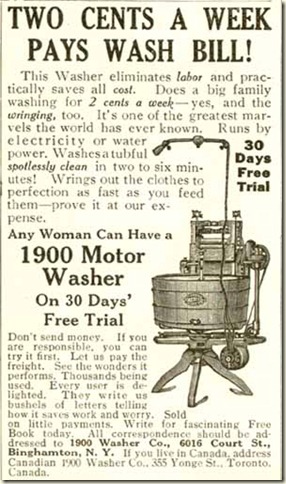
1913WasherAG 1913 ad source

The main reason I am glad I am living in 2013 and not 1913 is modern medicine – especially advances in childbirth, disease and pregnancy prevention and antibiotics.  Neither I nor my five children would be here without modern medicine.

This week alone, I have had three blood tests, an ultrasound, an x-ray, a blood transfusion and an operation.  I finally realised that my lazy holiday was actually something of a necessity, as I could not get off the couch.  Blood tests diagnosed a low blood count (a haemoglobin level of 61 instead of around 120), so I was put into hospital and given a blood transfusion.  That’s what four months of heavy monthly bleeding will do to you girls, so take care – don’t be slack like me and think it’s normal and that the tiredness is in your mind – GO TO A DOCTOR!  I had a uterine growth that needed removing, which  they did quite painlessly under a general anaesthetic, and two days later here I am back at home and feeling a whole lot better.  I can even manage to have a shower and wash my hair without getting breathless, and I even took the dogs for a walk this afternoon!

Page10Photo1R2

Nurse training at Atlantic Hospital, Iowa, 1913 – about to get an anaesthetic I think

I imagine that many women’s deaths were caused not just by childbirth, but by menstrual and uterine problems – something of course that wasn't’ talked abut 100 years ago – but in novels and death notices the women would have died of blood poisoning or heart failure.  Of course heart failure is what happens just before most people die, and is defiantly what happens if you have a low blood count.  I have found an online copy of ‘A reference hand-book of ‘gynecology’ for nurses’ published in 1913, which makes for delightful reading, and implies that only nurses dealt with these women’s issues, including cervical cancer and such, and doctors weren’t really involved. I may be wrong, but I recommend a quick look at this book for yourself!
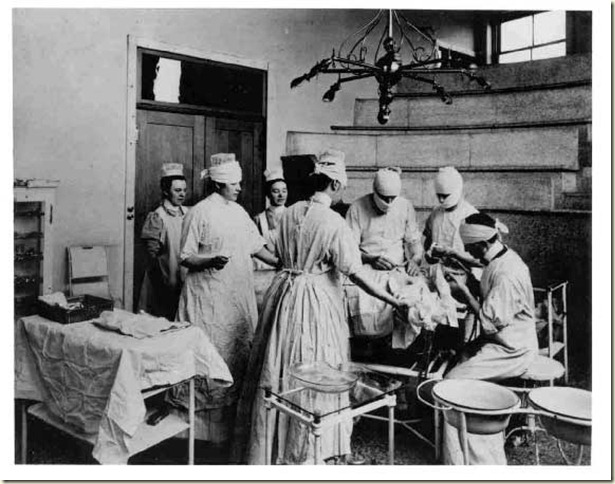
surgery

Surgery at St. Luke's Hospital, 1913 -A view of an operating room with surgery in progress.

So thank you again modern medicine, and all the wonderful doctors and nurses who strive to make us well and to the researchers who look for answers.  A stay in hospital is a wonderful way to make you appreciate life – especially a stay in the surgical ward.  Not that I recommend it, really!

Stay safe, and as usual, more images on tumblr.

Deb xxx

Friday, 4 January 2013

3 January 1913 & Vintage horse drawn transport


Today's blog is a little late, apologies, but I didn't want to skip it as I found so many lovely photos to share (the rest, as usual are on tumblr, with sources) .

met
1913 Metropolitan Horse Carriage Cover by Edward Penfield
Although cars were becoming more popular in 1913, the main form of transport for most ordinary people was still the horse.  If you have read my blog for a while, you will know I am a horse lover - this would be my ideal!

cast
Mary and Susan Lytherleigh  in a carriage drawn by two horses emerging from a driveway in Casterton, Victoria, in around 1905.

 My grandmother talks of riding in a horse and cart to go to town once a month when she was a little girl in the 1920s.  She grew up in country Victoria, near the Murray River, and I can imagine that she would have experienced this once or twice.
153354_large
Horse and carriage crossing a creek in NSW, 1914
Horses and horse drawn transport was available to women in the country, and they were able to be quite self sufficient in travelling. Driving an automobile was not only expensive at the time, but required lessons and practice, and many people in the country didn't' even know someone who owned car.

avoca
Group of Women With Horse Drawn Carriage, Avoca, Victoria, c. 1915  
Family groups were often large 100 years ago, but everyone could fit in the cart it seems.

160120_large
A family group in a horse drawn carriage on a mountain road in Tasmania, 1913.

 Even very large group of people could travel in an ordinary cart, as long as there were enough horses to pull it!

five
A large group of women descending Mt Wellington, Tasmania in an usual five-team horse-drawn carriage, 24 Dec 1912


Horse drawn vehicles were used for deliveries of milk, bread, groceries and beer.  My grandfather used a horse and cart to deliver groceries in Melbourne in the late 1950s, and I can remember the clip clop of horses hooves on milk rounds in Melbourne until the mid 1970s.
StateLibQld_1_113232_Queensland_Brewery_delivery_cart_with_driver,_1913
Queensland Brewery delivery cart with driver, Brisbane 1913 
The Carlton Draught Beer Clydesdales still make appearances throughout various towns and at special events (such as the AFL Grandfinal, below), however they travel by truck to get to various events now.
Getting ready for the grandfinal
Horse transport in Australia was used instead of rail or motor transport for timber and wool during WWI and into the 1920s.


wool
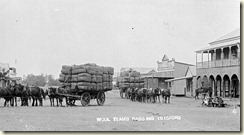
Horse teams and wagons laden with wool bales Isisford , 1915

The one form of horse transport we never had in Australia, as far as I can find out, was the sleigh.  I would so love to travel this way one day.

sleigh
Toronto, Horse-drawn sleigh, 1913

I would also love to participate in pleasure driving one day, and recapture and experience a bit of the past, but I don't believe horse and carriages should be on our busy modern streets.  Not only is there way too much traffic, most modern motorist are ignorant about horses and don't know they should slow down around them. Unfortunately our society as a whole is way so mechanized that we live life at way too fast a pace to tolerate a horse and cart going at a mere 5 miles or 10 km an hour. In some countries however, horses are still a way of life......

One of the scores of horse-drawn carts in Transylvania, c. 2011
Why did we move from horses at all?


It does look a lot easier, doesn't it?!

Deb xx

Monday, 31 December 2012

New Years Eve Vintage Style & Resolutions

I have a few new year’s resolutions, do you?
Like every year, I aim to lose weight, but unlike every year I want to do this by simply getting healthier – drinking less, exercising more, rather than giving up everything I love.
This would have been easier one hundred years ago in the United States, as over half of the population  were living under some sort of prohibition. At the end of 1913, five thousand supporters of prohibition paraded from the White House to the Capitol calling for national prohibition by 1920. America went from a culture where everyone drank, including children, to one where no one was legally allowed to – and we all know how well that went.  It makes me wonder if they are headed the same way with gun control laws…..
6684754074b5c6eda98047ce6f60e132_1M
Marching for prohibition 1913

Life one hundred years ago fascinates me – and it is my other new years resolution.  I want to look at 1913 in detail and get an idea of what people wanted and what they went through, as well as the fashions, inventions, movies and any interesting facts.  1913 sat between the world shattering events of the sinking of the Titanic in 1912, and the start of the great War in 1914.  It is sometime classed in the Edwardian Era, although Kind Edward died in 1910, and sometimes as part of the Titanic era.  1913 also falls in the Progressive Era of  history (basically 1890 to 1920), a period of social and political reform in the US and around the world.  It must have been a fascinating, and perhaps frightening, time to be alive.
Titanic-01

My aim on this blog will be to look at events of each day 100 years ago, to watch or find out about a movie each week, to look at the fashions and their influences, find and share vintage photos and ads, read books and magazines of the time, and delve more deeply into events if I can.  I am still researching steampunk as well, and hope by the middle of the year to be ready to put together a steampunk outfit based on my 1913 fashion research.

Please share if you have anything to ad or any special requests.

Meanwhile, here’s a quick look at New Years Eve 1912 style. If you were dining out, the scene may have looked like this:
dining

New Years Eve in a restaurant, Illustration from La Vie Heureuse Magazine, December  1912 source


And maybe you would have eaten this:
menu
source

This next photo was taken in New York between 1910 and 1915.  I like to think it was New Year eve 1912,  100 years ago today.
drinking

Have a great New Year’s Eve, what ever you may be doing!


Deb xx

Friday, 7 December 2012

The Edwardian Ostrich - 11 lovely things to buy


Some more lovely vintage photos and books featuring ostriches and feathers that I found today on Etsy (so they're all available to buy!):

A young lady wearing a big ostrich feather hat and standing beside her husband. c. 1900
Edwardian era purse with ostrich feathers - $42.99

An Edwardian woman in an Ostrich feather hat holding a small bunch of Roses. c. 1910 $8.50
Vintage photo 1910 Beauty Ladies Ostrich Feather Hats
1912 Ostrich Vintage Children’s Book Illustration $10

Original Edwardian hat with ostrich feathers $550

Autumn 1911 Gainsborough hat and millinery accessories catalogue $75
Edwardian ostrich feather fan c.1900. $68.50

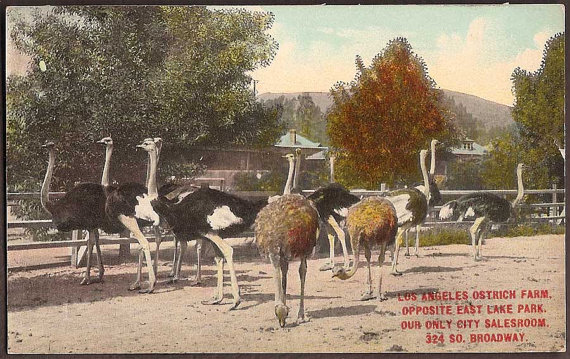
Los Angeles, California Vintage Coloured Postcard - Ostrich Farm East Lake Park c.1910

Antique Textile Dye Bottle Label c. 1910
This would be lovely to print out and make your own labels.  And how cute is this - in a 'I have to pee' kind of way!
too cute!
I think it's my favourite!
Peace, love and happy (pee) dancing,  Deb xxx