Showing posts with label scott. Show all posts

Tuesday, 30 April 2013

Scott sets flight record - April 1932


On 28 April 1932 Flight Lieutenant Charles William Anderson Scott landed his Gipsy Moth in Darwin, Australia with the statement that he had succeeded in achieving his object—to better Butler's time for the flight of 9 days 2 hr. 29 min. and so regain the " record " previously held by him. Scott accomplished the journey, nearly 10,000 miles, in 8 days 20 hr. 47 min., and thus bettered Butler's time by 5 hr. 42 min.

Scott in 1932
Scott had also broken many speed records across Australia including the Brisbane - Cairns record and the Brisbane - Melbourne speed record in 1930. He had escorted Amy Johnson across Australia following her record England - Australia flight and was also inspired by Bert Hinkler, who he had also met following his record breaking England - Australia flight in 1928.  Hinkler died on 7 January 7, 1933, during an attempt to beat Scott's 1932 record. Although Hinkler was seen over the Alps on the same day as he began his flight, nothing was heard of him for about four months. Then his crashed aircraft was found on the slopes of the Pratango Mountains in the Apennines.


Scott's success in April 1932 was the first of three England-Australia records, the next one being a record breaking flight back to England in 1931 in another DH Moth, and another record England - Australia flight in 1932.

On 30 June 1931 the London Gazette announce that "The King has been graciously pleased to approve of the award of the Air Force Cross to Mr. Charles William Anderson Scott in recognition of the distinguished services rendered to aviation by his recent flights between England and Australia."

Scott with his wife shaking hands with Lord Amulree. 1931
Scott was born in England in 1903, and learned to fly with the RAF in 1922.  He was a musician, poet and yachtsman, but also became he RAF's heavyweight boxing champion. What a man!  In 1926 he left the RAF and emigrated to Australia, where he took up a post as a commercial pilot for QANTAS, still in her infancy.  After a terrible crash that he only just survived, he was basically sacked, and decided to concentrate on setting records instead.  He also got married, the first time of three.


His greatest moment was probably winning the MacRobertson Air Race in 1934, which flew from Melbourne to London (and I will do a post on, one day!)

Scott in 1934
He won another race in 1936, and then served for a time as an ARP ambulance driver during WWII.  He then spent a brief period as an Atlantic ferry pilot, but found obscurity hard to accept.  After the glamour of winning and being wined and dined his life became normal.  He turned to drink and divorced for the third time.  He hardly saw his only daughter, who was in Australia, while he was in Europe. On 15 April 1946, whilst posted at the UNRRA headquarters in Germany, Scott committed suicide by fatally shooting himself with his army issue revolver. A sad end, but an interesting life -it would really make a great movie.  You can read more about him here.

Deb xx

Friday, 18 January 2013

18 January 1913- Rescued from Antarctica


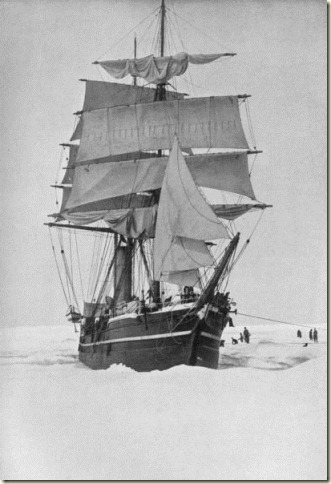
On 18 January 1913, the ship that had delivered the British Antarctic Expedition in June 1910, The Terra Nova, was finally able to break through the ice outside of Antarctica's McMurdo Sound to pick up the Northern Party, the remaining members of the expedition that had set out to locate the Southern Party that had been led by Robert Falcon Scott.
Scott’s expedition had attempted to be the first to reach the geographical South Pole, but when they reached it on 17 January 1912, they found that a Norwegian team led by Roald Amundsen had beaten them by 33 days.
newyorktimes
Breaking news in the New York Times March 8, 1911, “Amundsen reaches the South Pole” source
Scott's entire party died on the return journey from the pole; some of their bodies, journals, and photographs were discovered by a search party eight months later.
Scottgroup
Scott's party at the South Pole, 18 January 1912. L to R: (standing) Wilson, Scott, Oates; (seated) Bowers, Edgar Evans  source
Victor  Campbell was Scott’s second in command and head of the  Northern party that had sailed north and  put ashore at Robertson's Bay, near Cape Adare, where they were forced to spend the winter.  In January 1912 the Terra Nova took them 250 miles (400 km) south of Cape Adare and 200 miles (320 km) northwest of Cape Evans.   They spent another miserable winter with limited rations, supplemented by the occasional penguin and seal, as the ship could not reach them because of heavy pack ice. They built an ice cave on Inexpressible Island and finally on 30 September 1912, they set off for Cape Evans, arriving on 7 November after crossing more than 200 miles (320 km) of sea ice.
ice
Evans and Nelson making ice-cave. Jan. 12th 1911.
After learning of the death of Scott and the entire Polar party, as the senior remaining Naval officer, Campbell assumed command of the Terra Nova expedition for its final weeks, after reporting to the  crew that Scott's party had reached the South Pole on January 17, 1912, but had all died on the return journey.
terranova
The Terra Nova  source
The Amundsen-Scott South Pole Station was established in 1956-57 for scientific research, and has been staffed ever since by researchers and support personnel. During the Australian summer, from about November to March, about 250 scientists live at the station. That number drops to between 50 and 60 when the winter season descends, with its constant darkness and extreme temperatures.
Antarctica is now a popular tourist destination, during those summer months when the sun never sets, for those willing to spend big. Tourists pay tens of thousands of dollars for the trip, mostly to see penguins and icebergs, but you are able to actually travel to the Geographic South Pole, the southernmost point on the planet,  like the early explorers.  – it’s marked by a small sign and a tall stake driven into the ice, which is moved about 10 meters per year to compensate for the movement of the ice.
Ceremonial_South_Pole
The ceremonial south pole is used for photography purposes - the shiny metallic sphere atop a small red-and-white striped pole is located a short distance from the Geographic South Pole, and is surrounded by flags of the Antarctic Treaty countries.
I don’t think it’s in my top five places to visit.  What about you?
Deb xx
as usual, more photos on tumblr and ignore the underlining it won’t turn off