Showing posts with label King. Show all posts

Saturday, 19 January 2013

Saturday night movie–Dr. Jekyll and Mr. Hyde

 
Tomorrow I leave for Melbourne for a week, so I will probably not be blogging.  I will, however, be taking photos, which I will post on tumblr, so check that out if you're interested.  I will try and take shots of vintage Melbourne if I can, and maybe elephants. So anyway, this week a movie with no elephants, but it is vintage.

Motion pictures in 1913 were shorter than today, without sound and in black-and-white, of course, but they were sometimes presented as part of a set of vaudeville performances, with live musical accompaniment, or sometimes as a set of several short films.  In the days before movie palaces, movies were shown in normal theatres, which often gave them a special feel.  I quite like them, but they are definitely better with music than without.  My kids are not so impressed with my ‘old day movies’, but as they are short they try and put up with them just for me!

This 1913 dramatization of Robert Louis Stephenson’s classic horror story The Strange Case of Dr. Jekyll and Mr. Hyde (1886) was written and directed by Herbert Brenon and stars the ‘king’ of the silent films, William King Baggot. 
KingBaggot(1879-1948)
Baggot (November 7, 1879 – July 11, 1948) was also known as  "The Most Photographed Man in the World" and "The Man Whose Face Is As Familiar As The Man In The Moon," and he appeared in at least 269 motion pictures from 1909 to 1947; wrote 18 screenplays; and directed 45 movies from 1912 to 1928.
The most notable difference from the original written story is probably the addition of a love interest for the doctor, Alice (played by Jane Gail) , and while her presence adds little to the story, it is nice to see some feminine 1913 fashions.
vlcsnap-2012-12-27-17h13m19s145
Baggot’s portrayal of the metamorphosis sequences, from the upright Dr Jekyll to the crouched, evil Mr Hyde, are very good and show his excellence in the craft of acting – there are no special effects here apart from some stop motion photography while King applies his own makeup!
vlcsnap-2012-12-27-17h14m38s112  vlcsnap-2012-12-27-17h16m01s235
The film is only twenty-six minutes long and well worth a watch if you have time.


You can read more about the movie here, or find the movie for  free download here.  The above photos are stills I have taken from this version of the movie.  If you are not keen on silent movies, there are over 20 other version of the movie available, the latest a series made in 2008, and there was even a musical version, which will be played again on Broadway from April this year. 

comics_strange_case_mr_hyde
There are also rumours of a new movie by Dark Horse Entertainment, based on  the comic book by Cole Haddon, The Strange Case of Hyde , as well as Waterfoot Films' independent Strange Case of Dr. Jekyll, set in modern times and Jekyll, with Keanu Reeves and finally Guillermo Del Toro ‘s  own vision for Dr. Jekyll and Mr. Hyde.  As long as he doesn’t turn into a woman, I’m happy.

Enjoy, Deb xxx


Saturday, 10 November 2012

The Edwardian Era begins


The death of Queen Victoria on 22 January 1901 and the succession of her son Edward (technically Albert Edward Wettin, but Edward here for less confusion)  marked the end of the Victorian era.  Just weeks earlier, on 1 January, as the world celebrated the beginning of the 20th century, the British colonies of New South Wales, Queensland, South Australia, Tasmania, Victoria and Western Australia joined together as the Commonwealth of Australia, with Edmund Barton the first Prime Minister.


While Victoria had shunned society and dressed in mourning garb for forty years after the death of her husband in 1861, Edward was sociable and a great traveller.  As Victoria withdrew almost completely from public life, Edward was allowed to represent her at state occasions, although given almost no chance to participate in affairs of state. He became a leader of London society, spending his time eating, drinking, gambling, shooting, watching racing and sailing. He was actually quite spiffy too!

Prince Edward aged 19 c. 1860
Edward had been subjected to a strict regime of education and rules from an early age, as his parents were keen to ensure he was prepared to rule. He attended both Oxford and Cambridge and briefly joined the army. He spoke French, German, Spanish and Italian and toured the world on behalf of the royal family, including Italy, Spain, Canada, India, Egypt, Denmark, France, Germany, Belgium and Russia.  He had even travelled to America in 1860, the first of the Royal family to do so, and on his return had a liaison with an Irish actress that caused considerable scandal. His father visited Edward to reprimand him, and died two weeks later.  Victoria held her son partly responsible for the death of his father.
Prince Edward in military attire
Having mistresses was at the time not uncommon amongst the aristocracy, but his mother despaired of him and kept him away from taking an active part in politics. She once publicly said of him:
‘I never can, or shall, look at him without a shudder’

Edward continued life as a bit of a playboy, despite his marriage to Alexandra ,eldest daughter of King Kristian IX of Denmark, in 1863, and his six children.


The wedding of Prince Albert Edward and Alexandra of Denmark, London, 1863

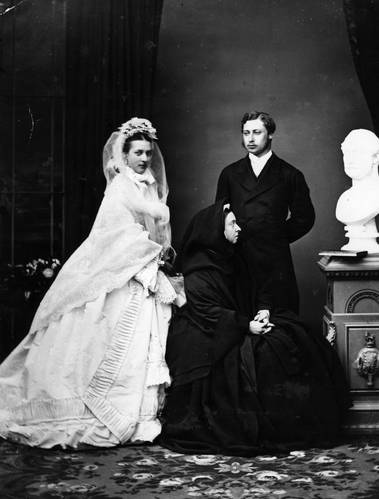
Prince Edward and Princess Alexandra of Denmark pose with Queen Victoria after their wedding c. 1863.
Although he did not propose to Alexandra until September of 1862, after he'd ended his relationship with his mistress Nellie Clifden, after his marriage he had a succession of mistresses   including Lille Langtry (actress), Lady Churchill (mother of Winston Churchill), Sarah Bernhardt (actress) and Alice Keppel (great-grandmother of Camilla, wife of Charles the current Prince of Wales, and his last and longest serving mistress),  Lady Brooke, Princess de Mouchy and Princess de Sagan.

Edward during a hunt in India in 1875

Never the less Edward was well received abroad.  In 1875 he toured India as heir-apparent. On his return he complained to his mother about British treatment of native Indians -
Because a man has a black face and a different religion from our own, there is no reason why he should be treated as a brute.’

Prince Edward as Grand Master of the Knights Hospitallers of Malta, at the Devonshire House Ball, 1897.

Edward was proclaimed Emperor of India on January 1, 1903, and a Delhi Durbar (or big party lasting two weeks) organised by Lord Curzon was held to commemorate the occasion. Edward did not attend, but sent his brother,  the Duke of Connaught. 
 Elephant Carriage of the Maharaja of Rewa at the Retainers' Review, 7th January 1903

Although maybe not a racist, the king was a little sexist.  He was totally opposed to the campaign by the National Union of Suffrage Societies and  the Women's Social and Political Union to achieve the vote for women, however, and politically he favoured the Conservatives.
A suffergette getting arrested c. 1903
He did some good, however, and made several royal visits to help prepare the way for international treaties .  Known as the 'Uncle of Europe', as he was related to most European royalty, he was able to assist in foreign policy negotiations. He was the first British monarch to visit Russia, in 1902, and his addresses during a state visit to Paris helped pave the way for the Anglo-French Entente Cordiale of 1904. He took a particular interest in military matters and opposed attempts to reduce public spending on the armed forces.  He was also a strong advocate of the Dreadnought battle ship building campaign as tension between the United Kingdom and Germany increased from about 1906, the same year the liberals were brought to power in the general election.

Edward c. 1895

Edward  was influenced by the art and fashions of everywhere he went, and  set the pace for men's fashions in this period, despite being quite portly. He had a great appetite, eating five large meals a day often consisting of ten or more courses. By the time he was king he had a waist of forty-eight inches, about twice that of the average corset wearing lady. Edward also smoked twelve large cigars and twenty cigarettes a day. If you have time, have a look at 'The Supersizers eat Edwardian' on youtube, below, in which they experience Edward's diet as well as that of the average Edwardian.


Prince Edward smoking a pipe c. 1868

The King  also influenced female fashions as he particularly favoured the shape of the 'mature woman'. I'll look at fashion through the decade in future posts. He also grew a lovely moustaches, something which I am particularly interested in at present!

King Edward in coronation robes, August 1902
Edward had only a short reign.  He did not become King until he was 59, and died nine years later of pneumonia.  For this reason the Edwardian Era is not usually isolated to the period of his reign (1901-1910), but encompasses the mid 1890s to the outbreak of World War 1 in 1914, with the Titanic era seen as part of this from about 1912-1914.

Prince Charles seems to have had a similar life to Edward in some ways, and Camilla's life has been likened to that of her great-grandmother, as a great mistress of her age.  What do you think?

Deb xx