Showing posts with label WWI. Show all posts

Thursday, 2 May 2013

Thurday thoughts - Rationing and World War One


I have been watching a lot of WWI movies lately it seems, and it got me started thinking about the homefront, and rationing.  I know rationing was a big thing during WW2, but what about the first time around.  Did it even happen, or was the population of such a size rationing was unnecessary?  I imagine that at the time, when there were not the processed foods and supermarkets as we have now, that saving. growing and preserving your own food was of prime importance to being with.  As this poster seems to suggest.

American WWI poster
It seems that soon after the outbreak of the war in 1914 the United Kingdom declared a blockade of the North Sea, to prevent ships reaching Germany.  Germany naturally responded by using its U-boats (submarines) to sink ships carrying military equipment or food to the United Kingdom.  As an industrial nation, Britain relied on the sea lanes to import food, and luxury items such as alcohol and cigarettes,  for its large urban population. The main exporters to Britain were America, Canada and Australia, which  meant that merchant ships had to cross the Atlantic Ocean. Up to 1916, these merchant ships could travel in relative safety, although by the end of 1916, U-German boats were on average destroying about 300,000 tons of shipping a month.

American WWI poster
Around the same time, The Defence of the Realm Act (DORA) was passed in Britain.  It’s main aim was to protect Britain from the German enemy getting information, be it given freely by conspirators or accidently by loose lips, and to allow the government to requisition any land or buildings needed for the war effort.   The first version was introduced on August 8th 1914 and was quite short.  You can read the 27 November version here.


Some of the things the British public were not allowed to do included flying a kite or lighting a bonfire (which may attract planes or zeppelins) , buying binoculars (to spy), feeding animals bread (waste) or discussing naval and military matters – censorship was therefore introduced.   During the autumn and winter of 1914, supplies of fuel and light were curtailed, street lamps were dimmed, and no long lines of lights were permitted. As the war continued, British Summer Time was introduced, to give more daylight for extra work, while opening hours in pubs were cut , alcoholic drinks were watered down and customers in pubs were not allowed to buy a round of drinks. People at home were also encouraged not to over indulge.


A similar act was passed in Canada on 22 August 1914, the War Measures Act and in Australia on 29 October 1914 as the War Precautions Act 1914. The Australian version did not limit food or alcohol consumption, but had quite a few paragraphs to do with ‘aliens’ and their internment or eviction from the country.  You can read an original copy here.  When they joined the war in 1917,  the United States introduced the Espionage Act of 1917 and the Sedition Act of 1918.

Of course, as is human nature in the face of impending disaster, people panic bought at the outbreak of war.  Some shops sold out of food in days in August 1914. However, after the initial panic, people settled down into a routine and food was not a problem until the end of 1916,  when the Germans introduced unrestricted submarine warfare.  Many merchant ships were then sunk , which had a drastic impact on Britain's food supply. In April 1916, Britain only had six weeks of wheat left and bread was a staple part of most diets. Food prices rose and by October 1916, coal was in such short supply that it was rationed by the number of rooms a family had in its house, and newspapers filled their pages with advice on fuel-saving cookery and fuel substitutions. In December 1916 a Food Controller was appointed and a Ministry of Food established “to promote economy and to maintain the food supply of the country”.

In February 1917, the German Navy sank 230 ships bringing food and other supplies to Britain. The following month a record 507,001 tons of shipping was lost as a result of the U-boat campaign. The success of the U-boat as a commerce raider forced the British to introduce a rationing system.
The restrictions introduced by DORA did not really work in regard to food consumption, so the government then tried to introduce a voluntary code of rationing, to a standard set  by the Royal Family.  This did not work either, as anyone with money could get more than enough food on the black market. Signs of malnutrition were starting to be seen in the poorer areas.

A smiling soldier sitting in the mud near the Front, eating a spoonful of hot food, possibly a potato, WWI
The idea of rationing food though,  was to guarantee supplies, not to reduce consumption. And although official figures apparently show that the intake of calories almost kept up to the pre-war level, for most people, the type of food eaten was different. The prestigious potato, that British staple, were in short supply.  Any area that could grow food was converted to do so - gardens were turned into allotments and chickens were kept in back gardens for eggs. Even if shops did get food in, the queues were huge, as described by WWI veteran Charles Young:

“when some food did get delivered to the shops everyone for miles around besieged the place. The queues stretched for miles, and if you were old or infirm you stood no chance. Food riots were very common. But news like this was kept from us, over in France. we only got to hear about it from men who came back after being on leave.”


A wartime food queue in Reading, UK
Meat was also hard to get. The consumption of butchers' meat dropped from an average of 2.36 to 1.53 lb a week during this period.  Bones from the shop were made into soups, and people in the country hunted rabbits and fished for their meat, and back yard rabbit keeping became popular.


Canadian WWI poster
Sugar, sourced largely from Germany before the war (beets) , was the most difficult  to come by item, and it was the first food to be rationed in January 1918.  The weekly consumption of sugar was 1.49 lb in 1914, it fell to 0.93 lb in 1918. By the end of April 1918 meat, butter, cheese and margarine were added to the list of rationed food. Ration cards were issued and everyone had to register with a butcher and grocer. This rationing took place after three and half years of fighting, which is astounding compared with the rationing in WWII, which began only three months after the outbreak of war.  Although officially the people of Britain did not starve, there were instances reported of children dying of starvation. Charles Young again:
“One said to me "Chas, I am going home to my wife and kids. I'll be some use to them as a cripple, but none at all dead! I am starving here, and so are they at home, we may as well starve together." With that he fired a shot through his boot. When the medics got his boot off, two of his toes and a lot of his foot had gone.”


British Food Rationing, First World War, 1918
The allied soldiers were given their own emergency ration, the so-called 'Iron Ration',  for use in the event of their being cut off from regular food supplies. The Iron Ration in 1914 was as follows:
1 lb. preserved meat
3 oz. cheese
12 oz. biscuit
5/8 oz. tea
2 oz. sugar
1/2 oz. salt
1 oz. meat extract

In addition the troops in the trenches were regularly supplied (or meant to be) with rations. Including meat, tea, jam and sugar.  You can see the daily rations for British and German troops here. The Germans seemed to get a lot more sugar and a bit more alcohol and tobacco....

Soldiers receive a midday ration near the front, August 1917.
In  Germany the food situation was more dire than in Britain.  It is thought that Germany did not introduce rationing, despite the decline in farm production and no access to American or Canadian goods.  Although the German  rural (and industrial) labour force had been largely reduced because of conscription Germany did not start using women to replace male workers as did Britain.  By 1917 there was wide-spread hunger in Germany. Potatoes were in short supply and many people subsisting on the less nutritious turnip.

German WWI Poster
The powers introduced by DORA allowed the government to take over land when it felt that it was necessary to do so, and in 1917, the government took over 2.5 million acres of land for farming.  By the end of the war, Britain had an extra three million acres of farming land, farmed mainly by the Women's Land Army (Conscientious objectors also worked on the land).   Some farmers resisted the idea of women working on farms, and the Board of Trade had to send officers around the country to persuade farmers to accept women employees. The strategy was successful, and by the end of 1917 there were over 260,000 women working as farm labourers. Indeed the British wheat harvest in 1917 was at record levels, thanks in no small way to women.

WWI poster
The Board of Agriculture also sent instructors around the country to demonstrate bottling and canning fruits and vegetables to cut back on waste, and the London County Council issued posters advising people to buy bread by weight rather than by the loaf. When the food shortage became more serious rations, grew stricter: the sale of luxury chocolates and sweets were stopped, the use of starch for laundering was restricted, the amount of bread or cake sold at tea shops was reduced to 2 ounces, and it became an offence to adopt and feed stray dogs. Everyone was advised to “Eat slowly: you will need less food.” or “Keep warm: you will need less food.”, yet no explanations were given on how to keep warm with fuel rationed and an insufficiently fat diet.

CHRISTMAS Postcard, 1917
Even though the United States did not ration food, the government urged people to conserve "before it is too late." Children were also called upon to show "thrift and economy" during the war.

US poster, WWI
Most signs of malnutrition were overcome after rationing was introduced, and rationing was in force until about 1920, despite the end of the war and access to imported goods.  For an in depth look into food rationing, have a look at the online book,  Foods That Will Win the War and How to Cook Them [1918].

Read more and References:

Wednesday, 1 May 2013

La Grande Illusion, 1937

Another war film this week, this time from France.  La Grande Illusion (also known as Grand Illusion) is a 1937 WWI film directed by Jean Renoir, who co-wrote the screenplay with Charles Spaak. The title of the film comes from a book – The Great Illusion by British economist Norman Angell – which argued that war is futile because of the common economic interests of all European nations.


Wednesday, 24 April 2013

Wednesday Movie Matinee - All Quiet on the Western Front


In Honour of Anzac day tomorrow, I thought I would look at a classic war movie today.

via

All Quiet on the Western Front is a 1930 realistic American war film adapted by George AbbottMaxwell Anderson, and Del Andrews from the Erich Maria Remarque novel of the same name. It was directed by Lewis Milestone, and was the first movie to win the Academy Awards for both Outstanding Production and Best Director.  It was also nominated for best writing and Best cinematography. The original movie is not a 'talkie', but some characters were recast and talking scenes were later added.  The sound effects are quite astounding in both versions, none the less.
Publicity photo of Lewis Milestone, 1930

It stars Louis Wolheim, Lew Ayres, John Wray, Arnold Lucy and Ben AlexanderA great number of German Army veterans were living in Los Angeles at the time of filming and were recruited as bit players and technical advisers, with around 2,000 extras used during production. The movie was filmed in Universal Studio back-lots, with the battle scenes shot at Irvine Ranch, California.
An excited Paul off to war
The story sees Paul Bäumer (Lew Ayres, in his second major role at only 21, and one which made him a star), a German soldier who—urged on by his school teacher—joins the German army shortly after the start of World War I.  He arrives at the Western Front with his friends and schoolmates where they meet Stanislaus Katczinsky, an older soldier, nicknamed Kat (Louis Wolheim), who becomes Paul's mentor. While fighting at the front, Bäumer and his comrades have to engage in frequent battles and endure the dangerous and often dirty conditions of warfare
For boys whose concept of war consists of love of country, adventure, bravery, honour, and glory they quickly change their minds once the wholesale slaughter of human beings begins.
Lew Ayres and Louis Wolheim 
Erich Maria Remarque stated at the beginning of his novel that "This book is to be neither an accusation nor a confession, and least of all an adventure, for death is not an adventure to those who stand face to face with it. It will try simply to tell of a generation of men who, even though they may have escaped shells, were destroyed by the war."
Reaching for a butterfly
The movie gives a realistic view of the conditions in which the soldiers find themselves - the monotony between battles, the constant threat of gunshot and bombings, the lack of food and comfort, the rudimentary training of young recruits (meaning lower chances of survival), and the deaths they have to face.  This is not really a movie about bravery, but there are many touching moments, like the butterfly scene (above) and the film’s final scene, when all the young, male corpses-to-be turn to face the camera while marching on to battle.
via
Universal re-released the film in 1939 aiming to remind people of the horrors of wars, with anti-Nazi propaganda read out throughout the movie.

1939 movie poster


On the movies first release, Variety wrote:
The League of Nations could make no better investment than to buy up the master-print, reproduce it in every language, to be shown in all the nations until the word "war" is taken out of the dictionaries.

Paul comforts his sister

Not everyone agreed.  Between 1928 to 1941, this was one of many films to be banned in Australia by the Chief Censor Creswell O'Reilly. The film was also banned in Italy in 1929, Austria in 1931, and not surprisingly in Germany, after, the Nazis first disrupted the viewings in the early 30s by releasing rats in the theatres.

Interestingly the film's star, Ayres, became a conscientious objector during World War II, although he did serve as a non-combatant, so I gather the story had  big effect on him.  It did on me, and while movies like this may not be able to get us to know what it’s actually like to be a soldier, they can help us begin to feel the tragedy of the sacrifice it requires, and what he survivors have to deal with for the rest of their lives. This movie, from the side of 'our' enemy, also helps us remember that we are all the same. Lest we forget.


Paul back home with his mother and sister. “You’re a soldier now, aren’t you? But somehow, I don’t seem to know you…”
For some reason I could not insert the video, but you can watch it here, or buy a copy here.

Deb xxx

Tuesday, 23 April 2013

Air travel in the 1930s & WWI aviators


The trouble with watching 1930s movies, and shows set in the 30s, like Agatha Christie's Hercule Poirot series, is that it makes me want to be there. It's not just the fashion, the manners and beautifully spoken English, it's the little things, like tea.  Last time I was on a plane I did not get served real tea, made from leaves, in a real china cup. A  tea-bag with warm water in polystyrene just doesn't taste the same!
Air travel c. 1930s - Death in the Clouds
One of the world's first (non-dirigible) airlines was Qantas (Queensland and Northern Territory Aerial Services Ltd), established in 1920, just a few months after the Netherlands' KLM airline was founded.  Qantas had flights from the coastal towns of Queensland to the outback, distances of 1000s of kilometres that took months on dirt roads.  In the 1930s Qantas linked up with Imperial Airways, a British Airline, to carry mail and other small freight from Australia to London.  In  April 1934 Qantas Imperial Airways began the first scheduled commercial passenger service between England and Australia - and it only took 10 1/2 days!

Imperial Airways poster about travel to Australia, 1930s
Even though the flight now takes under 24 hours, at that time the flight took about the quarter of the time of a ship.  It is hard to imagine a time without air travel, but was only in 1928 that Bert Hinkler became the first to fly solo from England to Australia, in his Avro Avian, and Kingsford-Smith and Ulm became the first to cross the Pacific Ocean in the "Southern Cross."  They also were the first to circumnavigate the globe by crossing the Atlantic in June 1930.

Air hanger for Qantas Empire Airways Ltd.Queensland, c. 1935
Australians had began the pioneering of  long distance flying after the end of the First World War, with  brothers Ross and Keith Macpherson Smith being the first to fly from England to Australia in their twin engined Vickers Vimy in 1919, taking less than 28 days, with actual flying time of 135 hours.

Ross and Keith Smith's Vickers Vimy biplane, 1919.
At the outbreak of the Great War, Ross Smith enlisted in the 3rd Light Horse Regiment, landing at Gallipoli 13 May 1915. He survived, and in 1917, the volunteered for the Australian Flying Corps. Australia had formed its own Central Flying School at Point Cook, Victoria  and formed its first squadrons of the Australian Flying Corps in 1914, the only Commonwealth country other than Britain to form such a force.  Ross was later twice awarded the Military Cross and the Distinguished Flying Cross three times, becoming and air ace with 11 confirmed aerial victories.  He was also the pilot for T. E. Lawrence (Lawrence of Arabia) and fought in aerial combat missions in the Middle East. His brother, Keith, flew in the Royal Air Force as a pilot between 1917 and 1919.


Captain Sir Ross Smith K.B.E., M.C., D.F.C., A.F.C., and his brother Lieutenant Sir Keith Smith K.B.E.1921
After their success in 1919, in 1922 Keith Smith planned an around-the-world flight in 1922, but abandoned it after his brother Ross was killed while testing a Vickers Viking amphibian aircraft which crashed soon after taking off from Brooklands in the UK. Keith remained in Australia, working in Sydney as an agent for Vickers, vice-president of British Commonwealth Pacific Airlines (taken over by Qantas in 1954), and as a director of Qantas Empire & Tasman Empire Airways Limited (a subsidiary of Imperial Airways which was the forerunner of British Airways).  No doubt he was one of the men in charge of organising the first airline flights to London.


International flights from Australia became increasing popular and by 1937, Qantas Empire Airways was running a flying boat airmail and passenger service from Sydney to Southampton. Passenger and airmail flights continued throughout World War II, with some alterations and restrictions.

I know everything is faster now, but I would love to have travelled like this occasionally:

1930 air travel
"January 10, 1930. Tea time in the air. Miss Wanda Wood, hostess for the Eastern Air Transport, serves tea for two -- Misses Charlotte Childress and Elizabeth Hume, aboard one of the line's passenger planes. The company provides bridge, tea and cigarettes, with hostesses to arrange the bridge games and serve the tea."

Wouldn't you?

Deb xx

Saturday, 9 February 2013

Telegraphists & faster technology

Last week I looked at the development of the telegraph.  The original Morse telegraph printed code on  punched tape, with the operator, by striking one of three operating plungers - one for the dot, one for the dash, and one for the space -  with small rubber tipped mallets, one in each hand.  The operator also had to move the tape at the same time, which could be slow and tiresome, despite the fact that a trained Morse operator able to transmit 40 to 50 words per minute.
"The telegraph operator is brain work, requiring close and unremitting application", as one professor summed it up. "The mental effort involved in receiving (morse code) from a sounder was exactly similar to that in which a shorthand writer was engaged when reporting a speaker verbatim, and it took as long to train a good telegraph operator as a good reporter."

Telegraphists were an elite group - usually well educated, in city and suburban post and telegraph offices, they occupied a position between the working classes of telegraph messenger, letter carrier and postal sorter, and the managerial classes of supervisor, postmaster and superintendent.  Usually men, especially in Australia, they showed their middle class alliance by dressing fashionably - gloves and brightly coloured waistcoats, even in the desert, such as in  Eucla in West Australia, where the men wore flannel trousers, white shirts, ties and the ornate waistcoats.


source
In 1855 American David Hughes designed a printing telegraph system, the first to print text onto paper.  It was in production until 1914.  It was a rival to the Baudot  system developed in the 1870s, with the piano key layout required minimal training for the operators. Messages were printed on paper tape by the type-wheel arrangement visible at the back. Power was supplied by a weight and pulleys underneath.
Hughes telegraph. Manufactured by Siemens und Halske, Germany
Meanwhile, in New Zealand, Donald Murray had a vision of a teletypewriter, apparently from looking at typewriters and cable-copy machines while working as a journalist with The New Zealand Herald in Auckland in 1887 - he thought that anyone could learn to type on a standard 'QWERTY' keyboardIn 1898, when his ideas had taken a practical form, he went to New York where he joined the staff of the Postal Cable Company.  By May 1899, Murray had worked out the mechanism for his design which set type by telegraph by connecting the keyboard to telegraph machinery, and applied for a US patent.  For his first US patent, Murray wrote, “My invention relates to improvements in printing telegraph apparatus, and is designed, by means of a transmitting device provided with an ordinary keyboard, such as the Remington, to operate at a distant station any ordinary typewriter …”


The Murray Keyboard, source

In late 1899 Murray sought a financial backer for his venture in New York. Unfortunately during transit to the US from Australia his system arrived at the New York office of Scientific American smashed into little pieces.  Murray was able to patch it up and successfully demonstrate it. Scientific American wrote that the Murray system was “without rival” for long telegraph lines, underground cables and press messages. They also  described the printer “as a sort cross between a sewing machine and a barrel organ”, as it was worked by the operator turning a handle.  It was dubbed by popular media as “Murray’s coffee mill” and the “Australian sausage machine”.

Murray's system in action
Murray then took his 'Murray Automatic Printing Telegraphy System'  to London.  For a short time he worked at the UK General Post Office, while further developing his  system of printing telegraphy.  He left the GPO in 1909 having established a Telegraph Engineering factory in London and he sold a number of his installations to Germany, Austria, Russia and Sweden, Brazil, Australia and New Zealand.   For more information on Donald Murray go to the excellent blog, Oz Typewriter.


In 1900, Canadian, Fredrick Creed also experimented with a faster way to send Morse code. His idea was for a typewriter style machine that would enable complete Morse code signals to be punched in the tape simply by operating the corresponding character keys.  Creed went to Scotland, and in a garden shed in Glasgow he transformed an old typewriter bought for fifteen shillings into his prototype keyboard perforator, operated by compressed air and controlled by a keyboard.  In 1902 the General Post office placed an order for 12 machines. 

With the aid of a small team of mechanics Mr Creed produced two further machines. These were a receiving perforator (reperforator), which recorded the incoming signals in a perforated tape identical with that used at the other end of the line for transmission; and a printer which accepted the received message tape and decoded it into plain language printed characters on ordinary paper tape. Thus was born the "Creed High Speed Automatic Printing Telegraphy System", later known in offices all over the world under the name of Telex. 
Creed joined with Harald Bille, a well known Danish telegraph engineer, in 1912 and the company of Creed, Bille was formed, increasing the workforce grew to 72.  That same year the Daily Mail became the first newspaper in the world to adopt the Creed System, and shortly the entire contents of the newspaper were being transmitted daily from London to Manchester for simultaneous publication.  Other newspapers shortly followed this lead and export business began to develop with orders from telegraph administrations and companies in Denmark, India, Australia, South Africa and Sweden.

From the Creed factory in Croydon, the Post Office Perforator No1 was used to prepare Telex tape off line. A character counter caused the lamp on the left to light when a line of text was nearly full, allowing the operator to enter a carriage return and line feed at the appropriate point. source

Like most technology at that time, many people were working on the same idea from different angles, so it;s' difficult to appropriate credit to each of the inventors concerned, but Murray and Creed were part of an amazing group of engineers  and inventors who revolutionised telegraphy.   Teleprinter,tele-typewriters or telex's opened telegraphy to broader use.  By adapting it to the typewriter, which was then becoming a standard business machine, it could be operated by less-skilled personnel, and basically anyone could operate one - even blind people and women!

Blind stenographer works with a dicta-phone & type writer, c. 1913
In 1913, British telegraph traffic peaked in volume with 82 million telegrams transmitted, but in the relatively short interval of the next 21 years, patronage declined and had dropped to 35 million telegrams per annum.  Also in 1913 America's Western Union developed multiplexing, which it made possible to transmit eight messages simultaneously over a single wire (four in each direction).  In the UK Creed was experimenting with high speed automatic telegraphy by wireless. Messages were successfully transmitted via an aerial on the roof of the company  to  Creed’s home about three miles away. The experiments had to be discontinued on the outbreak of the First World War, when the aerial was dismantled on Government order.

Automatic transmission would be introduced in 1914, and would allow around 20 messages to be transmitted at once, however experiments in wireless technology were suspended in the UK until after the war. WWI did allow more Australian women to assume telegraph positions previously held by men, although women had been doing the job quite successfully for some time by then.  There were women telegraph operators during the American Civil war, which you can read more about here.

Woman Telegraph Operator Lizzy Harding. It was made in 1917 by Harris & Ewing.

Deb xx

Saturday, 8 December 2012

Vintage Hand carts, Billy carts and Goat Carts

At my children’s school concert the other night the grade sevens performed a little skit about billycarts, taken from the ‘Unreliable Memoirs’ of Clive James. At about age 10 in 1949 Clive’s exploits at going down ‘Billy Cart Hill’ were hilarious, and got me thinking about billy carts, how they came to be and how we don’t really have them any more.

Australian 'billycarts' were used as early as the 1880s. They were either literally drawn by a billygoat - hence the Australian name 'billycart'- or small two wheeled hand carts for which the name billycart had already become a generic term.

cart
Australian Child's chair cart, 'mail cart' c.1890-1930 
billycart-1253846078--5021924038656004096
Billycart, c. 1950-1970. source

Billycart is also an Australian variation of the English goat cart which, like the dog cart, was originally an 18th and 19th century form of animal propelled cart. A later development - the mail cart - was a two wheeled vehicle designed to be pulled by children as a play thing. The British firm Simpson, Fawcett and Co   advertised these in the 1870s emphasising their exercise value.  Here is an invoice on headed paper from Simpson, Fawcett & Co. to Leeds Pail and Perambulator Works from 1879 with illustrations of 'Hammock woodenette' patent number 56, and 'Royal Mail cart' .

ad cart

Here is an actual mail delivery cart from about 1900.

post-barrow
source

. The mail cart, which could hold a young child, was also a precursor to the modern pram.

First_Pram_crop
Victorian mail cart pram, c,1898 source

1900-philly-baby-carriage-ad
Ad from 1900 source
   
In his 1952 memoir, Sydney bookseller James Tyrrell remembered as a boy using a 'billycart', or what was probably a form of mailcart/goat cart without the goat, to deliver books for Angus and Robertson.   Similar carts were used by bakers to deliver bread, such as this one in England c. 1903.


bread-cart-c1900
source

billycart
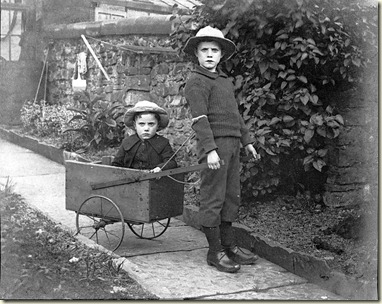
One small boy pulling another in an early billy cart. They are on a path in a back yard, c. 1915 source.

Later billy carts had four wheels and steering ropes, and were a home-made versions of commercially produced - and hence relatively expensive - pedal cars. like this one from about 1922.
antique_pedal_car_1922_
pedal car c. 1922
Of course they didn’t have pedals or hand cranks and were pushed or ridden down hill. They didn’t really have breaks either. Anthony Hordern and Sons Ltd, Australia’s largest department store at the time, was advertising billycarts in the 1920s - these were essentially the two wheeled mail carts of the late 19th century. However it was around this time or a little later that the 'modern' billycart developed as a fruit box with wheels or the more sophisticated H-shaped frame with rope controlled steering.

Harnessed goats were also used in a variation of this two wheeled cart - again using the term goat cart or 'go-cart'. Here are two boys playing with a small two-wheeled home-made goat-drawn cart, made from a wooden fruit box or crate marked 'J.T. MORTON' on the side.

goat cart australian


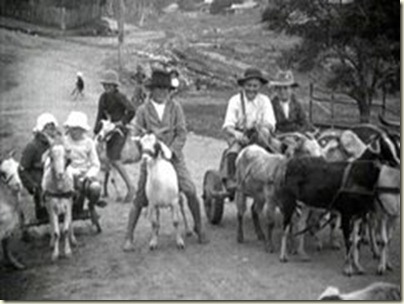
Billy cart racing(with goats) became a popular pastime for Australian children in the 1920s and thirties.  Here is a still from a 1920s  featuring boys riding on the back of goats and children in billycarts on the streets of Rockhampton, Queensland.

race


And Goat racing in 1926 at Ariah Park Sports Day - Ariah Park, NSW

goat racing aust
source

This goat cart, pulled by the champion goat "Coongal", gets privileged service from a Queensland Police officer as it crosses Queen Street in Brisbane, c. 1930.

traffic_police


Billy cart or goat racing is still a sport in Australian, although it has been condemned over the last few years for being harsh to both goats and children, as poorly trained feral goats have been used. Goats were usually well trained to pull carts in days gone past, and they were a re part of the family.
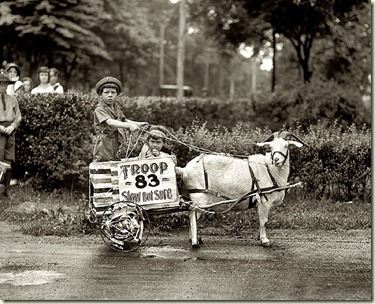
Billy carts, or goat carts were also popular in the US. with families from all walks of life.

5qtVgoat-cart-1920s-photograph
Scout troop goat cart c 1920s source

lang-39
Children with a goat cart in North Dakota c. 1930 source
source
The Harrison children, c. 1891 source
I think this is a great way to get around, don't you?! I can't imagine children now having this freedom though, although I do think goats are the perfect pets - they are vegetarian, could eat the prunings and vegie scraps, trim the grass and maybe even give milk. 

Of course pigs and dogs were also used to pull carts, and when dogs carts were outlawed in the UK in about 1840 as cruel, many dogs were killed as their owners could no longer afford to feed them.  Dog carts did continue in Belgium and some other European countries until the 1930s, and in WWI instead of pulling children, milk or bread they were used to carry guns or rolls of barbed wire for barricades.
source
Some large dog breeds would appear very suitable for pulling carts - they were bred for it after all. Like this Bernese Mountain Dog.

source

Today,although dog carts aren't used for commercial purposes, they are used as means of entertainment in a sport called carting, dryland mushing or sulky driving.  Just like sledding without snow, and it is done also by sled dog owners in the off season to keep them fit.

My eldest son used to walk the dog by letting him pull him on a skateboard, and my staffy now loves to pull me when I'm on my bike.  You'd think that if a dog is capable of pulling a human, it could pull a small cart of bread or ice cream.   Imagine a dog, or goat, drawn ice cream cart at the park or beach. My kids would love it - what a novelty, especially in this day and age when so many families cannot afford or have the space to have a pet.  And my dogs would think they'd died and gone to heaven if they could hang out with me outside all day and be petted by kids.  Maybe with regulations to prevent cruelty dog carts could become popular.......what do you think?


Deb xxx

As usual, more cart photos on tumblr.