Showing posts with label telegraph. Show all posts

Sunday, 10 February 2013

Wireless telegraphy circa 1913

 
In standard telegraphy,  a complete circuit (two wires) was used.  The first step towards wireless electrical telegraphy was discovered back in 1838, whereby if instead of two wires only one was used, and the other replaced by an earth connection,the effect could be equal to or better than what it was with the metallic circuit.

The second step was, of course, to get rid of the other wire. 

1922hugh

Many scientists made contributions to the practical aspects of wireless technology. Scottish theoretical physicist James Clerk Maxwell predicted the possibility of generating electromagnetic waves that would travel at the speed of light in the 1860s , formulating a classical electromagnetic theory  uniting all previously unrelated observations, experiments, and equations of electricity, magnetism, and optics . (he also made first durable colour photo in 1861).  Twenty years later German physicist Heinrich Hertz demonstrated this when he generated sparks between two metal balls and later experimenters managed to increase the distance across which waves could be transmitted.

In 1879 David Edward Hughes discovered that sparks would generate a radio signal that could be detected by listening to a telephone receiver connected to his new microphone design, and developed his spark-gap transmitter and receiver that could send and receive Morse code signals out to a range limited to 500 yards.  His work was dismissed as induction by some peers (but recognised in 1922 when his devices were recovered 20 years after his death). In 1894 British scientists, Oliver Lodge and Alexander Muirhead , sent Morse-code signals over a distance of half a mile.

David-Edward-Hughes-1831-1900-ve-icadi
David Edward Hughes (1831-1900) and his Telegraph table, source


In 1895 Russian physicist, Aleksandr Stepanovich Popov, built a receiver to detect electromagnetism in the atmosphere. He predicted that it might be used to pick up generated signals, and demonstrated sending and receiving messages between different points the following year.
CPA_6117
Radio pioneer Alexander Popov on the 1989 USSR stamp source


In 1898, Nikolas Tesla demonstrated a radio-controlled boat – something he had been working on since 1892.   Tesla changed the boat's direction, with manually operated controls on the command post.  Since this was the first application of radio waves, it made front page news, in America, at that time.  Tesla tried to sell his idea to the U.S. military as a type of radio-controlled torpedo, but they showed little interest,and remote radio control remained a novelty until after WWI.
 Tesla_boat   Tesla_boat1
Tesla’s radio controlled boat, source

Once 20 year old Italian Guglielmo Marconi took several previous inventions and discoveries and brought them together to produce radio in about 1895, it was a short step to produce electric wave telegraphy for communication.  With wireless technology it was possible to contact ships at sea, something which hadn’t been possible previously, so wireless telegraphy was a sure to be a hit. 

Marconi beat everyone to the finish line, applying for a patent and gaining backing in London in 1896.  Marconi founded the The Wireless Telegraph & Signal Company in 1897, and won the support of the Engineer in Chief of the Post office, William Preece,  demonstrating sending Morse signals between two post office buildings.  At first the distance was only 300 yards, but he extended that to 4 miles on Salisbury plains, and then sent messages across the English Chanel in 1899 using large transmitter masts.

Marconi’s first two commercial customers were Lloyd’s of London, who installed radio in a lighthouse off the Irish coast to report the passage of transatlantic ships and the East Goodwin lightship in the English Channel so it could keep in contact with land.  At this stage messages were still in code, but he also managed to transmit the first radio news in 1898 – regatta racing results.  In 1900, Tesla was granted patents for a "system of transmitting electrical energy" and "an electrical transmitter", and when  Marconi made his first transatlantic radio transmission in 1901, Tesla quipped that it was done with 17 Tesla patents. This was the beginning of years of patent battles over radio with Tesla's patents being upheld in 1903, followed by a reverse decision in favour of Marconi in 1904.
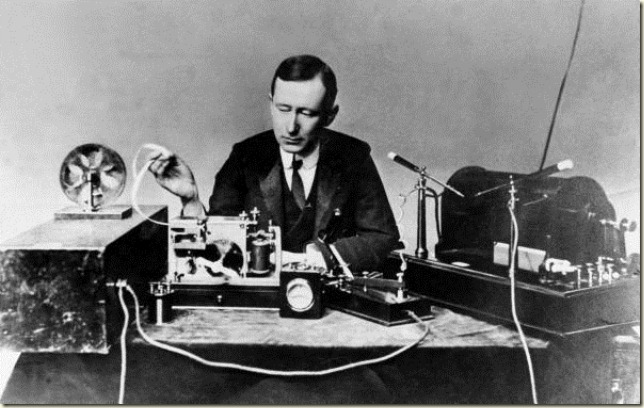
Guglielmo_Marconi_1901_wireless_signal
Marconi operating apparatus similar to that used by him to transmit first wireless signal across Atlantic, 1901 source


In 1899 the United States Army established wireless communications with a lightship off Fire Island, New York. Two years later the Navy adopted a wireless system. Up to then, the Navy had been using visual signalling and homing pigeons for communication.
In 1900 Marconi introduced wave tuning, specific wavelengths which radios today still use to send and receive, which meant that more than one transmitter could be used at a time, and also increase the distance the messages could travel.  Oliver Lodge had actually filed for a British patent on his radio tuner in 1898, the same year he applied for a patent for an improved loudspeaker .
oliver-lodge
Oliver Lodge, with loudspeaker, c. 1913 source


In 1901, radiotelegraph service was instituted between five Hawaiian Islands.  By 1903, a Marconi station located in Wellfleet, Massachusetts, carried an exchange or greetings between President Theodore Roosevelt and King Edward VII, and by then about 50 merchant ships were using wireless telegraph,with 25 shore stations.  The Royal Navy also embraced the technology, which enabled at least 80 naval ships to stay in constant contact with the admiralty – something to affect naval battles during WWI.  In 1905 the naval battle of Port Arthur in the Russo-Japanese war was reported by wireless, and in 1906 the US Weather Bureau experimented with radiotelegraphy to speed notice of weather conditions.

Marconi was also busy.   At the Wardenclyffe plant on Long Island he hoped to demonstrate wireless transmission of electrical energy across the Atlantic, but Marconi ‘s demonstration in 1901 beat him, and Tesla lost his funding.
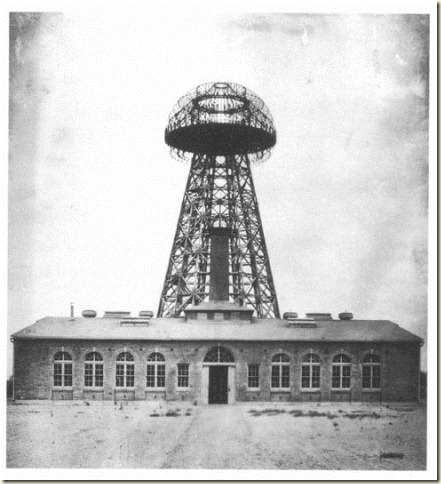
Tesla_Broadcast_Tower_1904
Tesla's Wardenclyffe plant on Long Island in 1904.


From 1904 when he immigrated to the United States from Luxembourg Hugo Gernsbacher established a radio and electrical supply house called Electro Importing Company and developed a small portable radio transmitter called the Telimco Wireless Telegraph.    He went on to patent 80 inventions. 
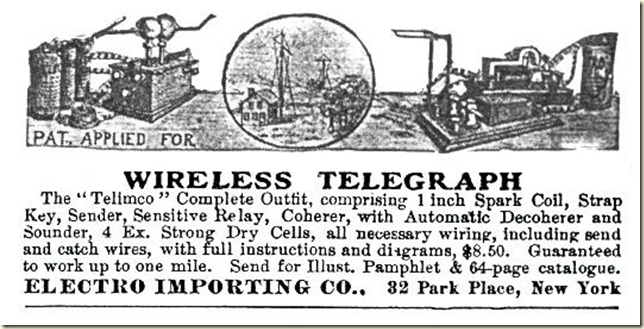
telimo wireless telegraph
In 1907 Marconi set up a cheap wireless telegraph service between New York and London, using stations in Ireland and Canada.  In 1909 he shared the Nobel Prize in Physics with Karl Ferdinand Braun "in recognition of their contributions to the development of wireless telegraphy."
Australia also adopted wireless telegraphy for communications at sea and in lighthouses, and wireless telegraphy gradually replaced the Overland Telegraph (completed 1872) allowing faster communication in remote locations.  Even before Marconi transmitted across the Atlantic,  spark transmitter experiments with radio telegraphy had taken place with 12” and 14” coils, in Australia from the mid 1890s.   In 1902, there was a successful contact from Hobart, Tasmania, with the HMS St. George, which was one of the first ships accompanying the Duke of York (later King George 5th) on his visit to Australia to open the first Federal Parliament in Melbourne.
hms_st_george
HMS St George, c. 1902, with telegraph towers, source


The technology quickly came under the control of the newly formed Federal Government through the Wireless Telegraphy Act of 1905.  In the same year Marconi’s company built Australia's first two-way wireless telegraphy station at Queenscliff in Victoria, followed by one in Devonport, Tasmania.  On the opening day for both stations,  July 12 1906, telegraph messages were exchanged between the Australian Prime Minister,   Australian State Governors, and other dignitaries, over the 150 km of water across Bass Strait.

In 1910, the first temporary ship-to-shore station opened in Australia, in Sydney, with the call-sign ATY.  Permanent stations opened in Melbourne (VIM, at the Domain site near Melbourne’s CBD), Perth (VIP), Sydney (VIS), Hobart (VIH), and Brisbane (VIB) in 1912  and in 1913 many other stations started up for ship-to-shore services.  By 1913 there were 19 radio telegraph stations operating from Australia for ships at sea.
1907domainmast
1912 - the Domain mast (recolored) source
In October 1911 Mawson purchased from the Australian Wireless Company, on a buy back agreement, two 2-kilowatt long-wave Telefunken wireless sets, costing £650 each (over $65,000 in today’s dollars).  He had decided that the cost was worth it to set up a wireless-telegraph relay station at Macquarie Island to ensure uninterrupted communication between his Australian base at Hobart and his two bases on the Antarctic coast.  This way he was able to take some  uncertainty out of Antarctic exploration and be able to announce his successes and difficulties as they occurred.  Unfortunately sometimes static prevented successful communication.
hut
Hannam and the wireless instruments at Cape Denison during the Mawson expedition.


Although the sinking of the Titanic in 1912 was a terrible disaster, the loss of life may have been total were it not for the ship’s radio operator alerting nearby ships.   Unfortunately other radio operators were not on duty, and so the message was delayed getting through – after 1912 all liners had to have a 24 hour radio watch.

In 1913, Marconi amalgamated with its main competitor, Telefunken, to form Amalgamated Wireless (Australasia) Ltd. (AWA).

rep Tesla-_620x0

During the WWI wireless telegraphy was widely used by wartime ground forces, and most private experiments in wireless technology were stopped for the duration.  Many naval ships were fitted with radios, although when they were used, it did make it easier for enemy submarines to discover where they were, and reconnaissance aircraft that carried wireless sets could also communicate the position of enemy ships and artillery.

In 1943, the 1904 U.S. version of Marconi’s patent,  US patent No. 763,772, was found to be invalid in a US  Supreme Court decision. There are some that claim this decision affirmed Nikolai Tesla as the inventor of radio  and others who claims the high court was trying to nullify a WWI claim against the U.S. government by the Marconi Company by restoring Tesla's prior patent.  What do you  think? I don’t know, I am just happy we have radio!  More on radio and 1913 technology next time.

Deb xx


Saturday, 9 February 2013

Telegraphists & faster technology

Last week I looked at the development of the telegraph.  The original Morse telegraph printed code on  punched tape, with the operator, by striking one of three operating plungers - one for the dot, one for the dash, and one for the space -  with small rubber tipped mallets, one in each hand.  The operator also had to move the tape at the same time, which could be slow and tiresome, despite the fact that a trained Morse operator able to transmit 40 to 50 words per minute.
"The telegraph operator is brain work, requiring close and unremitting application", as one professor summed it up. "The mental effort involved in receiving (morse code) from a sounder was exactly similar to that in which a shorthand writer was engaged when reporting a speaker verbatim, and it took as long to train a good telegraph operator as a good reporter."

Telegraphists were an elite group - usually well educated, in city and suburban post and telegraph offices, they occupied a position between the working classes of telegraph messenger, letter carrier and postal sorter, and the managerial classes of supervisor, postmaster and superintendent.  Usually men, especially in Australia, they showed their middle class alliance by dressing fashionably - gloves and brightly coloured waistcoats, even in the desert, such as in  Eucla in West Australia, where the men wore flannel trousers, white shirts, ties and the ornate waistcoats.


source
In 1855 American David Hughes designed a printing telegraph system, the first to print text onto paper.  It was in production until 1914.  It was a rival to the Baudot  system developed in the 1870s, with the piano key layout required minimal training for the operators. Messages were printed on paper tape by the type-wheel arrangement visible at the back. Power was supplied by a weight and pulleys underneath.
Hughes telegraph. Manufactured by Siemens und Halske, Germany
Meanwhile, in New Zealand, Donald Murray had a vision of a teletypewriter, apparently from looking at typewriters and cable-copy machines while working as a journalist with The New Zealand Herald in Auckland in 1887 - he thought that anyone could learn to type on a standard 'QWERTY' keyboardIn 1898, when his ideas had taken a practical form, he went to New York where he joined the staff of the Postal Cable Company.  By May 1899, Murray had worked out the mechanism for his design which set type by telegraph by connecting the keyboard to telegraph machinery, and applied for a US patent.  For his first US patent, Murray wrote, “My invention relates to improvements in printing telegraph apparatus, and is designed, by means of a transmitting device provided with an ordinary keyboard, such as the Remington, to operate at a distant station any ordinary typewriter …”


The Murray Keyboard, source

In late 1899 Murray sought a financial backer for his venture in New York. Unfortunately during transit to the US from Australia his system arrived at the New York office of Scientific American smashed into little pieces.  Murray was able to patch it up and successfully demonstrate it. Scientific American wrote that the Murray system was “without rival” for long telegraph lines, underground cables and press messages. They also  described the printer “as a sort cross between a sewing machine and a barrel organ”, as it was worked by the operator turning a handle.  It was dubbed by popular media as “Murray’s coffee mill” and the “Australian sausage machine”.

Murray's system in action
Murray then took his 'Murray Automatic Printing Telegraphy System'  to London.  For a short time he worked at the UK General Post Office, while further developing his  system of printing telegraphy.  He left the GPO in 1909 having established a Telegraph Engineering factory in London and he sold a number of his installations to Germany, Austria, Russia and Sweden, Brazil, Australia and New Zealand.   For more information on Donald Murray go to the excellent blog, Oz Typewriter.


In 1900, Canadian, Fredrick Creed also experimented with a faster way to send Morse code. His idea was for a typewriter style machine that would enable complete Morse code signals to be punched in the tape simply by operating the corresponding character keys.  Creed went to Scotland, and in a garden shed in Glasgow he transformed an old typewriter bought for fifteen shillings into his prototype keyboard perforator, operated by compressed air and controlled by a keyboard.  In 1902 the General Post office placed an order for 12 machines. 

With the aid of a small team of mechanics Mr Creed produced two further machines. These were a receiving perforator (reperforator), which recorded the incoming signals in a perforated tape identical with that used at the other end of the line for transmission; and a printer which accepted the received message tape and decoded it into plain language printed characters on ordinary paper tape. Thus was born the "Creed High Speed Automatic Printing Telegraphy System", later known in offices all over the world under the name of Telex. 
Creed joined with Harald Bille, a well known Danish telegraph engineer, in 1912 and the company of Creed, Bille was formed, increasing the workforce grew to 72.  That same year the Daily Mail became the first newspaper in the world to adopt the Creed System, and shortly the entire contents of the newspaper were being transmitted daily from London to Manchester for simultaneous publication.  Other newspapers shortly followed this lead and export business began to develop with orders from telegraph administrations and companies in Denmark, India, Australia, South Africa and Sweden.

From the Creed factory in Croydon, the Post Office Perforator No1 was used to prepare Telex tape off line. A character counter caused the lamp on the left to light when a line of text was nearly full, allowing the operator to enter a carriage return and line feed at the appropriate point. source

Like most technology at that time, many people were working on the same idea from different angles, so it;s' difficult to appropriate credit to each of the inventors concerned, but Murray and Creed were part of an amazing group of engineers  and inventors who revolutionised telegraphy.   Teleprinter,tele-typewriters or telex's opened telegraphy to broader use.  By adapting it to the typewriter, which was then becoming a standard business machine, it could be operated by less-skilled personnel, and basically anyone could operate one - even blind people and women!

Blind stenographer works with a dicta-phone & type writer, c. 1913
In 1913, British telegraph traffic peaked in volume with 82 million telegrams transmitted, but in the relatively short interval of the next 21 years, patronage declined and had dropped to 35 million telegrams per annum.  Also in 1913 America's Western Union developed multiplexing, which it made possible to transmit eight messages simultaneously over a single wire (four in each direction).  In the UK Creed was experimenting with high speed automatic telegraphy by wireless. Messages were successfully transmitted via an aerial on the roof of the company  to  Creed’s home about three miles away. The experiments had to be discontinued on the outbreak of the First World War, when the aerial was dismantled on Government order.

Automatic transmission would be introduced in 1914, and would allow around 20 messages to be transmitted at once, however experiments in wireless technology were suspended in the UK until after the war. WWI did allow more Australian women to assume telegraph positions previously held by men, although women had been doing the job quite successfully for some time by then.  There were women telegraph operators during the American Civil war, which you can read more about here.

Woman Telegraph Operator Lizzy Harding. It was made in 1917 by Harris & Ewing.

Deb xx

Friday, 8 February 2013

Tiffany's & the First Trans-Ocean Telegraph Cables

 
map[3]
Map showing the position of the cable from London to New York


In 1842, Morse had submerged a telegraph wire insulated with tarred hemp and India rubber, in the water of New York Harbour, and telegraphed through it, and the idea of a submarine line across the Atlantic Ocean began to be thought of as possible.

In the 1850's, a letter from London took 12 days to reach New York in the United States; 13 days to Alexandria in Egypt; 19 days to Constantinople in Ottoman Turkey; 33 days to Bombay in India; 44 days to Calcutta in Bengal; 45 days to Singapore; 57 days to Shanghai in China; and 73 days to Sydney in Australia. You can see we were a little behind the times in Australia!  So not only did we install telegraph line across the continent, but we wanted to link ourselves to the world by means of undersea cable.

Cyrus Field (1819-1892), in association with Peter Cooper and others, formed a company around 1854 to build a telegraph cable between Newfoundland and Ireland.  No one shop was large enough to hold all the cable needed, so The United States provided the U.S.N.S. Niagara and Great Britain the H.M.S. Agamemnon and loaded two ships with equal amounts of cable. They began their mission at a point midway between the continents, and sailed to the opposite shores. 


Over a core of seven copper wires over which messages travelled, there were three layers of a natural insulator called gutta percha. Yarn and stranded steel wire formed the outer layer.

On July 29, 1858, after four costly failures, the two ships returned to mid-ocean and spliced the lines together  for the last time. The Agamemnon sailed for Ireland and the Niagara was destined for Newfoundland, and on  August 5, 1858, each ship reached its destination.

On August 28, 1858 Frank Leslie's Illustrated Newspaper reported:
Complete Success of the Atlantic Cable
The telegraph cable is a complete triumph. Messages are passing over its wires quite freely, and there is no doubt a short time will enable our electricians to increase the velocity of transmissions so as to bring it up to those already in use. It is needless to remind the public how few had faith in such a wonderful achievement a month ago.

ship[4]
Machinery on the U.S.S. Niagara, provided for the second attempt to lay the Inter-Oceanic cable

The London Times referred to Field as “The Columbus of our time, who, after no less than forty voyages across the Atlantic in pursuit of the great aim of his life, had at length by his cable moored the New World close alongside the old.” 

The Great Exposition in Paris in 1867 Emperor Napoleon awarded a grand prize to Mr. Field and the Anglo-American and Atlantic Telegraph Companies. (Professor Hughes, of Kentucky, was also awarded a grand prize for his printing telegraph).

Sadly, the first cable didn't last long. After three weeks, it stopped working - the telegraph operators in their zest to communicate decided the answer to a weak signal was to use more power, so they fried the cable. By the time they laid the more permanent telegraph lines in the 1860s, operators had learned their lesson. The cable laying process also developed, and new machinery was invented to help the cable laying process.

machinery[3]
Machinery used for paying out the electric telegraph cable on board of the Niagara and Agamemnon.source


Contemporary interest in the submarine cable was huge. Field, ever the entrepreneur, entered into a deal with Tiffany & Company of New York, who purchased twenty miles of cable that had actually been submerged and retrieved from the bottom of the ocean. They cut it into 4-inch sections, each banded at the ends with brass ferrules and had a brass plaque that read “ATLANTIC TELEGRAPH CABLE/GUARANTEED BY/TIFFANY & CO./ BROADWAY • NEW YORK • 1858.”


cable2  

The cable souvenirs originally sold for 50 cents and came with a reproduced letter of authenticity from Field himself. There were also other souvenirs such as “paper-weights, cane, umbrella, and whip handles, bracelets, and watch-charms. 

Here's the Tiffany's ad for the cable:

1858TiffanyAd[1]

When the trans-Atlantic cable failed, sales of cable pieces stopped.  The remaining unsold pieces of cable were stored and forgotten. The New-York Historical Society has in its collection 930 pieces of Tiffany cable, still packed in the original crates for wholesale distribution.

Sections of the Atlantic telegraph cable (930) in original packing crates (8), source

Australia's overseas telegraph service was partly connected in the late 1860s, from London to Galle in Ceylon, where messages were taken by mail-boat to Adelaide in South Australia.  After the Overland Telegraph Line from Adelaide to Darwin was installed in 1872, a link to Bombay via Singapore and China was made, when the Eastern Extension, China and Australasia Telegraph Company (the Extension) was formed, a sister to the huge Eastern Telegraph Company, formed at the request of the British government by the amalgamation of four separate companies.

1901_Eastern_Telegraph_cables
Eastern Telegraph Company network in 1901 source

In 1876 the first Australia to New Zealand telegraph link was opened, and then one from Broome to Batavia (Jakarta) in 1889.Brisbane was linked to New Caledonia in 1891.   A further international link from Perth to the Cocos-Keeling Islands was installed in 1901, and in 1902 a telegraph cable across the Pacific between Canada and Australia (landing at Brisbane) via Fiji, New Zealand and Norfolk Island was completed. Another trans-pacific cable  linked the US mainland to Hawaii in 1902 and Guam to the Philippines in 1903.


Wednesday, 30 January 2013

A brief history of the telegraph in Australia

 
If you’ve read or seen Terry Pratchett’s Disc World series, and Going Postal in particular, you will understand what a shutter semaphore tower is.  Semaphore lines, or optical telegraphs, that sent messages to a distant observer through line-of-sight signals existed in Europe from as early as 1792, and there were also instruments such as the heliograph used from the 19th century, that use the suns rays for signalling.
Heliograph-2
Signalling with heliograph near Monument 92. Alaska - Canada border c. 1910
 In the early 1850s businesses were pressing the government to find a quicker method of communication in Victoria.  Finally in 1853 a decision was made to investigate the possibilities of the electric telegraph,  and coincidently at the same time a young Irish-Canadian engineer named Samuel Walker McGowan landed in Melbourne.  McGowan had studied and worked in the USA with Samuel Morse, the inventor of the Morse electric telegraph who had made his first successful trial of the technology in the US in May 1844 with his famous message, "What hath God wrought."   Morse, a professor of arts and design at the University of the City of New York, had been inspired to develop his telegraph by the electrical work of Professor Joseph Henry of the Albany Academy in New York and the first electric telegraph invented by Schilling in 1832.  In the US by 1854 there was already 23,000 miles of line.  Morse encouraged McGowan to head for Australia to try to establish the telegraph there, as the Victorian Gold Rush saw great wealth and expansion, in that colony sending with him an experienced telegraphist and a quantity of telegraph equipment.
History_Samuel_B._Morse_Telegraph      reciever
Morse and his telegraph c. 1844 , and his receiver used for the demonstration

How did it work? From Museum Victoria:
Telegraph signals were transmitted by an operator who depressed a key to complete an electric circuit and transmit current along the telegraph line. Releasing the key broke the circuit and cut off the current. Letters and numbers were represented by a sequence of short current pulses ('dots') and long current pulses ('dashes'), transmitted according to a defined code. The most widely used code was generally known as "Morse code".
At the receiving end of the telegraph line, the incoming current pulses passed to the receiving instrument, or 'sounder'. Two vertical wire coils were energised by the received pulses, causing the metal arm across the top of the coils to move up and down. The movement of the arm could be heard as a succession of metallic clicks. The interval between the clicks was short in response to the short current pulse representing a 'dot', or long in response to the long current pulse representing 'dash'. A skilled operator could interpret the succession of clicks as a pattern of dots and dashes and immediately decode the letters and numbers in the received message.

sounder   s2
Telegraph Sounder – c. 1860s

Hugh Childers, the Collector of Customs, who had been pressing for the introduction of the electric telegraph arranged for McGowan to demonstrate his equipment in Melbourne. McGowan then won the contract to erect 'a line of electric telegraph between Melbourne and Williamstown' and the first electric telegraph line in Victoria (and the first in Australia) opened for business in March, 1854, funded by the government but privately constructed.  
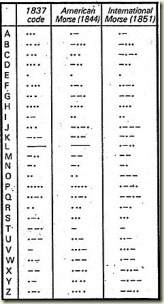
code  TelegraphTable3
How Morse code developed.

The telegraph network made it possible to communicate quickly - something that is taken for granted today – rather than sending messages by coach, pigeon, pony express or rail, but it was slow to catch on, as not everyone trusted information which had arrived via cable.  Some newspapers, for example, refused to print news which had arrived via cable as they doubted its truth, relying instead on pigeon post and human delivery. Reuters changed all this by setting up his "Submarine Telegraph" office in  1851 getting the ‘scoop’ on all international news.  One of the early important messages transmitted by telegraph in Australia was the first account to reach Melbourne of the Eureka rebellion on the gold fields at Ballarat in 1854.  The following year the line from Melbourne to Queenscliff was completed and the more shipping information and European news was made available.
cloncurry
The post telegraph office at Cloncurry, Queensland, c. 1912. There is a man up the telegraph pole in the centre of the photograph. source
 In 1856 Victoria, NSW and South Australia agreed to collaborate on establishment of an intercolonial telegraph network, as messages going across colonial borders initially involved operators in one colony  transcribing a message which was then physically handed to a counterpart in the second colony for transmission over that colonies wire.  South Australia also installed its first line in Adelaide.
post
Murtoa Court House and Post Office building, Victoria, c. 1890. Five men stand outside the post office while a sixth man, a woman and a small girl stand at the right. source

In Tasmania Hobart and Launceston were linked in 1857.  Adelaide and Melbourne were linked in 1858, the year in which the first NSW line was activated, and a Sydney-Melbourne link was in place by November 1858. The first line in Queensland was activated in April 1861, with a connection to Sydney in November of that year. The first transcontinental line in the US dates from the same year.
tas office
Scottsdale Post and Telegraph Office, Victoira 1906

By 1867 there were 1,676 miles of line within Victoria, handling 122,138 messages (compared to around 7.92 million in the US and 5.78 million in the UK that year).  Western Australia did not have its first line until 1869, but by 1875 a link between Adelaide and Perth was established. In 1872 the 2,900 kilometre Adelaide to Port Darwin link (the Overland Telegraph Line or OTL) was installed at a cost of £300,000.  This allowed fast communication between Australia and the rest of the world, via Singapore, and was one of the great engineering feats of 19th century Australia.The Batavia (Jakarta) to Broome link was completed in 1889, with a link to Perth via the Cocos-Keeling Islands in 1901.
Overland_Telegraph_Darwin
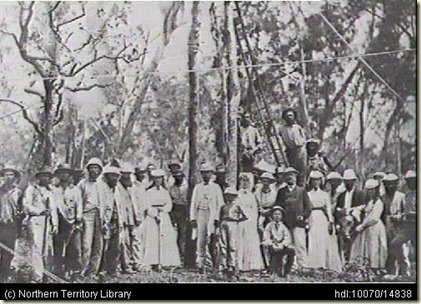
Planting the first telegraph pole, for the OTL, near Palmerston (Darwin) on 15 September 1870, source

By 1876 there were over 8,000 miles of line in Queensland alone. By 1900 virtually everyone in Australia had access to the telegraph, but they were still expensive (the cost per word for a message from London was at that time equivalent to the average weekly wage) and usually kept for special occasions such as births and deaths.  These telegraph messages sent by an electrical telegraph operator or telegrapher using Morse code  was known as a telegram.  A cablegram was a message sent by a submarine telegraph cable, often shortened to a cable or a wire, and I’ll look at these next time.
telegram
Telegram sent from Doncaster to Heidelberg in 1900 by J. W. Jenvey to S. W. Chambers giving information about wireless transmission experiments.


Deb xx