Showing posts with label australia. Show all posts

Wednesday, 14 August 2013

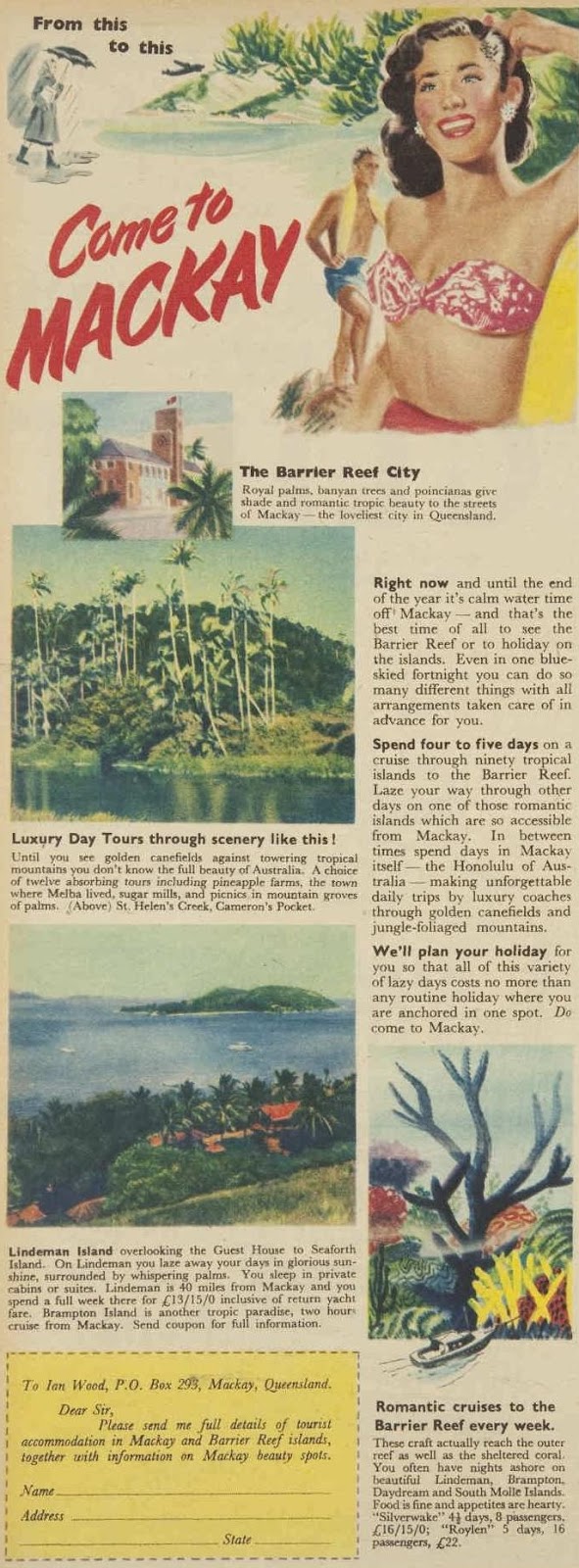
Mackay - "The Honolulu of Australia" in the 1950s

If you've read my blog for a while, you will know that I live in Mackay in North Queensland, Australia.  It's a town of about 90,000 people that depends more on mining and sugar growing rather than tourism, however it is seen as the gateway to the Whitsundays and the Barrier Reef.

I have lived here for about 10 years.  Apart from having to drive only 10 minutes to work, the best thing about Mackay is it's winters.  We don't need any sort of heating, and usually in winter we don't the air-con or fans either.   I do usually wear a jumper in the evenings, but rarely during the day.  And we don't usually get much rain in winter - the rainy season is November to March.

I recently found this ad from August 1952 which plays nicely on our sunny winters.....


vintage 1950s ad for travel to mackay, QLD


Tuesday, 7 May 2013

Australia 1932 - Unemployment hits 30%

In a previous post I looked at the beginning of the Great Depression, and Australia's jobless rate in 1930 - 20%.  In 1932 the unemployment rate rose to 30%. The worst in our  history.

Many other workers not listed as unemployed were only semi-employed.  Many farmers were destitute, because of the collapse of world agricultural prices, and reverted to subsistence farming - growing what they could eat.

Two men digging potatoes on farm, West Gippsland, 1930.

Obviously fuel was expensive, and so were horses it seems.

Boys plowing a field near Albury 1930s
Some men on sustenance payments, or "susso", were employed in public works programs, with many having to stay in labour camps away from their families.

Workers constructing the Yarra Boulevard, Melbourne, 1930s  (nicknamed Susso Drive)
In the cities people turned to begging and hawking, and evictions  bankruptcy and the sale of family valuable became common. Business such as retailers and manufacturers folded as the customers disappeared.  People began living in shanty towns in parks, on racecourses and in the bush, and even in the shallow sandstone caves in Sydney's Domain gardens.

Temporary Home Being Dismantled In Tent City, Red Cliffs, Victoria, c. 1932

To obtain the 'susso' payment you had to prove that you had been unemployed for at least two weeks, and be registered with the State labour exchange for at least seven days.  You could own a house and get the benefit, but no other property, such as a car.

Soup kitchen queue in Sydney in the 1930s.
As the unemployed people could not even afford to buy newspapers, the day's classifieds, with jobs available, were posted on boards outside the newspaper offices.  This lead to huge crowds outside newspaper offices each morning before dawn, with hundreds of people arriving for each position available.

Things could only get better.

Deb xx

Tuesday, 16 April 2013

Australia 1931 - Wages Cut & Holden merges with GM

Today another look at Australian history in the 1930s, and a bit about General Motors, who took over Australia's Holden Company in 1931.


General Motors was founded in Michigan in 1908, in Flint, Michigan, as a holding company for Buick who sold his company to  the Durant-Dort Carriage Company.  Established in business in 1886, by 1900 Durant-Dort was producing over 100,000 carriages a year in factories located in Michigan and Canada.  Durant already owned several Ford dealerships, and soon acquired Oldsmobile, Cadillac, Cartercar, Elmore, Ewing, and Oakland (later known as Pontiac), as well as several truck companies.


Durant lost control of GM in 1910 to a bankers trust when a deal to buy Ford fell through, so he left the firm and co-found the Chevrolet Motor Company in 1911 with Louis Chevrolet.  In 1916  Chevrolet bought 54.5% of GM with the backing of Pierre S. du Pont, and later that year the GM Company became incorporated as General Motors Corporation.


GM's headquarters were located in Michigin until the mid-1920s when it was moved to Detroit in 1923, when "the Durant Building" was completed in 1923. New president Alfred P. Sloan renamed the building 'Cadillac Place', and it remained their headquarters until 1996.

General Motors Building (Cadillac Place)
GM surpassed Ford Motor Company in sales in the late 1920s thanks to the leadership of  Sloan, who invented new ways of managing a complex worldwide organization, while paying special attention to consumer demands such as style, power, and prestige.  Safety wasn't a huge concern though it seems - when it was proposed Chevrolet should introduce safety glass, he opposed it because it threatened profits.  GM also introduced monthly payment plans that allowed more people to buy GM cars - Henry Ford was opposed to credit on moral principles.


In 1925, GM bought Vauxhall of England, and then in 1929 went on to acquire an 80% stake in German automobile manufacturer Opel. Two years later this was increased to 100%. In 1931, due to financial difficulties, Australia's most successful company of the 1920s, Holden's Motor Bodies Ltd was forced to merge with GM, who were able to acquire the Holden company at a 36% discount - a total sum of 1,750,000 pounds. What a great buy!  GM company directors stated that with a fall in national income of 140 million pounds, it would be some years before the automobile business in Australia recovered and shareholders saw a profit.

1930 Willys Model 98B Touring (Holden Bodied) - Australia


In January 2012 Australian headlines read:

"The closure of Holden's Australian operations is one option being considered by US parent company General Motors"
and indeed they did close some factories and have proposed more closures.  Times haven't really changed, have they?

Because of the huge fall in national income, in January 1931, the Commonwealth Arbitration Court reduced all wages within it's jurisdiction -  that is basically the whole of Australia's workforce.  The idea was that a reduction in wages would increase employment.  Because of the severe economic contraction, and the reduction of purchasing goods, employers still couldn't afford to keep excessive workers. A five-year unemployment average for 1930-34 was 23.4%, with a peak of approximately 30% of the nation being unemployed in 1932. This was one of the most severe unemployment rates in the industrialised world, exceeded only by Germany.  The majority of the people of Australia lived very well during the 1920s, so they felt the effects of the depression strongly.

1930s dole queue Australia
The basic wage was restored in April 1934, although it was based on a lower wage that before, and the trade unions were not happy.


In 1934 Larry Hartnett (later Sir Laurence Hartnett) was sent to Australia by GM as Managing Director of the Australian company with a directive to either make it profitable or close it down.  By 1935 the world economy had strengthened and Hartnett lifted production to 23,129 bodies and a profit of 650,000 pounds. The company also introduced the "Sloper" to the world which was the fore runner of the hatchback and led the rest of the world in producing the first all steel bodies. In 1936 the company moved to new headquarters, at Fishermens Bend, Melbourne.

Art deco GMH building, Fishermans Bend, Melbourne. 
In 1936 Hartnett began planning the complete production of a "wholly Australian car", however another World War intervened, with the (Menzies) government of the time putting these plans on hold. Instead they were the first Australian company to mass-produce internal combustion engines including Gypsy Major aeroplane, Gray Marine, and a 4-cylinder radial torpedo. After the war the, Holden returned to producing vehicle bodies, this time for Buick, Chevrolet, Pontiac and Vauxhall. The Government also asked for proposals from any local company for production of a complete car - and General Motors Holdens were the only company to reply.  In 1948, after many difficulties, including GM wanting the design done in America, the 48-215 Holden (or FX Holden, as it soon became known) was born.


An Australian-made car so captured the imagination that 18,000 people ordered one without knowing any details about it - the waiting list was two years long.  The car weighed about 1000 kilograms, could cruise at 100km/h and would do about 130km/h flat out. It could travel 48 kilometres on a gallon (4.55 litres) of fuel (about 9.5 litres per 100 kilometres) and seat six people. And it was powered by a straight-six engine and could out-accelerate anything.

Jack Rawnsley, one of the engineers who made the prototype FX Holden in 1946. It has now been restored and bought by the National Museum of Australia for $650,000 via
GMH also released the coupe-utility, now Australia's iconic car (although it was said to be invented back in the early 1930s by a young Ford Australia designer named Lew Bandt). You can read more about the ute here.


During the 1950s, Holden dominated the Australian car market. Ford Falcons went on to become some of the best-selling models ever and gave the Holden opposition terrible grief in the 1970s and '80s, as did Crysler. Large family cars are now being phased out - SUVs and small cars are more popular (we have one of each in our family, and not a Holden in sight.)  Both Ford and GM have made it clear that any future large cars will be global vehicles, not made-for-Australia specials.  Sadly, the end of the all-Australian car has come.

Deb xx


Tuesday, 2 April 2013

Australia 1930 - Jobless Rate Exceeds 20 Per Cent

Although I love a lot about the 1930s, there are some things that I am glad I missed. However, I think it's good to look at history to remind us of the mistakes made, so that we can hopefully learn from them - like the Great Depression.

1930s Oxymoron
Throughout the 1920s, the stock market had grown on speculation by people who bought on margin and, in fact, owned only a small portion of their stocks. Many could not meet margin calls - demands to put up the money to cover their loans. The result was panic selling. On October 29, 1929 (Black Tuesday) alone, stock values fell $14 billion on Wall Street. The great Depression had begun, and rapidly spread worldwide.  Queensland had already been pushed into a recession in 1926 by falling wool and mineral prices.  Dependent on exports to England, wartime inflation had upset the United Kingdom's terms of trade and their sluggish economy naturally reduced the demand for imports from Australia.  By 1930 international commodity prices collapsed, triggering a fall in export earnings and increasing overseas debt. Basically there was no money circulating within the population and therefore no one could buy anything, which meant no businesses made money and therefore no jobs were available in a catastrophic cycle.

$100 will buy this car must have cash lost all on the stock market
In August 1930 the visiting Bank of England representative, Sir Otto Niemeyer, insisted the Australian state, territory and federal governments balance their budgets, cut all overseas borrowing and lower all award wages by 10 per cent.the state. The State Premiers agreed to balance their budgets and not seek any more overeseas loans, and to finance only 'reproductive' public works. Many infrastructure projects, which had begun in the 1920's under the previous 'men, money and markets' policy, were stopped immediately, except perhaps the building of The Sydney Harbour Bridge which had begun in 1923 and kept many men employed during the depression.

Sydney Harbour Bridge c. 1929
The cut in public expenditure happened at the same time that private businesses were putting thousands of people out of work.  In November 1930 figures showed that 20.5 %, or 90,379 union members of a pool of 439,971, were unemployed.  A year later it would reach 28%. Those still employed had their hours lengthened and their wages cut, and set off to work each morning knowing there was every chance they could finish the day on the dole queue.

Men ordered to present food relief tickets for inspection because of fraud allegations, at the dole queues at No.7 Wharf, Circular Quay, Sydney. 11 June 1931.
For the majority of people, there was little government assistance, especially at the beginning of the crisis. Private charities were often the only source of support outside of families and neighborhood communities.

Unemployed men receiving food handouts
Protest marches and demonstrations by the unemployed in all states and territories demanded increased sustenance pay and rent subsidies. In April 1930 a mass meeting of the unemployed in Melbourne led to the establishment of the 'Anti-starvation Crusade' which planned to go directly to the State Government and ask that better remedies be put into action before winter, including banning unscrupulous landlords seizing furniture and turning tenants out into the streets. In 1931 over 1000 unemployed men marched from the Esplanade to the Treasury Buildings in Perth, Western Australia, to see Premier Sir James Mitchell.

 Perth 1931

Many people lost their homes and were forced to live in makeshift dwellings with poor heating and sanitation.   City and urban people planted gardens to produce fruit and vegetables. In some urban areas co-operatives were formed based on barter systems to share what was available.People set up camps int he domain in Sydney  and unemployment camps sprang up at various locations  including Happy Valley at La Perouse,  behind Congwong Beach. People often arrived with only the possessions they could carry, pick a spot and erect a hut with scrounged corrugated iron roofing, white washed hessian walls and earthen floors. They scrounged food from local Chinese market gardeners and local fishermen and the government provided one pint of milk per family per day. By 1932 Happy Valley had a stable population of at least 330.


Happy Valley, 1932
Labor Prime Minister James Scullin came to power on 22 October 1929, just a week before the stock market crash. in 1930 Mr Harris, the deputy leader of the Liberal opposition, somehow voiced his views that there was 'no one on the breadline' in Melbourne, and that there was no need of Unemployment Insurance in Victoria.

Breadline in New York City during the Great Depression.
By late 1930 the States started providing 'sustenance' or 'susso' for the unemployed in the form of ration vouchers, but this was worth only a tiny amount of the basic wage. Many people, especially in Sydney and Melbourne, turned to begging or 'door knocking', trying to sell small trinkets, fruit, shoelaces, soap, moth balls, artificial flowers or stockings to earn a few coins.

An unemployed man selling apples 1930s.
Others played instruments sang,and others feeling they had no choice turned to theft to provide themselves and their families with food. Sometimes children failed to thrive on food issued with the government rations, and would end up in hospital with malnutrition. Deaths from malnutrition, disease and suicide increased, and parents often went hungry to give what food they had to their children, and other parents choose to give their children to people that could care for them.
Children of migrant fruit worker in Berrien County, Michigan


David Potts in his 2006 book 'The Myth of the Great Depression' explains that dripping had to be substituted for butter, which apparently could be quite tasty. Unfortunately he then goes on to say that "going without food intermittently for two or three days, or five or ten, or even a degree of persistent hunger, does not damage the body or health". I's like to see him try it.

Schoolchildren line up for free issue of soup and a slice of bread
Not only was malnutrition an immediate effect of poverty, but also emotional and psychological distress - just imagine being forced out of your home as you could no longer pay the rent/mortgage, and had to take your family to live on the streets.  The majority of the people of Australia lived very well prior to the fall, so they felt the effects of the depression strongly.  

William Roberts, an original Anzac, and his family evicted from their Sydney home into the street 

Apparently today even many two-income families today are a paycheck away from losing their homes  because they are living beyond their means. So the lesson from this - minimize the amount of debt that you take on. Easier said than done sometimes. Oh, and don't have too many children. Like I did!

Back to something cheery tomorrow, although there are more Depression images on tumblr if you want to see them.

Deb xxx

Saturday, 16 February 2013

The Vintage Electric Iron


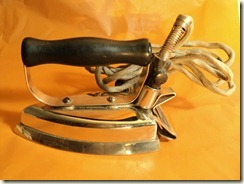
The electric iron was available in 1913, and by the 1920s was the most popular electrical appliance in Australia.
iron 1920s
1920's Edison Electric "Hotpoint" NP 27D Clothing Iron
1913ad
1913 Ad: GE Electric Flatiron "Even Heat Saves Money" source
 Hand irons were used for garment pressing long before electricity, heated directly either by gas flame or stove plate heat.  In China metal pans filled with hot water were used for smoothing fabrics as early as the 1st century BC.
Preparing silk 12th century
The people in North Europe used glass, wood and stones for smoothing clothes.   In the Middle Ages  blacksmiths began forging smoothing irons -   flat irons or sad irons (from an old word meaning solid)  - that were simply heated in a fire before use.


flatiron
Primitive sad iron
Later designs had an iron box which could be filled with hot coals, which had to be periodically aerated by attaching a bellows. In India, burning coconut shells were used instead of charcoal, as they have a similar heating capacity. Other box irons had heated metal inserts instead of hot coals.
charc
Charcoal laundry box Sad Iron c. 1880s source

Up to the middle of the 1800s, iron design was generally between the customer and the blacksmith, with only a couple of commercially available models.  In 1871 Mary Potts patented the Mrs. Potts Sad Iron, a hollow cast iron that could be filled with a material such as plaster of Paris, cement or clay, that Mrs. Potts claimed would hold the heat longer so that more garments could be ironed without reheating the iron.  The timber handle was detachable and remained cool to the touch.  She received a series of patents for variations on her iron and reissued others, and blitzed the competition with her advertising campaign, even using trading cards to advertise and spread the word of her product.

pottsback (1)

potts2  An oversized sunflower is used on this 1880s trade card advertising Mrs. Potts Cold Handle Sad Irons, which makes fun of a popular Aesthetic turn of phrase:“Isn’t it too-too? I will buy two and you can buy two-too.”
Original Patent Model of Mrs. Potts Sad Iron
Patented 1871 by Mary Potts


Most basic irons have been pointed at one end, or shield shape. The smoothly pointed shape makes it easier to get into tight spots and into cuffs, and for ironing of pleats, collars and small details.

fluted
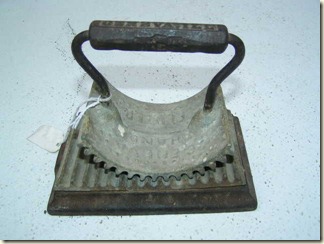
 Fluting iron, Geneva hand fluter patent 1866, source
heart
German brass heart shaped flat iron  source  
 
In the 1800s, an era when everything had to be ironed, manufacturers produced irons for every trade and every category of clothing  -.   sleeve irons, hatter's irons, fluting irons (good for cuffs), dressmaker's irons, artificial flower making irons, billiard table irons, and irons for polishing, glossing  and crimping.

On June 6, 1882, Henry W. Seely of New York patented the electric flat-iron – it weighed a mammoth 6 kg (15 pounds) and took a long time to warm up. Other electric irons had also been invented, including one from France in 1882 but they used a carbon arc to heat the iron, which was not a safe method . In 1892 hand irons using electrical resistance were introduced by Crompton and Co. and the General Electric Company. These irons consisted of a base with an electric heating element, and the iron that you held – so electricity heated the iron instead of another fuel.   Later "irons" would have the heating elements built in to the hand-held tool, which would allow the iron to stay hot and not need reheating.  Funny how we have now returned to two piece irons – those with separate bases. Steam irons were not introduced until the early 1950s.

ironing
 Ironing class at the Brisbane Technical College, ca. 1900.

In 1913 I may have been able to get one of these "Tank in the Handle" Gas Irons, patented in 1913 and manufactured by the Acorn Brass Mfg. Co. of Chicago, Illinois.  I’m not sure how well it worked, or how safe it was,  but it has a great streamlined, modern rocket look.  Gas irons continued to be popular well into the 1930s, and were made until the 1980s, but there were a few brands of electric irons around in 1913, including General Electric and Landers, Frary and Clark.
acorn5
"Tank in the Handle" Gas Iron 1913, source 
1913iron
  1913 Landers, Frary & Clark Universal Iron, source
  
 There were even Ironing Machines – in electric or non-electric form.

simplex
1913 Vintage Ad Simplex Ironer Iron Antique Machine, source

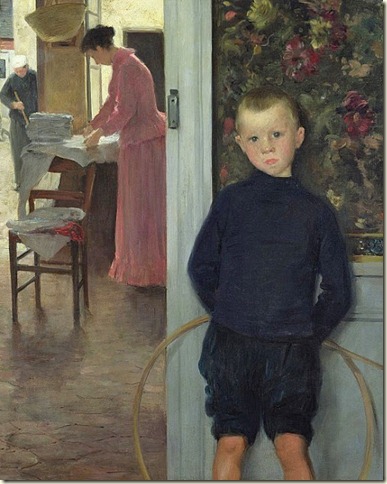
It’s nice to know that if I did live in 1913, I could have been using an electric iron to iron my husbands shirts.  That is if I still lived in Melbourne.  Here in Mackay electricity was not connected until 1924! I love this painting – the little boy reminds me of my youngest son, and I can imagine that is me doing the ironing while he plays outside.

7 Paul Mathey (French artist, 1844-1929)Interior with Woman and Child
Paul Mathey (French artist, 1844-1929) Interior with Woman and Child source

This photo is from an Amish homesteading blog I have just found. Erin Harrison and her girls use husband Marks Great Grandmother flat iron, that they heat of the stove. Erin makes even washing without electricity sound fun.

ironing

To finish, just because I think its beautiful, here is a Saunders Silver Streak iron from the 1940's.

pyrex
Saunders Silver Streak c. 1940s
During the WWII era when metal was in short supply (and when Pyrex cookware was becoming all the rage) the Saunders Machine and Tool Co. of New York utilized Pyrex glass bodies provided by the Corning Glass Co.  The entire top shell is Pyrex, with just the sole plate being chrome plated metal. They came in a range of colours including red, green, blue, silver and more.  Unfortunately the fragility of a glass iron made them a short lived and they were discontinued shortly after the war.  they are now a collectors item – expect to pay around $1,000 to $2,000! Even I would happily do the ironing if I had one of these.


Deb xxx

Thursday, 7 February 2013

Small Australian stores in 1913

Yesterday I looked at Bon Marche, the grand French department store. Today a look at quite the opposite – small, mainly family run stores in rural Australia one hundred years ago.  Most of them sold a range of goods, and I can imagine myself lost inside, browsing for hours……..or maybe not, as the horse might be getting a bit restless waiting for me!
For some reasons some of the images aren't showing - please go here for the first image if that's the case for you.


Raymont's store was built in 1885 by Thomas Percival Raymont to sell groceries and produce.  He bought and sold – what a great system – and was also an insurance agent.   The store was in operation for 65 years and was later managed by Thomas' son, Bill. Thomas and his wife Eliza lived in a house next to the store and there raised eight children (five dying in infancy). Up until the early 1900s the store was an agent for the supply of rations to the Aborigines who lived in Enoggera. From 1888 the store included the Post Office for the area, although it has a separate door, so it may have been leased to someone else.

John Stewarts grocery store at Annerley around 1913
John Stewarts grocery store at Annerley  c. 1913 source

Staff and customers outside John Stewart's grocery and provisions store on the corner of Ipswich Road and Clive Street around 1913. Possibly the family lived above the store, which was quite common in those days.
Gearys Commonwealth Stores in Chinchilla around 1913
Shop assistants and customers pose outside Geary’s Commonwealth Stores in Chinchilla, QLD c. 1913 source

Mr D. Geary came to Chinchilla from Miles in 1904 and set up this shop to supply basically everything to the local farmers who grew mainly grain, and also ran cattle, sheep and pigs.  Timber was also felled nearby.  I love the way the store also has an ironmongery.  I doubt ‘iron’ goods were made in the store, as blacksmiths usually had separate premises because of fires risks, rather it is an alternate name for hardware store.  However, the store was destroyed by fire in 1922.

Music store in Morgan Street Mount Morgan 1913
Music store in Morgan Street Mount Morgan, QLD 1913, source


I don’t know much about this one, but it’s great to see people in country Queensland had access to instruments and sheet music.

Store belonging to R. Beckett in Mundubbera, Queensland, 1913
This image may not work either, so go here to see it.
Beckett's store was a tailor, drapery and shoemaker business, but also sold stationery. It looks to be situated right in the bush, with no road.  Another building is being constructed near by, so maybe this was the start of the town.  It has a very wild-west feel to it, don’t you think?

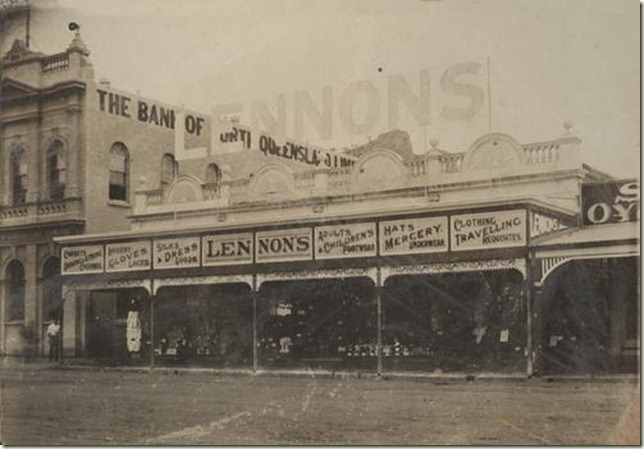
Lennons clothing store in Townsville 1913

Lennon’s clothing store in Townsville 1913.  By 1913 Townsville was fifty years old, and quite a large town.  The even had motorised buses! Lennon’s shop, positioned cleverly next to the bank, looks quite upmarket, and has a very large sign to attract customers – literally a sign of things to come.  A Mr William Lennon was involved in the Bank of Queensland in the 1880s, before opening his own stock agent store around 1900 – it’s possible this store is an off shoot of that.  Lennons’ sold footwear as well as clothing.  Here is the interior of their boot department.

Boot department inside Lennons Drapers

This last store is located in Oakleigh, Victoria, now a suburb of Melbourne but in 1913 it was more of its own town.  From the exterior is looks like the store was located near the railway line, and sold everything from cigarettes to groceries, and glassware to electrical goods. Like all of the other stores, it also has a generous veranda.

exterior oakly

I was happy to find an interior view of this same store. Definitely not a self service store – most goods are displayed behind the lovely wooden counters.

interior oakly

I love the old cash register and Dayton scales. Note the ‘ironmongery’ sign – probably more hardware.
Imagine being able to fit all available goods in one store today – no mega hardware or department stores, or supermarkets.  Shopping has certainly changed in 100 years.

More photos of stores on tumblr, including some overseas stores.

Deb xx