Showing posts with label electricity. Show all posts

Saturday, 16 February 2013

The Vintage Electric Iron


The electric iron was available in 1913, and by the 1920s was the most popular electrical appliance in Australia.
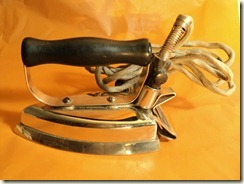
iron 1920s
1920's Edison Electric "Hotpoint" NP 27D Clothing Iron
1913ad
1913 Ad: GE Electric Flatiron "Even Heat Saves Money" source
 Hand irons were used for garment pressing long before electricity, heated directly either by gas flame or stove plate heat.  In China metal pans filled with hot water were used for smoothing fabrics as early as the 1st century BC.
Preparing silk 12th century
The people in North Europe used glass, wood and stones for smoothing clothes.   In the Middle Ages  blacksmiths began forging smoothing irons -   flat irons or sad irons (from an old word meaning solid)  - that were simply heated in a fire before use.


flatiron
Primitive sad iron
Later designs had an iron box which could be filled with hot coals, which had to be periodically aerated by attaching a bellows. In India, burning coconut shells were used instead of charcoal, as they have a similar heating capacity. Other box irons had heated metal inserts instead of hot coals.
charc
Charcoal laundry box Sad Iron c. 1880s source

Up to the middle of the 1800s, iron design was generally between the customer and the blacksmith, with only a couple of commercially available models.  In 1871 Mary Potts patented the Mrs. Potts Sad Iron, a hollow cast iron that could be filled with a material such as plaster of Paris, cement or clay, that Mrs. Potts claimed would hold the heat longer so that more garments could be ironed without reheating the iron.  The timber handle was detachable and remained cool to the touch.  She received a series of patents for variations on her iron and reissued others, and blitzed the competition with her advertising campaign, even using trading cards to advertise and spread the word of her product.

pottsback (1)

potts2  An oversized sunflower is used on this 1880s trade card advertising Mrs. Potts Cold Handle Sad Irons, which makes fun of a popular Aesthetic turn of phrase:“Isn’t it too-too? I will buy two and you can buy two-too.”
Original Patent Model of Mrs. Potts Sad Iron
Patented 1871 by Mary Potts


Most basic irons have been pointed at one end, or shield shape. The smoothly pointed shape makes it easier to get into tight spots and into cuffs, and for ironing of pleats, collars and small details.
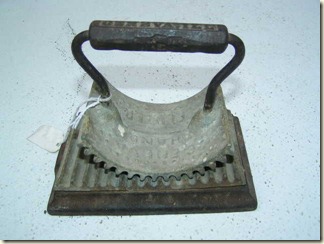
fluted
 Fluting iron, Geneva hand fluter patent 1866, source
heart
German brass heart shaped flat iron  source  
 
In the 1800s, an era when everything had to be ironed, manufacturers produced irons for every trade and every category of clothing  -.   sleeve irons, hatter's irons, fluting irons (good for cuffs), dressmaker's irons, artificial flower making irons, billiard table irons, and irons for polishing, glossing  and crimping.

On June 6, 1882, Henry W. Seely of New York patented the electric flat-iron – it weighed a mammoth 6 kg (15 pounds) and took a long time to warm up. Other electric irons had also been invented, including one from France in 1882 but they used a carbon arc to heat the iron, which was not a safe method . In 1892 hand irons using electrical resistance were introduced by Crompton and Co. and the General Electric Company. These irons consisted of a base with an electric heating element, and the iron that you held – so electricity heated the iron instead of another fuel.   Later "irons" would have the heating elements built in to the hand-held tool, which would allow the iron to stay hot and not need reheating.  Funny how we have now returned to two piece irons – those with separate bases. Steam irons were not introduced until the early 1950s.

ironing
 Ironing class at the Brisbane Technical College, ca. 1900.

In 1913 I may have been able to get one of these "Tank in the Handle" Gas Irons, patented in 1913 and manufactured by the Acorn Brass Mfg. Co. of Chicago, Illinois.  I’m not sure how well it worked, or how safe it was,  but it has a great streamlined, modern rocket look.  Gas irons continued to be popular well into the 1930s, and were made until the 1980s, but there were a few brands of electric irons around in 1913, including General Electric and Landers, Frary and Clark.
acorn5
"Tank in the Handle" Gas Iron 1913, source 
1913iron
  1913 Landers, Frary & Clark Universal Iron, source
  
 There were even Ironing Machines – in electric or non-electric form.

simplex
1913 Vintage Ad Simplex Ironer Iron Antique Machine, source

It’s nice to know that if I did live in 1913, I could have been using an electric iron to iron my husbands shirts.  That is if I still lived in Melbourne.  Here in Mackay electricity was not connected until 1924! I love this painting – the little boy reminds me of my youngest son, and I can imagine that is me doing the ironing while he plays outside.
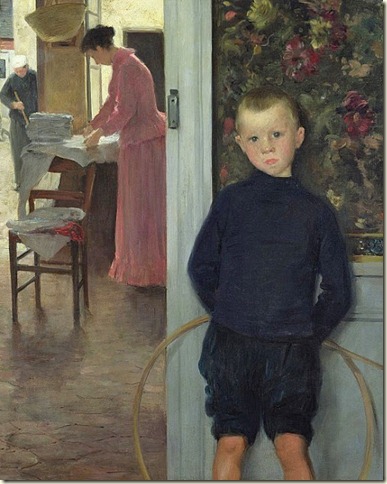
7 Paul Mathey (French artist, 1844-1929)Interior with Woman and Child
Paul Mathey (French artist, 1844-1929) Interior with Woman and Child source

This photo is from an Amish homesteading blog I have just found. Erin Harrison and her girls use husband Marks Great Grandmother flat iron, that they heat of the stove. Erin makes even washing without electricity sound fun.

ironing

To finish, just because I think its beautiful, here is a Saunders Silver Streak iron from the 1940's.

pyrex
Saunders Silver Streak c. 1940s
During the WWII era when metal was in short supply (and when Pyrex cookware was becoming all the rage) the Saunders Machine and Tool Co. of New York utilized Pyrex glass bodies provided by the Corning Glass Co.  The entire top shell is Pyrex, with just the sole plate being chrome plated metal. They came in a range of colours including red, green, blue, silver and more.  Unfortunately the fragility of a glass iron made them a short lived and they were discontinued shortly after the war.  they are now a collectors item – expect to pay around $1,000 to $2,000! Even I would happily do the ironing if I had one of these.


Deb xxx

Friday, 15 February 2013

Shock! Electricity comes Home

 
You can see by my recent posts that I have been looking a early technology.  I love history, and all things vintage, but to live in a time with no electricity seems almost unimaginable to me.   The electric light and electric motor were both invented in the 1830s, as was, believe it or not, the battery, but it wasn’t until around 1900 that both found their way into  homes and the kitchen.

American Thomas Davenport developed the first real electric motor ('real' meaning powerful enough to do a task) in 1834 although Joseph Henry and Michael Faraday created early motion devices using electromagnetic fields and Hungarian scientist Ányos Jedlik had developed an electromotor in 1828. The early "motors" created spinning disks or levers that rocked back and forth. They didn’t really do anything useful, but were important for leading the way to better motors in the future and other inventions such as generators. Commercial electric motors were in use from the 1870s.

DavenportMOTOR
The first Davenport motor      
 
Edison_Carbon_Bulb
 Edison’s original carbon-filament bulb
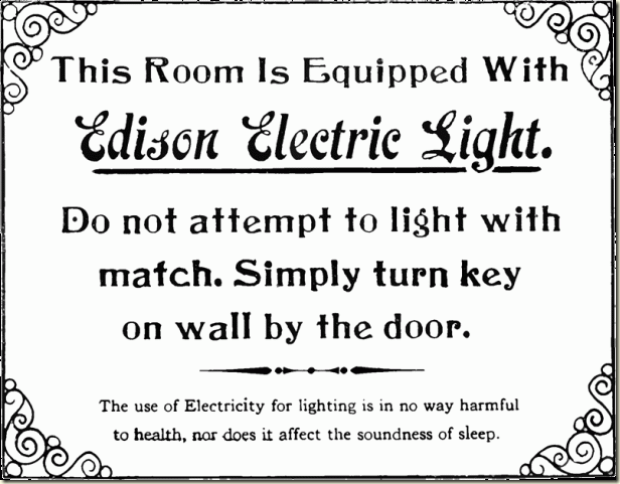
 Thomas Edison produced the first commercially viable incandescent light bulbs in 1879  (although at least 20 others contributed to it’s inventions) , and it was commercially available by 1885.  Electric lights were quickly put into factories and streets,  but actually spread quite slowly into homes, despite its advantages over gas lights.  Houses had to be wired for electricity, if there was a power station nearby, and not even could afford it or even trusted it. Often buildings would just have electricity put in downstairs rooms, worried that this new power would emit ‘vapour's’ while people slept. The bulbs were also expensive, around $60 each in today's money.  Wall outlets were also around since at least 1897, but they didn't become common until the late 1910s. At this point, one or two special outlets are considered enough for the average home.  The price of electricity, wiring and appliances gradually came down, and by the 1930s most people could afford electricity.

Edison-Electric-Light-Sign-612x477


In Australia the first electric light was put on public display in Sydney in 1863 to mark the marriage of Edward the Prince of Wales and Princess Alexandria, but this was an arc lamp rather than an incandescent globe.  Sydney did not have a power station until 1904, in Pyrmont, and Queensland was the first  colony to have a public electricity power supply. Initially, many local authorities raised funds, and provided supply for their own areas in whatever way they could. In 1882, a demonstration of what electricity could do was conducted with eight arc lights along Queen Street in Brisbane, with power supplied by a 10 hp generator driven by a small engine.  Australia was motivated to used electricity, as it was also a great method of pumping water – something often desperately needed – and 1000 km west of Brisbane the first hydroelectric bore was built at Thargomindah in around 1900.  We also loved electric trams (Melbourne still has them).

Advertisement for Barton White
Advertisement for Barton White & Co, manufacturers of electrical equipment, Brisbane, ca. 1890, source

Melbourne was the first city in Australia to operate a power station, and by 1894 most of the city's streets were lit with electricity.  By 1913 most British and Australian towns had electric street light, but the majority of middle class families still used gas for lighting their homes and to heat their water. Electrical appliances were available, if you had the money, but many didn’t.  Australia's Northern Territory didn’t have power until 1923, and Mackay got it’s first electric light pole that year as well, although electricity wasn’t actually connected until the following year.

Erecting the first light pole in Mackay
A crowd gathers at the erection of the first electric
 light pole in Mackay on May 3, 1923, on the river bank
 side of River Street, opposite the Mackay Customs House. 
source
View of an old gas light alongside an electric street light in Townsville June 1922
View of an old gas light alongside an electric street light in Townsville,
 June, 1922, 
source
 
By 1927, 34 per cent of homes in Australia were electrically wired, with the most popular electrical appliance being the clothes iron.  In England in 1921,  only 12 per cent of homes had electricity, despite the first British house being fitted with it in 1880 (Cragside, in Northumberland – they had there own lake that generated hydroelectricity).

kit
The Kitchen at Cragside, Northumberland source

In 1913, middle-class kitchens begin to resemble the kitchens of today. They contained a sink, stove and icebox, but are also the main workroom of the home and often had the  iron, ironing board and the sewing machine.   Most homes had a range, and in many it was now electric, although wood burning stoves were still common.  The modern kitchen in the 1913 may have an electric refrigerator, but they were more common in America than Australia at this time.

kitchen-1910
Kitchen c. 1913 – range, ironing board, sewing machine and electric iron with electrical outlet from the ceiling

Here’s a rough timeline of the invention of electrical appliances and who first invented them, but I want to look at each appliance in more detail in future posts – especially their development until 1913:

1859 – Electric stove - George B. Simpson
1882 – Electric iron – HW Seeley
1885 – Electric mixer - Rufus Eastman
1893 – Electric Kettle at Chicago’s world fair
1893 – Electric toaster - Alan MacMasters
1898 – Electric (belt driven) grinder for coffee - Hobart Manufacturing Company of Troy, Ohio
1903 – Electric Christmas tree lights – Edison
1904 - Electric washing machine- (unknown by wrongly credited as A. Fisher.)
1908 - Electric vacuum cleaner – J. Spangler.          
1911 - Electric air conditioning – W. Carrier.
1913  - Electric refrigerator – A. Goss. or Fred W. Wolf – refrigeration from 1872

After 1913 other items were invented, including waffle irons (1918), the Electric blender (from 1919),  electric coffee percolator (1920s), the electric dishwasher (1930s) and  microwave oven (1946).

Electrical wares on display in the Toowoomba Light and Power Companys shop window
Electrical wares on display in the Toowoomba Light and Power Company's shop window, c. 1930 source


I’ve just watched an ad for a robotic vacuum cleaner that even returns to its recharge unit when it’s low on power and has a uv disinfecting light  - appliances have certainly come a  long way! Personally I love my electric blender, coffee machine and washing machine.  Actually my air-conditioner is pretty great too. And my laptop. Which items couldn't you live without? 

1900house2
Washing without electricity – no thanks! source
.Deb xx