Showing posts with label cycling. Show all posts

Wednesday, 24 October 2012

1890s Cycling Fashions for Men


It is often remarked that men's fashions haven't changed much over the years.  Compared to women's fashions they didn't, but each decade did have it's own specialities, such as breeches or lace and embroidery on waistcoats. In looking at cycling fashions for men, I want to start with a little background at the everyday fashions for men of the 1890's.

The military greatly influence men's (and women) clothing, both in style and colour (red jackets from the late 1700's and khaki in the tropics).  During the 1890's there were still of course wars going on, but the fashion also looked towards the cycling craze of the time, and the overall silhouette of the 1890's was long, lean, and athletic. 
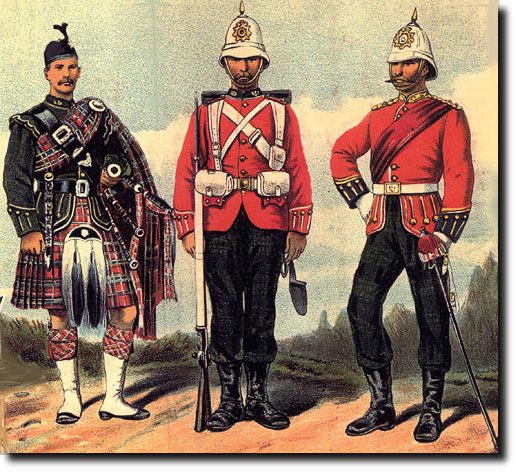
British army piper, private and office c 1890 source

When we think of Victorian fashions for men, apart from military uniforms, we often think of the formal and evening wear - tails and top hats. Dinner jackets or tuxedo's were worn in the evening, and tails only for formal evening events, and of course special race days, with a top hat. White shirts were worn with both, with black or bow ties, although they were again popular as day time accessories during the 90's.  The  Ascot tie was also worn, usually as a day accessory, made up as a neckband with wide wings attached and worn with a stick-pin, and a bowler hat and other soft felt hats or caps were worn during the day.

  
The Hon. Derek William George Keppel  Elegantly dressed Vanity Fair Illustration 1895
 and 
Mr Victor Cavendish, MP for Derbyshire West, wearing top hat. Vanity Fair Illustration 1895
Although frock coats and the cutaway morning coat was still worn for formal day occasions in Europe and major cities elsewhere, lounge (sack) jackets became popular for day time wear.  These were worn as a suit, either matching three piece affairs with a single breasted jacket, waistcoat and trousers, or with a contrasting waistcoat (vest). Fabric varied, and could be smooth and fine or rougher almost tweed. 

Morning coat and lounge suits c. 1895. source
Perhaps not a realistic cycling outfit of the time?

White Flannel Pants, blazer & Boater - pants rolled up a little at least! 
The blazer was worn for casual activities such as sailing or boating - cut in a similar style to the lounge coat, the fabric was either navy blue or brightly-colored or striped, often in wool flannel,  with patch pockets and brass buttons. These were often worn with light coloured flannel pants, or even shorts, with a straw boater or a cap.

Cycling in a blazer and cap c.1892 source

  
Mr Rudolf Chambers Lehmann, rowing coach,  In flannels and blazer and 

Mr Charles Pittman, rower, in white shorts and sweater.

Tweed jackets (Norfolk jacket) were fashionable to rugged outdoor and winter activities like hunting and shooting.  It featured paired box pleats over the chest and back for greater arm movement, with a fabric belt.  The matching trousers were often replaced with matching breeches (knickerbockers) to make it suitable for suitable for bicycling, and also golf, with knee-length stockings and low shoes, or for hunting with sturdy boots or shoes with leather gaiters
Sears Roebuck Catalogue 1897. source
"Tweed Ride" - 1896
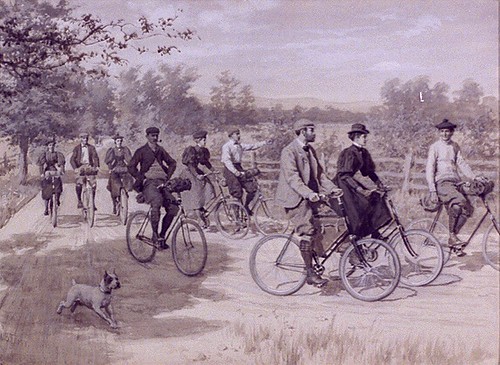
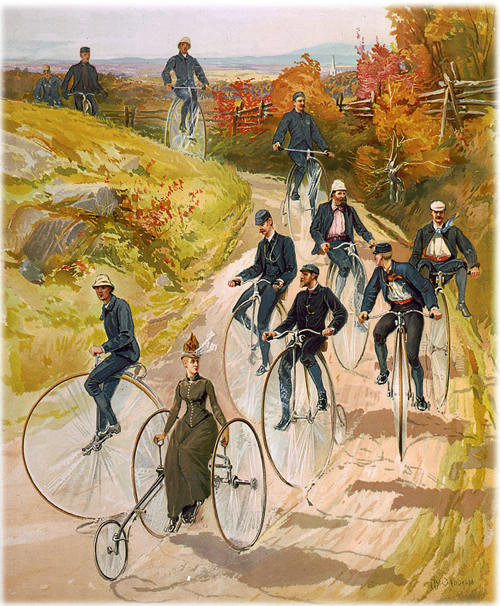
Tourists riding bicycles by A.B. Frost c.1896.

Thomas E. Kent for Bicycle Clothing 1896
Tweed and breeches or plus fours seem to be the most remembered clothing for gentlemen cyclists of this time, as shown by the recent 'tweed ride' or tweed run' phenomena of the last few years. Find out more about this recreation of past cycling tours here.

The poster from the first tweed run 2009
Caps & Breeches, cycling in Norway 1898 source

Cycling c. 1895 source
Many ordinary gents, or those riding to work where breeches would have not been worn, wore their day suits for cycling.  Some would tuck in one leg of there pants into their socks, to avoid it getting caught by the chain, and others would wear bicycle clips.  I can remember my father doing this.


Man and cycle, long trousers and felt cap, c.1895 source

Sear Roebuck Catalogue 1897
This gentleman looks like he did just sell his horse, don't you think!
man and cycle, long trousers, vest and Stetson c 1890s source
Although studio posed, this gent looks ready to go, with his pants tucked partially into his socks, and his tie tucked into his shirt.
Cyclist c .1890s source
French cyclists c 1895  source
There was also specialist sporting clothing for athletes such as swimmers, boxers and speed cyclists, but these were not generally worn by the ordinary man.
Cycling race, 1899 source
c 1890 source
French Olympic cyclists 1896 source
Where the military had influenced fashion, now the bicycle influenced the military.  Cycling squads were formed, and uniforms altered slightly to accommodate cycling soldiers. A look at those next time.


Deb xx

Tuesday, 23 October 2012

Bicycling 1890's Style for Ladies


Bicycling became almost a cult in the 1890s.  The development of the pneumatic tyre and the mass production of machines meant that cycling was now comfortable and affordable, and as Queen Victoria Herself had purchased tricycles for her daughters (Starley's), it also became acceptable.  As hundreds of young bicycle manufacturers competed for sales, prices dropped from over $100 to as low as $20 for a new cycle, making them in the reach of just about anyone.

True or not?!
The Pope Manufacturing Company in Hartford, Connecticut  had been making bicycles since 1878, and at the height of the bicycle craze in the 1890's, Pope was the city’s largest employer, with 4,000 workers producing 600 bicycles a day.  It is estimated that in 1897 between 1 1/2 and 2 million bicycles were manufactured n the US, and that by 1900 there were about 10 million bicycles in use (from a population of 75 million).
Ladies Cycle Club of Hartford, 1890. 

By 1896 the Raleigh Cycle Company in Nottingham, England was making 30,000 cycles a year in the largest factory in the world, and produced more cycles globally than any other company. I don't think this was considered normal bicycle riding attire, however!

1896 ad source 
The bicycle was considered the freedom machine.  People from all walks of life could afford not only to buy one, but to store it and learn to ride it - a bit different from horse riding. The bicycle was the instrument of social change in many ways, including allowing Victorian women mobility and independence.


"Let me tell you what I think about bicycling. It has done more to emancipate women than anything else in this world. It gives her a feeling of self-reliance and independence the moment she takes her seat; and away she goes, the picture of untrammelled womanhood. I stand and rejoice every time I see a woman on a wheel . . ."
-- Suffragette Susan B. Anthony in a Feb 2, 1896 speech, quoted in the New York World

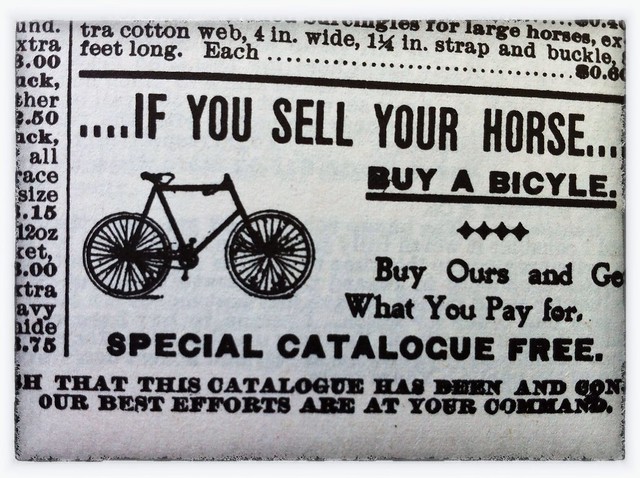
I love this ad from 1896 - finally a woman's word is taken seriously!

Trust a woman for buying the right thing (finally, we are being taken seriously!)


Although many women still wore their everyday dresses for cycling, special outfits did develop, and the  rational dress movement gained momentum, helping liberate women from corsets and ankle-length skirts. This Punch cartoon illustrates the point that many women enjoyed the freedom of the new fashion.
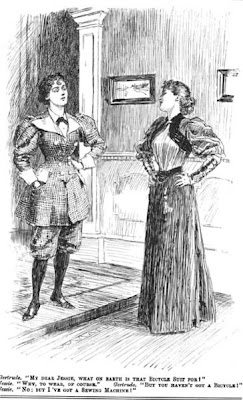
My Dear Jennie, what on earth is that bicycle suit for.  Why to wear of course.  But you haven't got a bicycle. No, but I've got a sewing machine!

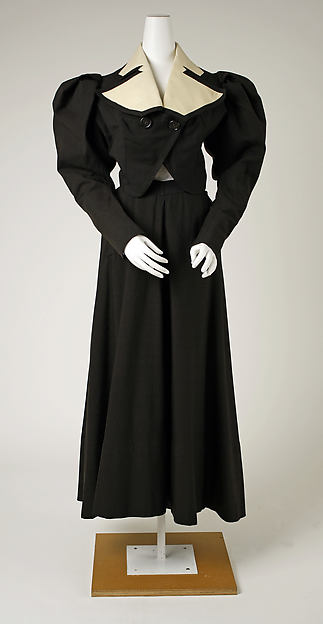
Some outfits kept the look of the longer dress or jacket, but hid bloomers underneath - much like the riding habits of the time. This one is French, circa 1895 (source). Stunning, don't you think?


Ensemble, Cycling  Ensemble, Cycling


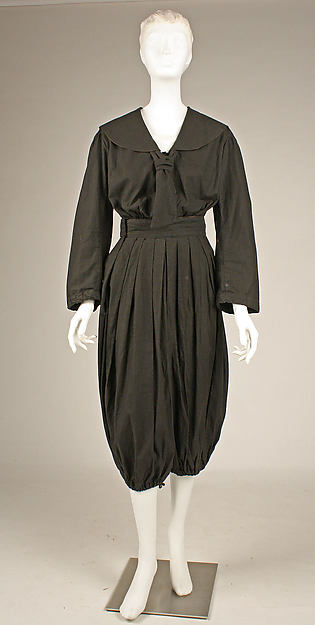
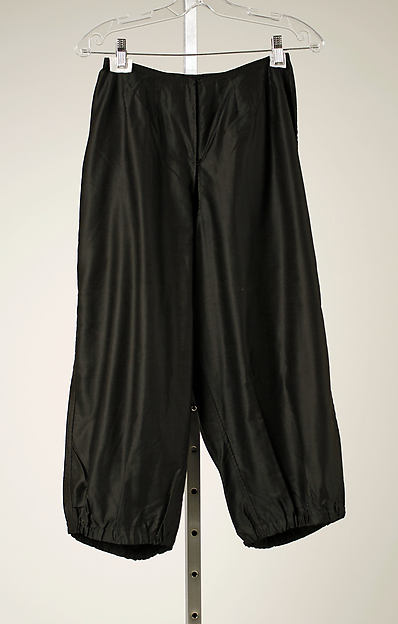
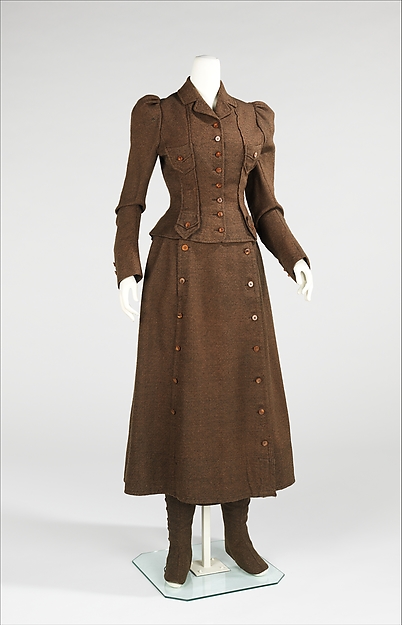
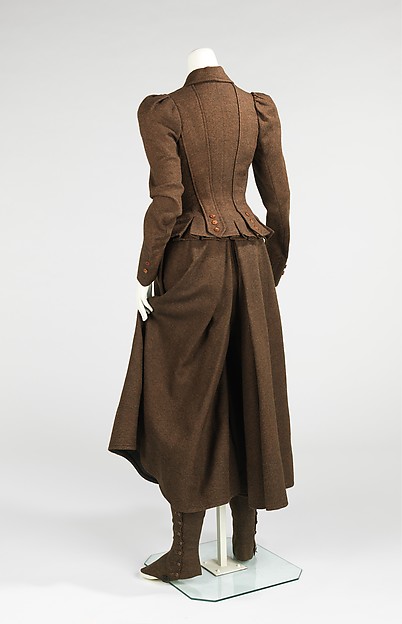
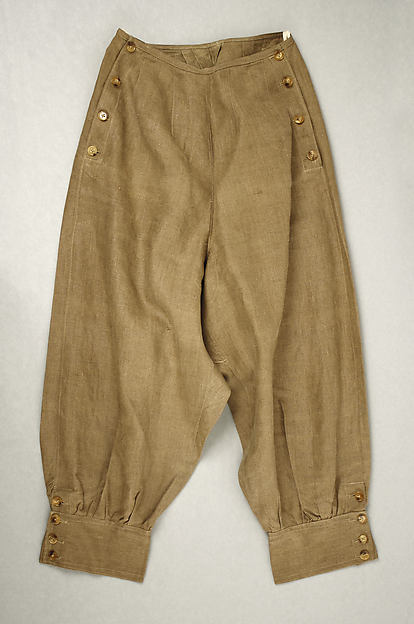
The other popular development in cycling fashion was the bifurcated skirt in about 1892, that was like pants at the back with the modest appearance of a skirt at front. This American suit of wool, linen, leather and silk also includes a pair of gaiters, which would provide protection for the legs. (source)

Suit, Cycling  Suit, Cycling
Bloomers and knickerbockers made bicycle riding even easier for women, but the style was still ridiculed by many as being unfeminine and unattractive. These outfits are from about 1895.  What do you think?
  

There was even music written about these intrepid women cyclists (source): 
Oh, the bicycle girl, when she gets on the road, Is bound neck or nothing to go!


  Web image of Box 061, Item 061.092, Page 000

Myself I love the calf length skirt, and I adore the hats!  So much nicer than today's regulation helmets.
Catalogue. c. 1897
In warm climates, like Australia, a blouse was often worn instead of the jacket, and a sensible straw hat for protection from the sum.
Lady cyclist, Brisbane, Australia c. 1895
An american version in linen -  source

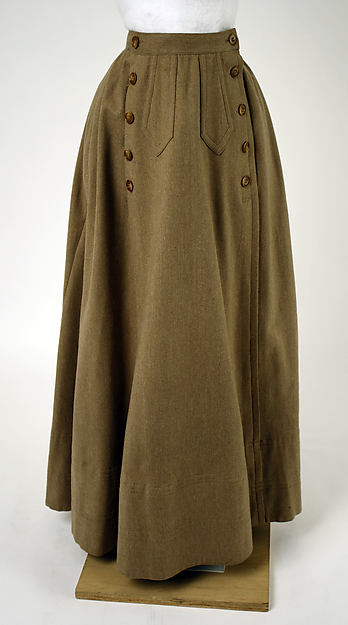
Separate skirts and bloomer continued into the 1900's, such as this wool and linen American pairing (source).


Ensemble, Cycling  Ensemble, Cycling
Although bloomers did also remain popular, and began to be manufactured by reputable companies, such as this suit (below left) by A.G. Spalding and Bros. from 1902.  It looks remarkably like the charcoal gym suit of a few years earlier by the Columbia Gymnasium Suit, Boston, Mass. (below centre source). 
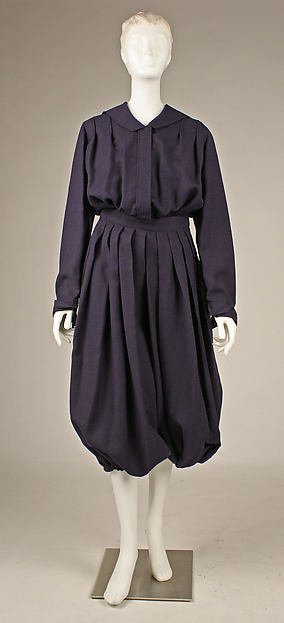
Suit, Cycling   Gym Suit  

In addition to the cycling outfit, the well-dressed woman also wore leggings or gaiters, a hat, doeskin gloves and perhaps gauntlets, and a pair of the broad, low, rubber-soled cycling shoes which had first come on the marker in 1891. A bicycle belt, from which hung a small leather purse, completed the outfit. 
Cycling Outfit 1895-1900
Manchester Galleries by kimberley
 cycling outfit c. 1895  source
Those undertaking a bicycling expedition (defined as any trip over an hour in length) were also recommended to outfit their bicycle with a lamp, and to pack matches, tools, a repair kit, sewing materials, and first-aid supplies (and baby?!).

Cycling in Sn Francisco 1890s  source

You'll notice that many of the costumes are sombre colours,  much like the riding habits that had been made by men's tailor's rather than seamstresses. Apparently the stylish women would dress to match her male companion, so grey, brown, dark green, or navy were the most popular colors.

What ever we may think about bloomers, cycling and bicycles really did change the face of fashion - and not just for women.  Men's cycling fashions are next!
Deb xx
Wednesday, 17 October 2012

Ladies Bicycling Outfits of the 1870s and 80s

By the mid 1870's, as well as riding horses, ladies were able to ride bicycles.
Lady cyclists c. 1890
Although the penny farthing had been introduced in the late 1860s, the velocipede in the 1830s, and the tricycle around one hundred years earlier, it was the introduction of the 'safety bicycle', designed by English engineer Harry (or Henry) John Lawson in 1876, that spurred the popularity of cycling. (Not the same Henry Lawson as the Australian poet, by the way, who was born in 1867).  Lawson's bicycle had peddles that were nearer to the ground, making it much easier to stop, and one would think also easier to start and stay on.


velocipedes_newton_wilson


At around the same time another English inventor, John Kemp Starley moved to Coventry to work with his uncle, the inventor James Starley and foreman of the Coventry Sewing Machine Company.  Founded in 1863, the company was finding it difficult to expand (thanks no doubt to Singer)  and decided to diversify into cycles.  Although Frenchman Eugene Meyer had invented the classic High-Bicycle (Penny Farthing) design and fashioned the wire-spoke tension wheel in 1869, James Starley was the one who added the tangent spokes and the mounting step in his model, the “Ariel” High Wheeler.  It was named after the Ariel works in Coventry, and was the first cycle to have solid rubber tyres.  James Starley also patented the first ladies bicycle, in 1874, which was ridden side saddle with one peddle.


The Ferret, March 22, 1870 with Ariel Cycle

Starley's Nephew John, with  friend William Sutton, started to develop safer and easier to use bicycles and also produced tricycles. From 1881 to 1886 in Great Britain, more tricycles were built than bicycles - they were more expensive but were perceived as more genteel, as ladies dresses could be shown off nicely  and the upper classes had the disposable income to buy them for the women (and children) in the family. 


Many ladies wore their everyday dresses for cycling. Lady cyclists on 'bone-shakers', as the early bicycles were known due to the unforgiving metal wheels, were among the first women to wear pants, or Bloomers.  The baggy legged pantaloons were based on oriental designs and were popularised by Mrs Amelia Bloomer in America who had been preaching the virtues of such dress since 1851.  Interestingly these outfits were not used for horse riding at the time. 

lever_drive_tricycle   


In 1883 Starley's products were being branded as Rover, and in 1885 they introduced the Rover Safety Bicycle (the company also introduced the Rover car, in 1904). This was basically the modern bicycle we know today -  a rear-wheel-drive, chain-driven cycle with two similar-sized wheels. 

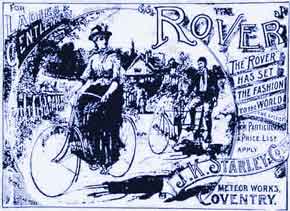
Ad for Rover Safety Cycle c. 1880


File:Ladies safety bicycles1889.gif
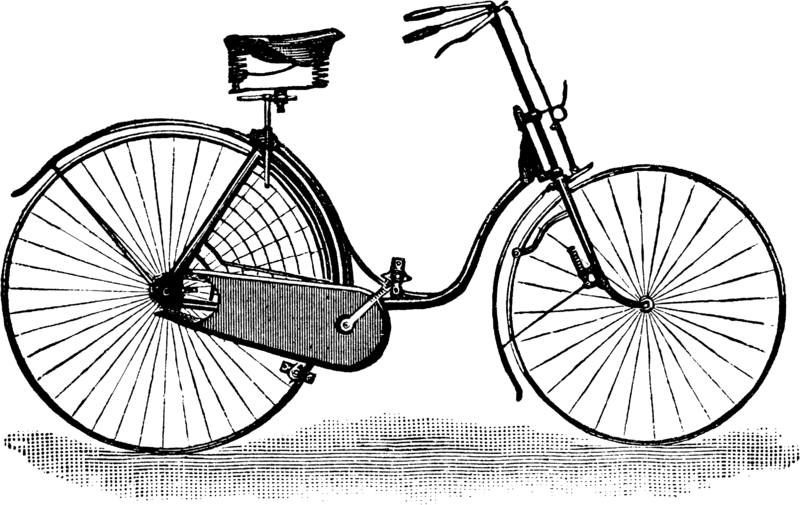
ladies Bicycle c.1880
Bloomers could still get caught in the chain, but soon a specific ladies safety bicycle was also developed, with a skirt (or bloomer) guard, which made things a little easier.

Woman posed with her bicycle. 1885


Bloomers were considered immoral by some, and caused major arguments in families, as well as arrests -  under an ordinance against “indecent apparel.” Skirts were much preferred for ladies, and many continued to wear normal walking dresses, although men were permitted to wear special cycling bloomers. 

Dress reform of the 19th century!
In in 1888 Belfast vet, John Dunlop, invented the pneumatic tyre, which made cycling a lot more comfortable. Don't you love the red tyres with the red oufit?!

Bicycle Catalogue 1890s source
More on the 1890's cycling craze and resultant fashions next time.

For more information and photos on Vintage Bicycles, go to Old Bike .com

Deb