Showing posts with label science. Show all posts

Tuesday, 12 February 2013

Early Radio & Vintage Crystal Sets


Despite having learnt at school that Marconi invented the radio, and wireless technology, I now know that is not correct.  Marconi was just the guy who managed to get someone to listen to his ideas, and give him financial backing.  Not to say he wasn't a genius, but there were a whole host of people who contributed to wireless technology, as I mentioned in my last post, not in the least Nikolas Tesla. But there are other contenders.

In 1997, The Institute of Electrical and Electronics Engineers (IEEE) , in New York, named Jagadish Chandra Bose (30 November 1858 – 23 November 1937), Professor of Physics at Presidents College in Bengal, one of ‘the fathers of radio science’.  He had transmitted and received a radio signal 2 years before Marconi, and some believe that  connections of Marconi's wealthy family stole Bose's design.  Bose was the first to use a semiconductor junction to detect radio waves, and he invented various now commonplace microwave components, as well as studying microwave activity in plants. Bose was not interested in patenting his inventions, and made his processes public at a presentation in 1899 at the Royal Institution, London.

J.C.Bose
Jagadish Chandra Bose in London, c 1899 source

Anyway, radio was invented. But it took someone else to work out how to transmit voices and music through radio waves.  That someone was, most agree, was Reginald Aubrey Fessenden (October 6, 1866 – July 22, 1932), a Canadian inventor and former employee of Thomas Edison.   Fessenden began  experimenting with wireless technology in the 1890s, after reading about Marconi and Lodge, and thought that  he could develop a far more efficient system.  In 1900 he went to work for the US Weather Bureau, wanting to develop coastal radio stations to transmit weather information to ships. He made great advances, and in December 1900 while experimenting with a high-frequency spark transmitter, successfully transmitted speech on over a distance of about 1.6 km (1 mile), although the sound quality was very distorted.
After a disagreement with the Weather Bureau, Fessenden left in 1902.  He soon found some financial backers, and decided to try to establish a transatlantic radiotelegraph service.  In January 1906, using his rotary-spark transmitters, Fessenden made the first successful two-way transatlantic transmission, exchanging Morse code messages between a station constructed at Brant Rock and one built in Scotland (Marconi had only achieved one-way transmissions at this time.)  Work was suspended due to weather, and then the  radio tower n Scotland collapsed, ending the service before it began.

reginald-fessenden-in-an-undated-photo_original

On Christmas Eve 1906, Fessenden sent out a short program from Brant Rock.  He used a transmitter consisting of a special high-frequency alternator, designed by Swedish engineer, Ernst Alexanderson, to generate continuous, unvarying frequency of 100,000 hertz ,for continuous wave radio.  Fessenden used a microphone to vary the radio waves to correspond with the sound waves from his voice and other music.  His programme included a phonograph record of Handel’s Largo, followed by Fessenden himself playing Holy Night on the violin and then reading a passage from the Bible.  The broadcast was heard several hundred miles away, however there was some accompanying static, due to irregularities in the spark gap transmitter he used.

ReginaldFessendensLab_lrg
Fessenden's lab in Brant Rock – alternator at right, Multiple Arc Apparatus at left. source


Fessenden broadcast a second short program on New Years eve, which he claimed was heard as far as the Caribbean.  Although now seen as a landmark, these two broadcasts were barely noticed at the time, although the New York Times did run an article about the events almost a year later.
Fessenden's broadcast foreshadowed of the future of radio, although his technical achievements at that time were not matched by financial success.  Fessenden was dismissed by his backer, NESCO, but  Alexanderson, who had designed the alternator for Fessenden, continued to work on alternator-transmitter development at General Electric, mostly for long range radiotelegraph use.  By 1916  the high-powered Alexanderson alternator was capable of transmitting across the Atlantic.

Alexanderson_Alternator
Alexanderson Alternator in the Grimeton VLF transmitter.


NESCO, who went into receivership for five years in 1912, the same year as vacuum-tube transmitters were invented.   While vacuum tubes and fancier electronics are newer developments in radio, the physical principles are the same, and the AM radio we use today is essentially what Fessenden invented in 1906. The modern cell phone also owes much to Fessenden -- the difference between it and his wireless technology is that the continuous waves are now altered using frequency instead of amplitude modulation.
For the ordinary public, the first widely used type of radio receiver, were Crystal sets. The rectifying property of crystals was discovered in 1874 by Karl Ferdinand Braun, and crystal detectors were developed and applied to radio receivers in 1904 by Bose,  G. W. Pickard, Dunwoody and others. Basically they found that crystals of certain materials, including silicon, lead sulphite, and silicon carbide, could ‘detect’ radio waves, allowing current to pass in only one direction, the weak signal had to be heard in headphones.  A thin wire connected the crystal to the electrical circuit, known as ‘cats whiskers’, which gave the crystal sets their other nickname.  

girls
Jean and Myrtle Cheers listening to a crystal set radio in their backyard, Brunswick, Christmas 1923. The set was made by their brother Ronald Cheers, when he was 20. source


Crystal radios are the simplest type of radio receiver  and can be handmade with a few inexpensive parts, like an antenna wire, tuning coil of copper wire and a crystal detector .  They were sold and homemade by the millions, leading to the development of radio as an entertainment medium in the 1920s, when the BBC in London began broadcasting news, weather and musical programmes in 1922, and Australian radio stations began in 1923.  Radio was advertised as a community and family activity.    
Crystal_radio_advertisement
1922 advertisement for Freed-Eisemann radios and a crystal set.
Soon of course, the vacuum tubes were used in radios for the public, and the popularity of crystal radios diminished.  Radio listening was still a community and family affair however.  A community radio listening facility was built in Sydney, for those unable to afford their own radio, and ads still used the family to sell radios.

July 1932 - Better Homes and Gardens Magazine

I was hoping to build a crystal radio set with my son this year, but due to the phase out of analogue radio  across Australia, crystal sets will become obsolete (the kits unable to buy already).  My old Radiola now plays only one station too. It’s a shame that this low cost, easy to make yourself technology will be unavailable to the next generation.  Maybe we’ll build a robot instead.

Deb xx


Sunday, 10 February 2013

Wireless telegraphy circa 1913

 
In standard telegraphy,  a complete circuit (two wires) was used.  The first step towards wireless electrical telegraphy was discovered back in 1838, whereby if instead of two wires only one was used, and the other replaced by an earth connection,the effect could be equal to or better than what it was with the metallic circuit.

The second step was, of course, to get rid of the other wire. 

1922hugh

Many scientists made contributions to the practical aspects of wireless technology. Scottish theoretical physicist James Clerk Maxwell predicted the possibility of generating electromagnetic waves that would travel at the speed of light in the 1860s , formulating a classical electromagnetic theory  uniting all previously unrelated observations, experiments, and equations of electricity, magnetism, and optics . (he also made first durable colour photo in 1861).  Twenty years later German physicist Heinrich Hertz demonstrated this when he generated sparks between two metal balls and later experimenters managed to increase the distance across which waves could be transmitted.

In 1879 David Edward Hughes discovered that sparks would generate a radio signal that could be detected by listening to a telephone receiver connected to his new microphone design, and developed his spark-gap transmitter and receiver that could send and receive Morse code signals out to a range limited to 500 yards.  His work was dismissed as induction by some peers (but recognised in 1922 when his devices were recovered 20 years after his death). In 1894 British scientists, Oliver Lodge and Alexander Muirhead , sent Morse-code signals over a distance of half a mile.

David-Edward-Hughes-1831-1900-ve-icadi
David Edward Hughes (1831-1900) and his Telegraph table, source


In 1895 Russian physicist, Aleksandr Stepanovich Popov, built a receiver to detect electromagnetism in the atmosphere. He predicted that it might be used to pick up generated signals, and demonstrated sending and receiving messages between different points the following year.
CPA_6117
Radio pioneer Alexander Popov on the 1989 USSR stamp source


In 1898, Nikolas Tesla demonstrated a radio-controlled boat – something he had been working on since 1892.   Tesla changed the boat's direction, with manually operated controls on the command post.  Since this was the first application of radio waves, it made front page news, in America, at that time.  Tesla tried to sell his idea to the U.S. military as a type of radio-controlled torpedo, but they showed little interest,and remote radio control remained a novelty until after WWI.
 Tesla_boat   Tesla_boat1
Tesla’s radio controlled boat, source

Once 20 year old Italian Guglielmo Marconi took several previous inventions and discoveries and brought them together to produce radio in about 1895, it was a short step to produce electric wave telegraphy for communication.  With wireless technology it was possible to contact ships at sea, something which hadn’t been possible previously, so wireless telegraphy was a sure to be a hit. 

Marconi beat everyone to the finish line, applying for a patent and gaining backing in London in 1896.  Marconi founded the The Wireless Telegraph & Signal Company in 1897, and won the support of the Engineer in Chief of the Post office, William Preece,  demonstrating sending Morse signals between two post office buildings.  At first the distance was only 300 yards, but he extended that to 4 miles on Salisbury plains, and then sent messages across the English Chanel in 1899 using large transmitter masts.

Marconi’s first two commercial customers were Lloyd’s of London, who installed radio in a lighthouse off the Irish coast to report the passage of transatlantic ships and the East Goodwin lightship in the English Channel so it could keep in contact with land.  At this stage messages were still in code, but he also managed to transmit the first radio news in 1898 – regatta racing results.  In 1900, Tesla was granted patents for a "system of transmitting electrical energy" and "an electrical transmitter", and when  Marconi made his first transatlantic radio transmission in 1901, Tesla quipped that it was done with 17 Tesla patents. This was the beginning of years of patent battles over radio with Tesla's patents being upheld in 1903, followed by a reverse decision in favour of Marconi in 1904.
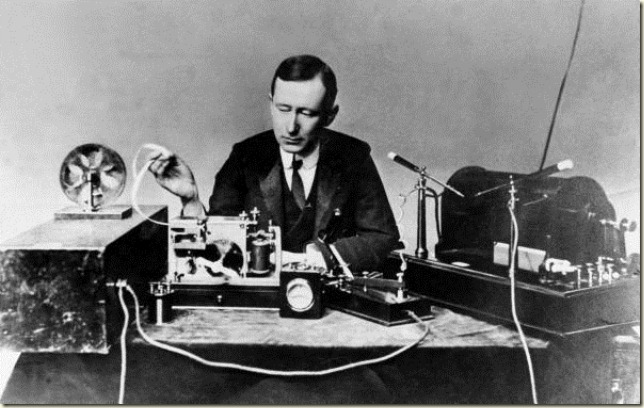
Guglielmo_Marconi_1901_wireless_signal
Marconi operating apparatus similar to that used by him to transmit first wireless signal across Atlantic, 1901 source


In 1899 the United States Army established wireless communications with a lightship off Fire Island, New York. Two years later the Navy adopted a wireless system. Up to then, the Navy had been using visual signalling and homing pigeons for communication.
In 1900 Marconi introduced wave tuning, specific wavelengths which radios today still use to send and receive, which meant that more than one transmitter could be used at a time, and also increase the distance the messages could travel.  Oliver Lodge had actually filed for a British patent on his radio tuner in 1898, the same year he applied for a patent for an improved loudspeaker .
oliver-lodge
Oliver Lodge, with loudspeaker, c. 1913 source


In 1901, radiotelegraph service was instituted between five Hawaiian Islands.  By 1903, a Marconi station located in Wellfleet, Massachusetts, carried an exchange or greetings between President Theodore Roosevelt and King Edward VII, and by then about 50 merchant ships were using wireless telegraph,with 25 shore stations.  The Royal Navy also embraced the technology, which enabled at least 80 naval ships to stay in constant contact with the admiralty – something to affect naval battles during WWI.  In 1905 the naval battle of Port Arthur in the Russo-Japanese war was reported by wireless, and in 1906 the US Weather Bureau experimented with radiotelegraphy to speed notice of weather conditions.

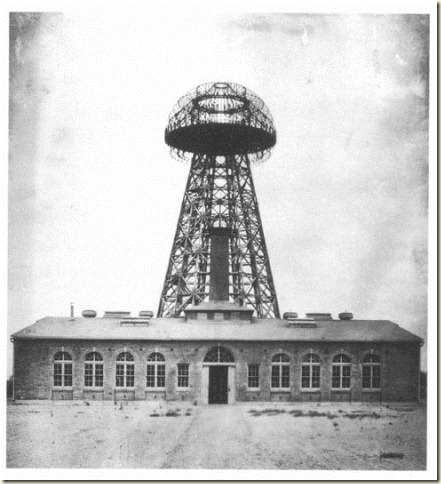
Marconi was also busy.   At the Wardenclyffe plant on Long Island he hoped to demonstrate wireless transmission of electrical energy across the Atlantic, but Marconi ‘s demonstration in 1901 beat him, and Tesla lost his funding.
Tesla_Broadcast_Tower_1904
Tesla's Wardenclyffe plant on Long Island in 1904.


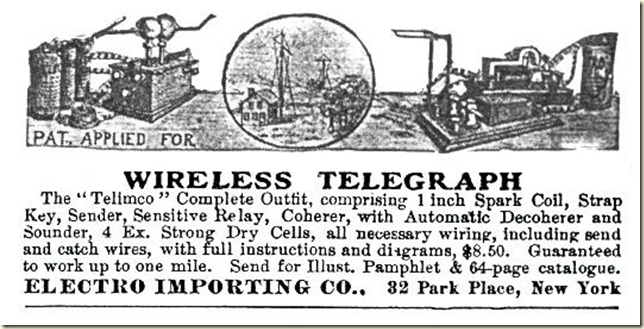
From 1904 when he immigrated to the United States from Luxembourg Hugo Gernsbacher established a radio and electrical supply house called Electro Importing Company and developed a small portable radio transmitter called the Telimco Wireless Telegraph.    He went on to patent 80 inventions. 
telimo wireless telegraph
In 1907 Marconi set up a cheap wireless telegraph service between New York and London, using stations in Ireland and Canada.  In 1909 he shared the Nobel Prize in Physics with Karl Ferdinand Braun "in recognition of their contributions to the development of wireless telegraphy."
Australia also adopted wireless telegraphy for communications at sea and in lighthouses, and wireless telegraphy gradually replaced the Overland Telegraph (completed 1872) allowing faster communication in remote locations.  Even before Marconi transmitted across the Atlantic,  spark transmitter experiments with radio telegraphy had taken place with 12” and 14” coils, in Australia from the mid 1890s.   In 1902, there was a successful contact from Hobart, Tasmania, with the HMS St. George, which was one of the first ships accompanying the Duke of York (later King George 5th) on his visit to Australia to open the first Federal Parliament in Melbourne.
hms_st_george
HMS St George, c. 1902, with telegraph towers, source


The technology quickly came under the control of the newly formed Federal Government through the Wireless Telegraphy Act of 1905.  In the same year Marconi’s company built Australia's first two-way wireless telegraphy station at Queenscliff in Victoria, followed by one in Devonport, Tasmania.  On the opening day for both stations,  July 12 1906, telegraph messages were exchanged between the Australian Prime Minister,   Australian State Governors, and other dignitaries, over the 150 km of water across Bass Strait.

In 1910, the first temporary ship-to-shore station opened in Australia, in Sydney, with the call-sign ATY.  Permanent stations opened in Melbourne (VIM, at the Domain site near Melbourne’s CBD), Perth (VIP), Sydney (VIS), Hobart (VIH), and Brisbane (VIB) in 1912  and in 1913 many other stations started up for ship-to-shore services.  By 1913 there were 19 radio telegraph stations operating from Australia for ships at sea.
1907domainmast
1912 - the Domain mast (recolored) source
In October 1911 Mawson purchased from the Australian Wireless Company, on a buy back agreement, two 2-kilowatt long-wave Telefunken wireless sets, costing £650 each (over $65,000 in today’s dollars).  He had decided that the cost was worth it to set up a wireless-telegraph relay station at Macquarie Island to ensure uninterrupted communication between his Australian base at Hobart and his two bases on the Antarctic coast.  This way he was able to take some  uncertainty out of Antarctic exploration and be able to announce his successes and difficulties as they occurred.  Unfortunately sometimes static prevented successful communication.
hut
Hannam and the wireless instruments at Cape Denison during the Mawson expedition.


Although the sinking of the Titanic in 1912 was a terrible disaster, the loss of life may have been total were it not for the ship’s radio operator alerting nearby ships.   Unfortunately other radio operators were not on duty, and so the message was delayed getting through – after 1912 all liners had to have a 24 hour radio watch.

In 1913, Marconi amalgamated with its main competitor, Telefunken, to form Amalgamated Wireless (Australasia) Ltd. (AWA).

rep Tesla-_620x0

During the WWI wireless telegraphy was widely used by wartime ground forces, and most private experiments in wireless technology were stopped for the duration.  Many naval ships were fitted with radios, although when they were used, it did make it easier for enemy submarines to discover where they were, and reconnaissance aircraft that carried wireless sets could also communicate the position of enemy ships and artillery.

In 1943, the 1904 U.S. version of Marconi’s patent,  US patent No. 763,772, was found to be invalid in a US  Supreme Court decision. There are some that claim this decision affirmed Nikolai Tesla as the inventor of radio  and others who claims the high court was trying to nullify a WWI claim against the U.S. government by the Marconi Company by restoring Tesla's prior patent.  What do you  think? I don’t know, I am just happy we have radio!  More on radio and 1913 technology next time.

Deb xx


Wednesday, 16 January 2013

15 January 1913 - Royal Geographical Society

sign
source
 The Royal Geographical Society is a British society founded in 1830 by the learned gentlemen of London mainly as a debating and dining society.  It also aimed to promote geographic awareness and to work out ways of exploring a world that was still largely a mystery.  The Society began as the Geographical Society, but was awarded a Royal Charter in 1859.   In it’s  earlier years the society was concerned mainly with  ‘colonial’ exploration in Africa, the Indian subcontinent, the polar regions, and central Asia , with famous names such as Livingstone, Stanley, Scott, Shackleton, Hunt and Hillary.
map room
The Royal Geographical Society map room in 1912.

On this day in 1913 the members  voted overwhelmingly to admit women, after 82 years as an all-male organization.  However, the society did occasionally let women in before 1913.  In 1882 Isabella Lucy Bird (1831–1904), arguably the greatest Victorian lady traveller, was inducted as the first woman Fellow of the Royal Geographic Society.  While the British Empire swept across continents, Bird migrated to far-flung places, many of which barely register on a traveller’s radar even today.  She documented her journeys in detailed books with matter-of-fact titles such as Six Months in the Sandwich Islands (1875), A Lady’s Life in the Rocky Mountains(1879), Unbeaten Tracks in Japan (1880), and Korea and Her Neighbors(1898).

Archive_NOV12
A Mantzu family, Sichuan, China, 1895, by Isabella (Bird) Bishop

Another fellow was  Mary Kingsley (1862-1900), a British explorer who made two pioneering trips to West and Central Africa and was the first European to enter remote parts of Gabon.
kingsley.191143401
Mary Kingsley source

The Royal Research Ship Discovery was commissioned by the Royal Geographical Society in 1900 and built by the Dundee Ship Building Company. Discovery was the first ship built in Britain for scientific research and one of the last wooden three masted sailing ships to be constructed. It was launched on 21 March 1901 at a cost of £44,322.

Antartic
Discovery
In 1933, the Institute of British Geographers was formed by some Society fellows, as a sister body to the Society.  They merged in January 1995 to create the new Royal Geographical Society (with the Institute of British Geographers), and today has 15,000 members, aiming to advance geography through supporting geographical research, education and outdoor learning, public engagement and policy. You can read more about the society here.

Happy exploring,

Deb xxx