Showing posts with label steampunk. Show all posts

Wednesday, 13 February 2013

Vintage Technology & Kitchen Inspiration


I have been looking a lot at vintage technology lately, and I mean a LOT (see my previous posts if you haven't already).   Materials used 100 years ago for building telegraph receivers radios and telephones are what I love today – timber, brass, copper – traditional, long lasting and beautiful.

At present I have very little brass and copper in my home – these days stainless steel and aluminium seem to have taken over, especially in the kitchen – but I would love more traditional materials, and a look that is rustic and comforting, rather than modern look or a clean, sanitized reproduction of the old.  Maybe in my next home! 

Meanwhile, here is some inspiration to go on with…..sources are at the end.

      brass  pot rack
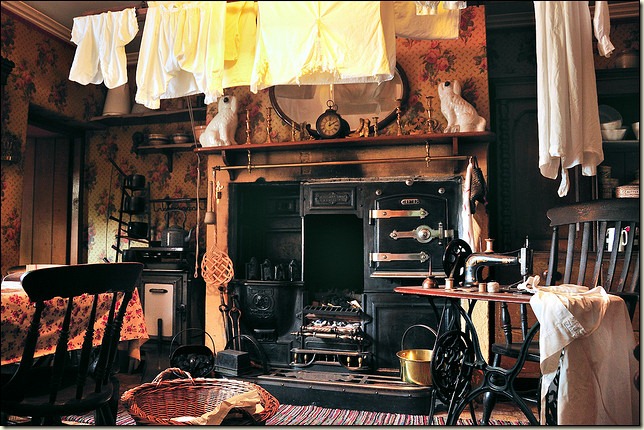
VictorianKitchenUK
french-industrial.01  grinder
1913kit
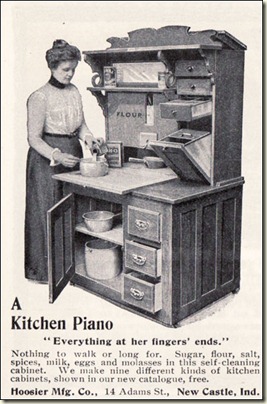
piano   hoosier
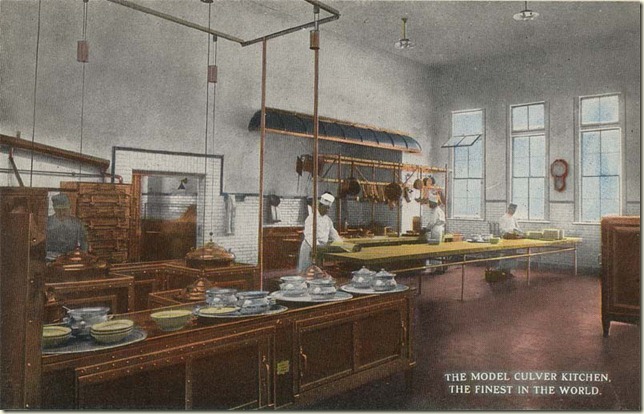
culver_kitchen_1913_cma_postcard
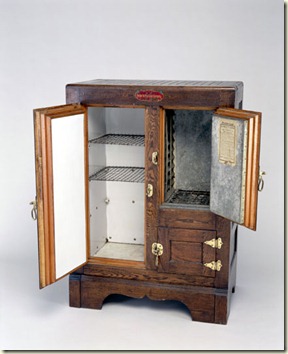
10240844  2457_medium
scales
Sources:
JH Blog – brass bucket sink
1900 Farmhouse – pot rack
Ask Home Design
New Collector – French farmhouse light
Ruby Lane – coffee grinder
Flicker – Kitchen at Beamish
Antique homestyle – Kitchen piano
Hoosier Kitchen Cabinets 1900 to 1930
Culver History – Mess Kitchen c. 1913
UK Science Museum - Dry-air syphon refrigerator c. 1900
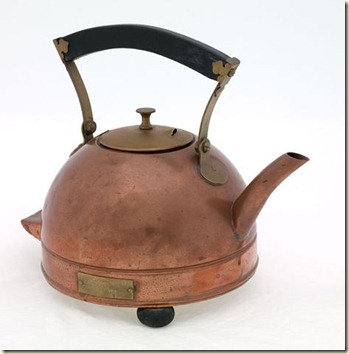
Museum Vic – copper kettle
Etsy – scales c. 1906

If you find a copper fridge, please let me know!


Deb xx

Friday, 8 February 2013

Tiffany's & the First Trans-Ocean Telegraph Cables

 
map[3]
Map showing the position of the cable from London to New York


In 1842, Morse had submerged a telegraph wire insulated with tarred hemp and India rubber, in the water of New York Harbour, and telegraphed through it, and the idea of a submarine line across the Atlantic Ocean began to be thought of as possible.

In the 1850's, a letter from London took 12 days to reach New York in the United States; 13 days to Alexandria in Egypt; 19 days to Constantinople in Ottoman Turkey; 33 days to Bombay in India; 44 days to Calcutta in Bengal; 45 days to Singapore; 57 days to Shanghai in China; and 73 days to Sydney in Australia. You can see we were a little behind the times in Australia!  So not only did we install telegraph line across the continent, but we wanted to link ourselves to the world by means of undersea cable.

Cyrus Field (1819-1892), in association with Peter Cooper and others, formed a company around 1854 to build a telegraph cable between Newfoundland and Ireland.  No one shop was large enough to hold all the cable needed, so The United States provided the U.S.N.S. Niagara and Great Britain the H.M.S. Agamemnon and loaded two ships with equal amounts of cable. They began their mission at a point midway between the continents, and sailed to the opposite shores. 


Over a core of seven copper wires over which messages travelled, there were three layers of a natural insulator called gutta percha. Yarn and stranded steel wire formed the outer layer.

On July 29, 1858, after four costly failures, the two ships returned to mid-ocean and spliced the lines together  for the last time. The Agamemnon sailed for Ireland and the Niagara was destined for Newfoundland, and on  August 5, 1858, each ship reached its destination.

On August 28, 1858 Frank Leslie's Illustrated Newspaper reported:
Complete Success of the Atlantic Cable
The telegraph cable is a complete triumph. Messages are passing over its wires quite freely, and there is no doubt a short time will enable our electricians to increase the velocity of transmissions so as to bring it up to those already in use. It is needless to remind the public how few had faith in such a wonderful achievement a month ago.

ship[4]
Machinery on the U.S.S. Niagara, provided for the second attempt to lay the Inter-Oceanic cable

The London Times referred to Field as “The Columbus of our time, who, after no less than forty voyages across the Atlantic in pursuit of the great aim of his life, had at length by his cable moored the New World close alongside the old.” 

The Great Exposition in Paris in 1867 Emperor Napoleon awarded a grand prize to Mr. Field and the Anglo-American and Atlantic Telegraph Companies. (Professor Hughes, of Kentucky, was also awarded a grand prize for his printing telegraph).

Sadly, the first cable didn't last long. After three weeks, it stopped working - the telegraph operators in their zest to communicate decided the answer to a weak signal was to use more power, so they fried the cable. By the time they laid the more permanent telegraph lines in the 1860s, operators had learned their lesson. The cable laying process also developed, and new machinery was invented to help the cable laying process.

machinery[3]
Machinery used for paying out the electric telegraph cable on board of the Niagara and Agamemnon.source


Contemporary interest in the submarine cable was huge. Field, ever the entrepreneur, entered into a deal with Tiffany & Company of New York, who purchased twenty miles of cable that had actually been submerged and retrieved from the bottom of the ocean. They cut it into 4-inch sections, each banded at the ends with brass ferrules and had a brass plaque that read “ATLANTIC TELEGRAPH CABLE/GUARANTEED BY/TIFFANY & CO./ BROADWAY • NEW YORK • 1858.”


cable2  

The cable souvenirs originally sold for 50 cents and came with a reproduced letter of authenticity from Field himself. There were also other souvenirs such as “paper-weights, cane, umbrella, and whip handles, bracelets, and watch-charms. 

Here's the Tiffany's ad for the cable:

1858TiffanyAd[1]

When the trans-Atlantic cable failed, sales of cable pieces stopped.  The remaining unsold pieces of cable were stored and forgotten. The New-York Historical Society has in its collection 930 pieces of Tiffany cable, still packed in the original crates for wholesale distribution.

Sections of the Atlantic telegraph cable (930) in original packing crates (8), source

Australia's overseas telegraph service was partly connected in the late 1860s, from London to Galle in Ceylon, where messages were taken by mail-boat to Adelaide in South Australia.  After the Overland Telegraph Line from Adelaide to Darwin was installed in 1872, a link to Bombay via Singapore and China was made, when the Eastern Extension, China and Australasia Telegraph Company (the Extension) was formed, a sister to the huge Eastern Telegraph Company, formed at the request of the British government by the amalgamation of four separate companies.

1901_Eastern_Telegraph_cables
Eastern Telegraph Company network in 1901 source

In 1876 the first Australia to New Zealand telegraph link was opened, and then one from Broome to Batavia (Jakarta) in 1889.Brisbane was linked to New Caledonia in 1891.   A further international link from Perth to the Cocos-Keeling Islands was installed in 1901, and in 1902 a telegraph cable across the Pacific between Canada and Australia (landing at Brisbane) via Fiji, New Zealand and Norfolk Island was completed. Another trans-pacific cable  linked the US mainland to Hawaii in 1902 and Guam to the Philippines in 1903.


Saturday, 27 October 2012

Victorian Nostaglia & Steampunk

I have come to a realisation.

I love Steampunk.

What is "Steampunk?" you may ask.

Basically Steampunk is Victorian science-fiction-fantasy, or the past that never was.  Old done in a new way or vice-versa - Victorian outfits with a modern twist, or mobile phones made of leather and brass. Steampunk takes it's name from the time of Steam power, and the punk genre of being different and questioning everything. Why do we have to have boring clothes made in China or plastic everything and sameness?  Why can't we have beauty and fun, traditional materials like leather, timber, brass and copper, items that can be tinkered with and not just thrown away when broken or uncool.  With Steampunk, you have the best things of the Victorian era, without the hardships, racism, sexism and child labour. It's Victorian nostalgia in a way - looking at the past through rose coloured glasses.
.
Put these on baby!

If you love vintage, you're part steampunk already.  I have been Seampunk for years and just never knew it had a name.  My first house (twenty years ago now) was built in 1910, with high ceilings and  lots of timber and we renovated it with brass light fittings and fans, and had brown velvet sofas and Persian rugs.  I so miss it, but hoped in Queensland I would have an old timber Queenslander - I am still waiting. One day I may have something like this!

Brooklyn House, Fraser Coast QLDc. 1890  source
Probably not, but while I am waiting I shall continue to research the Victorian and Edwardian eras, and Steampunk.  As well as this blog I have started a tumblr page, which explores Steampunk in all it's forms, with photos and quotes.  It's called Brass Butterflies and the link is in the side bar.

As well as being a little bit 'Steamy' in my daily life, I am working on some costume ideas for a Steamfest next August in Ipswich, Queensland, so I'll jot about then too.  Any input is welcome!  And if you are in Queensland next August, think about attending.........


Go to the website for more information.

Farewell for now, tumblr awaits.

Deb xx

Friday, 14 September 2012

Mackay 1862


Earlier this year I was fascinated by 1942, a time 70 years ago when the world was at war.  Now it is the Victorian era that is stirring my fancy, maybe because of my new interest in Steampunk. According to Wikipedia, the Victorian era of British history was the period of Queen Victoria's reign from 20 June 1837 until her death on 22 January 1901, although the Victorian Era style of clothing is seen to continue until about 1912.
In Steampunk it is British Victorian history and fashion that is paramount, with twists from US military costume (the civil war was going on of course), the wild west and world explorers etc.  Steampunk is not huge in Australia, but I thought I might go back and have a look at some Australian history and fashion during this time,and I thought it would be nice to start around 150 years ago, in 1862, which coincidentally is the year the town of Mackay, where I know live, was founded.
Mackay is on the coast of central Queensland, about midway between Rockhampton and Townsville and 820 km north of Brisbane. It now has a population of about 85,000. 

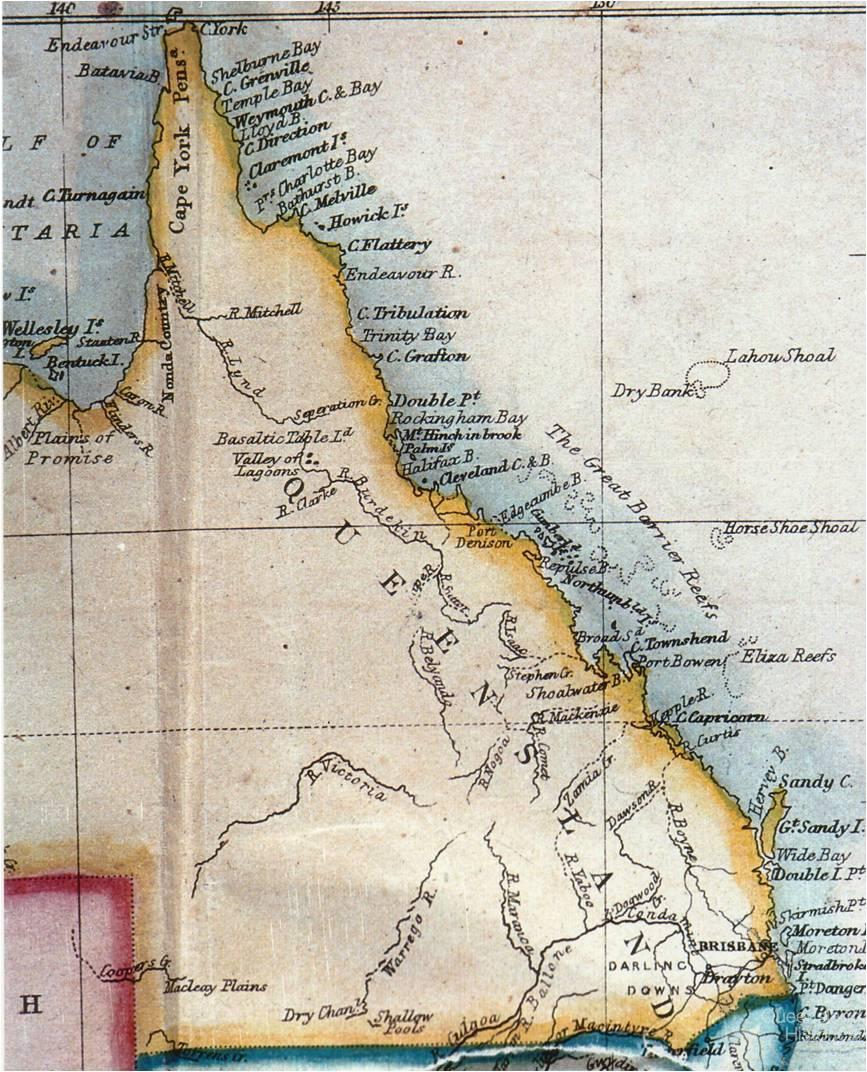
Map of Queensland in 1861 - neither Mackay or the 'Pioneer River is on it, but it  is the area just south of Port Dennison (now Bowen)
 I don't know much about the history of Mackay, having grown up in Melbourne, Victoria and studied history from a Victorian (Australian) viewpoint, and only having been here for ten years, but I am to find out more.  Let's start with the basics:
Mackay itself was named after the explorer John Mackay who led an expedition from Armidale, New South Wales, in search of northern grazing lands. In May 1860, after exploring inland regions, Mackay reached a huge blue river, which he named after himself.  In 1862 he and a partner took up a pastoral run along the river,  at a site now known  as Greenmount, which is about 14 km west of the town of Mackay.
Greenmount Homestead, Walkerston, Mackay
Greenmount Homestead

The venture did not last long, and in 1915  Albert (A. A.) Cook established the first Aberdeen Angus cattle stud at Greenmount, and built a homestead.  His son Thomas Albert Cook carried on the business. The house is still standing and is open to visitors.

Albert is pictured with his children Althea (on the bike), John and Tom  in the front yard of Greenmount  Homestead . source
Late in 1862 Governor Bowen and Commodore Burnett changed the name of the river to Pioneer,   the name of the boat they travelled in.  This was to avoid confusion with a Mackay River at Rockingham Bay (since renamed Tully River), but they then named the new town on the south bank of the river near the coast after Mackay. By 1870s Mackay had a booming sugar industry (as it does today) and the town was quite grand. By 1871 the population of Mackay was 729 and grew to 2075 by 1881 with the arrival of immigrants, mainly from Scotland, and of workers from the South Sea Islands.  
Cedars Sugar Plantation near Mackay c. 1880 source

By the 1870s there was also a mining industry in the area, mainly for copper - today's mining industry is mainly coal. 

The climate in Mackay is tropical - hot and humid in summer and warm in Winter. I wear a jumper perhaps a dozen times a year, and love air-conditioning in the summer.  Imagine wearing these fashions from 1860 in Summer here!

London fashions of 1860 source

I'm off to do more research......
Deb xxx