Showing posts with label Harlow. Show all posts

Wednesday, 8 May 2013

Wednesday Movie Matinee - Red Dust, 1932


Today's movie post is part of the Mary Astor blogathon (which I have very kindly been allowed to join) an event honouring the life and film career of actress Mary Astor, for her birthday week, and is hosted by Tales of the Easily Distracted and Silver Screenings. Click on the picture link for a complete list of participating blogs.

Mary Astor (1906 - 1987) was an American actress whom most people would remember for her role in The Maltese Falcon with Humphrey Bogart, in 1941, but in total Mary appeared in a phenomenal 123 motion pictures over four decades.  Although not strictly a star in the accepted sense of her time, she was a featured player who became a star in the eyes of the public, always a lady and very sexy, without being an overt ‘sex-bomb.’ 
    

In Red Dust, made almost ten years earlier in 1932, Mary Astor was billed as a supporting role, but hers was essentially pivotal as the third point in a love triangle. Clark Gable and Jean Harlow were the top billers, and it was the second of six movies the Gable and Harlow made together. They are all just so photogenic, and I have included a lot of screen shots from the movie.  It was just too hard to choose between them!


The movie opens with a very young, thin Gable (Carson) looking suave in jodhpurs in the middle of the rubber plantation, and cross about the lack of rubber coming out of the trees. Something he checks by swishing the raw 'rubber milk' or latex around in his mouth. Yuch!  

Then there’s a dust storm and Carson and his sidekick 'Mac' McQuarry go back to camp to wash up.  They find a drunk asleep at the table and carry him into his room to sleep it off.  They throw him on to the bed in the dark – right on top of Vantine (Harlow). She’s just landed there from Saigon to escape a 'spot of trouble.'


Carson is sick of the work, the heat, the dust one week and the mud the next – just to get rubber “to keep old ladies warm”. Vantine and Carson don’t hit it off at first, but after a discussion about blue cheese he smiles for the first time, changes his mind, and they get VERY friendly.


Before she knows it her four weeks in  are over, and Vantine is back on the boat to Saigon, and Carson offends her by offering her money for 'expenses.'  The new plantation engineer Willis and his wife have just arrived on the same boat, and look sparkling and white, and slightly out of place.


Carson is shocked to see her, a woman, and poor Mary is a bit shocked at the state of the house, and the washroom, which is outdoors and has no privacy, but she is full of plans to make everything ship shape and homey. Willis is the meantime is ill – with fever. Mary and Carson don’t hit it off either, and he refuses to get the doctor or to stay and nurse Willis, and Barbara gets mad and slaps him.
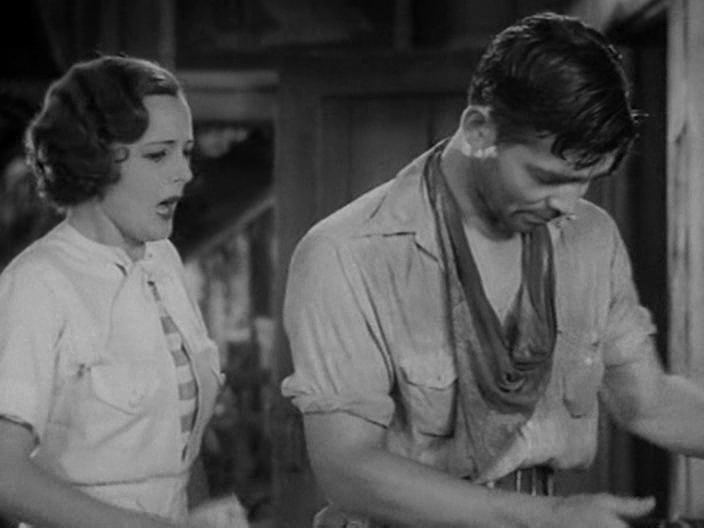

"Do you think you can treat Gary like one of your Coolies"
The gang are just congratulating themselves with the fact that Vantine left before the Willis's arrived - how would they explain her - sister or governess? - when Vantine walks back in. The boat has broken down.  Barbara and Vantine meet at breakfast and Vantine spins a story that Barbara doesn't believe.


Meanwhile Willis is getting worse, and Barbara is in a panic. Carson stays and nurses him for two days, and the fever breaks.  Barbara is apologetic for her earlier behaviour, and it's obvious that Carson has feelings for her.  He brushes Vantine off when he finds her in his room that night. Poor Vantine, you just can't help but like her, despite her not being the sharpest tool in the shed (she breaks a barometer because it's not telling the time properly).


The next day Willis is up and ready for work, and Vantine teases Carson by having a bath without shutting the curtains. Of course while he's telling her off, Barbara appears. Carson takes her off for a tour of the camp, including the 'factory' where the rubber 'milk' is transformed into rubber (by adding acidic acid), and then put through rollers to make it a sheet. It's quite an interesting process, and Mary is impressed.


Barbara discovers that none of the workers are allowed to bring their wives, as the camp is 'no place for a woman.' The native women would cause trouble and the white women couldn't "stand the gaff". Carson tells her that was born to it, and doesn't' mind the loneliness, but admits that Vantine is part of the life here, "if a man is interested." Barbara aims to be happy and find her place, and thinks she could be happy on the plantation. Carson asks if he can make it his job to make her happy.  Before she can answer a sudden storm makes them run for home, and Carson ends up carrying Barbara, who's dressed in high heels. Vantine sees Carson carry Barbara up the stairs into her room, where they share a kiss.


"Did the duchess sprain her ankle?" Vantine asks Carson when he appears.  She knows something is going on between them - the lipstick on his face is a give away.  Carson leaves and Barbara, scared of the storm, asks Vantine if she can stay with her.   The girls have a chat, both bemoaning the fact that neither of them could resist Carson.


That night they all sit down to dinner.  Gary and Carson talk about  the coolies, and how you can't trust them when your back is turned - and Barbara,  feeling guilty, excuses herself.  Carson, meanwhile, organises for Gary and the other men to go on a surveying trip that will take a few weeks, and be too harsh for the women.  Barbara is worried, and wants to go, and Vantine threatens to tell Gary that something is going on between his wife and Carson.  She doesn't though, and Carson and Barbara end up falling in love.


They talk of their future, about getting out of "this rotten country," and Carson says he will tell Gary when he visits the men the next day.  Barbara is worried, because Gary is "so helpless." When Gary and Carson have a chat while waiting to shoot a tiger, Gary tells him how much he loves Barbara, and how wonderful their life will be when they move back to America.  Carson realises that Gary is right, and that really Barbara could never be truly happy in the jungle.


"You got him!"
Carson leaves without staying the night - six hours in the dark - and the other men tell Gary that Carson is making a play for his wife. Gary decides to follow him, but there is no need, as Carson had has a change of heart.  He has decided to be noble, he tells Vantine over a bottle, and sacrifice his love for Barbara so that she and Gary and stay together.


Carson decides that Vantine is more his type - suited to the 'dirty, rotten country,' and really they do seem well suited. They even have a sweet way of calling each other by nicknames - Fred and Lilly. Of course while they're embracing, after a playful wrestle, Barbara walks in. She;s not happy.


Carson tells Barbara that he is not a one woman man, but she is welcome to take her turn. Astor plays the wronged lover to perfection, and shoots Carson, and with wonderful timing, Gary walks in. To protect Barbara, Carson and Vantine tell Gary that Carson had tried to break into Barbara's room because he was drunk, and had been after her all along. Gary is at once proud of his wife, and disgusted with Carson, and when Vantine suggests to him that he take Barbara away, he agrees. As does Carson who says, "You two pack your tennis racquets and go back where you belong."  
"If she hadn't plugged you I would have" says Gary
Vantine helps Carson patch up his wound, with some effort, and then the next day reads to him from the paper - including the news that the Willis's are sailing to San Francisco.  She continues reading to him, bedtime stories, until he puts Barbara out of his mind and the two end up happily ever after....


The alternative name for this movie could have been Rain, as it seems to rain all the time, but of course there was another movie in 1932 with that title, starring Joan Crawford (see the review here). In that movie, Crawford played a prostitute, which Harlow's character has been called in this movie, and the nice lady was played by Kendall Lee, but she did not feature much, unlike Astor in Red Dust. A similar character however, who even has a similar line about the rain never stopping.


Kendall Lee in Rain, 1932

I like to think of Harlow's Vantine more as just a girl out for a good time, thank a hooker. Astor's Barbara, however, is almost her opposite. Naturally dark haired, not bottle blonde, conservatively dressed, not flauntingly 'half naked', and definitely a lady - a lady who was smart and sexy, without being overtly so, strong and brave to a point, who fell in love with another man, against her better judgement.  You just know that after this experience she would return to America a better, stronger person, more in love her husband than ever and ready to raise a family. 


Mary Astor and Gene Raymond in “Red Dust” (1932)

Living in the tropics in 2013, as I do, with air-conditioners, fly screens and electricity, I can't imagine that tropical Asia would have been a great place for a lady in the 1930s, let alone one like Astor's Barbara, either. We never really learn exactly where the plantation is (although we see a bucket labelled the North Co-chin Rubber Co in the first scene), but we do learn it is close to Saigon, Vietnam.  


In 1925 the Michelin Rubber Plantation was begun near Dầu Tiếng District in Binh Duong Province, 72 km northwest of Saigon, and I like to think Carson's plantation was nearby.  Michelin would have course produced rubber for car tyres, and in this movie Carson talks of producing rubber for hot water bottles, pencil erasers and teats for babies bottle, so it was probably small than Michelin's  12,400 hectares (31,000 acres). You can read more about natural rubber here.  Rubber production in Vietnam and all of Asia was disrupted by the Japanese in WWII, and of course by the later Vietnam war.  Vietnam is currently the fifth largest producer of natural rubber in the world. 

Gable also starred in the remake of Red Dust, Mogambo, twenty years later, with Ava Gardner in Harlow's role, and Grace Kelly playing a part similar to one portrayed by Mary Astor. It's on my 'to watch' list!

All in all a wonderful movie, one of Jean Harlow's best and one where Mary Astor get's almost enough screen time. Gable isn't bad either, and Gene Raymond's performance as the nice guy show promise. See it if you can. If not, here's a trailer to get you going.


Deb xx

Thursday, 14 March 2013

Jean Harlow & 1930s Hair Inspiration


Although I love natural products, there is one thing I have recently decided to do that involves some serious chemicals– go blonde! I was blonde as a child, and well into my 20s, then got mousier and a bit grey.  The last few years I have been using a herbal dye to do brunette.  But the time as come to relive my youth and be blonde again. I may have been slightly inspired by Jean Harlow in the 1930 film "Hell’s Angels".

A young, healthy Jean Harlow

Jean’s almost white platinum blonde hair and caused quite a stir in 1930 – nice girls did not colour their hair! Although Jean claimed her hair colour was natural, it was rumoured that she used peroxide, ammonia, bleach and soap flakes to get that ‘bombshell’ look. Peroxide sometimes caused burning to the scalp, which could result in hair loss.  Alfred Pagano, hairdresser to the stars, once said abut Jean Harlow, "I used to bleach her hair and make it 'platinum blonde, we used peroxide, ammonia, Clorox, and Lux flakes! Can you believe that?" And this process was done weekly. Could this be the reason Jean Harlow died so young, at age 26. Probably not in itself, she reportedly contracted polio, meningitis, and scarlet fever before the age of 16 then had pneumonia, two abortions, an appendectomy, multiple bouts of influenza, and a bad reaction to wisdom teeth extraction. She had  eloped when she was 16 with Charles 'Chuck' McGrew who was 20. Two months after their marriage McGrew turned 21 and received a part of his large inheritance. Jean and Charles moved to Los Angeles in 1928, settled in a house in Beverly Hills, where Jean led the life of a wealthy socialite. Neither worked  and both were thought to drink heavily.


eleanor_fashion_1930_02
Jean Harlow in 1930
In 1929 the couple divorced and, Harlow made a few movies in which she appeared as an extra, until her break with Hell's Angels in 1930 at age 18.  In 1932 she married MGM executive Paul Bern , but while Jean was busy shooting 'Red Dust', Bern was found shot dead at their home.  Rumours were that it was Jean who murdered him, though Bern's death was officially ruled as suicide. 
Paul Bern and Jean Harlow on their wedding day, July 2, 1932

Her hair did begin to fall out before her death though, and she wore a wig during the filming of China Seas. After this she changed her hair colour.  Jean complained about ill health in May, 1937 while filming Saratoga. Her symptoms were fatigue, nausea  water weight and abdominal pain, but were not taken serious by her doctor who believed she was suffering from a gall bladder infection and the flu. One month later, she was dead, her body double it’s size because of fluid retention. Officially,Jean died of kidney failure, or "nephritis," caused by a build-up of toxins over time because the body can't process waste. Weekly hair bleaching would not have helped.

JeanHarlow-Universal-23ST
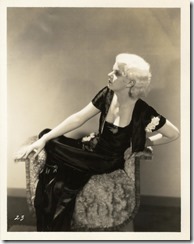
Jean Harlow, studoi portrait
Actor William Powell had a close relationship with Jean beginning in 1935. They were apparently engaged for two years but were forbidden by Louis Mayer, head of MGM, to marry, as  Jean was now MGM's hottest property, paired with the top leading men of the time including Spencer Tracy and Cary Grant. 
Powell and Harlow in 'Reckless'
It is reported that a single white gardenia with an unsigned note was placed in her hands before she was interred, presumed to have been written by Powell. The note read, "Good night, my dearest darling". He also paid for her final resting place—a $25,000, 9×10-foot private room lined with multi-coloured imported marble located in the "Sanctuary of Benediction" of the Great Mausoleum, Forest Lawn Memorial Park, Glendale. You can read more about Jean Harlow here.

lilian
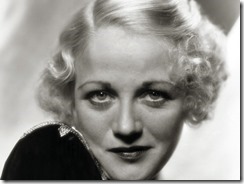
Lilian Harvey, 1933
Safe commercial hair dyes had been around since 1907, when French chemist Eugene Schueller developed synthetic chemical formulation he called Aureole, later renamed L’Oreal, however most blonde tinting was done with the aid of peroxide. In 1903, the New York Times carried the comment 'I hate girls who make up, and most of these blondes are peroxides.'  In 1909 Mr H Rowland apparently stated: 'Men say they hate anything loud about a woman; it must be disgust that makes them  always turn around to stare after a peroxide blonde.'
1930shair
Thelma Todd, 1933
The blunt cuts of the 1920s gave way to softer more feminine shapes in the 30s, as women started to add waves to their hair. Finger waves were styled with fingers and waving lotions, without the aid of irons or shaping tools, and was affordable for every woman.  Pin curls were made by wrapping hair around the finger and pinning the coil close to the head with a bobby pin. The curls were held securely until the hair dried, then the pin was taken out and the curl would stay in place. Women who could not afford to visit the salon would also bleach their hair at home.

wynne-gibson-hairstyle
Wynne Gibson, 1932
By 1932, hair was most often parted in the middle, and the longer waves were sometimes pulled back and secured at the neckline. The same year New York chemist Lawrence Gelb developed a hair colour product that penetrated the hair shaft – his product? Clairol.

francine-larrimore-hairstyle
Francine Larrimore, 1936
The 1930s are back in fashion, as collections from Ralph Lauren and others showed last year, and blonde hair with finger waves and pin curls are back. Click here for a tutorial on finger waves.

Not wanting to risk unnecessary toxic exposure or scalp burning, I went to the salon for my blonde transformation and got foils. Not quite movie star locks, or looks, but I'm happy. I may even spend more than five seconds styling it when the weather is cooler!


Deb xx

Wednesday, 13 March 2013

Hell’s Angels, 1930

Hell'sAngelsPoster
Movie Poster
 
No, not the Bikie gang, the 1930 war movie set during the war in Europe – World War One as we now know it. It starred Ben Lyon and James Hall as English brothers Monte and Roy Rutledge, and Jean Harlow as Helen, the girl that gets between them. It also features John Darrow as the brothers German friend, Karl Armstedt.

hellsangels
James Hall, Jean Harlow and Ben Lyon


The plot is basic – boy meets girl and falls in love, girl is not the good girl he thinks, girl plays around, girl seduces boys brother – but there is the little twist of the German friend also called up to fight. Not wanting to bomb his adopted home of England, he purposefully deceives his Zeppelin crew into sending bombs into a lake, rather than Trafalgar Square. This is probably my favourite scene of the movie. 

vlcsnap-2013-03-10-15h04m02s167  vlcsnap-2013-03-10-14h56m01s230
Karl gets the bad news he’s been called up, and confirming that Trafalgar Square has been hit

Jean Harlow is surprisingly good as the bad girl, but most of her costumes are definitely more 1930 than WWI. 

  vlcsnap-2013-03-10-14h54m32s105 vlcsnap-2013-03-10-15h01m51s138

The second half of the movie (after the intermission, which I love) is really more a war movie, with little appearance by Harlow.  There is lots of flying, and scenes in the mess, and the brothers volunteer for a dangerous mission over Germany. Hundreds of lives depend on them, but will the cowardly Monte overcome his fears?  The night before the mission is spent in the company of loose women while consuming lots of alcohol, and Monte really wants to forget about the mission – but his brother, who  finds out Helen’s true nature when she sees him with another man, talks him into it.

vlcsnap-2013-03-10-15h14m30s49  vlcsnap-2013-03-10-15h15m33s168
Helen tells Roy what she really thinks of him, and he drowns his sorrows

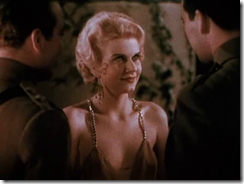
The film was directed and produced by Howard Hughes (yes that one) and written by Harry Behn and Howard Estabrook. Originally started as a silent film in 1927, with Norwegian silent film star Greta Nissen cast as Helen, Hughes took over directing mid way through and decided to use the new sound technology that had just been released. Due to her accent, Nissen was let go, and the role of Helen went to teenage up-and-coming star Harlow, who James Hall had seen in a review, and was just 18 at the time of shooting. One talking scene filmed in Multicolor but printed by Technicolor, provide the only colour film footage of Jean Harlow, and other scenes are in black and white and others in blue and pink tones.

vlcsnap-2013-03-10-14h51m32s97  vlcsnap-2013-03-10-14h51m18s214

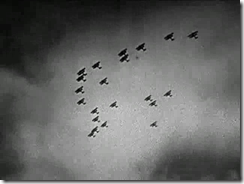
Hughes along with pilot Harry Parry, designed many of the aerial stunts for the dog-fighting scenes that were filmed by pioneering aerial cinematographer Elmer Dyer. The scenes really are quite amazing for the time,  and Hughes hired a team of actual World War I pilots to fly. Hughes  directed the aerial scenes from overhead, using radio control to coordinate the flying manoeuvres.

Clarke_and_Roy_Wilson_flying_airplanes_in_the_movie_Hells_Angels   vlcsnap-2013-03-10-15h06m01s77
Clarke and Roy Wilson flying airplanes in Hell's Angels.

One manoeuver that Paul Mantz, principal stunt pilot, thought to dangerous Hughes attempted himself – and crashed and was seriously injured with a skull fracture.  Three other aviators and a mechanic were killed during the film's production - Al Johnson crashed after hitting wires while landing at Caddo Field, California, C. K. Phillips crashed while delivering an S.E.5 fighter to the Oakland shooting location, Australian Rupert Syme Macalister, was also killed and Mechanic Phil Jones died during production after he failed to bail out before the crash of a German Gotha bomber, piloted by Al Wilson.

vlcsnap-2013-03-10-14h58m29s166  vlcsnap-2013-03-10-15h08m46s191
Crashing to his death and shooting the enemy
With the majority of the film shot and in editing, Hughes realized a similar film, The Dawn Patrol starring Douglas Fairbanks Junior, would become a competitor at the box office.  Not only did Hughes attempt to lease all available period aircraft so his competitor could not, he brought a lawsuit that alleged that the screenplay of Hell's Angels was plagiarized. The lawsuit resulted in The Dawn Patrol being rushed through post-production in order to be in theatres before Hell's Angels. In late 1930 the distributers of Dawn Patrol, Warner Bros.won the suit, and The Dawn Patrol won the Academy Award for Best Story for John Monk Saunders in 1938.

HellsAngels012012LC-3Some
Movie poster

Hell's Angels is now hailed as one of the first sound blockbuster action films. It was released by United Artists and, despite its initial poor performance at the box office, eventually earned its production costs twice over to a tune of $8 million dollars.

1930

Enjoy, Deb xx