Showing posts with label Food and Diet. Show all posts

Friday, 30 August 2013

Mid-Century Recipe 2 - Braised Oxtail

I have made this dish twice now - the family demanded a repeat performance.  There is not much meat on an oxtail, but the flavor is delicious, and if your family enjoy chewing on bones, like mine do, they will love it. It's also cheap - about $5 per oxtail.  This quantity serves four - I double it for our family.
Ingredients for braised oxtail
What you need


Some chopped parsley for colour would look nice if you have it. And don't worry if you don't have little onions, just add another large one sliced.

It takes about 15-20 minutes to put together and two to three hours to simmer.  You can transfer it to the oven, just keep it on low.  I put it in the oven last night at about 4.30, before a school concert, and when we returned (starving) at 7, it was ready to eat.

Yummy!

I had never heard of oxtail until I had dinner at my mother-in laws one night.  A girl of the 50s, her oxtail soup was a specialty of hers.  This recipe is similar - just add a bottle of red wine to the sauce if you want soup.

♥ Deb


Friday, 23 August 2013

Mid-Century Recipe 1 - Beef Stew

This is the first vintage recipe I have attempted with our new menu. I often make stew, usually a 'clean out the fridge' stew at the end of the week, with a tin of tomatoes or beans added.  This recipe looks very basic, but the flavor was quite surprising.  Everyone loved it, even the teenage daughter, and we turned the leftovers into pies (using frozen puff pastry and muffin pans) the following day, which were fantastic (much better than four'n'twenty but a similar flavor).

Home made beef pies
Beef Pies
So what you need is this:

Ingredients for home made beef stew
Recipe - see below
Time - takes about 15 minutes to put together and two hours to simmer.

  • Diced beef (stewing steak) about 700g (1 1/2 pounds)
  • 2 onions
  • Stock (beef, or I used Vegemite in water) 2 cups (1 pint)
  • Fat (dripping, or I used coconut oil) about a tablespoon
  • Flour about 1/2 cup (1 1/2 ounces)
  • Vinegar, 1 teaspoon
  • Salt and pepper
  • Herbs (bunch of mixed fresh or spoon of dried, I used a stick of 'mother of herbs')
Serve with mashed potatoes and a green veg medley.


Thursday, 22 August 2013

Meal Planning Mania

I mentioned the other day that as part of my being a good mid-century housewife I cam going to go back to planning our weekly meals. This is the sort of thing I want to do -

vintage 1960 menu plan for winter, by Mrs Beeton


You may be able to tell, by the little giveaways like 'liver and bacon', 'fricassee of rabbit' and dessert with every dinner, that this is a vintage meal plan. From my 1960 copy of 'Mrs Beetons Cookery and Household Management,' to be exact.

Sunday, 21 July 2013

Food of the Fifties - 1953

What were people eating in the 50s?  Everything we read today tells us that we eat much more processed foods now than  they did fifty years ago.  But do we?  Here are some food ads from the year 1953, taken from the Australian Women's Weekly magazine June issue.


Mmmm, fish and cheese in the one recipe. I think I may try it out on the kids.

Images via

Deb xx

Tuesday, 12 March 2013

The 1930s Diet, grapefruit & my first week

 
 Diets really became popular in the 1930s.  The Hollywood, or Grapefruit, diet was developed then, with lots of women striving to look like their favourite actress. In this low calorie diet (800-1,000), most people will lose weight, but it has nothing to do with grapefruit having a fat burning enzyme, it’s just a nutritious low-calorie fruit (66-84 calories per serving), loaded with vitamin C and fibre. Unfortunately unless it’s a pink grapefruit, it’s also quite horrible without sugar. Most versions of the Grapefruit Diet include a small variety of foods for breakfast, lunch, dinner, and at bedtime, with half a grapefruit at each meal.  If  could replace the grapefruit with, say, mango, I’d do it. But grapefruit, you have to be kidding.

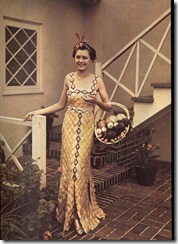
And what to do with all those grapefruit peels? Make a dress of course.

grapefruitdress
To celebrate the beginning of harvest in the fertile Rio Grand Delta. 1930s.

The Lancet’ noted in 1933 that in “these days of ‘slimming’ there was no more popular subject of discussion among the ladies than the reduction in weight”. Anxiety about excess weight was exploited in weight loss books and advertisements of “slimming” foods such as Ryvita and Ryebic crisp bread, slimming teas, tablets, remedial products such as Linia Shorts intended to massage away the abdominal “danger curve” and vibration machines which promised to exercise “All the body without effort” and reduce obesity “without drugs or dieting”.

tea 

The new middle class of the 1930s with it’s sedentary lifestyle, particularly among the men, saw an average daily intake of 3,500 calories, compared to about 2,500 calories for working class people.  The working class were of course facing economic depression, high unemployment and poverty – much like now really – getting enough to eat would have been more of a problem for them than losing weight.

freecoffee
Free coffee and soup for the unemployed during the 1930s
The fashions of the 1930s also employed a long, lean silhouette. Women wanted to look like their favourite movie stars – Jean Harlow, Greta Garbo, Marlene Dietrich, Carole Lombard. Bette Davis – but often these woman also had to struggle with their weight.

Jean-Harlowe  jeanharlow1930sportrait

In between films, Jean Harlow would eat whatever she wanted and gain some weight.  When it came time for filming a new movie,  Harlow would have to put herself on a strict diet of salads and vegetables to get back to her thin movie weight. 

Meanwhile other affluent women were going to weight loss camps, as these photos from a 1930s Life Magazine show.
measure fatcamp

Don’t you love the high heels for exercise?!

Another secret to a girlish figure was Bile Beans, a quack remedy for the flu in the late 1800s, and used for “biliousness” and weight loss in the 1930s. Basically they were laxatives, thanks to a bitter ingredient called aloin disguised by cardamom, peppermint oil, and wheat flour, and wrapped in an attractive black gelatine coating. Delicious!

bile2
1930s
On a personal note, I have lost a whole 2.5 kg this week, in my first week on the Fatty liver diet!!.

Deb xx


Tuesday, 5 March 2013

1920s Weight Loss & Fatty Liver


I have decided to lose weight this year – it was one of my new year resolutions, and part of my getting healthy plan. It's strange how it sort of creeps up on you - If I'd had a great vintage wardrobe it wouldn't have happened, I'm sure.   My last blood test showed my blood count is almost back to normal (I was severely anaemic), although my blood pressure is too high, and I am now on blood pressure medication.  I also have abnormal liver function, and now that hepatitis has been ruled out, I apparently have a ‘fatty liver.’  This is how I look now, more or less. I would never wear shorts that short though!

fat2
Over weight and at fat-camp in the 1930s

The cause of this, my doctor tells me, is a ‘typical western diet.’  My diet over the years has been anything but typical.  I grew up whole wheat everything and NO soft drink, was vegetarian for 8 years, vegan for two of those, did raw food for one year and for my last pregnancy in 2005, with twins, gave up sugar.  I have newer smoked or ‘done drugs’, or taken excessive amounts of medications or painkillers and I am a moderate drinker, who has abstained before during and after each pregnancy (all four of them). I don’t have a sweet tooth, drink only two cups of tea or coffee a day and drink lots of water.  There must be more to it than ‘typical western diet.’

According to fatty liver guru, Sandra Cabot, grains as well as sugar is a major cause of fatty liver. So those whole grains I have been eating over the years – brown rice, whole wheat, oats – may not have been as good for me as I was lead to believe. Bugger!  So now I am cutting out all grains and sugar for 8 weeks, to see if there is any improvement.

fatty
Not the safest way to weight loss, 1960s
At present, according to this BMI calculator, I am borderline obese (its about 29) and need to lose at lest 20 kg.  I have known that I’m overweight for some time, but I have been struggling to lose it, even before I became ill.  Apparently having a fatty liver prevents you from losing weight.  If I can get my liver healthy, I can apparently lose weight!
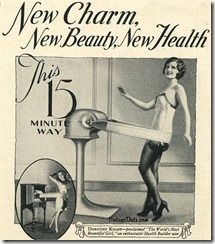
1929-1
weight loss in 1929, when an economic depression is not enough

Apart from being overweight, especially around the abdomen, the other major signs of fatty liver are high blood pressure and bad skin.  Well, I have had both of those things for ever – why didn't someone mention this to me years ago?!

Miss Camilla Clifford (The Gibson girl) - American musical comedy star
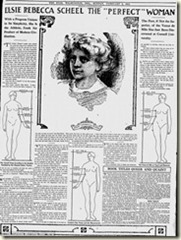
One hundred years ago the female physical ideal was very different, the curvy Gibson Girl look was in, and my BMI, had it been a thought of concept, wouldn't have seemed so bad.  A series of articles in 1912 and early 1913 saw Brooklyn-born Cornell student Elsie Scheel, 24, hailed 'the most nearly perfect physical specimen of womanhood'. At 5ft 7in tall and 171 pounds (12 stone 3 pounds), with a pear-shaped chest-waist-hips ratio of 35-30-40 inches (close to the proportions of the Venus de Milo), her BMI would have been close to 27, which is also in the overweight category.   Elsie, however,  who was selected by university medical examiner Dr Esther Parker from a group of over 400 women, was described by the New York Times as 'a light-haired, blue-eyed girl whose very presence bespeaks perfect health.'
perfect2
1912

Elsie  said that 'She has never been ill and doesn't know what fear is' - indeed, she believes women would be happier if they 'got over the fear of things'.  Her tips for a healthy diet and lifestyle? She rarely ate breakfast, candy and avoided tea and coffee but loved beef steak, and thought walking better than staying up late dancing or studying.   She called herself an ardent suffragette and said that 'if she were a man, she would study mechanical engineering as she likes to work about an automobile.'   As a woman, however, an a  student of horticulture, her ambition as was grow vegetables on her father's farm.  Quite a healthy pursuit indeed – I would love to be a farmer. I wonder what her liver looked like.
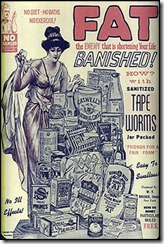
I can imagine the taller, thinner and darker girls reading this article one hundred years ago and despairing, or at least feeling inadequate.  Maybe they would have resorted to something like this:
tapewormsad
Yes, tapeworms!
By the 1920s the ideal was for a much slimmer body. Curves were out. Which was good really, because after WWI many people were extremely thin, due to food shortages and rationing, soldiering and working. One things settled down after the war the 20s lifestyle became one of excess for many, including the new middle class with their sedentary jobs, and it became easier to overeat. Weight loss again became a hot topic. especially as scientists had just discovered the connection between weight and diabetes. Every newspaper and magazine had articles about diet and losing weight, and weight loss products like pills, rubber clothing and reducing creams flooded the market.  Advertisers knew that fat was scary.

Cashing in on fear, 1920s Kelloggs ad

Many middle class women, many already quite slim, wanted to lose even more weight in order to look good in the slimline fashions of the 1920s that exposed ankles, calves and even upper arms and knees!. Many doctors considered this harmful, saying that extreme thinness and women’s “thin and scraggy” figures and “haggard, drawn expression” were the very opposite of beauty and a threat to women’s responsibility as mothers. Somehow I don't think all women were concerned about that.


Cigarette smoking was also becoming accepted for women, and advertisers homed in on their desire to keep slim, creating a strange link between smoking and beauty that is finally starting to disappear ninety years later. Obviously cigarettes don't give you diabetes!

Lucky Strike, 1927

I am not about to take up smoking, try tape worms or slimming vibrators, but I am aiming to lose weight.  Not for beauty, but for health. More importantly I want to lose fat, especially in my liver.  As my health improves with diet, I aim to excessive more - beginning with walking the dogs at least half an hour per day, a nice gentle exercise my doctors recommends. If only it would stop raining!
An English lady walking her Russian Borzois, 1930s

 I’ll keep you updated.

And if you know anything about fatty liver, let me know!

Deb xxx


Monday, 9 April 2012

7 & 8 April - Easter Weekend


I hope you are having a happy Easter!
Here in Mackay there are four main ideas of how to spend Easter:-
  1. Go camping (fishing and boating), and enjoy the great out doors;
  2. Stay home, check out the markets and local music, do lunch and eat;
  3. Go to church, at least on Good Friday and Easter Sunday; or
  4. Stay home and tackle a renovation project.
WE have, of course, decided to do all four.  We like the great outdoors in small doses – sleeping with mozzies does not appeal, nor does getting up at dawn with the kids for 3 days in a row.  So we visit one of our local beaches for a few hours instead, and get some gardening done at home.  We also do lunch – Easter Sunday with the folks, and Monday with friends.  We don’t do church (sorry, but I have friends that do),but I put classical fm on the radio and listen to choirs over the weekend.  And of course we do some DIY – this weekend the downstairs bathroom and laundry.  It’s still ongoing, so I will post some before and after photos soon.

This Easter is lovely because we have all our children back home, plus our eldest son’s girlfriend.  So lunch was great fun, and of course Easter bunny also visited so the little kids hunted for eggs in the garden.

  easter 017  easter 032  easter 034    easter 035

Terrine for entree, roast pork and veg for main, and assorted choc delights for dessert.
No war information this weekend, just some images.  Here is a sweet little movie of one family’s Easter picnic in 1942, and a lovely photo of ladies after church in Texas, USA, all in their best hats.

enjoy!

And here is one from Australia in Easter 1942, of RAAF personnel digging trenches while stationed at the Royal Exhibition Building, Carlton Gardens, Melbourne.  You can read about it here.

Photograph - RAAF Personnel [copy] (Photographs)
Deb xxx

Saturday, 7 April 2012

6 April 1942–Easter Buns & War

Today in 2012 it’s Good Friday, so we have been busy baking Easter buns.
004
Here’s the recipe we used.
Ingredients:
  • 4 cups (600g) plain flour
  • 1 tsp mixed spice
  • pinch salt
  • 60g butter, softened, plus extra to serve
  • 1/2 cup (110g) caster sugar
  • 1 tablespoon dried yeast
  • 1cup sultanas
  • 1 cup lukewarm milk, plus extra, for brushing
  • 1 egg, lightly beaten or extra milk, for glazing
  • 1/3 cup self-raising flour for crosses
Glaze
  • 2 tbsps warm water
  • 1 tbsp sugar
  • 1/4 tsp gelatine
Method:
  1. Sift flour, spice and salt in a bowl. Melt butter and stir in with sugar, yeast and sultanas.
  2. Add 1/2 cup warm water, milk and egg, and mix to a soft dough. Knead until smooth and elastic. Shape into a ball and place in a clean, greased bowl.
  3. Cover bowl completely with plastic wrap and a tea towel. Leave to rise in a warm place for 1-1 1/2 hours until doubled in size. 
  4. Lightly grease a baking tray, two trays. Turn dough onto a lightly floured surface and gently pat out to 3cm thickness. Cut into 16 pieces and gently shape each into a ball, and place buns on prepared tray or cake pans. Let to rise in a warm place for 20-30 mins.
  5. Preheat oven to 180 degrees Celsius ( fan forced). Brush buns with beaten egg or extra milk. Combine self-raising flour and 1/4 cup water in a small bowl until smooth. Spoon into a snap lock bag, snip end and pipe crosses on buns.
  6. Bake buns for 15 mins, until golden brown. Meanwhile stir together water, sugar and gelatine.  When cooked, remove from oven and brush with Glaze.
Eat! 
Today in 1942 (Easter Monday) 10 DC-3's of Pan American Airways begin hauling 30,000 gallons of fuel and 500 gallons of lubricants from Calcutta to the airstrip at Asansol Airfield, completing the mission on the following day.  This fuel was for use by Lieutenant Colonel James Doolittle's Tokyo raiders, already at sea aboard the aircraft carrier USS Hornet
HMAS GERALDTON was commissioned at Sydney on tis day in 1942, under the command of Harold M. Harris .  She was one of sixty Australian Minesweepers (commonly known as corvettes) built during World War II in Australian shipyards as part of the Commonwealth Government's wartime shipbuilding programme.   GERALDTON was employed on patrol duties off the east coast of Australia for a short before leaving to join the Eastern Fleet in July 1942, and going to Colombo.

Also on this day an RAAF plane is damaged in combat and ditched.   Pilot Les Jackson exchanged fire and claimed hits on two Zeros that made head on passes against him, and damaged his engine. He made a forced landing outside Port Moresby on a coral reef in about six feet of water.  One pilot recalled (p28),
“The engine sat down with the wings and tail high and dry. As the rest of us came down towards the strip, Les stood out on one wing waving his arms and doing a jig, obviously to indicate he was OK. I heard John Jackson call 'there's a kite on the reef. The pilot's OK - jumping about. Seems a happy sort of chap.' John hadn't recognized his brother."
File:150494LDJackson1942.jpg
Flight Lieutenant Jackson (second from left) with fellow pilots of No. 75 Squadron in Port Moresby, 1942 Source
Jackson was born in Brisbane, Queensland, and had joined the air force before war broke out in 1937, after first training as an accountant.
Here is a lovely short movie of Easter Bonnets in New York, 1942.
Easter bonnets in New York, Easter 1942
Have a peaceful Easter,
Deb xx


Thursday, 5 April 2012

4 April 1942–Garden Armies, Ration Diet Results & Wednesday Wedding Photo


I have spoken before of “Dig for Victory’, a publicity campaign urging householders to grow their own vegetables as a contribution to the war effort. In Australia, this was launched by the Prime Minister, John Curtin, in January 1942. According to the same magazine, the idea of “Garden Armies” was launched in February 1942 at the Melbourne Town Hall, with the aim of forming “teams of girls , who will dig for victory instead of playing basketball or hockey,” growing vegetables throughout every suburb, wherever they could get land. The article continued with the idea that “Housewives are asked to give an hour or 2 each week to help with the watering and weeding of plots.” Here is the article, with photos.  They also had a “Summer Girl” Quest to help raise funds and awareness.

 summer girl quest
Well, I have done two whole weeks on my WWII ration diet.  I have had a few wines and the occasional Guinness,  but my butter, cheese and sugar has been severely restricted.  The result?  I have lost weight!  Only 1.5kg over the two weeks, but that is better than I had been doing.  My bust measurement also went down an inch, and my waist half an inch.  Those hips didn’t move, however! So I am happy with the results so far, and I will definitely continue with the diet.  I won’t show every meal, but I will try and post new recipes occasionally.

My cooking skills are also improving, as I try and use what’s in the fridge to make dinner.  This has also saved money – usually we do a big weekend shop, but I put it off this week until the fridge was empty.  It Wednesday and I am still going , with only needing to buy a litre of milk and  some cat food.  Pet food was also rationed during the war, so I will start experimenting with pet food too!  Last night the dog ate the left over soup/stew that was a bit old, mixed with some tinned fish for cats – he loved it.
So tonight's dinner is a variation of beef Bourguignon – this time with red cabbage instead of carrots, and no bacon.

And to the Wednesday Wedding photo – two from Melbourne:


weddings (2)
Have a lovely vintage day
Deb xx

Monday, 2 April 2012

1 April 1942 - Ration diet day 12

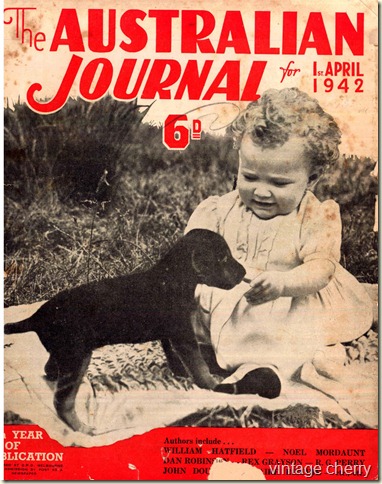
1 april
April 1, 1942 115th Day of War
Above is the cover of my Australian Journal of the day – I will try and post some articles from this magazine over the next few weeks.
Here is an excerpt from the diary of Captain Albert Brown,  April 1942.  Captain Brown was a POW after the battle of Bataan.
Yes, it's April Fool's Day for the men on Bataan, the only army in the world boxed up and bottled up; We certainly are the biggest fools of this war, fighting for the biggest and strongest nation in the world. The war dept. keeps telling us to fight to the last man, fight to the last hole, for help-men-guns-material are on the way. They have deserted us and we are on our own; every day is an "April Fool's Day."
You can read more of his diary here.
To the diet.  Bacon, my one egg for the week, a tomato and slice of toast for breakfast.  Yes, it was given to me in bed again, but this time no camera.  The bread was homemade, and delicious.  It’s so lovey being married to a man who can cook!
We spent the morning at Cape Hillsborough, a beach and national park about an hours drove away.  We brought a thermos of coffee and biscuits, and I must say that after walking and swimming I was peckish and did have one bickie.  It’s such a beautiful spot, photos don’t do it justice.  We would love to live out that way some day, and get a few acres. The country side is hilly. green and treed (with eucalypts and hoop pines), with great views of the surrounding waters (part of the Great Barrier Reef Marine Park).  Explorer James Cook named Cape Hillsborough during his voyage up the Queensland coast in 1770.
009   003  011  002  022
We did think about fish and chips for lunch, but came home for reheated pizza and a glass of wine.  We had home made pizza for dinner last night (leftovers, with seafood or bacon, with a little cheese on bread dough) .  Then we had home popped popcorn and watched a movie. 

026   027  015

Dinner was home made fish and chips  (grilled fish and cooked frozen chips) with salad.  I also used my last weeks sugar, and leftover butter and oil rations to make a slice. I added cocoa for a chocolate hit, but you can add real chopped chocolate, or leave it out altogether.

Easy Ration Slice
  • 1 cup oil/melted butter
  • 1 cup sugar
  • 1 cup chopped nuts
  • 2 cups whole meal flour (SR or add baking powder)
  • 1 cup rolled oats
  • 3 tablespoon cocoa (or your ration of chocolate) or teaspoon vanilla
Mix and press into slice tin.  Bake for about 20 minutes.  You can also roll into balls and press into biscuits if you have the time and energy!
Hope you had a lovely weekend too.

Deb xx