Showing posts with label health. Show all posts

Tuesday, 5 March 2013

1920s Weight Loss & Fatty Liver


I have decided to lose weight this year – it was one of my new year resolutions, and part of my getting healthy plan. It's strange how it sort of creeps up on you - If I'd had a great vintage wardrobe it wouldn't have happened, I'm sure.   My last blood test showed my blood count is almost back to normal (I was severely anaemic), although my blood pressure is too high, and I am now on blood pressure medication.  I also have abnormal liver function, and now that hepatitis has been ruled out, I apparently have a ‘fatty liver.’  This is how I look now, more or less. I would never wear shorts that short though!

fat2
Over weight and at fat-camp in the 1930s

The cause of this, my doctor tells me, is a ‘typical western diet.’  My diet over the years has been anything but typical.  I grew up whole wheat everything and NO soft drink, was vegetarian for 8 years, vegan for two of those, did raw food for one year and for my last pregnancy in 2005, with twins, gave up sugar.  I have newer smoked or ‘done drugs’, or taken excessive amounts of medications or painkillers and I am a moderate drinker, who has abstained before during and after each pregnancy (all four of them). I don’t have a sweet tooth, drink only two cups of tea or coffee a day and drink lots of water.  There must be more to it than ‘typical western diet.’

According to fatty liver guru, Sandra Cabot, grains as well as sugar is a major cause of fatty liver. So those whole grains I have been eating over the years – brown rice, whole wheat, oats – may not have been as good for me as I was lead to believe. Bugger!  So now I am cutting out all grains and sugar for 8 weeks, to see if there is any improvement.

fatty
Not the safest way to weight loss, 1960s
At present, according to this BMI calculator, I am borderline obese (its about 29) and need to lose at lest 20 kg.  I have known that I’m overweight for some time, but I have been struggling to lose it, even before I became ill.  Apparently having a fatty liver prevents you from losing weight.  If I can get my liver healthy, I can apparently lose weight!

1929-1
weight loss in 1929, when an economic depression is not enough

Apart from being overweight, especially around the abdomen, the other major signs of fatty liver are high blood pressure and bad skin.  Well, I have had both of those things for ever – why didn't someone mention this to me years ago?!

Miss Camilla Clifford (The Gibson girl) - American musical comedy star
One hundred years ago the female physical ideal was very different, the curvy Gibson Girl look was in, and my BMI, had it been a thought of concept, wouldn't have seemed so bad.  A series of articles in 1912 and early 1913 saw Brooklyn-born Cornell student Elsie Scheel, 24, hailed 'the most nearly perfect physical specimen of womanhood'. At 5ft 7in tall and 171 pounds (12 stone 3 pounds), with a pear-shaped chest-waist-hips ratio of 35-30-40 inches (close to the proportions of the Venus de Milo), her BMI would have been close to 27, which is also in the overweight category.   Elsie, however,  who was selected by university medical examiner Dr Esther Parker from a group of over 400 women, was described by the New York Times as 'a light-haired, blue-eyed girl whose very presence bespeaks perfect health.'

perfect2
1912

Elsie  said that 'She has never been ill and doesn't know what fear is' - indeed, she believes women would be happier if they 'got over the fear of things'.  Her tips for a healthy diet and lifestyle? She rarely ate breakfast, candy and avoided tea and coffee but loved beef steak, and thought walking better than staying up late dancing or studying.   She called herself an ardent suffragette and said that 'if she were a man, she would study mechanical engineering as she likes to work about an automobile.'   As a woman, however, an a  student of horticulture, her ambition as was grow vegetables on her father's farm.  Quite a healthy pursuit indeed – I would love to be a farmer. I wonder what her liver looked like.
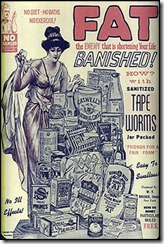
I can imagine the taller, thinner and darker girls reading this article one hundred years ago and despairing, or at least feeling inadequate.  Maybe they would have resorted to something like this:
tapewormsad
Yes, tapeworms!
By the 1920s the ideal was for a much slimmer body. Curves were out. Which was good really, because after WWI many people were extremely thin, due to food shortages and rationing, soldiering and working. One things settled down after the war the 20s lifestyle became one of excess for many, including the new middle class with their sedentary jobs, and it became easier to overeat. Weight loss again became a hot topic. especially as scientists had just discovered the connection between weight and diabetes. Every newspaper and magazine had articles about diet and losing weight, and weight loss products like pills, rubber clothing and reducing creams flooded the market.  Advertisers knew that fat was scary.

Cashing in on fear, 1920s Kelloggs ad

Many middle class women, many already quite slim, wanted to lose even more weight in order to look good in the slimline fashions of the 1920s that exposed ankles, calves and even upper arms and knees!. Many doctors considered this harmful, saying that extreme thinness and women’s “thin and scraggy” figures and “haggard, drawn expression” were the very opposite of beauty and a threat to women’s responsibility as mothers. Somehow I don't think all women were concerned about that.


Cigarette smoking was also becoming accepted for women, and advertisers homed in on their desire to keep slim, creating a strange link between smoking and beauty that is finally starting to disappear ninety years later. Obviously cigarettes don't give you diabetes!

Lucky Strike, 1927

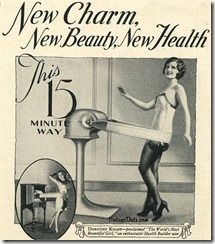
I am not about to take up smoking, try tape worms or slimming vibrators, but I am aiming to lose weight.  Not for beauty, but for health. More importantly I want to lose fat, especially in my liver.  As my health improves with diet, I aim to excessive more - beginning with walking the dogs at least half an hour per day, a nice gentle exercise my doctors recommends. If only it would stop raining!
An English lady walking her Russian Borzois, 1930s

 I’ll keep you updated.

And if you know anything about fatty liver, let me know!

Deb xxx


Thursday, 28 February 2013

Whiter Teeth, Fresher Mouth & Advertising


Another day another visit to the dentist – today the beginning of a crown and an hour in the chair - what fun. And I am back tomorrow.

I now have to use toothpaste for sensitive teeth – apparently it makes a coasting on the teeth to protect them a bit, as well as containing an ingredient which can get into the teeth as a substitute for calcium. As someone who loves natural, (nasty) chemical free products, this is a bit hard for me.

Did you know modern toothpaste contains these ingredients:.
That's why there are warnings on the tube not to eat the stuff.

colgate
Colgate ad, 1959 in Ebony Magazine
toothpaste_1949colgate
Colgate ad, 1949    
                                      Some herbal toothpastes contain:
  • peppermint oil
  • myrrh
  • plant extract (strawberry extract)
  • special oils and cleansing agents
These ingredients in herbal, or natural, toothpastes, were also used in the 19th century, although instead of pastes, powders were the norm. Most were homemade, with chalk, pulverized brick, or salt as ingredients.  Strawberry was considered to be a "natural" solution for preventing tartar and giving fresh breath.  Charcoal was also very popular for teeth cleaning, as recommended in the 1866 Home Encyclopaedia.  Clove oil was another ingredient – chewing on cloves is said to eliminate tooth ache.

calvert
Calvert Toothpaste, UK (1890)
The first 'toothpaste', Dr. Sheffield's Creme Dentifrice in a collapsible lead tube, was manufactured in London from 1892, the idea springing from painters using paint from tubes. Copying Sheffield, Colgate & Company Dental Cream was packaged in collapsible tubes from 1896.  Fluoride, basically a by product of aluminium smelting and still a debatable inclusion, was first added to toothpastes in the 1890s.

sheff
Dr Sheffield,s ad, 1905

Arm & Hammer marketed a baking soda-based toothpowder in the United States until about 2000, and Colgate currently markets toothpowder in India and other countries. I still use bi-carb for teeth cleaning now and again – which is also in some modern toothpastes.  One hundred years ago I may have used this tooth powder which your poured from a tin, rather than in a glass jar.

toothpaste_1913
Jewsbury & Brown's Oriental Tooth Powder ad, 1913
Striped toothpaste was invented in New York by Leonard Lawrence Marraffino in 1955, and the patent was later sold to Unilever (originally Lever Brothers, the makers of Sunlight soap). They marketed it with the imaginative name of ‘Stripe’.

striped
Stripe, 1955
There are now nearly fifty manufactures of toothpaste worldwide, with many different products. Some brands have en around for a long time - like Colgate (1890s), Sozodont (1859, first a powder), Stomatol (Swedish from about 1900), Ipana (US, 1901), Lion (Japan, 1918) and Pepsodent (USA, 1920s).

ipana
Ipana ad, 1934

Do you have a favourite toothpaste?

More images on tumblr.

Deb xx

Wednesday, 27 February 2013

Going to the Dentist

My oven cleaning plans were interrupted today, as I managed to get an appointment at the dentist.

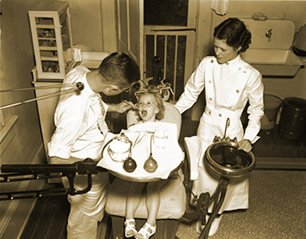
At the dentist 1936
I had put it off, then I was ill, but now I am determined to get all my health issues sorted. I think I am still put off by visits to the dentist as a young girl in the early 70s - my dentist was about 100 and still had his original office set up from about the 1920s. There were big old leather chairs and a really big noisy drill -still have night mares about getting fillings!

Dr Withers, Utah, 1930s
 My dentist now is a lovely Indian lady, who is gentle and unassuming and quite painless.  She reassured me that the one filling I thought I needed I didn't, as my teeth are just getting sensitive because of a slightly receding gum line.  The major issue, the collapse of a tooth over an old root canal , is fixable, and will cost less than $2,000, so I am pretty happy.  I have to go back for two more visits over the next few days, and then in a fortnight for the crown to be fitted when it's back from the lab.

Lavoris Ad, USA (1920)

Now I just have to do as my dentist tells me - FLOSS and only use toothpaste for sensitive teeth.  She's so nice I promised I would.  I really don't want to end up with some of these:

George Washington's false teeth of hippo ivory
Have been to the dentist lately?


Deb xxx

Sunday, 13 January 2013

Women’s Health–Why I’m glad I’m not a 1910s Woman

There are some days I would really love to live one hundred years ago,  when life seemed less hectic, fashion was wonderful, servants abounded and people used manners - but it is easy to idealize an earlier period in history and look at it through rose coloured glasses.  What I am hoping to do on this blog is look at the reality of the past,the good and the bad, to learn from it, appreciate it and then appreciate what we have today. 

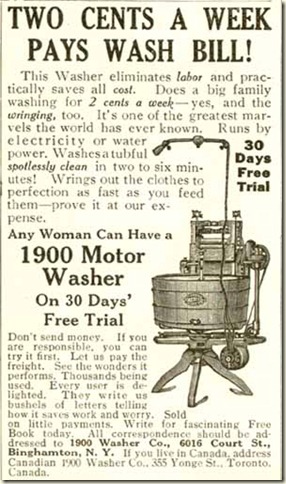
For instance,  I love my washing machine – I use it everyday and can’t imagine not having it.  Mind you, if I was a middle class women in 1913 I probably would have either had a live in maid or sent my laundry out to be cleaned. Or maybe I could have bought one of these:

1913WasherAG 1913 ad source

The main reason I am glad I am living in 2013 and not 1913 is modern medicine – especially advances in childbirth, disease and pregnancy prevention and antibiotics.  Neither I nor my five children would be here without modern medicine.

This week alone, I have had three blood tests, an ultrasound, an x-ray, a blood transfusion and an operation.  I finally realised that my lazy holiday was actually something of a necessity, as I could not get off the couch.  Blood tests diagnosed a low blood count (a haemoglobin level of 61 instead of around 120), so I was put into hospital and given a blood transfusion.  That’s what four months of heavy monthly bleeding will do to you girls, so take care – don’t be slack like me and think it’s normal and that the tiredness is in your mind – GO TO A DOCTOR!  I had a uterine growth that needed removing, which  they did quite painlessly under a general anaesthetic, and two days later here I am back at home and feeling a whole lot better.  I can even manage to have a shower and wash my hair without getting breathless, and I even took the dogs for a walk this afternoon!

Page10Photo1R2

Nurse training at Atlantic Hospital, Iowa, 1913 – about to get an anaesthetic I think

I imagine that many women’s deaths were caused not just by childbirth, but by menstrual and uterine problems – something of course that wasn't’ talked abut 100 years ago – but in novels and death notices the women would have died of blood poisoning or heart failure.  Of course heart failure is what happens just before most people die, and is defiantly what happens if you have a low blood count.  I have found an online copy of ‘A reference hand-book of ‘gynecology’ for nurses’ published in 1913, which makes for delightful reading, and implies that only nurses dealt with these women’s issues, including cervical cancer and such, and doctors weren’t really involved. I may be wrong, but I recommend a quick look at this book for yourself!

surgery

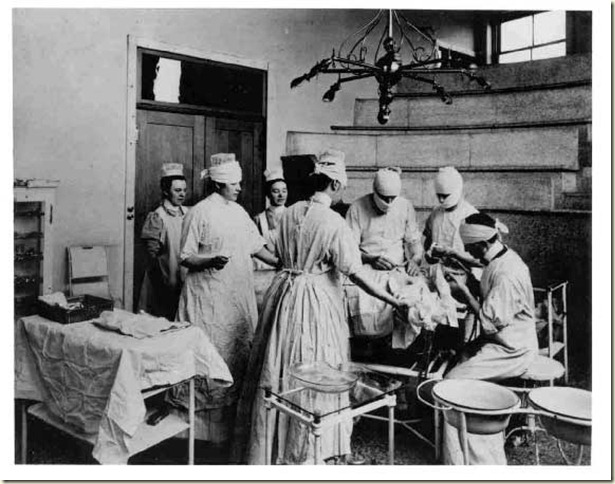
Surgery at St. Luke's Hospital, 1913 -A view of an operating room with surgery in progress.

So thank you again modern medicine, and all the wonderful doctors and nurses who strive to make us well and to the researchers who look for answers.  A stay in hospital is a wonderful way to make you appreciate life – especially a stay in the surgical ward.  Not that I recommend it, really!

Stay safe, and as usual, more images on tumblr.

Deb xxx