Zebras have always been one of my favourite animals - they're like small horses, but with really amazing fashion sense.
Because of their resemblance to horses there has always been great interest in taming and training zebras as riding and harness animals.
 |
| A zebra-driven taxi cab leaving Brixton and heading for Stockwell in 1915 |
Given their nature Zebra's seem to be a odd choice for a pulling animal. The
few photos available of Zebra hitches all seem to be from around the same time
period. It is as if it was one of those things that "seemed like a good
idea at the time," and after everyone had tried their hand at it the
practice was abandoned.
In 1866 Zebra's were introduced to Central Park Zoo in New York City.
There are three species of zebras: the plains zebra, the Grévy's zebra and the mountain zebra. In 1899 a pair of rare Cape Mountain Zebras were photographed at the London Zoo. The female (feeding) had been
bred in Amsterdam, which was an achievement as these animals were often very
aggressive with one another. Indeed, the male in this photograph died in 1909
as a result of injuries inflicted by another female.
Here is someone riding a zebra at the Wingfield zoo, c. 1900
Zebras grazing happily at Rhodes Farm, Cape Town, c.1905.
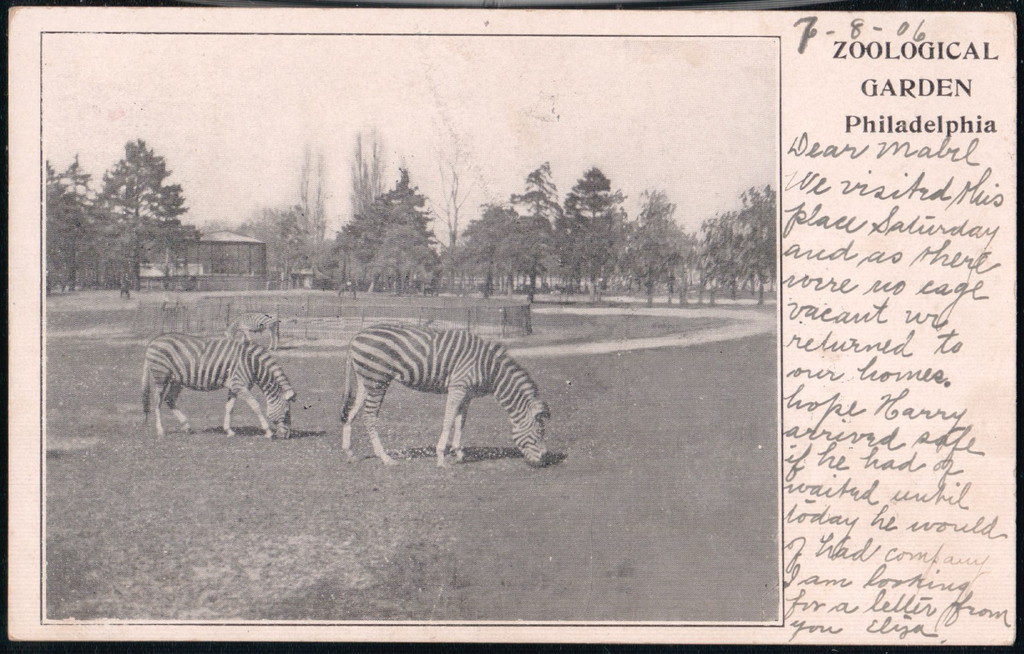
Zebras at the zoo in Philadelphia, c. 1906.
A Band Of Zebras at the Chicago Zoo, around 1909.
I'm not sure if this is the same zoo in Chicago - Lincoln Park Zoo.
 |
| Zebras at Lincoln Park Zoo, Chicago c. 1911 source |
They look to have had a better enclosure than the zebra(s) at the Milwaukee-Washington Park zoo.
 |
| Milwaukee-Washington Park zoo c. 1911 source |
Could this be the same Zebra?
This photograph taken outside the London Zoological Society
offices in 1914 shows one of the zoo's earliest forays into marketing.Four zebras pull a cart advertising a brand of tea. Paying passengers were able to sit alongside the driver.
 |
| Four Zebras and advertising cart, 1914. source |
Like mules, donkey/horse crosses, these animals would seem better suited to pulling carts than purebred zebras. “Zebroid, zedonk, zorse, zebra mule, zonkey, and zebrule” - these are the names of the offspring of any cross between a zebra, usually the stallion, and any other equine; however, the offspring of a donkey sire and zebra dam is called a “zebra hinny” or “donkra”, but are rare.
.
 |
Two zebroids (zebra/ass hybrids) drawing a cart in 1915, source
|
Grevy's zebra of East Africa is immune to tsetse fly and colonists once viewed it as a substitute for the mule. The zebra's stripes are thought to change the polarization of the light around them, making them less attractive to biting insects.
 |
| A zebra pair harnessed between mules in Kenya, 1929 source. |
 |
| Famous
African explorer, Osa Johnson, on her trained zebra, circa 1930 source |
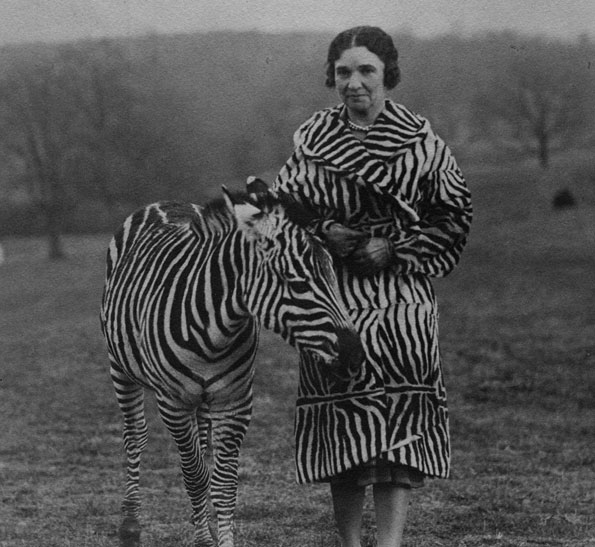
Viola Townsend Winmill, imported her zebra, Nderu, in June 1930 from Kenya and trained it to pull a cart. I love the matching outfits!
Mrs. Winmill even added a sunroom on the back of a tenant house known as Whiffletree Manor at her 350-acre farm, Clovelly. The “Zebra Room” paid homage to Nderu’s distinctive black and white stripes with lamps and rugs.
I would like the room better with plain coloured furniture. Or maybe these art deco chairs.
I am off to Melbourne next month, so I might get to see the zebras at the zoo again.
 |
| Zebras at the Melbourne Zoo |
Zoo's have there place for breeding endangered animals I think. Hunting for skins and habitat destruction have endangered both Grévy's zebra and the mountain zebra, and one supspecies, the Quagga, is already extinct. Plain zebras, or Burchell’s zebras, are the most abundant of the three zebra species, but even their habitat of the savannahs of Eastern Africa are under threat. You can help the world wildlife fund protect zebras by adopting one here.
Maybe it's just that my name rhymes with zebra that I like them. I could write a poem.
Debra
Saw a zebra
at the zoo
Maybe not.
 |
| coloured zebra via |
And by the way, according to wikipedia, the zebra's background colour is black and the white stripes and bellies are additions. And despite being black and white, it is thought that zebras actually see in colour. Who knew?!
Deb xx