Showing posts with label 1800s. Show all posts

Saturday, 17 May 2014

Regency Resources - Corsets and Stays

A few weeks ago I wrote of my plans to attend a Jane Austen festival in Canberra next April, and my preparations for same.  Well, I have begun!


I ordered the Regency Underthings Pattern (digital version) from Sense & Sensibility Patterns - a bargain at $9.95 as it includes patterns for a chemise, short stays, and two chemisettes. 


I bought 5m of fine white cotton sheeting fabric ($20) and have made my first (of three) chemises, and it is so comfortable I have been wearing it to bed! I have also made both version of the chemisettes (basically under-blouses with no sleeves) in the same fabric - they just need the ribbon draw string inserted at the bottom and perhaps a ribbon to the the frilled neck one - although I am thinking of just using a brooch. 

chemise and  chemisettes
chemise and  chemisettes
Now tackling the short stay.  My first attempt at the stay (a sort of regency bra or short corset) was too large, and I realized I had cut out the wrong size - sizes 8 to 26 are included - but now I think I have the right fit.  The stay consists of three layers, and is a bit more fiddly than the other under-things. The instructions recommend to start with the lining, which is what I have done.


Short stay - lining
Short stay - lining
I am a C cup, so hopefully the stay will hold mE in, or up, but apparently if you are a D cup or larger, a longer stay is better.

The Oregon Regency Society have some wonderful pointers about short stays -

Short Stays
I particularity love this advice -

"The rule of thumb is this, your gusset cups should not cover much more than the lower half/hemisphere of your breasts. The nipple should be just barely covered by the edge of your binding, or even half-covered.  The top half of your breasts should be pillowed in the cups.  What keeps them from falling out is the neckline of your shift. "

For some more wonderful advice, illustrations and history I have found these sites helpful and interesting -

A pair of transitional stays, from the Victoria and Albert Museum.
Another example of a cotton Regency corset (c. 1800-1825) – from the National Trust website
Achieving a proper fit with Regency stays – by Oregon Regency Society
Examples and pictures of Regency era underwear – Jessamyn’s Regency Costume Companion


Now to find a pattern for some pantaloons.....
Deb xx

Saturday, 26 April 2014

Jane Austen and a Brief History of the Regency Empire Style

I have just re-read Emma, by Jane Austen.  Now, as I am wont to do, I am obsessed with all things Emma and indeed Jane Austen. I've watched both 1996 versions of the movie, and the 2009 mini-series (forgive me if I sound a bit Austen-ish in my speech!), and I am trying to find a copy of the 1972 mini-series.

I have also been searching the the web and found, much to my delight, that there  there are thousands of Jane Austen fans out there, and even those who attend re-enactments and fairs, and dress in the period.  There is even a Jane Austen Fair here in Australia! It is held in Canberra, NSW each April, so I have just missed it - but that means I get 12 months to prepare for the next one!  I jokingly mentioned to my husband the other day and told him that the activities including dancing and a ball as well as concerts, a costumed promenade around the lake, theatre and archery, and he said it actually sounded like fun.  I couldn't believe it, as normally he is not too keen on my vintage obsessions, so we vowed then and there that we would attend. How exciting. Now to study the period and plan a wardrobe. For both of us....

Napolean and Josephine

The 2015 Jane Austen Festival will be celebrating the 200th Anniversary of The Battle of Waterloo, as well as Jane Austen’s Men, so I would like to make a wardrobe that could have been worn in 1815.  Napoleon of course was the instigator of the Empire Silhouette -  he admired the ancient Greco-Romans and their fighting style, and their draped, tubular, less-corsetted, high-waisted fashion became popular with a public wishing to differentiate themselves from the aristocracy with their powdered wigs, panierred skirts and extreme corsetry. Josephine did a lot to promote the style, as fashion was no longer dictated by the court at Versailles and the sometimes over-extravagant Marie Antoinette. Gentlemen also began to wear trousers, in the fashion of French peasants,  instead of the knee breeches and stockings that had been popular for centuries.
 
Rutger Jan Schimmelpenninck with his Wife and Children c. 1802
I find it interesting that even through Napoleon was an enemy of Britain, the Empire silhouette was taken up by the British, and her colonies, and most of Europe, except perhaps for Spain  - the British, often seen as straight laced and conservative, adopted a fashion that almost allowed the natural form of women to be shown, with only a few layers of fine muslin, cotton or silk fabric and the top of the breasts often actually visible! It is thought than 'Dandy' Beau Brummell introduced the male fashion of trousers to Britain, along with the cravat, and tailored linen jackets.  Linen jackets also became a trend in women's fashions - the shortened spencer to wear with high waisted dress - as did linen skirts.  Perhaps he was also partly responsible for the Empire dress craze for women, or maybe women were just eager to embrace practical fashion that actually allowed them some freedom of movement and routine. Or perhaps it was the British who started the trend and the fashion moved from Britain to France.

Even the Prussian aristocracy did not want to be aligned with the French royals - here is Louise of Mecklenburg-Strelitz, (1776-1810) the wife of king Friedrich Wilhelm III of Prussia, in 1798, before she was pursued across Europe by Napoleon. Her skin is so pale it'a little hard to see where the dress begins, but it is quite low cut with a little sheer fabric across the breasts and is obviously in the empire style with gathers under the bust. Is she wearing neck protections?!

Portrait by Nikolaus Lauer, 1798

It's as if women suddenly thought "let's just ditch the dress and wear our underwear!" In  the painting below you can see the young girl with her simple white chemise style dress, the older girl with her dress gathered under the bust, and her mothers similar but with an extra cross-over piece (probably for ease of breast-feeding). The father has his top-coat on so one would assume the women are not in their underwear.

Painting of a family game of checkers ("jeu des dames")c. 1803, Louis-Léopold Boilly

As the style progressed the skirts began to flatten at the front and gather just from the bodice at the centre back, as in this example from about 1810. Note the very sheer patterned muslin over a plain chemise.


1812

The Empire style did waiver a little in France, as it was said that many women were dying from cold because of lack of clothing.  However, when a newspaper report told of  Madam Hamelin, the first woman to run the Théâtre de Paris, adopting the style, it persisted.

Madam Hamelin
Other fabrics were used - thicker cottons and silks in patterns, florals, checks and brocades - and shawls and spencers did protect the wearer from chills (Mr Woodhouse would be happy).  The patterns, and a slightly shorter ankle length, also prevented the dress from becoming dirty so quickly.


There are examples of dresses from the period in bright blues and yellows, and even red and tartan. (You can see my pintrest board for more examples).

Silk tartan dress
I do love this period of fashion - it looks quite comfortable and easy to wear, and actually quite modern, especially  compared to what came twenty and even fifty years later. The style was sort of taken up again one hundred years later, in the 1910s, with the tea-dresses in the neo-classical style, although the breasts were not quite such a feature.  Maybe another 100 years on we are due for a resurgence? Not too far fetched an idea, as the maxi-dress is already popular!

Although it was a time when the distinction of styles among the classes was quite blurred, middle and upper-class women did distinguish between "morning dress" (worn at home in the afternoons as well as mornings) and evening attire — generally, both men and women changed clothes in preparation for the evening meal and possible entertainments to follow. There were also further gradations such as afternoon dress, walking or promenade dress, riding habits, travelling dress, dinner dress, etc.

Morning or domestic dress, 1811

According to "The English Lady's Costume", published in London in 1811, morning dresses were worn inside the house and were high-necked and long-sleeved, covering throat and wrists, generally plain and without decoration.  Evening gowns, on the other hand,  were often extravagantly trimmed and decorated with lace, ribbons, and netting. They were cut low and sported short sleeves, baring bosoms - not beyond the boundaries of decency, however, especially for those past the blush of girl-hood.

Carriage or promenade dress, 1811
So it appears, that at the very least, I need to sew a morning dress, a carriage or promenade dress and an evening dress for my self, and have accessories such as gloves and a shawl, and at least a sun-hat.  I plan to find some patterns and make a first dress in calico or muslin and experiment. I will look at each style of dress in more detail as I go.

In the meantime, I have a few more (free) books for my reading list -

the rest of   "The English Lady's Costume" - which can be read online here; and

"The Age of Napoleon: Costume from Revolution to Empire, 1789-1815" - online here.

Saturday, 8 December 2012

Vintage Hand carts, Billy carts and Goat Carts

At my children’s school concert the other night the grade sevens performed a little skit about billycarts, taken from the ‘Unreliable Memoirs’ of Clive James. At about age 10 in 1949 Clive’s exploits at going down ‘Billy Cart Hill’ were hilarious, and got me thinking about billy carts, how they came to be and how we don’t really have them any more.

Australian 'billycarts' were used as early as the 1880s. They were either literally drawn by a billygoat - hence the Australian name 'billycart'- or small two wheeled hand carts for which the name billycart had already become a generic term.

cart
Australian Child's chair cart, 'mail cart' c.1890-1930 
billycart-1253846078--5021924038656004096
Billycart, c. 1950-1970. source

Billycart is also an Australian variation of the English goat cart which, like the dog cart, was originally an 18th and 19th century form of animal propelled cart. A later development - the mail cart - was a two wheeled vehicle designed to be pulled by children as a play thing. The British firm Simpson, Fawcett and Co   advertised these in the 1870s emphasising their exercise value.  Here is an invoice on headed paper from Simpson, Fawcett & Co. to Leeds Pail and Perambulator Works from 1879 with illustrations of 'Hammock woodenette' patent number 56, and 'Royal Mail cart' .

ad cart

Here is an actual mail delivery cart from about 1900.

post-barrow
source

. The mail cart, which could hold a young child, was also a precursor to the modern pram.

First_Pram_crop
Victorian mail cart pram, c,1898 source

1900-philly-baby-carriage-ad
Ad from 1900 source
   
In his 1952 memoir, Sydney bookseller James Tyrrell remembered as a boy using a 'billycart', or what was probably a form of mailcart/goat cart without the goat, to deliver books for Angus and Robertson.   Similar carts were used by bakers to deliver bread, such as this one in England c. 1903.


bread-cart-c1900
source

billycart
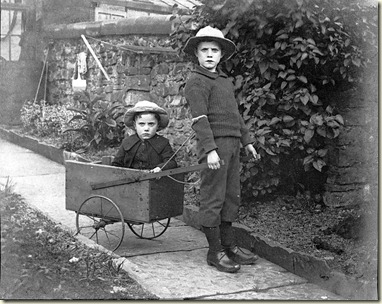
One small boy pulling another in an early billy cart. They are on a path in a back yard, c. 1915 source.

Later billy carts had four wheels and steering ropes, and were a home-made versions of commercially produced - and hence relatively expensive - pedal cars. like this one from about 1922.
antique_pedal_car_1922_
pedal car c. 1922
Of course they didn’t have pedals or hand cranks and were pushed or ridden down hill. They didn’t really have breaks either. Anthony Hordern and Sons Ltd, Australia’s largest department store at the time, was advertising billycarts in the 1920s - these were essentially the two wheeled mail carts of the late 19th century. However it was around this time or a little later that the 'modern' billycart developed as a fruit box with wheels or the more sophisticated H-shaped frame with rope controlled steering.

Harnessed goats were also used in a variation of this two wheeled cart - again using the term goat cart or 'go-cart'. Here are two boys playing with a small two-wheeled home-made goat-drawn cart, made from a wooden fruit box or crate marked 'J.T. MORTON' on the side.

goat cart australian


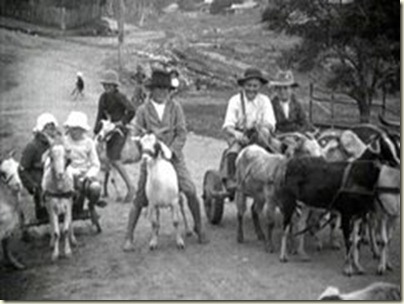
Billy cart racing(with goats) became a popular pastime for Australian children in the 1920s and thirties.  Here is a still from a 1920s  featuring boys riding on the back of goats and children in billycarts on the streets of Rockhampton, Queensland.

race


And Goat racing in 1926 at Ariah Park Sports Day - Ariah Park, NSW

goat racing aust
source

This goat cart, pulled by the champion goat "Coongal", gets privileged service from a Queensland Police officer as it crosses Queen Street in Brisbane, c. 1930.

traffic_police


Billy cart or goat racing is still a sport in Australian, although it has been condemned over the last few years for being harsh to both goats and children, as poorly trained feral goats have been used. Goats were usually well trained to pull carts in days gone past, and they were a re part of the family.
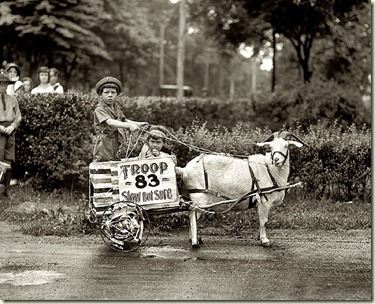
Billy carts, or goat carts were also popular in the US. with families from all walks of life.

5qtVgoat-cart-1920s-photograph
Scout troop goat cart c 1920s source

lang-39
Children with a goat cart in North Dakota c. 1930 source
source
The Harrison children, c. 1891 source
I think this is a great way to get around, don't you?! I can't imagine children now having this freedom though, although I do think goats are the perfect pets - they are vegetarian, could eat the prunings and vegie scraps, trim the grass and maybe even give milk. 

Of course pigs and dogs were also used to pull carts, and when dogs carts were outlawed in the UK in about 1840 as cruel, many dogs were killed as their owners could no longer afford to feed them.  Dog carts did continue in Belgium and some other European countries until the 1930s, and in WWI instead of pulling children, milk or bread they were used to carry guns or rolls of barbed wire for barricades.
source
Some large dog breeds would appear very suitable for pulling carts - they were bred for it after all. Like this Bernese Mountain Dog.

source

Today,although dog carts aren't used for commercial purposes, they are used as means of entertainment in a sport called carting, dryland mushing or sulky driving.  Just like sledding without snow, and it is done also by sled dog owners in the off season to keep them fit.

My eldest son used to walk the dog by letting him pull him on a skateboard, and my staffy now loves to pull me when I'm on my bike.  You'd think that if a dog is capable of pulling a human, it could pull a small cart of bread or ice cream.   Imagine a dog, or goat, drawn ice cream cart at the park or beach. My kids would love it - what a novelty, especially in this day and age when so many families cannot afford or have the space to have a pet.  And my dogs would think they'd died and gone to heaven if they could hang out with me outside all day and be petted by kids.  Maybe with regulations to prevent cruelty dog carts could become popular.......what do you think?


Deb xxx

As usual, more cart photos on tumblr.


Wednesday, 28 November 2012

Ostrich Feathers in Fashion


Ostrich Hunt, Etched by Stefano della Bella c. 1654 source

Ostriches have been hunted and farmed for their feathers, skin, oil and meat since Roman times.  Ostrich feathers have been used in fashion for thousands of years and were at one time worth more than their weight in gold.

Golden Gate Ostrich Farm Certificate for 5 Shares of $10 each, issued 26th Nov 1912 source

Ostriches are native to the African continent but are farmed worldwide.  Ostriches are so adaptable that they can be farmed in climates ranging from South Africa to Alaska.  It is thought that ostriches were domesticated at Oudtshoorn- a town on the southern most tip of Africa, where Ostriches roamed the plains  for centuries.   The modern domestic ostrich was bred from a cross between South Africa's indigenous bird, the South African Black, and the Evans-Lovemore strain of Barbary blue-necked ostriches (141 of which were secretly smuggled out of North Africa and brought to Oudtshoorn by a group of adventurers), and farming began in about 1860.

A Poke Bonnet c. 1860, source


Silk dress with ostrich feather trim c. 1875 source

Ostrich feathers in ladies clothing and hats was the height of fashion in Victorian and Edwardian Europe where they were especially popular for use on the latest fashionable hats. 

American silk and wool hat with ostrich feathers c.1910 source


c. 1911, source


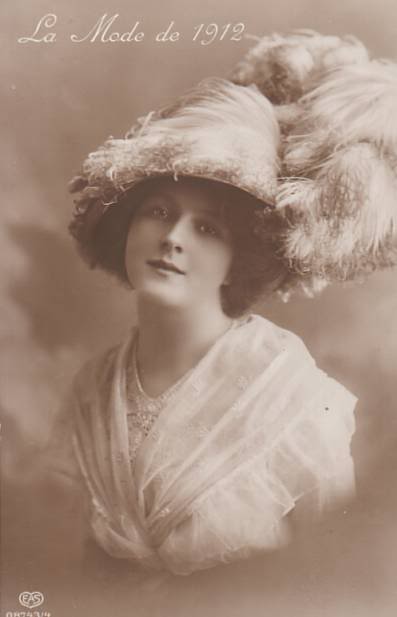
A headline inThe New York Times from 1912 read: OSTRICH FEATHERS ONCE MORE IN WIDE USE. The article explained: “For hat trimming one plume, full and long, is considered sufficient, and in almost every instance the tip of the plume is placed toward the back of the hat, or resting at the back of the head.”
Between 1875 and 1880, ostrich  prices reached up to £1000 per breeding pair, and farmers of the region, quickly realised that ostriches were far more profitable than any other activity. Numerous immigrants, particularly the Jews of Eastern Europe and Lithuania, moved to Oudtshoorn, so that it earned the nickname "Little Jerusalem" by 1890.  By 1900 there were over 700,000 birds in captivity world wide, including in Australia and new Zealand

"Ostrich farming in Auckland District. Young Birds inspecting visitors, Helvetia Park, Auckland," 1905, 

 The best plumes are from the male birds were carefully cut, with sharp scissor like tools, and used for women’s hats as well as  capes, hand fans, boas, muffs, and trimmings on a variety of clothing and accessories.  At the peak of their popularity during the “feather fashion craze” of the early 20th century, plumes were found in dozens of sizes, made into fantastic shapes and amazing types. 

Fan of mother of pearl & ostrich feathers c. 1900 source

Fan dancer c. 1910


a Russian singer with Feather boa, c. 1900

South African ostrich feather dusters were developed in Johannesburg, South Africa by missionary, broom factory manager, Harry S. Beckner in 1903. He felt that the Ostrich feathers made a convenient and most efficient tool for cleaning up the machines at the broom factory.  By 1905 the Ostrich Duster was the must have item in many a household and were sold in ever increasing numbers which saw the introduction of the  feather duster salesman!  

Ostriches were also valued for their leather, which meant that in the 18th century they were almost hunted to extinction.  It is claimed that ostriches produce the strongest commercial leather, and it is highly prized for its strength and beauty and is still used today for shoes, purses, wallets, luggage and other small accessories.

Cawston Ostrich Farm,  in South Pasadena, California , just 5km north of downtown Los Angeles,  was opened in 1886 by Edwin Cawston as  America's first ostrich farm, after he imported fifty ostriches from South Africa (although less than half survived the journey).  Ostrich farms soon became popular tourist destinations. Guests could feed the birds and could be taken for ostrich drawn carriage rides or ride on the birds back, and women could buy leather products and feather hats in the farm's shop.

Children in an ostrich pulled cart at the Cawston Ostrich Farm, South Pasadena c. 1925


A thrilling ride at Cawston's c. 1927 source

It was primarily the invention of the motor car and the advent of the First World War that brought the Ostrich Feather Boom Era to an end. Faster open vehicles played havoc with the ladies’ splendid feather decorated fashions and fashion trends in 1914 and onwards were generally more sober and less flamboyant.

The burst of the 'feather bubble' wreaked havoc on thousands of people, particularly, argues Sarah Abrevaya Stein in her  book Plumes: Ostrich Feathers, Jews, and a Lost World of Global Commerce,Jews, such as those of Oudtshoorn and their relatives elsewhere. 

Ostrich feathers did pop up now again after WWI, and examples in fahsion can be found from every decade.  Look at this stunning dress by Louiseboulanger, from 1928, with trim of individual filaments of ostrich plume knotted together to form longer strands, each dyed a different tone for the effect of an ombré cascade.


Dress by Louiseboulanger, c.1928 source

In about 1934 Chanel designed a gown and matching evening cape  in black silk crêpe and embellished with combed ostrich feathers, suitable for a 1930s dance hall or a private cocktail party perhaps.

Chanel, c. 1934 source


Ginger Rogers wore a similar ensemble in white in the musical  "Top Hat" with Fred Astaire in 1935.


Ostrich feather hats, with smaller feathers, were also popular in the 1940s.

American dinner hat, wool with purple ostrich feathers. c. 1942, source
And the fifites loved glamorous feather slippers!


The 1961 French film L'Année dernière à Marienbad (released in the USA as Last Year At Marienbad and in the UK as Last Year in Marienbad)  directed by Alain Resnais heavily featured ostrich feathers, in costumes designed by Chanel.

 Delphine Claire Beltiane Seyrig in  L'Année dernière à Marienbad, source

This dress is by the  House of Dior, designed by Marc Bohan (French, born 1926), c. 1965–68, in yellow silk, with black ostrich feathers, sequins and beads.

House of Dior c. 1960s, source 
Here's a stunning 1979 number by Bill Blass, silk with ostrich feathers.

Bill Blass, c1979 source
Vintage Ostrich feather Dress with paisley pattern, by James Galanos, c. 1980s source
Strangely enough, it is now the car industry that uses the most feathers.  According to BMW's Munich Factory in Germany, the most important part of a cars finish is the paint shop, the cleanest section of the factory.  The workers wear dust-free, lint-free overalls from head to toe, and to get the best finish each car's shell is dusted down by an amazing machine that gently strokes it all over with Ostrich feathers before painting.

There are still many uses for ostrich feathers in fashion around the world.  When I think 'feathers' the Rio Carnival springs to mind, as do Las Vegas showgirls with thier giant feather fans. Feather boas are still popular, and feather trimmings and plumes are still used as accessories in the millinery industry, and on ladies evening gowns. Here is a lovely ensemble from Oscar de la Renta's winter collection 2004/2005, with a subtle ostrich feather hemline.


Oscar de la Renta 2004/5 source

Hilary Swank's Gucci gown at the 2011 Oscars is a lovely example of elegant ostrich feathers.


 And subtle feather use on this cute modern fascinator.


Of course there are always traditional feather fashion, such as the Order of the Thistle with their black velvet hat  trimmed with white ostrich feathers and a black egret or heron feather.


Prince William, Earl of Strathearn, after becoming a Knight of the most ancient and most noble Order of the Thistle
 source

Do you like feathers?

Deb xx