Showing posts with label 1940s. Show all posts

Wednesday, 28 January 2015

Vintage Fashion - A capsule Wardrobe 1942 style

I have capsule wardrobes on my mind!

Here is a nice little article from January 1942 ( Australian Women's Weekly), with a seven piece wardrobe in oatmeal linen, and over-checked linen with navy, blue, red and aqua. Perhaps like this colour scheme -

vintage colour scheme in oatmeal, navy, blue, red and aqua


vintage 1940s capsule wardrobe

I don't know about wearing the same blouse every day - may if there were two? Of course this would have been wartime, so fabric would have been rationed - maybe the oatmeal linen was from actual linen feed bags?!

Hmmm....

Tuesday, 11 February 2014

Vintage Fashion - Little Sally Wears Blue Jeans

Today a quick post with part two of Sally the paper-doll - you can find part one here.


I seriously love those jeans! They can work for a vintage look, can't they - just look at Marilyn Monroe (or Norma jean Baker as she was then) in this photo -

 Norma Jean Baker in a Pair of late 40's Levis 501XX RedLines, 1948
This photo comes from a wonderful blog post on the history of Levis Jeans, which you can find here.

If you want to find 1940s and 50s vintage reproduction jeans to buy, have a look at Freddies of  Pinewood, Vivian of Holloway, Lily Scarlet, and Hey Day Clothing, or for real vintage blue jeans, have a look at Etsy.

Saturday, 30 November 2013

Saturday Movie - The Yearling, 1946

It''s Saturday again, which in my home is housework day, including ironing.  Now ironing is not something that I love, especially with the weather is as warm as it is here, but now that I watch an old movie while I iron, the time goes much faster.

Todays movie (kindly aired by GEM) is 'The Yearling', a 1946 Technicolor family film by MGM which features a fawn - Bambi like - who is adopted by a young boy. But the movie is so much more than that.

The yearling Movie Poster, 1946
via

The boy, Jody, is played by ten year old Claude Jarman, Jr., and his parents are played by the wonderful Gregory Peck and Jane Wyman.   The fawn is orphaned when it's mother is killed in order to use its insides to save Peck from a snake bite.  Despite being extremely poor, the parents agree to Jody looking after the fawn until it's old enough to go back to the wild.  Of course Jody and the fawn become so attached that this proves difficult, even though the grown deer is a huge nuisance, eating crops and trashing the farm.

Marjorie Kinnan Rawlings’s novel the Yearling, 1930s
Cover, 1939

The film was based on Marjorie Kinnan Rawlings’s novel of the same name written in 1938.  It was initially published as an adult novel, and won the Pulitzer Prize for Fiction, staying top of the bestseller

Wednesday, 30 October 2013

Mid-Century Designers - Mainboucher


I was browsing the Met Museum's online collection the other day, as you do, and came across this stunning dress.


It's a satin cocktail dress designed in about 1955. The strapless dress has been lifted our of the ordinary with tiers of self petals enveloping the hips and finishing just below the knee.The cross-over wrap jacket has 3/4 sleeves (perfect for short gloves ) with a collar that can be worn up  to frame the face - perfect with a modern short haircut or up-do.

Cocktail ensemble  by Mainbocher c.1955


And the designer? Mainbocher - someone I had not heard much of, so of course had to research a little.

Mainbocher  (Main Rousseau Bocher) was born in Chicago in 1890.  He traveled to France when he was about 20, and got a job as an artist with Harper's Bazaar.  In 1922 he became the fashion editor of French Vogue, before opening his own couture salon in 1929.  Mainbocher became "the American" in Paris that any woman who could afford his luxuries, turned to. His clothes were elegant and different - strapless dresses (new in the 30s), cotton gingham evening dresses, and fabrics such as men's shirting, linen toweling, velvet and cotton pique. He also loved feminine details such as gigot sleeves ( or leg-of-mutton sleeves, popular in the 1830s), as seen in this burgundy velvet dress from 1934.

Velvet frock and hat, 1934
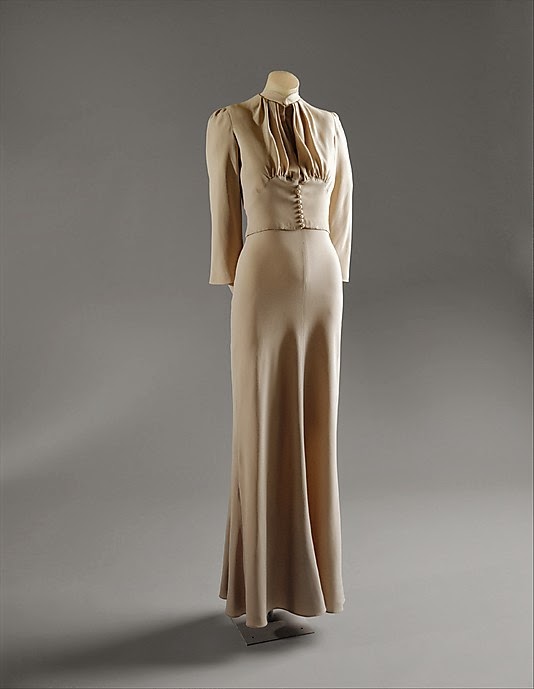
He designed much of Wallis Simpson's wardrobe, naming a color, "Wallis Blue," for her. In 1937, he also designed the wedding dress and trousseau for her marriage to the former Edward VIII (the Duke of Windsor).


A defect in the stability of the dye has caused the dress to lose its "Wallis" blue, but the styling shines through.

Wedding ensemble
At the beginning of WWII, in 1939, Mainbocher closed his Paris house and returned to New York, opening his first showroom on Madison Avenue, next door to Tiffany's at 57th Street.

Main Bocher in New York c. 1940
His final Paris collections created a storm of controversy, shaped as it was by the "Mainbocher Corset," with a nipped-in waist which radically altered the undefined silhouette of the thirties. The corset was immortalized in 1939 by Horst.
Corset by Detoile for Mainbocher, 1939 by Horst
The corset controversy proved to be a significant marketing opportunity, and in the US Mainbocher teamed up with the Warner Brothers Corset Company and streamlined the design for mass production.  He also designed women's uniforms for the American war effort, such as this Red Cross Uniform from about 1940, as well as uniforms for the WAVES (Women Accepted for Volunteer Emergency Service).

WWII Red Cross Uniform c.1940 by Mainbocher
Red Cross Uniform c. 1940s
 In 1947, eight of the New York Dress Institute's Ten Best-Dressed Women in the World were Mainbocher clients, including among them Gloria Vanderbilt, whom he designed for until his retirement in 1971, at age 81.

Horst P. Horst, Portrait of Gloria Vanderbilt wearing a creation of Mainbocher, 1966
 Gloria Vanderbilt wearing a creation of Mainbocher, 1966
The Mainbocher label is now set to be revived, after French entrepreneur Arnaud de Lummen acquired the trademark rights and intellectual property to the label in 2012. Why?

"You start with roots and a history. When you relaunch, you already have a story to tell. After a few years, people completely forget that the brand was dormant. People think it's always been there. It's reassuring to consumers that you're not a newcomer."

Ahhh...De Lummen is best known for buying Vionnet in 2006, before selling the brand to Matteo Marzotto and Gianni Castiglioni three years later.

Without Mainboucher himself, what is really the point?

More images of Mainboucher's creations here and here.

Sunday, 27 October 2013

Eye-Catching Vintage Style Lips & Tips

It's been a busy weekend here, with lots of walks on the beach, my middle daughter Aimee in a drama performance, and actually catching up with friends for dinner (see my instagram!).

So an easy post today - inspired be me wearing my Besame Red Lipstick again instead of the normal 8 hour Revlon. The red colour is just so much better! I still have to remember not to kiss the kids on the forehead.....and remember to blot!

1950s Lournay lipstick ad 1952
1952
And here's an article from 1940....


So just watch that your 'cupid's bow' is even, if you "don't want an evil expression"!

Deb

Wednesday, 16 October 2013

Vintage Beauty - Happy Birthday Linda Darnell


Linda Darnell, 1940s
Linda Darnell was only forty one when she died of burns received in a house fire, and by then her Hollywood flame was dwindling.  The gorgeous star reportedly never really wanted to be an actress and was pushed into to it by her mother, although her siblings disagree! It seems Linda was incapable of dealing with the stresses of Hollywood and ended up in a downward spiral of alcoholism, unsuccessful marriages and highly publicized scandalous affairs.  Despite around fifty movies, and being named one of the most 'beautiful people' of the 1940s, she failed to receive recognition from the industry and its critics, and disappeared from the screen in the 1950s. Her choice or not?

Wednesday, 9 October 2013

A new blog - Women in Wartime

If you have read this blog for a while you'll know that I love history, and in particular World War Two. To keep this blog more about mid-century than war, I have started up a new blog - The Wartime Woman . It's mainly just articles and pictures from my collection of vintage mags, as well as some articles and pictures from my trawl of the net, and I will occasionally do a bit of real research to.  Hopefully it will be a bit of an archive for those interested in the the war and women's roles, especially in Australia. It's also a tribute to my grandmothers, both of whom were born in 1918 and were young mothers during the war.

If you'd like to check it out, please head to http://thewartimewoman.wordpress.com/

Yes it's on Wordpress - which I am still getting used to.  Any tips welcome - especially for adding side widgets!

Here's some of the sort of 40s wartime fashion I'll be featuring.

Economy fashion from 1943
♥ Deb

Thursday, 6 June 2013

The Australian Women's Weekly launched - June 1933

I have been struck down with a horrible cold this week (thank you my darling children), so forgive my errant ways.  I am busy drinking green smoothies and garlic and lemon tea to get well by the weekend, as I am off to Sydney.  Civilization as my father kindly put it.  Hopefully lots of photos when I return. I have also been busy on my new blog -Home Lust -  in which I have been looking at houses of the 40s and 50s.  Please visit and follow if you can, I would love some followers!

Anyway, today some more history.  This weekend is the 80th anniversary of the launch of The Australian Women's Weekly, which officially began circulation on Saturday, 10 June 1933 (although the first copies of the magazine hits the streets the Thursday before).

Other newspapers of the day described the magazine as "a women's magazine that seeks to cover a wide range of issues whilst still presenting the traditional women's magazine articles on home making and cooking."  It was said to be "innovative in style and content when compared with existing women's magazines" both published in Australia or imported.

The Australian Women's Weekly, officially began circulation on Saturday, 10 June 1933
via
The Weekly itself stated that would endeavor to "cover adequately and in full detail every field of work, play or interest for women - especially where women have something at stake; to create interests for women; to be of practical help, by service and guidance, to women in domestic, social, and business life, to be of interest to all women...in every field where where women are and where their eyes will turn will be covered for them by brilliant specialists."

The Weekly did in fact align itself with women's issues and the cause of women's rights from the very first issue.  The cover above shows the story by Mrs Linda P Littljohn, a prominent feminist of the time, titled, "Equal Social Rights For Sexes: Mrs. Littlejohn Outlines Big Issues To Be Fought For", which covered the Women Voter's Federation conference. More prominently  though, are four models alongside the headline, "What Smart Sydney Women Are Wearing."

The magazine was not owned by women though. It was started by Frank Packer (a familiar media mogul name), who was only 26 at the time, together with former deputy Prime Minister and Treasurer, EG Theodore. The editor was also a man, George Warnecke, who stated that the magazine employed a comparatively large staff of women, and that he "wanted women to tackle all kinds of news while preserving the qualities of femininity."


Scottie Dogs, From the Australian Women's Weekly, June 1933
From the Australian Women's Weekly, June 1933
Some of my favorite Covers:

Australian Women's Weekly Cover, cockatoo,  June 1940
1 June 1940
Australian Women's Weekly Cover, Victory Loan, March 1944
18 March 1944
Australian Women's Weekly Cover, New Look Fashion, February 195
18 February 1950
The first 50 years of the publication Weekly from 10 June 1933 to 15 December 1982 (when it changed to  monthly)  can be viewed online at Trove Australia.  Just a little reading for the long weekend!

Deb xx

Saturday, 25 May 2013

40s Design - Scalamandre's Zebra

Continuing with my zebra theme, this week a look at zebra's in design, and in particular on walls.

 The Town House Hotel in Los Angeles was built in 1929 and was designed  by Norman W. Alpaugh.  It was once among the most luxurious hotels in Southern California.  It's "Zebra Room", featuring zebra murals and zebra patterned crockery, opened 1937 or 38.
Zebra room diners 1940s
Zebra room diners
African adventurers such as Martin and Osa Johnson had helped to make safari themes popular in the 1930s.

osa johnson 1930s zebra
Osa Johnson

A couple of years later, in New York, new arrival Gino Circiello opened his restaurant, Gino's.  He was helped with his business by Franco Scalamandre, who was known to help Italian Americans get their financial footing.  Circiello chose a zebra design wallpaper for his restaurant walls,  a creation of Scalamandre's wife, Flora.  "I chose it because I love to hunt," Circiello says, "and it is something that people will remember."

It certainly is memorable!

vintage 1940s zebra wallpaper Scalamandre

via
Scalamandre has just reissued their classic Zebra wallpaper in new vibrant colours,although I think I like the black and white version best.

vintage 1940s zebra wallpaper Scalamandre
Wall paper chic
If you don't want to wall paper your home, there is always the Scalamandre Zebra Tote.
vintage 1940s zebra wallpaper Scalamandre tote
Scalamandre Zebra Tote.
Or the silk scarf.

vintage 1940s zebra wallpaper Scalamandre silk scarf

Or even home wares - Scalamandre teamed up with Lenox for their new collection, which unfortunately is available exclusively at Bloomingdale’s

vintage 1940s zebra wallpaper Scalamandre home wares

I love the dinner setting.  I could have my own zebra room.....

Scalamandre by Lenox Zebras 5-Piece Place Setting

At $216.60 per five place setting, may be not any time soon. But a girl can dream.....

Deb xx

Wednesday, 22 May 2013

Australian Home Journal Spring 1942

Today in history a look at some of the fashions and articles from the Australian Home journal from October 1942 - Spring in Australia. My copy is a little ratty, especially the cover, but it is still very readable and has the original free patterns.


1942 was about the middle of WWII, and America had been in the war for almost a year. ' Sew and Save' and 'Make do and Mend' were popular catch cries. This article shows how to pick apart old clothes to make new ones - an evening dress into a night gown, a coat into a skirt and Mother's dress into a child's dress.

There were also instructions for making a summer hat out of left over dress fabric, and and making short socks, using only one clothing coupon instead of 4 for a pair of stockings! 


I am currently listing this and other vintage mags on Etsy, if you're interested.

Deb xx

Wednesday, 15 May 2013

Since you went away, 1944


I have just finished reading 'Come in Spinner', a giant of a novel written in 1951 about the experiences of a group of Australian women on the homefront during WWII. I haven't been able to get a copy of the mini-series  (it was a huge book), so instead I have been watching a few 'homefront' movies. The first one was the classic and well known 'Mrs Minniver' (1942), and then the less known 'Since You Went Away'(1944), which stars one of my favourite actresses, Claudette Colbert. A brief look at that one today.
Cast
Claudette Colbert as Mrs. Anne Hilton
Jennifer Jones as Jane Deborah Hilton
Joseph Cotten as Lieutenant Commander Tony Willett
Shirley Temple as Bridget 'Brig' Hilton
Monty Woolley as Colonel William G. Smollett

Hattie McDaniel as Fidelia (the maid)
Lionel Barrymore as Clergyman
Robert Walker as Corporal William G. 'Bill' Smollett II

Agnes Moorehead as Mrs. Emily Hawkins
Alla Nazimova as Zofia Koslowska 
Albert Bassermann as Dr. Sigmund Gottlieb Golden


The cast of the movie
This epic movie (almost 3 hours, and with an intermission) was directed by John Cromwell and produced by David O. Selznick (Gone with the wind), and based on the 1943 novel Since You Went Away: Letters to a Soldier from His Wife by Margaret Buell Wilder, which was in turn based on her newspaper column "Letters to a Soldier from His Wife" for the Dayton (OH) Journal Herald. Like the heroine of "Since You Went Away", Wilder was raising two teenage daughters and taking in boarders to make ends meet while her husband, Donald, was serving in Europe during World War II.


Missing you already
The story begins in small town America in January 1943, with the empty chair of of Mr Hilton, who has (finally) joined the war effort and left for training. His wife, Ann, is bereft, and her loneliness begins the moment he is gone, but she tries to be cheerful for her two teenage daughters, Jane and Brig. Without her husbands wage as an ad executive coming in, things are tight, and Ann has to sell the car, dismiss the maid and take in a lodger.  Fidelia the maid soon returns, and works for room and board in between her war work. The first applicant, a young marine, sees daughter Jane and immediately accepts the unseen room, but Ann tells him it's taken. Instead crusty retired Colonel Smollet moves in. He gets some lesson from courtesy from Brig, and turns out to be a nice guy after all.


Smollet and Brig hit it off
Smollet's almost pacifist grandson Bill soon appears and becomes Jane's love interest - once her crush on friend of the family, officer Tony, has run it's course. Jennifer Jones (Jane) and Robert Walker (Bill) were going through a horrible divorce when the movie was filmed, but on camera they have wonderful chemistry and play the parts of young love brilliantly.


Jane, Bill and Tony
It is a very sentimental, at times corny, movie, but there are some wonderful insights into the realities of life on the home front in America.  Perhaps they didn't have to worry about bombs dropping on them, but there was still the pain of separation, the loneliness and worry, the shortages and rationing, and the death of loved ones far from home.   The family and it's relationships are the main focus of the film, but there are some great scenes  that show how the war affects others. There is a scene on a train, in which Ann and her daughters are trying to get to town to see her husband before he leaves for the South Pacific, which shows wounded and limbless soldiers, a young woman with a baby who has never seen it's father, a young girl refugee, and an old lady whose nurse grand-daughter is missing in action. And then of course they just miss seeing him because their train had to wait for a supply train to go through.
The baby hasn't met his father yet
When Jane graduates high school she gets a summer job with the red-cross, and her work in the hospital prepares her for the possibility of Bill coming home injured. 


Jane in the rehabilitation room at the hospital
Brig meanwhile is helping the war effort by starting a salvage centre for paper and metal.


Unfortunately Bill doesn't  return home, and Ann has to break it to Jane - her own husband is already missing in action. She also has to tell his grandfather, the colonel, who feels guilty as he pressured Bill into being a soldier. "My grandson had to die for me to be proud of him."


Jane continues her work at the hospital, and assists psychiatrist Dr. Golden, who explains - "there's a whole wide broken world to mend". His is only a small role, but it shows that soldier
s psychiatric wounds were beginning to be taken seriously. Golden tells her to do her best to help the men rebuild their confidence in them selves.


'Agnes Moorhead plays Ann's friend Emily, who is slightly self-absorbed and pretentious, and shows us the evil and unpatriotic things that everyday people may be guilty of. When Emily tells Jane that she shouldn't be touching common young men at the hospital, Jane sets her straight, and Ann then feels so guilty for helping more with the war effort that she gets a job as a welder in a ship yard. "If Claudette Colbert can do it, you can too" seems to be the message. 


Ann meets refugee Zofia at the shipyard, and they become friends. Zofia recants the inscription on the Statue of Liberty - "give me your tired, your poor, your huddled masses yearning to breathe free" - and tell's Ann that she is what she thought America would be. Ann is floored by the compliment.


It's Christmas time, and after a cheerful game of charades, Fidelia puts presents, those she has been safe keeping for Mr Hilton, under the tree. Ann opens hers and bursts into tears. 


But then, with perfect timing, the phone rings, and the message comes that Ann's husband is alive and coming home. She rushes upstairs to tell her daughters the good news, and the movie ends a happy note - one to give hope to wives and mothers everywhere. It is indeed a tear jerker!


Like Mrs Minniver, this movie was great propaganda for the war effort. Soon after some of the stars helped to promote war bonds as well.


16-year-old Temple in 1944 in Ottawa
 at a ceremony to raise money for Canadian Victory bonds
The music score was by Max Steiner, and won the Academy Award for Best Music, Scoring of a Dramatic or Comedy Picture. You just know that when you hear the dramatic music as Bill goes off on duty that it's not going to end well, but there are some musical snippets here and there of contemporary music. 


Max Stiener, right, with his award
It was also   nominated for Best Picture, Best Actress in a Leading Role (Claudette Colbert), Best Actress in a Supporting Role (Jennifer Jones), Best Actor in a Supporting Role (Monty Woolley), Best Cinematography, Black-and-White (Lee Garmes), Best Film Editing, Best Art Direction-Interior Decoration, Black-and-White (Mark-Lee Kirk, Victor A. Gangelin), and Best Effects, Special Effects. It lost out in most categories to the comedy 'Going My Way' starring Bing Crosby.

If you have time, you can watch the entire movie here.


Deb xx