Saturday, 15 September 2012

Ladies Fashion of the 1860s


There were two main trends in 1860s European and European-influenced fashion, which of course includes Australia.  One was characterized by extremely full skirts that used crinolines and/or hoops to give them body and often lots of of trimming and embellishment.  Crinolines were originally used in the 1830s, and were petticoats made from the material of the same name, which was  a linen mixed with horsehair. The word comes from the French for 'crin' and 'lin', meaning horsehair and linen respectively.  This thicker, but possibly itchy, material replaced the layers of petticoats that were used earlier. By the 1840s layers were gathered and sewn onto a petticoat lining, giving even more fullness.

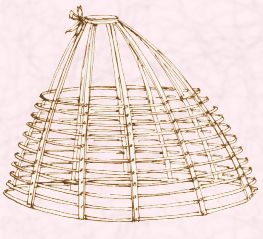
Even with all this gathering upto 6 petticoats were used to achieve the desired result.  this would be quite hot of course, and so developed the crinoline cage, or hoop in the late 1850s.  Hoops were quite involved structures made of cane and fabric, before being made and patented  in metal by an American called W. S. Thomson. These “American Cages” needed only one petticoat over them to soften the cages lines.  If you have ever worn a modern hoop under a dress, you know how awkward they can be to wear, let alone put on.  These cages did result in lots of breakages too, but the fashion persisted.

You can get a feel for the size of the skirt in Manets painting below.

Lady with a Fan, 1862 by Édouard Manet

This was the type of fashion common in civil war America, as portrayed in Gone with the Wind. 

The other fashion was almost the extreme opposite, rejecting highly structured clothing in favour of simple, almost streamlined designs and beautiful fabrics. This second trend, or alternative fashion, was influenced by the Artistic Dress movement.  This Artistic form of dress was considered ‘anti-fashion’ and spread in the 1860s in literary and artistic circles, by followers of the Pre-Raphaelite Brotherhood that had formed in the late 1840s in opposition to the classical poses and art of Michelangelo (the painter of the Raphael) and his followers. They considered the fashion of rigid corsets and hoops as both ugly and dishonest. The movement itself preferred the art of Flemish and medieval painters, and the artistic style of dress was characterised by "medieval" influences such as juliette sleeves, the soft colors of vegetable dyes (rather than the artificial new pinks and purples), narrow skirts, and simple ornamentation with hand embroidery.

This style of dress can be seen below in Whistler’s painting of 1862, and also in the poster for Gone with the Wind, were the older, more sophisticated ladies seemed to be wearing more streamlined gowns by the end of the movie.

Symphony in white 1 whistler

Symphony in White, No. 1 by James MacNeill Whistler, 1862. source

By the early 1860s, skirts had (thankfully) reached their ultimate width, and were quite bell shaped. Morning dresses featured wide pagoda sleeves worn over undersleeves or engageantes. High necklines with lace or tatted collars or chemisettes  (false blouse) completed the demure daytime look.  You can see these features in this 1861 plate from Godey's Lady's Book.
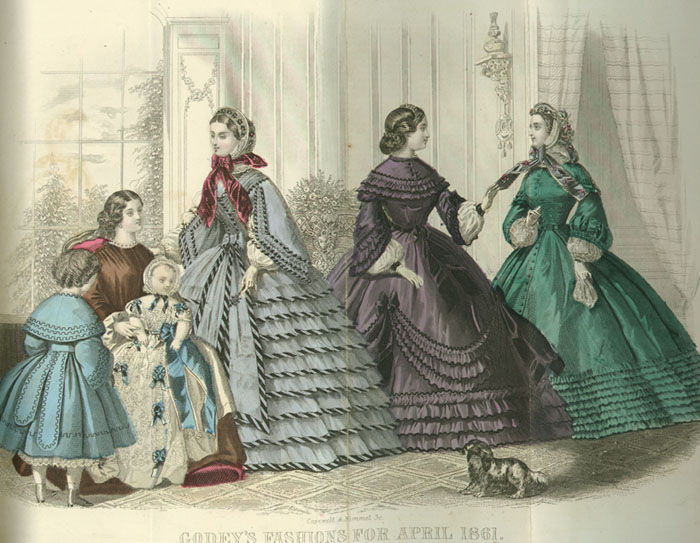
File:Godey-april-1861.jpg

A few years later and the skirts became flatter at the front, but still projected out quite a way behind, as in this ad from 1865 in Harper’s Weekly.
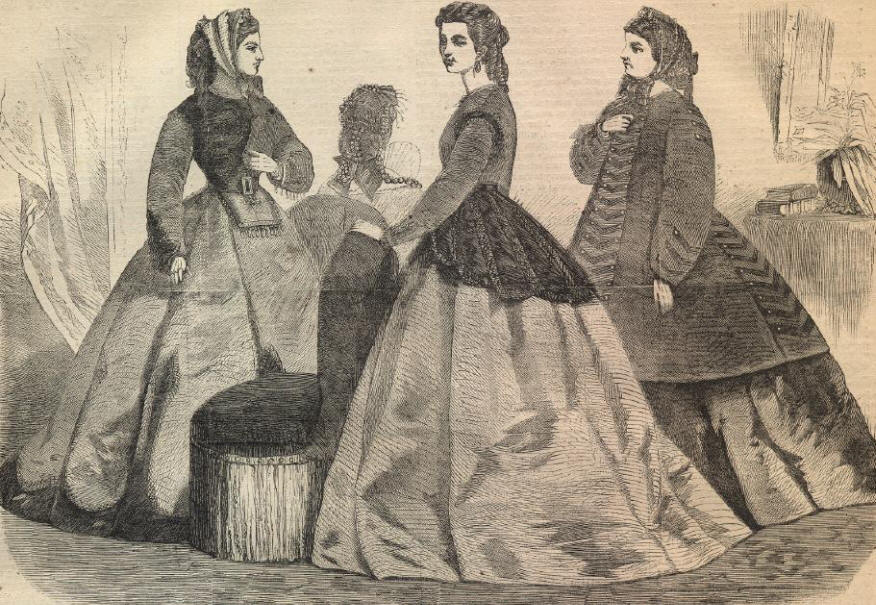
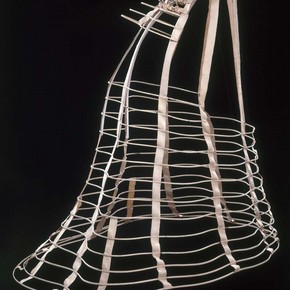
A cage crinoline with a a flatter front.

Evening dresses had low necklines and short sleeves, or even sat off the shoulder, as in the painting below.  Often short gloves or lace or crocheted fingerless mitts were worn.

1861 Marii Sawiczewskiej by Leopold Löffler

Skirts were now assembled of shaped panels, to give the required width at the hem but with less bulk at the waist. Heavy silks in solid colors became fashionable for both day and evening wear.   The first chemical dyes in mauve and bright purple were discovered in 1856 and quickly became fashionable colors.  Sometimes a skirt was made with two bodices, one long-sleeved and high necked for afternoon wear and one short-sleeved and low-necked for evening.

As the decade progressed, sleeves also narrowed, and looped up overskirts became popular, either with matching or contrasting underskirts.  The crinoline gave way to the Crinolette,  a hybrid of the later bustle and crinoline, where the cage structure was still attached around the waist and extended down to the ground, but only down the back of the wearer’s legs.   There was also the ‘Tournure dress improver’ also made of the horsehair material, that was also worn at the back of the skirt

This was quickly superseded by the true bustle, which was sufficient for supporting the drapery and train at the back of the skirt.  You can see the beginning of the bustle below in an evening dress with crinolette from about 1868.

1868 (estimated) Queen Maria Henrietta source

Fashions were adopted more slowly in America than in Europe. It was not uncommon for fashion plates to appear in American women's magazines a year or more after they appeared in Paris or London, and the same was true in Australia.  In the photograph below Mrs Tulley in Australia wears a very full skirt with crinoline, in about 1868.  It’s hard to see in her sitting position, but it does look like the bell shape rather than the flatter front version which was popular in Europe by now.

 source

In this photo from 1866 although the skirt is full, the crinoline does not seem too large – maybe Ms Anna Darsey was not as fashion conscious. Being from Undulla, a long way west of Brisbane on the Darling Downs, maybe she just didn’t feel the need, or was she influenced by the movement?

I can picture her in breeches and a blouse, as would be practical for life on a farm, but maybe she also wore a riding habit  - a fitted jacket with long sleeves, worn over a collared shirt or  chemisette. They were worn with long skirts and  fashionable hats. This 1856 French fashion plate from Journal des Demoiselles, shows a fair lady riding side-saddle with a very full skirt which reaches almost to the ground. At least there is no cage!

The fashion for long riding habits did not miss Australia.  Here is a photo from 1865 of a lady equestrian from Wangaratta, Victoria. You’d really want to have a large horse and not a pony.

  source

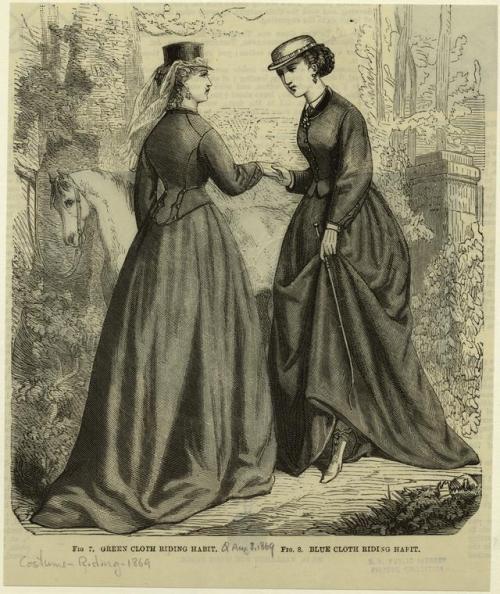
These English riding habits, originally published in The Queen, Aug. 1869, are still quite long too. English riding habits originally published in The Queen, Aug. 1869.
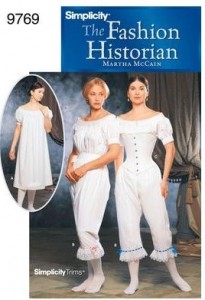
Let’s face it, ladies in the 1860s did not wear pants.  Even for horse riding.  Pants, or drawers,  were worn as undergarments only.  The long pants were needed in case the cages upended.  I have just ordered this Simplicity pattern – how exciting!  Far too pretty for just underwear though….   Simplicity 9769
Of course the other main undergarment apart from the nightie like looses chemise, was the corset, which I will look at next time….

I really do love those riding habits though – maybe I should take up side saddle?!

Deb  xxx


Friday, 14 September 2012

Mackay 1862


Earlier this year I was fascinated by 1942, a time 70 years ago when the world was at war.  Now it is the Victorian era that is stirring my fancy, maybe because of my new interest in Steampunk. According to Wikipedia, the Victorian era of British history was the period of Queen Victoria's reign from 20 June 1837 until her death on 22 January 1901, although the Victorian Era style of clothing is seen to continue until about 1912.
In Steampunk it is British Victorian history and fashion that is paramount, with twists from US military costume (the civil war was going on of course), the wild west and world explorers etc.  Steampunk is not huge in Australia, but I thought I might go back and have a look at some Australian history and fashion during this time,and I thought it would be nice to start around 150 years ago, in 1862, which coincidentally is the year the town of Mackay, where I know live, was founded.
Mackay is on the coast of central Queensland, about midway between Rockhampton and Townsville and 820 km north of Brisbane. It now has a population of about 85,000. 

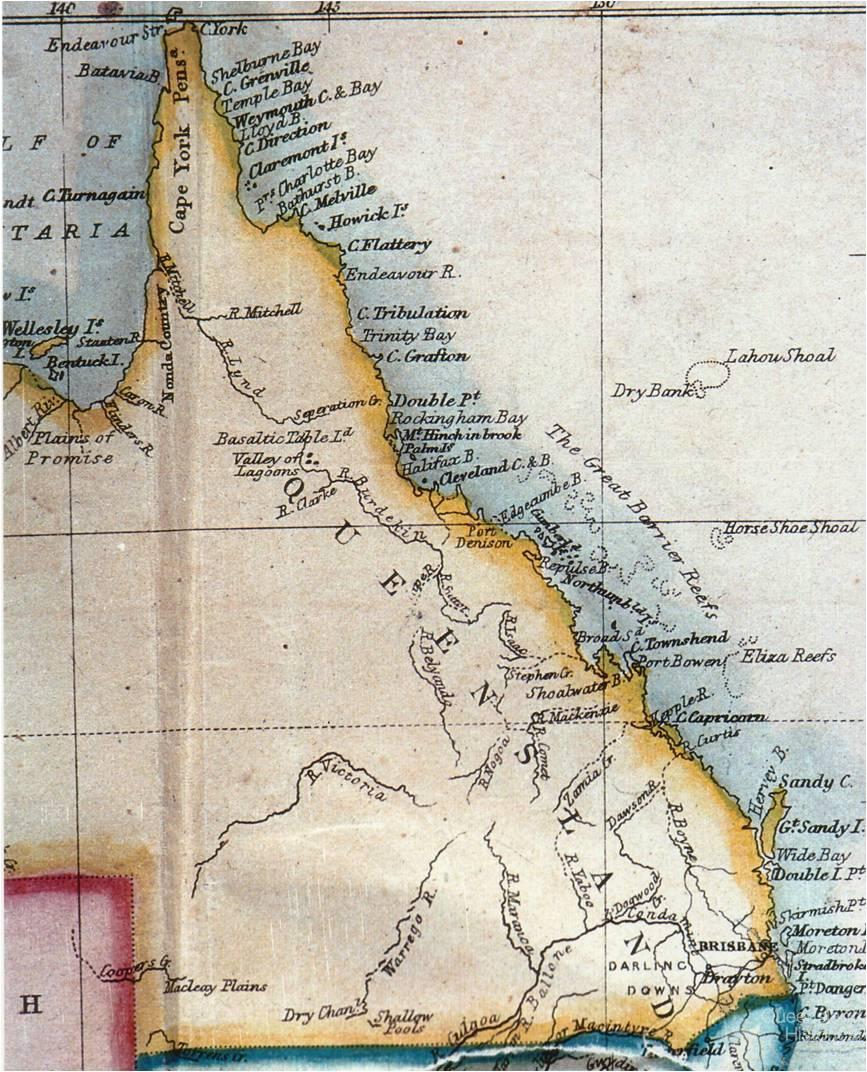
Map of Queensland in 1861 - neither Mackay or the 'Pioneer River is on it, but it  is the area just south of Port Dennison (now Bowen)
 I don't know much about the history of Mackay, having grown up in Melbourne, Victoria and studied history from a Victorian (Australian) viewpoint, and only having been here for ten years, but I am to find out more.  Let's start with the basics:
Mackay itself was named after the explorer John Mackay who led an expedition from Armidale, New South Wales, in search of northern grazing lands. In May 1860, after exploring inland regions, Mackay reached a huge blue river, which he named after himself.  In 1862 he and a partner took up a pastoral run along the river,  at a site now known  as Greenmount, which is about 14 km west of the town of Mackay.
Greenmount Homestead, Walkerston, Mackay
Greenmount Homestead

The venture did not last long, and in 1915  Albert (A. A.) Cook established the first Aberdeen Angus cattle stud at Greenmount, and built a homestead.  His son Thomas Albert Cook carried on the business. The house is still standing and is open to visitors.

Albert is pictured with his children Althea (on the bike), John and Tom  in the front yard of Greenmount  Homestead . source
Late in 1862 Governor Bowen and Commodore Burnett changed the name of the river to Pioneer,   the name of the boat they travelled in.  This was to avoid confusion with a Mackay River at Rockingham Bay (since renamed Tully River), but they then named the new town on the south bank of the river near the coast after Mackay. By 1870s Mackay had a booming sugar industry (as it does today) and the town was quite grand. By 1871 the population of Mackay was 729 and grew to 2075 by 1881 with the arrival of immigrants, mainly from Scotland, and of workers from the South Sea Islands.  
Cedars Sugar Plantation near Mackay c. 1880 source

By the 1870s there was also a mining industry in the area, mainly for copper - today's mining industry is mainly coal. 

The climate in Mackay is tropical - hot and humid in summer and warm in Winter. I wear a jumper perhaps a dozen times a year, and love air-conditioning in the summer.  Imagine wearing these fashions from 1860 in Summer here!

London fashions of 1860 source

I'm off to do more research......
Deb xxx 

Tuesday, 11 September 2012

Steampunk Love

I don’t know how I have been around so long and not heard of Steampunk before.  I have seen it, in movies such as Wild Wild West and the Extraordinary League of Gentlemen, and even the kids movie Atlantis.  I have loved Jules Vern forever too, and the scene in Back to the Future 3 where Doc makes a time machine out of the old steam train.  And also Dr Who and Captain Jack from Torchwood and basically any historical fiction or time travel movie or book.  Basically, (according to Wikipedia) "steampunk involves an era or world where steam power is still widely used—usually the 19th century and often Victorian era Britain—that incorporates prominent elements of either science fiction or fantasy."  
Remember that giant spider robot in Wild Wild West?
The Steampunk band Abney Park in their song Steampunk Revolution sing of being sick of evolution, and having a revolution -  “in with the old and out with the new’.  This song really explains a lot about what Steam punk is, and the video is great  - see it here on youtube. 
Part of the Steam punk philosophy is “Use what you have”– when things are broken, figure out how to fix them, and find out how things work.  I think Steampunk will suit my youngest son – he loves to collect old shiny things and make them into other things.  I can fix things like clothing, and of course I love to thrift, but mechanical things are a little beyond. me.  My dad on the other had is brilliant at this, and will hopefully pass his skills on to my son.  For example Dad has part built and renovated every house we have ever lived in, and recently when the fan on his tv broke he used a normal fan set up behind it until the replacement part arrived (which he then installed himself).  I have also just found  instructables which has loads of videos on how to fix things too.
  source  source
There is Steampunk fashion, which I love – very vintage. Although costumes can include corsets, long Victorian dresses, blouses and top hats, much like burlesque, much of it can be worn everyday, like vests, white shirts, boots, jodhpurs or khakis and suspenders. Goggles and monocles are popular for certain Steampunk looks, and others are associated with more extreme articles of costuming, such as mechanical arms or ray guns.  Although you can buy ready made steam punk costumes, they really are just costumes, like something you would wear on Halloween.  More important in Steampunk, as with any vintage style, is to make it your own – make it personal.  Get a thrift or army disposal item and modify it.  Take it in, hem it, create a ruffle.  Artvixn has a great book on the Steampunk archetypes, and a great introduction on how to dress Steampunk on Squidoo, if you are interested.  The main Steampunk styles are The Lady/aristocrat/dandy, The Aviator/explorer, the military man, the western/hunter/fighter the femme fatale/Lolita and the inventor/mechanic/scientist with derivatives within these.   I love the explorer look – it’s so practical, if only I looked good in jodhpurs!
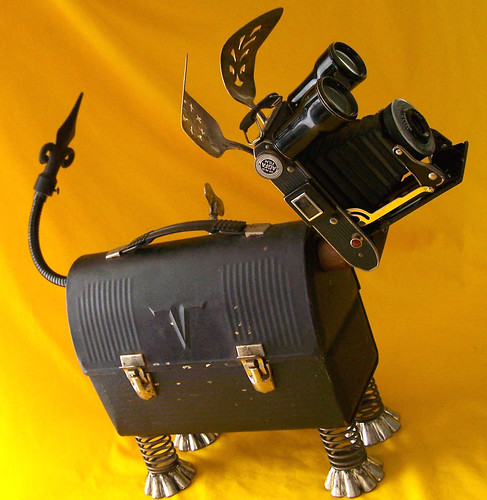
Of course you can also get steam punk inspired sculptures and  jewellery, which my daughters love.
 sourcesource
 
I love this seahorse, of course.  Maybe some steam punk inspired seahorse jewellery…….and steam punk interiors also abound:
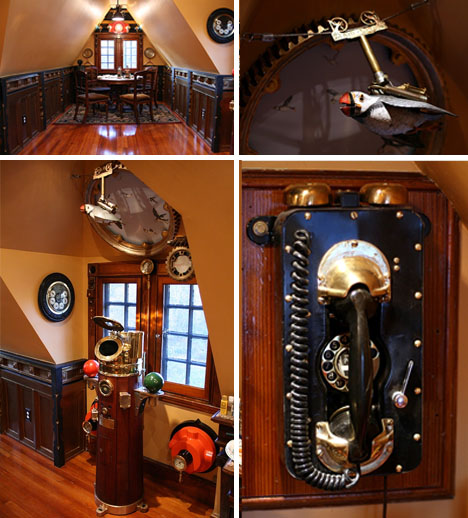
The Edison  in LA’s historic centre, with an amazing website you just have to see for yourself (make sure the sound is on!) by Kelly Architects.

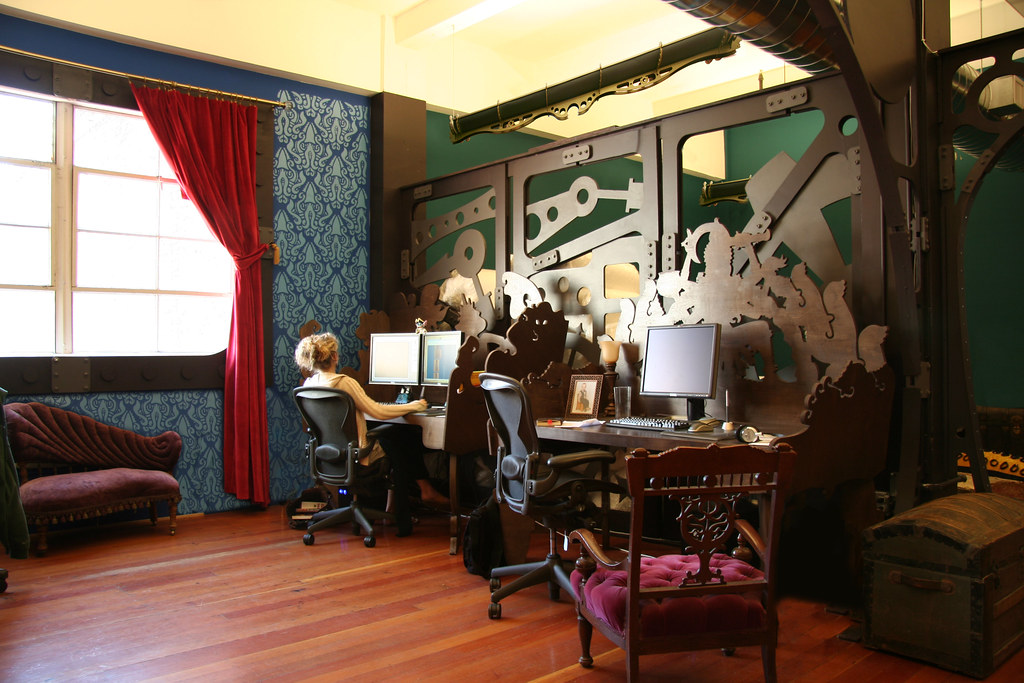
An open office space for Three Rings game development studio in San Francisco, designed by Because We Can, with workspaces for over 20 people, a game  room, lounge, and a bike storage rom.  Wouldn’t you love to work there!
IMG_2978_2
Bruce and Melanie Rosenbaum began fixing and enhancing period pieces for their own house, and then founded restoration and redesign business ModVic.  Go to their website for a virtual tour of their amazing home.

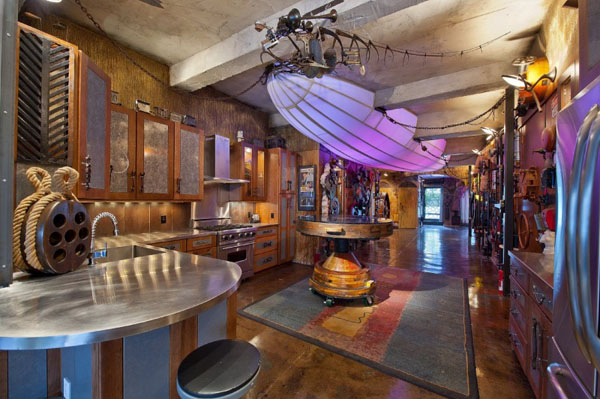
A Steampunk Apartment designed and built by movie producer Jeremy Noritz.
Steampunk NY flat
You can see more photos here.  Hmmm, a zeppelin light, now there’s an idea…..
So Steampunk – do you love it or hate it?
Deb xx


Wednesday, 5 September 2012

Erstwilder Retro Jewellery

The lovely Laurence at Lost in the 50s in Belgium did a recent post on Erstwilder jewellery - retro resin jewellery designed in Melbourne by Louisa Camille.  As an Aussie I felt a bit out of it that I hadn't heard of Erstwilder, so of course I had to investigate! The Erstwilder catchphrase is "quirky companions to keep your days dandy", and they certainly are quirky! 

Here is "Brida the Botannical" Fox hairclip:


At about $19.50 it makes a great and different present for a special little (or big) girl.  I know my seven year old and 16 year old both love it!  The packaging is also lovely:


If like me you live out of a capital city and can't find a stockist, you can buy online at ebay (I did, they're great) or the Puss'n' Pooch gallery, or just search google.  You can also find Erstwilder on facebook where you can keep up with new items and the process of creation.

Being a Scottie dog lover I had to get this brooch ($22.50):


And just because it is so cute, I also ordered this jaguar - for a gift you understand.


He is sooo cute though, I don't think I can part with him!

Next time I may have to get this sweet little poodle:

Ahhh, choices, choices.........there are also necklaces and earrings. I just found out they do a seahorse:


 Just as well Christmas is coming!

Do you love Erstwilder too?

Deb xxx


Monday, 3 September 2012

Father's Day on the Deck

Yesterday I posted about my deck makeover. Well, the deck was certainly well used today for Fathers Day!

We started with breakfast, eggs Benedict with smoked salmon, and presents.


Olivia waits patiently for everyone else.
I remembered I had a vintage aqua and pink table cloth in the cupboard.  Just what we needed, and I after a shake out it was used again for a bar-b-que lunch with Mum and Dad.  Dad has had two lots of radiation this year for two different lots of cancer, so fathers day was extra special this year.  He even had a little tipple to celebrate.
Cheers Dads!

The dads then got to watch football on tv for a few hours. It was the last game before the finals start, and hubby found out that he won a tipping competition - the prize is two tickets to the grand final in Melbourne, plus accommodation. What a great father's day present.  Guess who he's taking? I must really love you Dad!

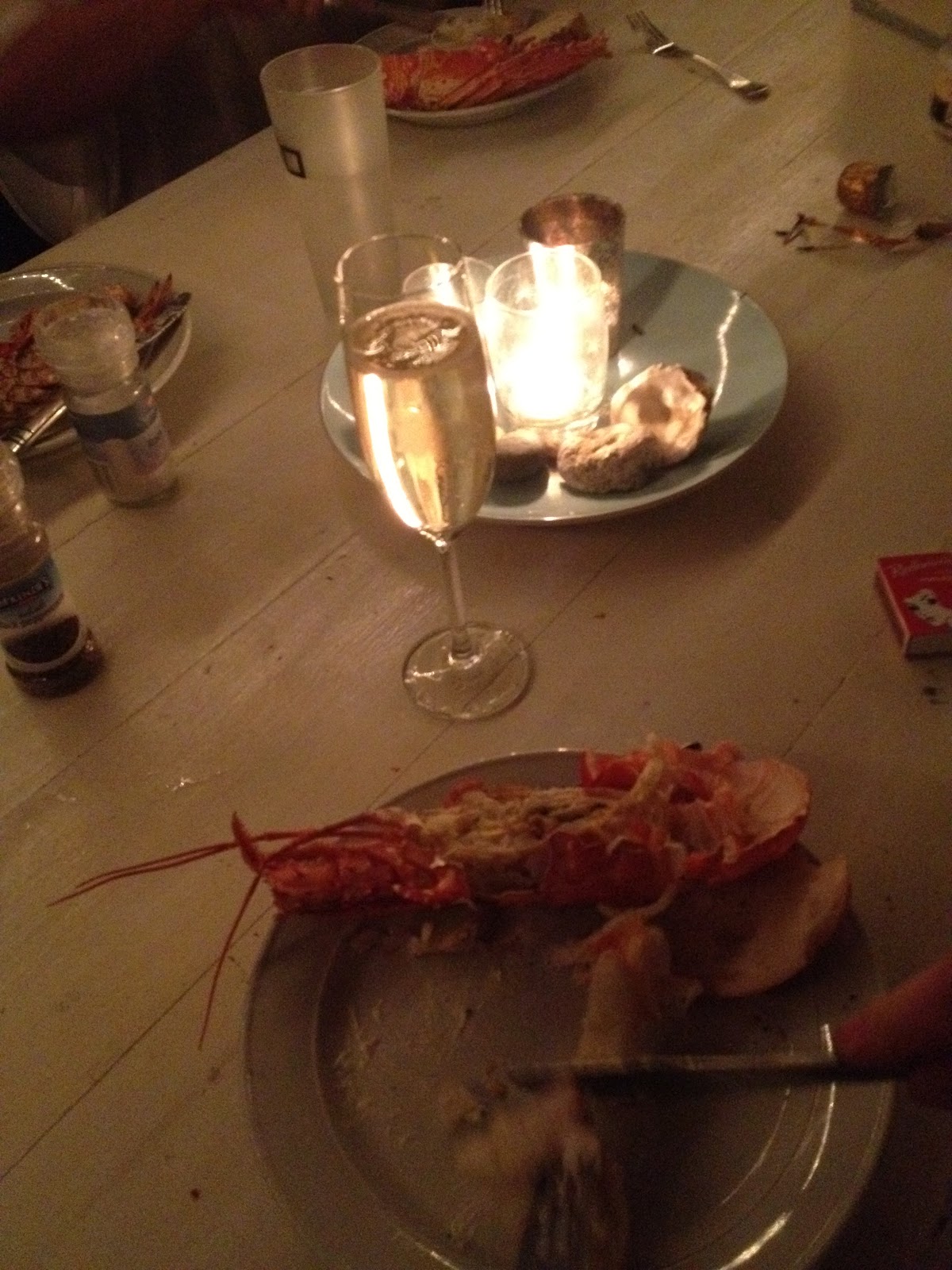
We finished the day with lobster and champagne by candlelight.  What a great day....


Happy Fathers Day!

Deb xxx