Showing posts with label Australian. Show all posts

Sunday, 21 July 2013

Food of the Fifties - 1953

What were people eating in the 50s?  Everything we read today tells us that we eat much more processed foods now than  they did fifty years ago.  But do we?  Here are some food ads from the year 1953, taken from the Australian Women's Weekly magazine June issue.


Mmmm, fish and cheese in the one recipe. I think I may try it out on the kids.

Images via

Deb xx

Wednesday, 17 July 2013

MCM Audette House and Castlecrag

Today a look at an iconic Australian mid-century home, Audette House, designed in 1953 by Peter Muller.

Born in Adelaide on 3 July 1927, Peter Muller graduated in Architectural Engineering in 1948.  He was the first architecture recipient of The United States Education Foundation  Fulbright scholarships in 1950, and did post-graduate study in Philadelphia. On his return to Sydney in 1952 the chairman of the Foundation, Mr. Hauslabe, and his step-son Bob Audette approached Mullerr and asked him to design a solar - efficient house for their block in the Sydney suburb of Castlecrag - they thought that with Peter having been in the US for his studies he would understand Colonial architecture. Instead, Muller presented them with this modern model and plans:

1952 model for Peter Muller's Audette House
via

Monday, 15 July 2013

Mid-Century Fashion from July 1950

Today some snippets from the 15 July 1950 issue of the Australian Women's Weekly -

The cover features artist Rene's interpretation of Marcel Rocha's taffeta evening gown with a  dramatic frill over one shoulder -

cover 15 July 1950 issue of the Australian Women's Weekly
The Fashion pages -

pleats are in with the fashion designers of New York and Paris -

Paris fashion in July 1950 Australian Women's Weekly

"the belted line, the crisp white dicky front, the full sleeve the slim skirt, mannish bow ties with starched collars, are all high fashion for Spring 1950"

Paris fashion in July 1950 Australian Women's Weekly
 Australia -
fashion in July 1950 Australian Women's Weekly 

 and straight from Hollywood!

hollywood dressing rooms 1950

but even though are glamorous, Hollywood stars are not always happy."Hollywood's fierce competition can wreck careers, marriages and health." Nothing new there then!

hollywood stars unhappy in 1950

And to finish this lovely ad for a Nylon night gown by Presitge.  Stunning!
.
vintAGE 1950 NIGHTGOWN AD


For more images from this issue, see tumblr.

Deb xx

Thursday, 6 June 2013

The Australian Women's Weekly launched - June 1933

I have been struck down with a horrible cold this week (thank you my darling children), so forgive my errant ways.  I am busy drinking green smoothies and garlic and lemon tea to get well by the weekend, as I am off to Sydney.  Civilization as my father kindly put it.  Hopefully lots of photos when I return. I have also been busy on my new blog -Home Lust -  in which I have been looking at houses of the 40s and 50s.  Please visit and follow if you can, I would love some followers!

Anyway, today some more history.  This weekend is the 80th anniversary of the launch of The Australian Women's Weekly, which officially began circulation on Saturday, 10 June 1933 (although the first copies of the magazine hits the streets the Thursday before).

Other newspapers of the day described the magazine as "a women's magazine that seeks to cover a wide range of issues whilst still presenting the traditional women's magazine articles on home making and cooking."  It was said to be "innovative in style and content when compared with existing women's magazines" both published in Australia or imported.

The Australian Women's Weekly, officially began circulation on Saturday, 10 June 1933
via
The Weekly itself stated that would endeavor to "cover adequately and in full detail every field of work, play or interest for women - especially where women have something at stake; to create interests for women; to be of practical help, by service and guidance, to women in domestic, social, and business life, to be of interest to all women...in every field where where women are and where their eyes will turn will be covered for them by brilliant specialists."

The Weekly did in fact align itself with women's issues and the cause of women's rights from the very first issue.  The cover above shows the story by Mrs Linda P Littljohn, a prominent feminist of the time, titled, "Equal Social Rights For Sexes: Mrs. Littlejohn Outlines Big Issues To Be Fought For", which covered the Women Voter's Federation conference. More prominently  though, are four models alongside the headline, "What Smart Sydney Women Are Wearing."

The magazine was not owned by women though. It was started by Frank Packer (a familiar media mogul name), who was only 26 at the time, together with former deputy Prime Minister and Treasurer, EG Theodore. The editor was also a man, George Warnecke, who stated that the magazine employed a comparatively large staff of women, and that he "wanted women to tackle all kinds of news while preserving the qualities of femininity."


Scottie Dogs, From the Australian Women's Weekly, June 1933
From the Australian Women's Weekly, June 1933
Some of my favorite Covers:

Australian Women's Weekly Cover, cockatoo,  June 1940
1 June 1940
Australian Women's Weekly Cover, Victory Loan, March 1944
18 March 1944
Australian Women's Weekly Cover, New Look Fashion, February 195
18 February 1950
The first 50 years of the publication Weekly from 10 June 1933 to 15 December 1982 (when it changed to  monthly)  can be viewed online at Trove Australia.  Just a little reading for the long weekend!

Deb xx

Thursday, 7 February 2013

Small Australian stores in 1913

Yesterday I looked at Bon Marche, the grand French department store. Today a look at quite the opposite – small, mainly family run stores in rural Australia one hundred years ago.  Most of them sold a range of goods, and I can imagine myself lost inside, browsing for hours……..or maybe not, as the horse might be getting a bit restless waiting for me!
For some reasons some of the images aren't showing - please go here for the first image if that's the case for you.


Raymont's store was built in 1885 by Thomas Percival Raymont to sell groceries and produce.  He bought and sold – what a great system – and was also an insurance agent.   The store was in operation for 65 years and was later managed by Thomas' son, Bill. Thomas and his wife Eliza lived in a house next to the store and there raised eight children (five dying in infancy). Up until the early 1900s the store was an agent for the supply of rations to the Aborigines who lived in Enoggera. From 1888 the store included the Post Office for the area, although it has a separate door, so it may have been leased to someone else.

John Stewarts grocery store at Annerley around 1913
John Stewarts grocery store at Annerley  c. 1913 source

Staff and customers outside John Stewart's grocery and provisions store on the corner of Ipswich Road and Clive Street around 1913. Possibly the family lived above the store, which was quite common in those days.
Gearys Commonwealth Stores in Chinchilla around 1913
Shop assistants and customers pose outside Geary’s Commonwealth Stores in Chinchilla, QLD c. 1913 source

Mr D. Geary came to Chinchilla from Miles in 1904 and set up this shop to supply basically everything to the local farmers who grew mainly grain, and also ran cattle, sheep and pigs.  Timber was also felled nearby.  I love the way the store also has an ironmongery.  I doubt ‘iron’ goods were made in the store, as blacksmiths usually had separate premises because of fires risks, rather it is an alternate name for hardware store.  However, the store was destroyed by fire in 1922.

Music store in Morgan Street Mount Morgan 1913
Music store in Morgan Street Mount Morgan, QLD 1913, source


I don’t know much about this one, but it’s great to see people in country Queensland had access to instruments and sheet music.

Store belonging to R. Beckett in Mundubbera, Queensland, 1913
This image may not work either, so go here to see it.
Beckett's store was a tailor, drapery and shoemaker business, but also sold stationery. It looks to be situated right in the bush, with no road.  Another building is being constructed near by, so maybe this was the start of the town.  It has a very wild-west feel to it, don’t you think?
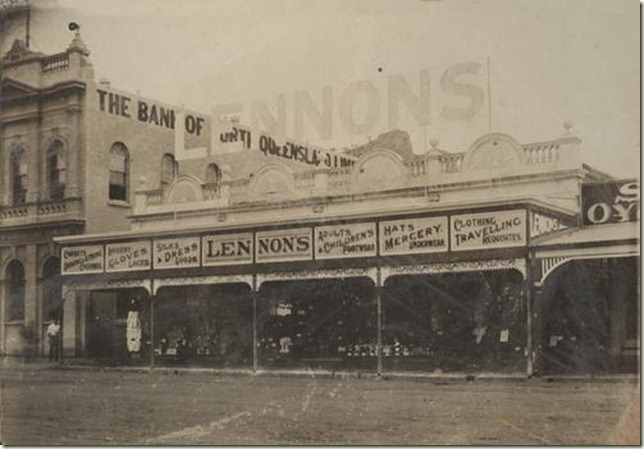
Lennons clothing store in Townsville 1913

Lennon’s clothing store in Townsville 1913.  By 1913 Townsville was fifty years old, and quite a large town.  The even had motorised buses! Lennon’s shop, positioned cleverly next to the bank, looks quite upmarket, and has a very large sign to attract customers – literally a sign of things to come.  A Mr William Lennon was involved in the Bank of Queensland in the 1880s, before opening his own stock agent store around 1900 – it’s possible this store is an off shoot of that.  Lennons’ sold footwear as well as clothing.  Here is the interior of their boot department.

Boot department inside Lennons Drapers

This last store is located in Oakleigh, Victoria, now a suburb of Melbourne but in 1913 it was more of its own town.  From the exterior is looks like the store was located near the railway line, and sold everything from cigarettes to groceries, and glassware to electrical goods. Like all of the other stores, it also has a generous veranda.

exterior oakly

I was happy to find an interior view of this same store. Definitely not a self service store – most goods are displayed behind the lovely wooden counters.

interior oakly

I love the old cash register and Dayton scales. Note the ‘ironmongery’ sign – probably more hardware.
Imagine being able to fit all available goods in one store today – no mega hardware or department stores, or supermarkets.  Shopping has certainly changed in 100 years.

More photos of stores on tumblr, including some overseas stores.

Deb xx


Monday, 4 February 2013

The Heliograph– vintage solar communication

Back to vintage technology today.

Before the telegraph there was the Heliograph, an instrument that reflected the sun's light to an observer at a distance.  In Greek, helios, means "sun", and graphein, meaning "write.  Its main uses were in the military (army and navy), survey and forest protection work.  Heliographs were used in the Zulus Wars of 1879 and the Boer Wars, and were standard issue in the British and Australian armies until the 1960s.  They were used by the Pakistani army as late as 1975.

heliograph-at-work
Wood engraving of the heliograph at work in the Zulu wars, Published by the Illustrated London News, 1879 source

The first recorded use of heliograph comes from 405 BC when the Ancient Greeks used polished shields to signal in battle. In about 35 AD, the Roman emperor Tiberius, by then very unpopular, ruled his vast empire from a villa on the Isle of Capri. It's thought he used a heliograph to send coded orders every day to the mainland, eight miles away.

sheild

The first modern documented use of a heliographic device came in 1821, when the German professor Carl Friedrich Gauss developed and used a predecessor of the heliograph (the heliotrope) which directed a controlled beam of sunlight to a distant station.  It was meant to be used for geodetic survey work, but was later used extensively by the British and the American armies as a 'wirefree' field telegraph - using Morse Code.

fsm91_057400
Darby Knob heliograph lookout station near Calaveras Station, Canada, 1914.


The simplest heliostat is a mirror hung up at a distant station so as to reflect a flash to the observer whose station may be up to 80 miles from it.  For survey work the mirror can be adjusted so that the flash occurs exactly at some prearranged hour, and if fitted with clock-work, the mirror can be made to revolve with the sun, and so to reflect a beam of sunlight steadily in one direction. If the beam or flash of light is interrupted, either by momentarily pivoting the mirror, or by interrupting the beam with a shutter, a code such as Morse code can be sent to the observer.
HelioInst

The following is a description of the Heliograph from the Telegraphic Journal, reprinted in the Brisbane Courier Mail in 1881.
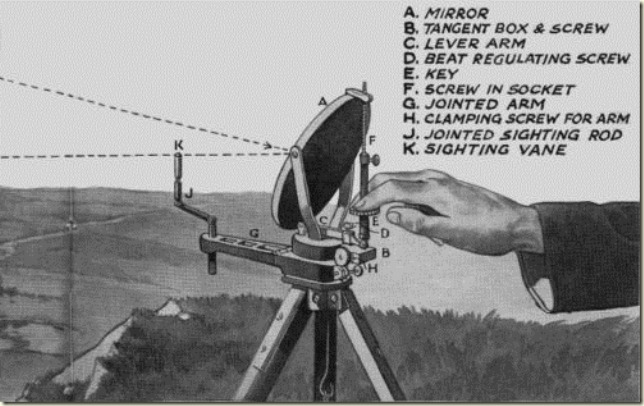
The apparatus consists of a metallic bar sup-ported in a perpendicular position by tripod legs ;at the summit of this is a ball and socket joint with a very short arm, to which is fixed a circular  mirror 3 in. in diameter, having a small hole pierced through the centre of the backing and the silvering removed at that point. A short distance below the ball and socket joint, a light arm, about 8in. in length, and also movable by a ball and socket joint and clamped by a screw behind, is affixed to the standard. The outer end of this arm is fitted with another circular mirror, removable at pleasure and capable of adjustment to any angle. There is also a sight vane consisting of an oblong piece of metal with a V-shaped nick in the centre of one of its ends; this can be attached to the end of the arm in place of the second mirror when occasion requires.This completes the apparatus, which the inventor has constructed so as to fit into a leather bag 13in. long, 3 1/2 in. wide, and 1 1/2 in. deep, and which weighs about 2lb.

myhelio5

The heliograph is used in the following manner :- When the sun is in front, that is towards the distant station, the instrument is set up with the sight vane in the general direction of the distant station and the mirror facing in the same direction. The eye is then placed as close as convenient to the back of the mirror, and the latter looked through at the centre hole ; at the same time the V of the sight vane is set in line  with the distant station. The mirror and sight arm are then so manipulated that the dark spot cast by the unreflecting centre hole is thrown on the bottom of the V in the sight vane, whilst at the same time the centre hole, bottom of the V, and distant station are in one straight line. Thus the "flash" is directed on the distant station. When the sun is not in the  direction of the distant station the sight vane is removed and the second mirror substituted.The instrument is then set up so that the principal mirror faces the sun and has its back towards the distant station ; the centre hole is than looked through and the mirrors manipulated until the reflection of the distant station is seen within the V of a piece of paper fixed on the surface of the second mirror, and at the same time the dark spot from the central un-reflecting portion of the other mirror is thrown on the bottom of the V. It is in all cases necessary occasionally to readjust the apparatus as time goes on so as to make up for the apparent motion of the sun.
The " flash" having been properly established,signalling is carried on by using tho Morse alphabet of "dots" and " dashes," which is  effected simply by interposing the hand, a note-book, piece of board, or other opaque sub-stance smartly between the sight vane and the surface of the mirror. By this means, with practice, letters can be sent as fast as the eye can read. In military signalling it has recently been decided to signal by obscuration instead of flashing, which renders this instrument rather more handy than if "flashing"' only were used.

signallers_1914
British army signallers c. 1914 source


During the First World War wired telephones were used where possible but this involved laying landlines which was a hazardous job due to enemy shelling. The Heliograph was used for signalling to a distant point, and was normally set it up on high ground, quite close to the frontline troops.  These signallers provided vital information back to their Company and Battalion H.Q.

AWMB00277helioTiberias
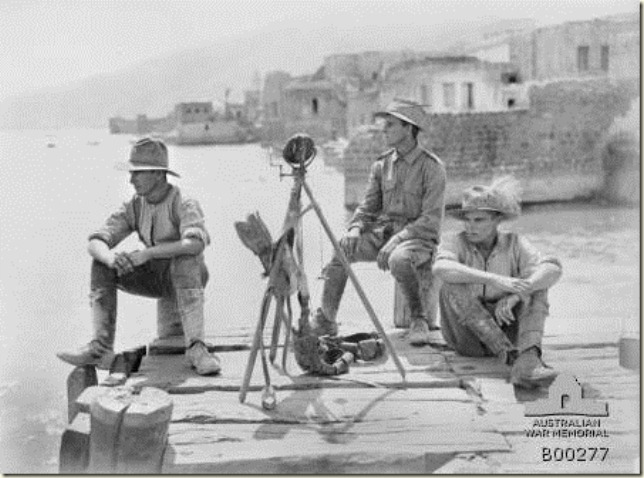
A signal post at Tiberias. Three members of the 8th Australian Light Horse Regimental Signal Station, with their heliograph on the pier on the Sea of Galilee, 1918  source


In deserts and in most parts of Australia where there is little coverage, the heliograph was a great means of communication.   In 1932, 16 year old Vera Halifax used a heliograph to save her life.  Vera lived with her father on a remote quarantine station, 10 miles out of Darwin. She was stricken with acute appendicitis and summoned help by  sending a message in Morse code by heliograph. A launch was sent to the station and she was rushed to hospital where an immediate operation was successfully performed. Vera was taught how to signal by Mr. Gordon Cowper, the Government engineer who runs the launch to the station so she could obtain news from Darwin each day, and it was he  who saw her frantic call for help and brought her to hospital.
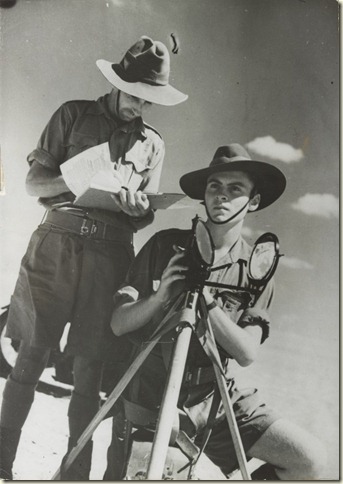
In 1941 an appeal was launched for AIF recruits. The posters showed  Australian heliograph signallers at work in the desert.

helioaus

Australian signallers put the sun to work, 1941 source


demon
Demonstrating technique of heliograph in the Australian Army Volunteer Defence Corps, 1943. source

With the advent of the ‘wireless’ or radio after 1900, the use of heliographs declined. Today they are mainly used by reenactors, although compact versions are popular with bushwalkers and survivalists.

Heliograph (1)   363365951_tp
source

With the floods and fires we are having in Australia at present,  and the communications difficulties they present, keeping one in the kit may not be a bad idea!

Deb xxx


Sunday, 6 January 2013

6 January 1913 & battleships


On this day in 1913 an explosion of a boiler on the French battleship Massena killed 8 members of the crew.

Masséna was a pre-dreadnought (1885 to 1905) battleship of the French Navy, built in the 1890s, one of  five built in response to the seven shops built by the British navy. She was named after Marshal of France André Masséna.
Massena-Marius_Bar
French battleship Masséna  source


 The design of the Masséna was altered during construction, and her weight was increased, causing a stability problem that inhibited accurate firing of her guns.  She did however serve in both the Northern and Mediterranean Squadrons during her career,  including a period as the flagship of the Northern Squadron, but she was withdrawn from service before the outbreak of WWI in 1914. On 9 November 1915 she was scuttled at Gallipoli to create a breakwater to protect the withdrawing Allied forces.
In 1906 the British Royal Navy launched a revolutionary battleship - The Dreadnought – with an "all-big-gun" armament scheme and steam turbine propulsion. It had such an impact that all similar battleships built after her were referred to as "dreadnoughts," and earlier battleships became known as pre-dreadnoughts.  The arms race between the world powers, but principally Britain and Germany, was renewed.
HMS_Dreadnought_1906_H61017
HMS Dreadnought, 1906 source


The HMS Benbow  was an Iron Duke-class battleship, the third ship of that particular class, which was the last group of Dreadnought battleships built, in 1913. She measured over 622 feet in length and displaced 25,000 tons.
HMSBenbowDreadnought
The HMS Benbow  source


Also in 1913 (November), the Jean Bart the first French "Dreadnought" was completed, and finished her trials before WWI began the following year.  Jean Bart escorted France, which was carrying the President of the French Republic, Raymond Poincaré, on a state visit to Saint Petersburg, Russia in July 1914, and they were returning when war broke out, but made it to France without encountering German ships.  She was later torpedoed, but was repaired and also saw service in WWII.
Jean_Bart_Cuirasse_1913
The Jean Bart in 1913, source

Another class of battleship, the  King George V-class battleship, was built around the same time at Scotts' shipyard at Greenock on the River Clyde.  One of four, The Ajax was launched in 1913.
The fledgling Australian Royal navy also commissioned a ship in 1913  - the HMAS Australia,  one of three Indefatigable-class battlecruisers built for the defence of the British Empire and ordered by the Australian government in 1909.
HMAS_Australia_1914
HMAS Australia, commissioned 1913 source

Australia1-3
Some crew of the HMAS Australia
From 1859 until 1913, a squadron of the British Royal Navy was maintained in Australian waters, but now Australia was attempting to protect itself.  You can read more about he HMAS Australia here, although I do intend to look more closely at the Australian navy later in the year.  You can also read more about Dreadnoughts and the naval race before WWI, here.

Well, I have learnt a lot about ships today – I hope you have too!
i
As usual, more images on tumblr.

Deb xx