Showing posts with label riding. Show all posts

Wednesday, 24 October 2012

1890s Cycling Fashions for Men


It is often remarked that men's fashions haven't changed much over the years.  Compared to women's fashions they didn't, but each decade did have it's own specialities, such as breeches or lace and embroidery on waistcoats. In looking at cycling fashions for men, I want to start with a little background at the everyday fashions for men of the 1890's.

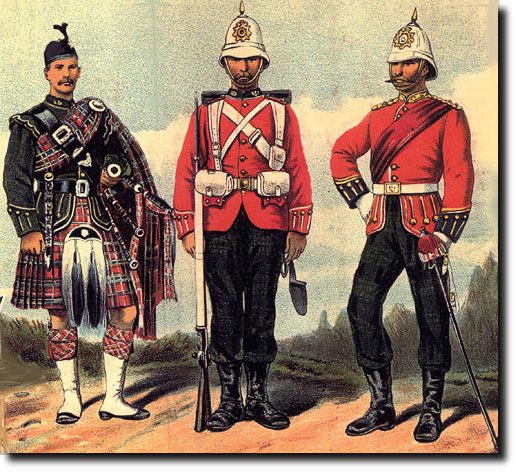
The military greatly influence men's (and women) clothing, both in style and colour (red jackets from the late 1700's and khaki in the tropics).  During the 1890's there were still of course wars going on, but the fashion also looked towards the cycling craze of the time, and the overall silhouette of the 1890's was long, lean, and athletic. 
British army piper, private and office c 1890 source

When we think of Victorian fashions for men, apart from military uniforms, we often think of the formal and evening wear - tails and top hats. Dinner jackets or tuxedo's were worn in the evening, and tails only for formal evening events, and of course special race days, with a top hat. White shirts were worn with both, with black or bow ties, although they were again popular as day time accessories during the 90's.  The  Ascot tie was also worn, usually as a day accessory, made up as a neckband with wide wings attached and worn with a stick-pin, and a bowler hat and other soft felt hats or caps were worn during the day.

  
The Hon. Derek William George Keppel  Elegantly dressed Vanity Fair Illustration 1895
 and 
Mr Victor Cavendish, MP for Derbyshire West, wearing top hat. Vanity Fair Illustration 1895
Although frock coats and the cutaway morning coat was still worn for formal day occasions in Europe and major cities elsewhere, lounge (sack) jackets became popular for day time wear.  These were worn as a suit, either matching three piece affairs with a single breasted jacket, waistcoat and trousers, or with a contrasting waistcoat (vest). Fabric varied, and could be smooth and fine or rougher almost tweed. 

Morning coat and lounge suits c. 1895. source
Perhaps not a realistic cycling outfit of the time?

White Flannel Pants, blazer & Boater - pants rolled up a little at least! 
The blazer was worn for casual activities such as sailing or boating - cut in a similar style to the lounge coat, the fabric was either navy blue or brightly-colored or striped, often in wool flannel,  with patch pockets and brass buttons. These were often worn with light coloured flannel pants, or even shorts, with a straw boater or a cap.

Cycling in a blazer and cap c.1892 source

  
Mr Rudolf Chambers Lehmann, rowing coach,  In flannels and blazer and 

Mr Charles Pittman, rower, in white shorts and sweater.

Tweed jackets (Norfolk jacket) were fashionable to rugged outdoor and winter activities like hunting and shooting.  It featured paired box pleats over the chest and back for greater arm movement, with a fabric belt.  The matching trousers were often replaced with matching breeches (knickerbockers) to make it suitable for suitable for bicycling, and also golf, with knee-length stockings and low shoes, or for hunting with sturdy boots or shoes with leather gaiters
Sears Roebuck Catalogue 1897. source
"Tweed Ride" - 1896
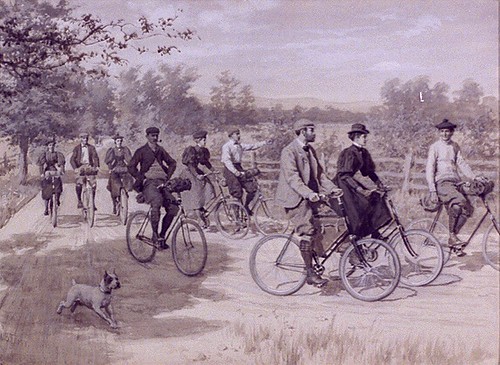
Tourists riding bicycles by A.B. Frost c.1896.

Thomas E. Kent for Bicycle Clothing 1896
Tweed and breeches or plus fours seem to be the most remembered clothing for gentlemen cyclists of this time, as shown by the recent 'tweed ride' or tweed run' phenomena of the last few years. Find out more about this recreation of past cycling tours here.

The poster from the first tweed run 2009
Caps & Breeches, cycling in Norway 1898 source

Cycling c. 1895 source
Many ordinary gents, or those riding to work where breeches would have not been worn, wore their day suits for cycling.  Some would tuck in one leg of there pants into their socks, to avoid it getting caught by the chain, and others would wear bicycle clips.  I can remember my father doing this.


Man and cycle, long trousers and felt cap, c.1895 source

Sear Roebuck Catalogue 1897
This gentleman looks like he did just sell his horse, don't you think!
man and cycle, long trousers, vest and Stetson c 1890s source
Although studio posed, this gent looks ready to go, with his pants tucked partially into his socks, and his tie tucked into his shirt.
Cyclist c .1890s source
French cyclists c 1895  source
There was also specialist sporting clothing for athletes such as swimmers, boxers and speed cyclists, but these were not generally worn by the ordinary man.
Cycling race, 1899 source
c 1890 source
French Olympic cyclists 1896 source
Where the military had influenced fashion, now the bicycle influenced the military.  Cycling squads were formed, and uniforms altered slightly to accommodate cycling soldiers. A look at those next time.


Deb xx

Tuesday, 23 October 2012

Bicycling 1890's Style for Ladies


Bicycling became almost a cult in the 1890s.  The development of the pneumatic tyre and the mass production of machines meant that cycling was now comfortable and affordable, and as Queen Victoria Herself had purchased tricycles for her daughters (Starley's), it also became acceptable.  As hundreds of young bicycle manufacturers competed for sales, prices dropped from over $100 to as low as $20 for a new cycle, making them in the reach of just about anyone.

True or not?!
The Pope Manufacturing Company in Hartford, Connecticut  had been making bicycles since 1878, and at the height of the bicycle craze in the 1890's, Pope was the city’s largest employer, with 4,000 workers producing 600 bicycles a day.  It is estimated that in 1897 between 1 1/2 and 2 million bicycles were manufactured n the US, and that by 1900 there were about 10 million bicycles in use (from a population of 75 million).
Ladies Cycle Club of Hartford, 1890. 

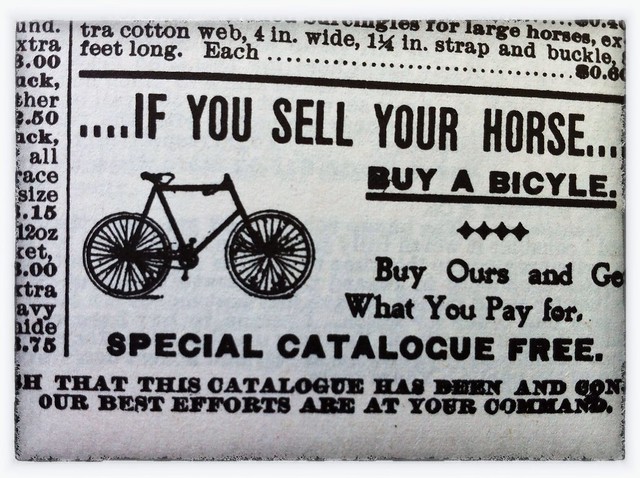
By 1896 the Raleigh Cycle Company in Nottingham, England was making 30,000 cycles a year in the largest factory in the world, and produced more cycles globally than any other company. I don't think this was considered normal bicycle riding attire, however!

1896 ad source 
The bicycle was considered the freedom machine.  People from all walks of life could afford not only to buy one, but to store it and learn to ride it - a bit different from horse riding. The bicycle was the instrument of social change in many ways, including allowing Victorian women mobility and independence.


"Let me tell you what I think about bicycling. It has done more to emancipate women than anything else in this world. It gives her a feeling of self-reliance and independence the moment she takes her seat; and away she goes, the picture of untrammelled womanhood. I stand and rejoice every time I see a woman on a wheel . . ."
-- Suffragette Susan B. Anthony in a Feb 2, 1896 speech, quoted in the New York World

I love this ad from 1896 - finally a woman's word is taken seriously!

Trust a woman for buying the right thing (finally, we are being taken seriously!)


Although many women still wore their everyday dresses for cycling, special outfits did develop, and the  rational dress movement gained momentum, helping liberate women from corsets and ankle-length skirts. This Punch cartoon illustrates the point that many women enjoyed the freedom of the new fashion.

My Dear Jennie, what on earth is that bicycle suit for.  Why to wear of course.  But you haven't got a bicycle. No, but I've got a sewing machine!

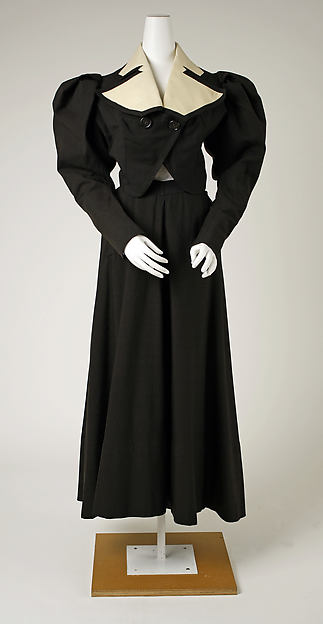
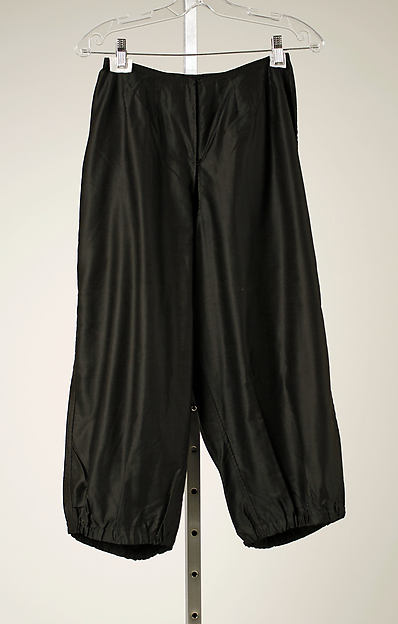
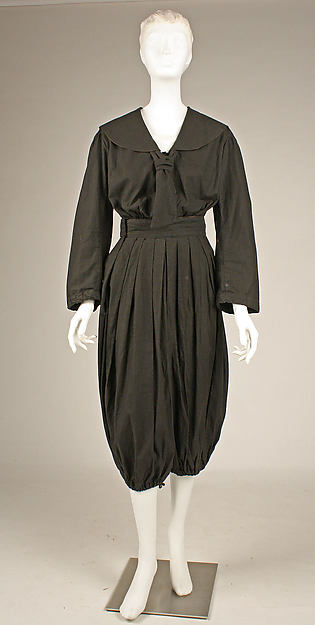
Some outfits kept the look of the longer dress or jacket, but hid bloomers underneath - much like the riding habits of the time. This one is French, circa 1895 (source). Stunning, don't you think?


Ensemble, Cycling  Ensemble, Cycling


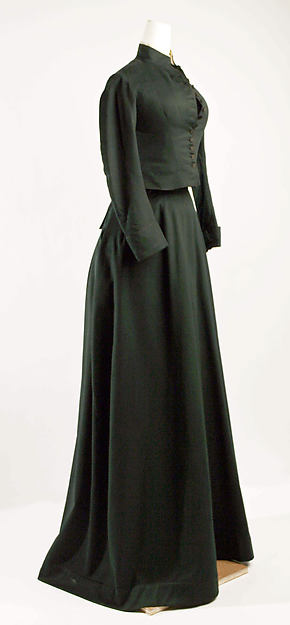
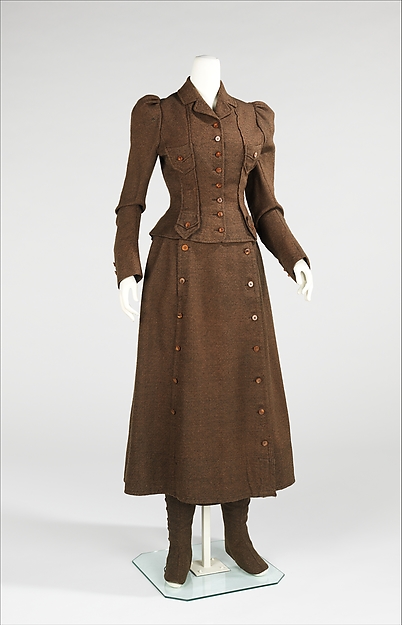
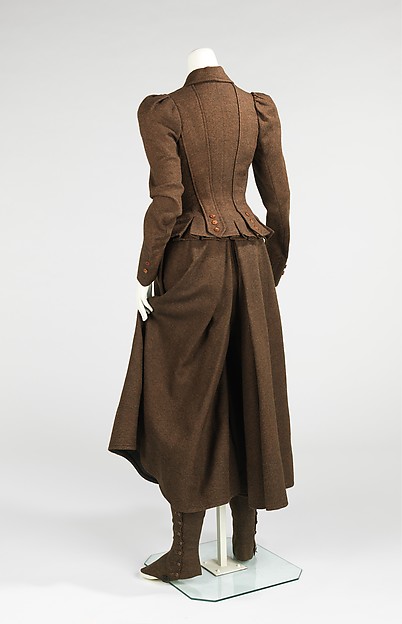
The other popular development in cycling fashion was the bifurcated skirt in about 1892, that was like pants at the back with the modest appearance of a skirt at front. This American suit of wool, linen, leather and silk also includes a pair of gaiters, which would provide protection for the legs. (source)

Suit, Cycling  Suit, Cycling
Bloomers and knickerbockers made bicycle riding even easier for women, but the style was still ridiculed by many as being unfeminine and unattractive. These outfits are from about 1895.  What do you think?
  

There was even music written about these intrepid women cyclists (source): 
Oh, the bicycle girl, when she gets on the road, Is bound neck or nothing to go!


  Web image of Box 061, Item 061.092, Page 000

Myself I love the calf length skirt, and I adore the hats!  So much nicer than today's regulation helmets.
Catalogue. c. 1897
In warm climates, like Australia, a blouse was often worn instead of the jacket, and a sensible straw hat for protection from the sum.
Lady cyclist, Brisbane, Australia c. 1895
An american version in linen -  source

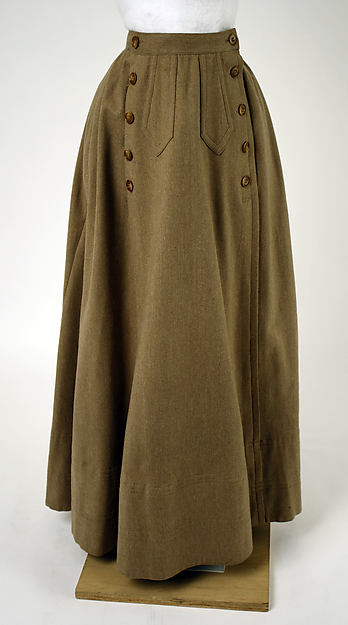
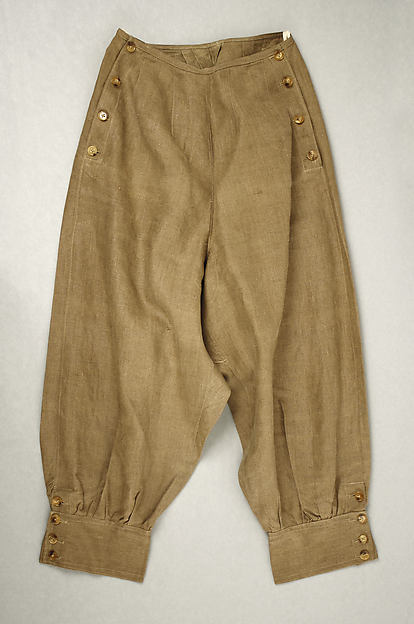
Separate skirts and bloomer continued into the 1900's, such as this wool and linen American pairing (source).


Ensemble, Cycling  Ensemble, Cycling
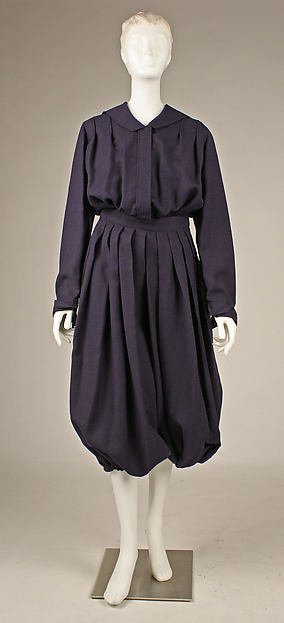
Although bloomers did also remain popular, and began to be manufactured by reputable companies, such as this suit (below left) by A.G. Spalding and Bros. from 1902.  It looks remarkably like the charcoal gym suit of a few years earlier by the Columbia Gymnasium Suit, Boston, Mass. (below centre source). 
Suit, Cycling   Gym Suit  

In addition to the cycling outfit, the well-dressed woman also wore leggings or gaiters, a hat, doeskin gloves and perhaps gauntlets, and a pair of the broad, low, rubber-soled cycling shoes which had first come on the marker in 1891. A bicycle belt, from which hung a small leather purse, completed the outfit. 
Cycling Outfit 1895-1900
Manchester Galleries by kimberley
 cycling outfit c. 1895  source
Those undertaking a bicycling expedition (defined as any trip over an hour in length) were also recommended to outfit their bicycle with a lamp, and to pack matches, tools, a repair kit, sewing materials, and first-aid supplies (and baby?!).

Cycling in Sn Francisco 1890s  source

You'll notice that many of the costumes are sombre colours,  much like the riding habits that had been made by men's tailor's rather than seamstresses. Apparently the stylish women would dress to match her male companion, so grey, brown, dark green, or navy were the most popular colors.

What ever we may think about bloomers, cycling and bicycles really did change the face of fashion - and not just for women.  Men's cycling fashions are next!
Deb xx

Tuesday, 9 October 2012

Victorian Riding Habits - 1870s and 1880s

Although I ride, I have never ridden side saddle.  I remember as a little girl being allowed to side on a saddle at an historical property in Victoria called Bontharambo.  I have never forgotten that day.  It always looks so glamorous though, don’t you think?

Henride Montpezatd Ainecy - Elegant Lady Riding Her Horse Sidesaddle
Until about the mid 1500s women wore their everyday day clothes for riding.  The first habits were often military looking, copying the uniforms of the male riders of the day.  Gradually riding habits evolved – what was one more change of dress in the day if you had servants to help you?  Given the cost of the saddle the horse and the habit, and the fact that a lady needed assistance to mount side saddle, only women of substance could afford to ride at all.
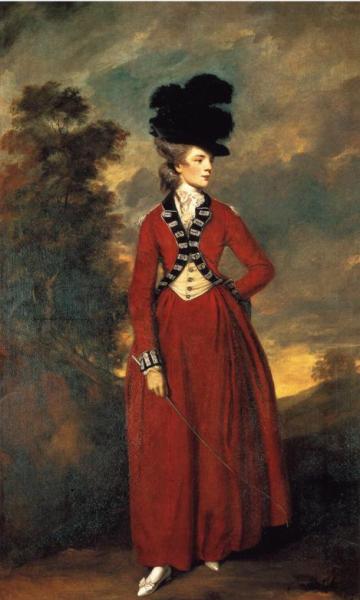
 Portrait of a Lady in a Riding Habit
Lady Worsley by Sir Joshua Reynolds, 1776 and Portrait of a Lady in a Riding Habit by Enoch Seeman the younger source
During the Victorian era  riding habits tended to follow fashion of the day, but unlike the day clothes of the time, riding habits were sombre in colour (earth colors like blue, green brown and also black) with little trim - any colour or trim was seen in the utmost of bad taste. Riding habits were also made by men’s tailors, rather than seamstresses, so the colours and fabrics would have been the same as used n men’s clothing and uniforms. In tropical climates and the colonies, such as India and Africa and Australia, the habits would have been lighter in colour – cream or beige – just as men’s suits and uniforms would have been.
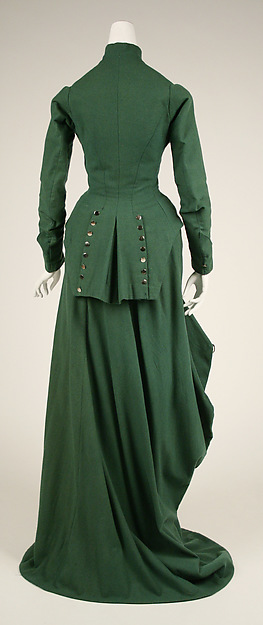
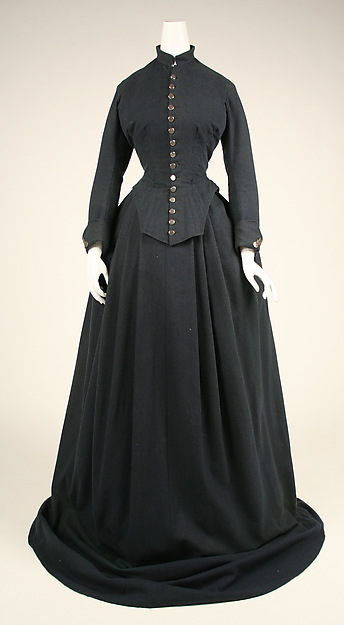
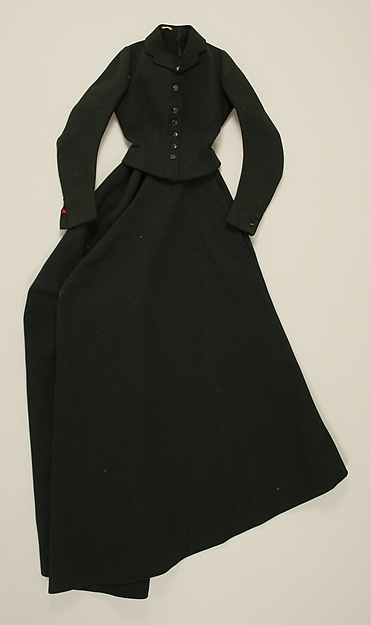
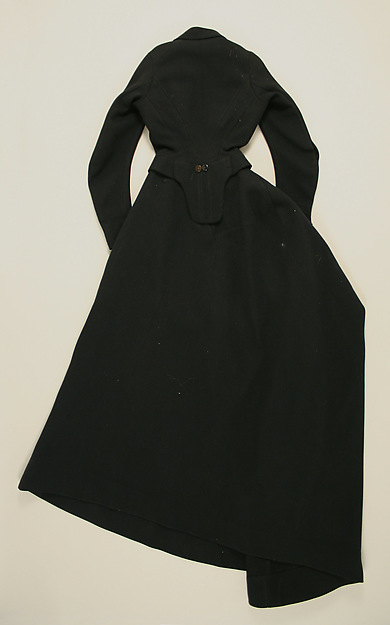
Different riding habits were also worn for different occasions. One for use when riding in the park, a simpler version for summer wear, and those that hunted had a distinct habit for hunting. They were all highly tailored however, often with a jacket with a basque bodice - form fitting with boning,  fully darted and high collared, with decorative front buttons and a separated small tail. 
 
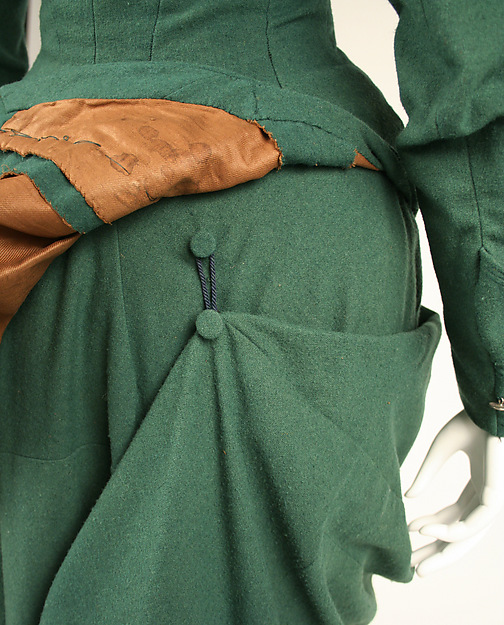
From the 1830's through the early 1870's the skirt was full and flowing and although picturesque, could cause a danger to both rider and horse. In 1875, the first safety skirt was introduced , with it longer on the left side and the front to hide the feet while sitting side saddle but shorter on the right side to make dismounting easier and faster.  When walking the extra length was draped around the right hip and fastened at the centre back waist with a button and ribbon loop, as in the small photo below. Either drawers, or soft leather breeches were worn underneath the skirt, and a  silk  undervest and corset would have been worn under the bodice.  By about  the 1910  the skirt evolved into the open-sided apron with no back, which was worn with matching pants or jodhpurs. When mounted it would not be known that it was only an apron because of the way it has been designed to sit on the rider.
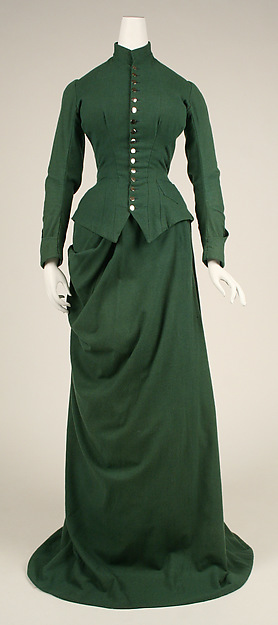
Riding HabitRiding Habit  Riding Habit
American wool riding habit c. 1875
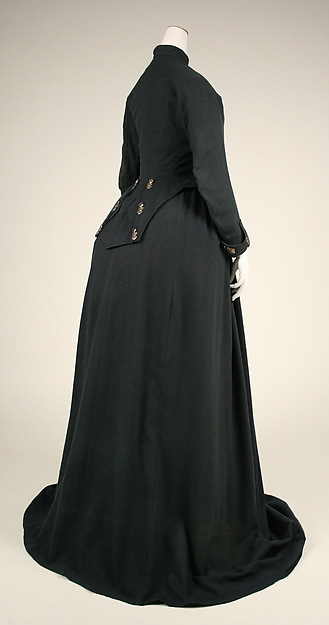
Riding Habit  Riding Habit
American wool riding habit c. 1880
Riding HabitRiding Habit
British wool riding habit c 1880-83
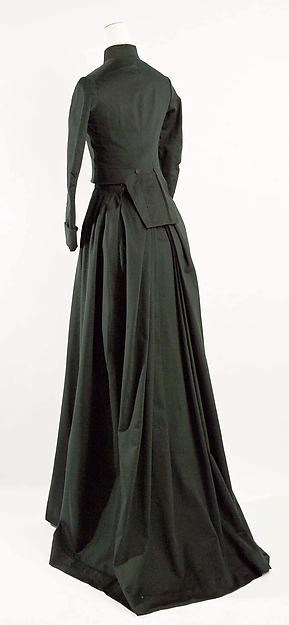
Riding Habit Riding Habit
French wool riding habit c. 1887
Here is a short little video I found that shows two ladies in traditional Victorian riding habits, as well as how to sit and ride side saddle.
  The photos of outfits were found at this source.
If your are interested, here are some side saddle links.
The Side Saddle Association – UK
The American Side Saddle Association
Side Saddle Ireland
Side Saddle Association of South Australia
Side saddles and suffragettes article
SideSaddle Wiki
Riding Aside – how to guide
And Where to Buy:
Side Saddle .com – UK site with mail order – you can buy everything here including habits
Wendy’s Saddlery  - Australian saddle maker who makes custom side saddles
Hundred Oaks – American side saddles including English and Western
Tattersalls Side Saddles – Canadian site with saddles and western clothing
Side Saddle Dressmaking Patterns – UK online site with copies of original period patterns
Ageless Patterns – riding habits of the late 1880s and other period patterns
SSA - More patterns
Deb xxx