Today a look at ads from 1935 which give a bit of an idea of the 1930's ideal of beauty, and some of the products that were around to help you be at your most beautiful. First you had to be thin -
Although certain foods were seen as healthy and essential -
Even chocolate -
and alcohol -
Not to mention health giving cigarettes!
A beautiful complexion was key - and it needed liver salts, tablets, cleansing oils and creams.
Unwanted hair could be removed -
and of course there was always make up to make you even more beautiful -
And finally, this is Mrs Thelma Peake of Queensland, in July 1935 - Queensland's all round leading woman athlete of the day.
She is so fit and healthy looking! Thelma was a Long Jump National Championship during the 1930s, but also competed in sprints, hurdles and middle-distance events. Through her career she set many firsts - 1935 - the first mother to become a national champion or record-holder in athletics 1938 - the first mother (or married woman) to represent Australia internationally. She may also have - the first mother to win an individual medal (and a team gold medal) at an international games in Sydney 1938. After 1940 the approach of war in the Pacific war forced the cancellation of most sports in Queensland, so she retired from athletics prematurely at the age of 26. I think I like the 30s ideal woman - what about you?
Rosemary Clooney, known to her friends as Rosie, or even Clooney, was born in Kentucky on 23 May 1928. A talented singer, one of her earliest hits was the crazy but cute "Come On-a My House" in 1951.
As I get older I find high heels more and more uncomfortable to wear. As I work from home, and live in the tropics, these days I mostly wear sandals or thongs (flip flops), or in winter low heeled or flat Mary Janes - they have a great vintage vibe and are very comfortable and supporting. Even in the 50s the overuse of high heels was warned against. The Australian women's Mirror in December 1959 stated: "It is not to be expected that any of us will wish to refrain absolutely from wearing high heels, but whenever possible we should save them for dress-up occasions and wear moderate or low heeled shoes during the day or while we are working."
Today another vintage beauty - actress Janet Blair. Born as Martha Jane (or Jean) Lafferty (she took her acting surname from Blair County, Pennsylvania) in Altoona, Pennsylvania on 23 April 1921. Ms Blair began her acting career on film in 1941 in 'Three Girls About Town',a Columbia comedy film also staring Joan Blondell and Binnie Barnes. In 1942, with Fred Astaire in 'You'll never get rich,' as well as 'Blondie Goes to College', 'Two Yanks in Trinidad', 'Broadway' and 'My Sister Eileen', with Rosalind Russel, while being placed under contract to Columbia Pictures. During World War II, she made a string of successful pictures. Her singing and dancing made her a popular entertainer on several bond-selling tours, and after filming 'Once Upon a Time' with Cary Grant she went on a tour of American Army Camps. In 1943 she married Sargent Louis Ferdinand Busch, US Army, whom she met while singing with the late Hal Kemp's band, where Busch was piano player and arranger. Ms Blair bought an interest in a music publishing business in Los Angeles and contracted all of Kemp's musicians.
1943
In 1944 Ms Blair filmed the technicolor 'Tonight and Every Night', where she played Rita Hayworth's best friend. In the late 1940s, she was dropped by Columbia and did not return to pictures for several years.
In 1947 Columbia loaned Ms Blair to United Artist for 'The Fabulous Dorsey's" a film about the famous dance-band leaders.
With red hair in 1947
In 1948 Ms Blair appeared in three movies, including the film noir 'I love trouble', and also appeared on television in 'The Ford Theater Hour.'
Blair played Nellie Forbush in a touring production of Rodgers and Hammerstein's South Pacific; she starred in that musical for over 3 years, and claimed to never have missed a performance. She was also seen in a national tour of Mame, with Bells Are Ringing and Follies among other theatre credits. During the tour, she also got married to second husband, producer-director Nick Mayo, and they became parents of Amanda and Andrew. They divorced in 1971.
She also starred on Broadway in the 1953 play 'A Girl Can Tell', by F. Hugh Herbert. It ran for 60 performances at the Royale Theatre.
She appeared on television on various variety shows including "The Ford Theatre Hour," "The United States Steel Hour," "A Connecticut Yankee," "One Touch of Venus" (in which she played the title role), "The Chevy Mystery Show," "The Outer Limits," "Destry," "Marcus Welby, M.D.," "Fantasy Island," "The Love Boat," and "Murder, She Wrote" ( her last TV appearance, 1991).
Blair recorded an album in the early 1960s entitled 'Flame Out' - a collection of ballads like "Don't Explain" and "Then You've Never Been Blue".
Face masks are something I always love, and have rarely bought from a store. Home-made face masks are easy and fun, and really simple. I used to use just plain yoghurt on my face, but now I find my skin a bit too sensitive for that. Egg white is great, but it feels really weird and drying when on (you can also use the yolk to condition your hair). Mashed banana is interesting, but my favourite would have to be just plain honey. A Honey Face Mask
Start with a freshly cleansed face (I find a bicarb soda scrub then an apple cider vinegar tone and tepid water splash great)
Smear on the honey (use a spoon to put some on your clean fingers).
Avoid your eyes, but do your lips, and make sure your hair is tied well back or in a shower cap. The honey goes on easily and tends to sink into the skin, so it's quite easy to wash off.
I like to lie down for about 10 minutes while it's working its magic!
If you want to be more creative, add a little milk and witch hazel to the honey, as suggested in this article from 1936.
You'll see the other ideas include oats mixed with warm milk, egg yolk and almond oil, fresh yeast and milk, and the egg-white mask. The last mask, or astringent pack, is really the only one you couldn't eat! After the mask you can rinse your face in water with a squeeze of lemon juice, as done by actress Beverly Roberts in the photo above. Beverly lived to 95, and had beautiful skin all her life. Here is a photo of her aged 93 - amazing!
I lovvve vintage, but unfortunately the 1950s were really the start of everything bad when it comes to cosmetics and beauty products. After World War 2 they seemed to be obsessed with cleanliness and banishing germs - and just as with housing there were so many new products and ingredients available - and you can see that by the ads of the time.
Nyal, 1955
Hair had to be clean, neat and controlled.
Brylcreem 1955
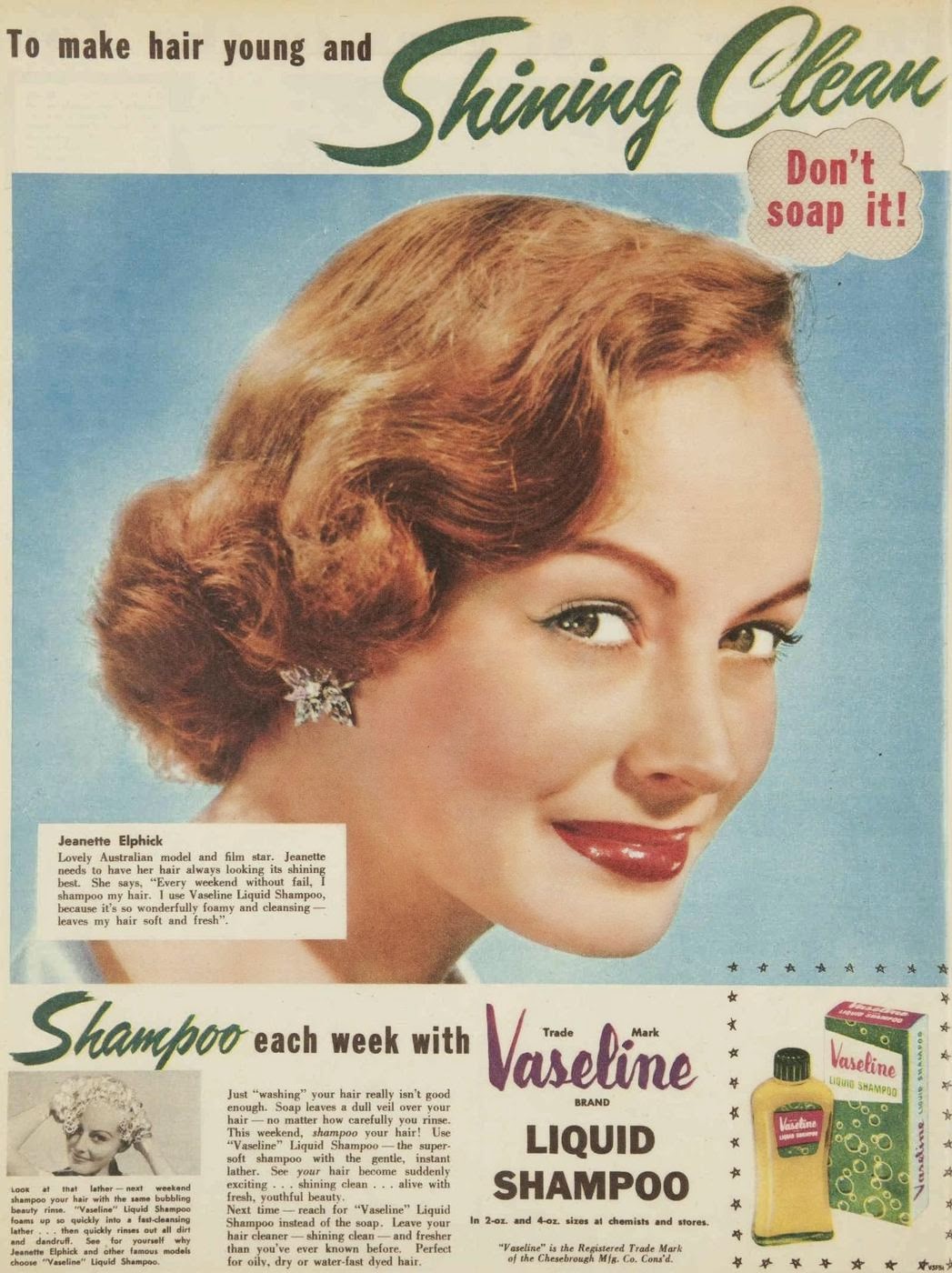
And soap just wasn't good enough any more.
Vaseline shampoo, 1955
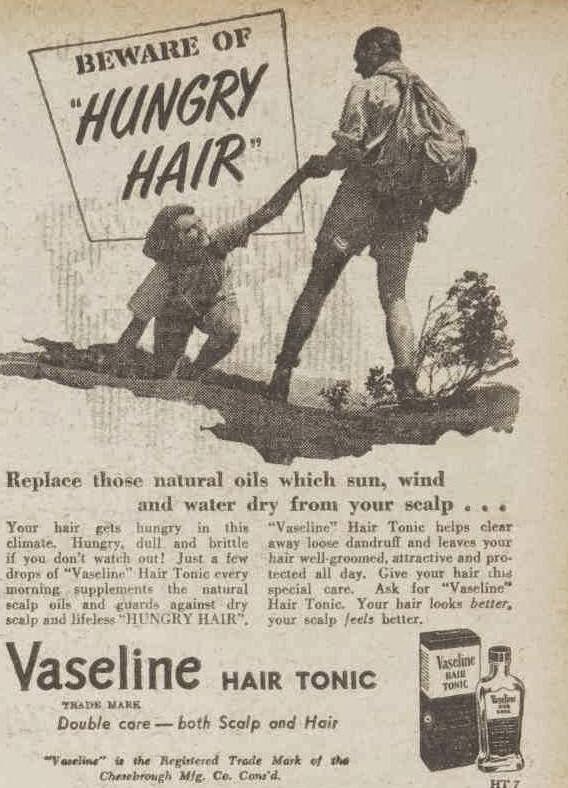
Vaseline had been patented in the 1870s, and as a by product of petroleum production it was by no stretch of the imagination good for you, but the advertising of the 1950s put it and similar products at the forefront of consumers minds and made them appear safe, and necessary.
Vaseline hair tonic, 1950
Petroleum is one ingredient that we shouldn't be using in cosmetics. According to world famous environmentalist and my all time hero, David Suzuki, there are twelve ingredients we need to avoid at all costs - he calls them the deadly 12 - 1. BHA and BHT Used mainly in moisturizers and makeup as preservatives. Suspected endocrine disruptors and may cause cancer (BHA). Harmful to fish and other wildlife. 2. Coal tar dyes: p-phenylenediamine and colours listed as "CI" ,FD&C Blue No. 1" or "Blue 1 Potential to cause cancer and may be contaminated with heavy metals toxic to the brain. 3. DEA-related ingredients In creamy and foaming products, such as moisturisers and shampoos. Can react to form nitrosamines, which may cause cancer. Harmful to fish and other wildlife. 4. Dibutyl phthalate Used as a plasticizer in some nail care products. Suspected endocrine disrupter and reproductive toxicant. Harmful to fish and other wildlife. 5. Formaldehyde-releasing preservatives Also in nail polishes 6. Parabens Used in a variety of cosmetics as preservatives. Suspected endocrine disrupters and may interfere with male reproductive functions. 7. Parfum (a.k.a. fragrance) Any mixture of fragrance ingredients used in a variety of cosmetics — even "unscented." Can trigger allergies and asthma, linked to cancer and neurotoxicity. Harmful to fish and other wildlife. 8. PEG compounds "eth" (e.g., polyethylene glycol). Used in many cosmetic cream bases, if contaminated with 1,4-dioxane, may cause cancer. Also for related chemical propylene glycol and other ingredients with the letters 9. Petroleum Used in some hair products for shine and as a moisture barrier in some lip balms, lip sticks and moisturisers, bay oil - makes an unbreathable barrier on the skin, ageing it faster and may cause cancer. Read more » 10. Siloxanes Look for ingredients ending in "-siloxane" or "-methicone." Used in a variety of cosmetics to soften, smooth and moisten - also hair products. Suspected endocrine disrupter and reproductive toxicant 11. Sodium laureth sulfate - SLS Used in foaming cosmetics, such as shampoos, cleansers and bubble bath, can be contaminated with 1,4-dioxane, which may cause cancer. 12. Triclosan Used in antibacterial cosmetics, such as toothpastes, cleansers and antiperspirants. Suspected endocrine disrupter and may contribute to antibiotic resistance in bacteria. Harmful to fish and other wildlife If, like my husband, you've gone - "What, but I remember my father using coal tar soaps for years", you can read more and download the fact sheet here. And there is also a downloadable pocket shopping guide, here. Products that have been advertised for over 100 years seem to be safe, don't they. Surely they wouldn't still be using products 100 years later is they were bad for you?
Coal tar soap, 1952
People have done stupid things for beauty (just think of arsenic in face powder to make skin white) and even sillier things to make money. Today there are many companies using the terms 'natural' and 'organic' when their products are anything but - you really need to read the labels and go with companies with a good reputation. Stay tuned each Wednesday for some more vintage beauty ideas. Deb
Here in North Queensland it's hot. Most of the time. Now that my hair is longer, I tend to wear it up every day - it takes me about two minutes to do a French roll with bobby pins, and I don't have to worry about 'the frizz' caused by the humidity. I do dream about short hair though. In reality, however, it takes much more work than long hair - mine always needs wetting and re-drying in the morning - and you have to get it cut more often to keep the style. And is short hair vintage? Well it can be - think Audrey Hepburn and Jackie Kennedy (these shots from 1962).
Of course these lovely ladies have very natural colored hair, but along with short hair came the desire for interesting colours.
1962 ad
I actually quite like this style - but I know the fringe would never sit like that for me, and she probably had to use gallons of hairspray! Short hair was very popular in the 60s, but you didn't just get it cut short, you had it styled - you could get 'the Jackie' or 'the Audrey', or even 'The Cabbage' or "the Chou.'
They look like quite a bit of work! but of course in the 60s help with styling at home was at hand - with the hair-dryer!
1964
I remember my mum using one of these when I was little....I must try and find a photo......
Now of course we have straighteners, curlers, instylers etc, but why is it (most of ) us women feel the need to change our hair style and color so often? Seriously - I have only one friend in her 40s who has never coloured her hair - and she's had the same long straight style since her 20s. I in the meantime have been straight and long, curly and bobbed, pixie cut, many shades of blond, brunette, black, red and even purple. I think now I am naturally grey, but I'll give it a few more years before I let it take over.
In 1948 petite 15 year old school girl Mary Frances Reynolds won the "Miss Burbank: beauty contest. Her impersonation of Betty Hutton, and her pert, green eyed face and trim 5 ft 1 in figure caught the attention of a Warner Brothers talent scout, and a successful screen test followed.
At age 16, changing her name to Debbie Reynolds, she signed a contract with Warners, fitting drama, singing and dancing lessons in between her schooling. When her contract was not renewed, Metro-Goldwyn-Mayer (MGM) gave her a small part as American boop-boop-a-doop singer of the 1930s, Helen Kane, in the film Three Little Words (1950) starring Fred Astaire and Red Skelton.
Her role won her a movie contract, with Warners signing her for seven-years. In her next film, Two Weeks with Love (1950) with Jane Powell, she had a hit with the song "Aba Daba Honeymoon", which she sung with co-star Carlton Carpenter.
Her big musical chance came in 1952 with a leading role in "Singin' in the Rain" as Gene Kelly's romance and dance partner. Her dancing really improved during the movie, with many hours of practice and great help from both Gene Kelly and Donald O'Connor.
In the Esther Williams film 'Skirts Ahoy' Debbie had a wonderful dance sequence with Bobby Van. which confirmed her as one of the best song and dance starlets in Hollywood.
In the early 50s Debbie's named was lined with that of Robert Wagner, but her nice , unspoiled girl-next door image remained unchanged. Born on 1 April 1932 to a nice middle class family, and winner of 48 girl-scout merit badges, Debbie apparently preferred jive dancing and playing her French horn to a night on the town.
Debbie Reynolds, 1953
By the mid-1950s, she was a major star, appearing in more than 17 movies during the decade. In Bundle of Joy (1956) she appeared with her then-husband, Eddie Fisher. In October of that year the couple had their own bundle of joy - baby daughter Carrie Fisher.
Their marriage also produced a son, author/host producer Todd Fisher, but ended in divorce in 1959 when Fisher fell in love with Reynolds's former (and later) friend Elizabeth Taylor.
November 1958
Another major movie for Debbie was "Tammy and the Bachelor" in 1957, in which she co-starred with Leslie Nielson. She played a hick country girl from the depths of Mississippi who meets and falls in love with a gent from the smart part of town.
Her version of the song "Tammy" earned Debbie a gold record and was the best-selling single by a female vocalist in 1957.
Debbie also scored two other top-25 Billboard hits with "A Very Special Love" (1958) and "Am I That Easy to Forget" (1960)—a pop-music version of a country-music hit made famous by both songwriters Carl Belew (in 1959), Skeeter Davis (in 1960), and several years later by singer Engelbert Humperdinck - quite poignant after her short marriage.
Debbie Reynolds, 1957
1962 saw Debbie play showgirl Thelma Ritter in a major role opposite Gregory Peck - in the first drama to be made in 'Cinerama' - the epic western 'How the West Was Won.'
In 1964 Debbie starred in "The Unsinkable Molly Brown", a biographical film about the famously boisterous Titanic shipwreck survivor. She received a nomination for the Academy Award for Best Actress for the role.
Debbie herself says that she was "a real ham" in her early movies, and that it wasn't until "Goodbye Charlie" also in 1964, that she really learned to act. In the late 1960s Debbie hosted her own television show - The Debbie Reynolds Show.
In what Debbie has called the "stupidest mistake of my entire career", she made headlines in 1970 after having a fight with the NBC television network over cigarette advertising on the program - NBC cancelled the show, despite Debbie winning a Golden Globe Award nomination for Best Actress – Television Series Musical or Comedy that year.
In 1977, after her thirteen year second marriage to Harry Karl also ended in divorce, Debbie said that she would not marry again - "I'm resigned to not marrying again. Twice has been enough" she told the Australian women's Weekly. " I just want to keep working." After losing her estimated $15 million dollar fortune to to Karl's gambling, it's hard to blame her, although she called him " a sweet man who loved my children and me... he just loved my money more’.
Debbie Reynolds age 45, 1977
Unfortunately for Debbie she did marry again, to real estate developer Richard Hamlett. In the 1990s they bought a run-down Las Vegas hotel and casino and renovated them, adding a Hollywood Movie Museum which showcased her extensive collection of movie memorabilia. the couple divorced in 1994, after the hotel went broke. In June 2011, unable to find a suitable home for her large collection, she began auctioning it off.
The first auction, which included Marilyn Monroe’s ‘subway’ dress from The Seven Year Itch and Charlie Chaplin’s bowler hat, made £8 million.
By 2001 Debbie and Elizabeth Taylor had reconciled to such a degree that they starred together - with Shirley MacLaine and Joan Collins - in the TV film These Old Broads, written by her daughter Carrie Fisher.
In November 2006, Reynolds received the "Lifetime Achievement Award" from Chapman University (Orange, California). On May 17, 2007, she was awarded an honorary degree of Doctor of Humane Letters from the University of Nevada, Reno, (Reno, Nevada) where she had contributed for many years to the film-studies program.
Debbie continues to perform successfully on stage, television and film, with her most recent movies including Katharine Siegel's 'One for the Money' (2012) and as Liberace's mother in 'Behind the Candelabra' (2013). Even with the nose she looks amazing!
“I have never had a better time than being Liberace’s date,”Debbie said in 2013. “We all knew he was homosexual. That was a friend: You know what they love and the people that they love, and what they are.”
And at least he didn't take her for millions of dollars! Debbie says now that she's done with men - "dogs are less demanding," she says "and they don’t spend all the money." Amen girl!