Showing posts with label movies. Show all posts

Friday, 28 February 2014

Five for Friday - Crazy Nuclear Holocost Movies

A little while back I did a post about that great mid-century concern - Survival in Nuclear Attack. There are some wonderful and crazy movies around on this topic, and here are five of my favourites - all with vintage appeal of course!


1. This is my all time favourite - 'Blast from the Past'.  It's child friendly (mostly) with a little romance, has great actors (including Christopher Walken Sissy Spacek and Brendan Fraser) , wonderful fashion and a fully fitted out 1950s bomb shelter.  Planning to live underground from the time the bombs (Cuban Missle Crisis and Cold War) go off until its safe to emerge - 35 years later - Walken as nuclear physicist  Calvin Webber secretly builds enormous self-sustaining fallout shelter beneath his suburban home.  made in 1999, it is the ultimate prepping movie in my book!


2. For a completely different style of movie, there is the 1964 British-American black comedy film 'Dr. Strangelove' or 'How I Learned to Stop Worrying and Love the Bomb', which satirizes the nuclear scare. It was directed, produced, and co-written by Stanley Kubrick and stars, among others, the brilliant Peter Sellers, who plays several roles. When a crazy United States Air Force general orders a first strike nuclear attack on the Soviet Union the President and his advisers, as well as a Royal Air Force officer try to recall the bombers to prevent a nuclear apocalypse. Crazy but interesting!


3. The classic made in Australia 'On the Beach' is a 1959 post-apocalyptic movie based on the novel written by British-Australian author Nevil Shute after he immigrated to Australia. It stars (not Australian) Gregory Peck, Ava Gardner and Fred Astaire, and looks the experiences of a group of people in Melbourne as they await the arrival of deadly radiation spreading towards them from the northern hemisphere following a nuclear war a year previously - in 1964 no less! Not cheery, and they don't survive, but a great movie. Here's the final scene.


4. 1955's 'Day the World Ended' stars Richard Denning as Rick, a heroic scientist who, among others, must face off against a mutant monster, and protect the beautiful women (Lori Nelson as Louise Maddison and Adele Jergens as Ruby) after an atomic war destroys human civilization.  Shot in just ten days, it is a typical 50s horror flick - not a great movie, but some of the outfits are to die for!


5. Another satirical black comedy is 'The Bed-Sitting Room' from 1969, based on the play of the same name by Spike Milligan. The film is set in London on the third or fourth anniversary of the Third World War - a nuclear war which lasted two minutes and twenty-eight seconds, including signing the peace treaty. Three (or possibly four) years after the nuclear holocaust, the survivors wander amidst the debris mutating into household objects.  It is a very bizarre film, but the acting is wonderful.  Ralph Richardson plays Lord Fortnum, who is fearful that he will mutate into the "bed sitting room" of the title, and eventually does. Watch here with a glass or two of alcohol!


Have a wonderful weekend, Deb xx

Tuesday, 17 December 2013

Mid Century Movie - Home at Seven, 1952

Oh I love school holidays - sleeping in, no lunches to make in the morning, and daytime television!

Today Gem kindly aired the 1952 British Drama 'Home at Seven.'  Directed by and starring one of the best British actors ever (Sir) Ralph Richardson, it also featured Margaret Leighton, Jack Hawkins, Campbell Singer and Michael Shipley.

Movie Poster for Home at Seven, 1952
Movie poster by Robb
The movie was based on the play 'Home at Seven by R. C. Sherriff' which was produced in London's West End in in 1950, also starring Ralph Richardson, and was a huge successes.  The movie was not quite as successful at the box office.

The plot follows David Preston (Ralph Richardson), is a timid middle-class, middle-aged bank clerk living in the London suburbs, who returns home one evening at 7pm as usual (to very upbeat music) only to find his wife in tears - he has been missing for 24 hours. He tells her that's impossible - he is carrying the Monday paper, and looks quite fresh, not like's he's been asleep for a day.  He tells his wife she's tired and got confused - shes been working too hard and must take it easier - of course she must be going mad!  And then he realizes he's carrying Tuesday's paper. Aha!

Preston is unable to account for his disappearance to his wife (Margaret Leighton) who calls in the understanding local doctor (Jack Hawkins).  The doctor decides that Preston must be suffering from amnesia.  Preston does have a little secret though - he has a drink at the pub after work each night where there is an attractive barmaid.  Important or not?

Gradually he finds out that during the time he was an amnesia victim, the funds of his social club were stolen and the steward murdered.  Preston finds that he did actually have motive and opportunity, and begins to believe that he committed the murder and robbery during his lost hours. When the police start their inquiries he gives a false alibi - it seems that fear has altered his mental balance.  Of course his alibi is soon exposed and he soon starts thinking his memories - guilty ones - are returning. No more spoilers! It's quite a good story, and well worth the watch.

Margaret Leighton, 1955
Eileen Bates (who worked on the African Queen) was responsible for the hairstyles, which are wonderful and worth a look if you love 40s hair.  George Partleton , who worked on over seventy movies (including Lolita in 1962) did the makeup. The set's and costumes were designed by Vincent Korda and Frederick Pusey.

Deb xx

Saturday, 30 November 2013

Saturday Movie - The Yearling, 1946

It''s Saturday again, which in my home is housework day, including ironing.  Now ironing is not something that I love, especially with the weather is as warm as it is here, but now that I watch an old movie while I iron, the time goes much faster.

Todays movie (kindly aired by GEM) is 'The Yearling', a 1946 Technicolor family film by MGM which features a fawn - Bambi like - who is adopted by a young boy. But the movie is so much more than that.

The yearling Movie Poster, 1946
via

The boy, Jody, is played by ten year old Claude Jarman, Jr., and his parents are played by the wonderful Gregory Peck and Jane Wyman.   The fawn is orphaned when it's mother is killed in order to use its insides to save Peck from a snake bite.  Despite being extremely poor, the parents agree to Jody looking after the fawn until it's old enough to go back to the wild.  Of course Jody and the fawn become so attached that this proves difficult, even though the grown deer is a huge nuisance, eating crops and trashing the farm.

Marjorie Kinnan Rawlings’s novel the Yearling, 1930s
Cover, 1939

The film was based on Marjorie Kinnan Rawlings’s novel of the same name written in 1938.  It was initially published as an adult novel, and won the Pulitzer Prize for Fiction, staying top of the bestseller

Tuesday, 8 October 2013

Mid-Century Movie - The 7th Dawn

I got home the other afternoon to find this 1964 movie on TV - The 7th Dawn.
.
via

Friday, 27 September 2013

The Baby and the Battleship, 1956

It's so nice when commercial television stations play classic movies that are hard to find - especially during the school holidays!

Baby and the Battleship movie poster
via
Today's movie was The Baby and the Battleship -  a 1956 British comedy film in the style of Abbott and Costello, directed by Jay Lewis, based on the novel by Anthony Thorne.  The film, shot in colour, was one of the ten most popular movies at the British box office in 1956.

via
And there's good reason.  The acting is great, the scenery lovely  and the ships realistic - The Royal Navy provided a large amount of cooperation with sequences filmed aboard HMS Birmingham and in Malta.


The story is also good.  Two sailors, Puncher (John Mills), ex-boxing champion of the navy, a simple sole, and Knocker (Richard Attenborough , go ashore when their ship pulls into Naples.  Knocker goes through his little black book and remembers where they can find some beautiful girls.  He gets a date with Maria (Lisa Gastoni, who you may have seen in Gidget goes to Rome, 1963) for the evening - but her Papa only agrees if they take the youngest child of the family, a 10 month old baby with them, as Mama is away.  He is the long awaited boy of the family - number 13 after 12 girls, making the bakers dozen.


They have a nice evening at a party in the town square, until there's an argument, and a brawl ensues.  Puncher Roberts is briefly knocked unconscious and wakes to find the square empty - except for the baby. 

Baby and the Battleship


Unable to find his friend Knocker, or the child's sister, he smuggles the baby aboard their ship, which departs in the night - heading for a series of joint operations with Allied navies off the coast of Italy. 

Baby and the Battleship

The crew help to keep the baby, who they have named 'Baker' after his Italian baker Papa, a secret, while learning some parenting skills from George (Lionel Jeffries).  Although they have some strange ideas on baby care, they do manage to fashion a rubber teat for a bottle using the fingers of the Doctors rubber gloves, and even find milk - by stealing it from the ships cat rations.

Baby and the Battleship

Meanwhile, Knocker has to explain to the Navy why he's not on board, and explain the loss of the baby to Papa.  The baby's uncles (who look like they could be in the Mafia) keep tabs on Knocker to make sure he doesn't skip town. The ship is under radio silence for training and contact with them is limited.


The ship has a visit from the officials of a nearby neutral power that the British are hopeful to impress, and a through inspection takes place.  It gets harder to hide the baby, and the boys have to keep on the move from one section of the ship to another.  The ships captain and the officers begin to realize somethings up, but they're not quite sure what. The captain begins sidetracking the visitors, but the baby is eventually discovered. The Captain stops the war games, and the visiting Marshal, impressed that the captain has put humanity before war is now pro-British. 


Baby Baker is finally returned to his parents in Naples, and the Captain is decorated for handling a tricky situation - which lets Knocker and Puncher off the hook. 

The movie has a great cast, with other notable actors including Duncan Lamont as the Master-at-Arms and
D. A. Clarke-Smith as The Admiral. Well worth the watch.

Deb xx

Friday, 20 September 2013

Mid-Century Movie - Sound Barrier 1952

movie poster - the sound barrier, 1952


The Sound Barrier is a British film released in 1952, directed by David Lean and starring (Sir) Ralph Richardson, Nigel Patrick, and Lean's wife of the time, Ann Todd. 

Thursday, 29 August 2013

Mid-Century Movie - Female on the Beach, 1955

It has been quite a while since I have done a movie post.  I have been wanting to watch this one for some time, and finally found a copy.  I even managed to get my husband to watch it with me - and he liked it!  The house is one of the stars in this movie, and it's worth watching for that alone, but the costumes are also great, and the story's not bad.

The Low Down

'Female on the Beach' is a 1955 feature film starring Joan Crawford as a widow and Jeff Chandler as her 'beach bum' lover. It was directed by Joseph Pevney (who directed many Star Trek episodes) and produced by Albert Zugsmith (who also produced Orsen Welles 'Touch of Evil' in 1958). It did not get great reviews at the time.


Female on the Beach, poster (Universal International, 1955)


Friday, 26 July 2013

Mid-Century Living rooms Hollywood Style


Today some mid-century living rooms of the rich and famous.

Greer Garson sits her living room at home in Los Angeles' exclusive
Bel Air neighborhood, picking out records to play in April 1943,
a month after her Best Actress Oscar victory for Mrs. Miniver.
Sophia Loren in her Italian villa, 1964 via

John Wayne’s living room of his ranch house in the San Fernando Valley - he loved Asian art
 John Wayne’s living room of his ranch house in the San Fernando Valley -
he loved Asian art.
via
McQueen takes a call in the living room of his eclectic home in Hollywood, 1963
Steve McQueen takes a call in the living room of his home in Hollywood, 1963
 
via


Beneath an artificial dogwood tree, Joan Crawford and her fourth and final husband,
Pepsi-Cola CEO Alfred N. Steele, relax on the plastic-covered sofas of their
18-room New York City duplex penthouse in the 1950s.
  via
Kim Novak Playing Guitar Beside Pet Great Dane Warlock at Her Home in Big Sur
via

Fred Astaire built his Beverly Hills residence in 1959, and the living room featured comfortable modern upholstered furniture and contemporary art.
Fred Astaire built his Beverly Hills residence in 1959, and the living room
 featured comfortable modern upholstered furniture and contemporary art.
  via

Kirk Douglas stretches out on a skylit sofa in his Beverly Hills home in the early 1960s
Kirk Douglas stretches out on a skylit sofa in his Beverly Hills home in the early 1960s.
Above him hang two Pablo Picasso paintings that he and his wife Anne purchased in 1960.
via

Monday, 17 June 2013

Going Gidget Crazy

Gidget's TV series on DVD
At the school fair a few weeks ago I found a 4 DVD set of 'Gidget,' the 1960s series starring Sally Fields. I loved this series as a kid - I wanted to live near the beach and surf, and for my dad to be just like Mr Lawrence (played by Don Porter).  Now I do live near the beach, but we don't have surf, but my kids love the show.  All 32 half hour episodes.  That;s a lot of Gidget.

The Gidget movies and tv series were based on the 1957 novel by Frederick Kohner, who wrote about his daughter Kathy Kohner and her experiences in Malibu when she started surfing.  She was only 15 but hung out with surfers such as Miki Dora, Mike Doyle and Micky Munoz - who gave her the nickname “Gidget” (girl plus midget equals Gidget).

16 Year old surfer Kathy “Gidget” Kohner, Malibu, circa 1957
Now I have also tracked down the Gidget movies. Sandra Dee plays Gidget in the first movie - she is petite, but blond and definatley not Jewish, but I actually quite like her in the role.

Here's the first part of the original 'Gidget' movie.

Deb xx

PS more vintage surfing pics on tumblr

Wednesday, 22 May 2013

Wednesday Movie - The Philadelphia Story, 1940


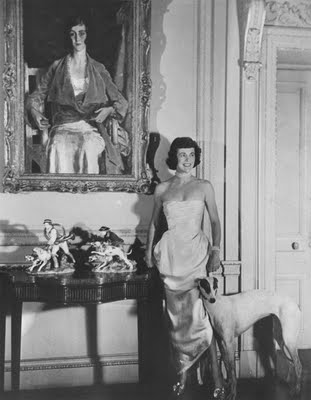
Today a look at another one of my favourite movies. If you have seen 'High Society' (1956) with Grace Kelly, you know the story - both are based on Phillip Barry's Broadway play 'The Philadelphia Story.' Barry wrote the play specifically for Katharine Hepburn, whose lead female character  Tracy Lord was inspired by real-life Philadelphian WASP heiress Hope Montgomery Scott (1905-1995), who had married a friend of Barry's.

Helen Hope Montgomery Scott
After several commercial failures and being labelled "box office poison" by Photoplay Magazine in 1938, Hepburn returned to Broadway.  She ended up backing Barry's play, foregoing a salary in return for an estimated 45% of the play's profits.  The play opened in late March 1939 and ran for a full year with more than 400 performances and a nationwide tour.  Hepburn was back!  She then bought the rights to the play, and brought the story to MGM, picking her own  co-stars (James Stewart and Cary Grant), screenwriter (Donald Ogden Stewart), and director (George Cukor).  Cukor had already made four successful films with Hepburn in the 30s, including Holiday(1938) and Little Women (1933).

Director Cukor and cast
Hepburn's role as a rich, snooty, care-free socialite who is humbled and becomes a real-life, compassionate person when she really falls in love, struck home with viewers, and as well as lifting the public's perception of her, the film became a major box-office success,  breaking all records during it's run at Radio City Music Hall in New York.


1940-1945 Interior of Radio City Music Hall in New York City
The film also earned six major Academy Award nominations including Best Director, Best Picture, Best Actor, Best Actress and Supporting Actress, and Best Adapted Screenplay.   Donald Stewart won the award for best screenplay  and Jimmy Stewart won the Academy Award for Best Actor (his sole career Best Actor Oscar, and over Henry Fonda in Grapes of Wrath), but Hepburn lost the Best Actress Award to Ginger Rogers for her work in Kitty Foyle and Hussey to Jane Darwell for the Grapes of Wrath.  Hepburn did win a 1940 New York Film Critics Circle Award for her performance however,  and the film was named one of the ten best of the year by Film Daily.

1941 Best Actor Jimmy Stewart & Best Actress Ginger Rogers
The chemistry between Grant and Hepburn is wonderful as it was in 'Bringing Up Baby' (1938), and watching Tracy Lord finally grow up and become capable of loving someone other than her self is reminiscent of the coming of age of  Jane Austin's 'Emma.'  Stewart is wonderful too, but he does seem so much better suited to his witty and beautiful photographer colleague that I spent most of the movie wanting to kick him and ask him what he was doing mooning after Tracy - his 'golden girl.'

Tracy and Mike
Ruth Hussey as Elizabeth Imbrie is definitely my favourite character - calm, cool, well-dressed and witty, her one liners are so quick you almost miss them. When they are first shown into the mansion's 'south parlor,' she says to Stewart's Mike, 'What's this room? I forgot my compass.'  And when Grant's CK Dexter-Haven asks "Can you use a typewriter?", her reply is "no thanks I have one at home." Love her!

Liz and Mike
I thought Mary Nash's portrayal of Tracy's mother Margaret was also outstanding - she has some of my favourite lines. When Tracy congratulates her for standing up to her errant father, she replies, "Yes, now I have my self respect and no husband."  Tracy and Margaret both agree that their first choice of husbands was unfortunate, and Margaret says, " We both might face the fact that neither of us have proved to be a very great success as a wife." Tracy replies, " We just picked the wrong first husbands, that's all."

Dinah, Margaret, CK and Tracy
John Halliday as Tracy's father also grew on me during the film, especially when he showed his human side and told Tracy some home truths.  Virginia Weilder as little sister Dinah is also very good, if slightly precocious, and Roland Young as Uncle Willie is also wonderful.  Weidler retried from film at age 17, after 40 movies, and Young was the original movie Watson to John Barrymore's Homes in 1922.

Tracy's father gives her a talking to
In 1995, The Philadelphia Story film was deemed "culturally, historically, or aesthetically significant" by the Library of Congress and was selected for preservation in the United States National Film Registry.  It was also recently selected as one of the top 100 American films of all time by the prestigious American Film Institute. 

I found a 2010 version of the DVD at the op shop (Warner Brothers), and the quality of the picture is outstanding. If you can get a copy , watch it - it's even better than 'High Society,' - there's no singing, just great acting.  Well except for Stewart's drunken 'Somewhere over the rainbow."  Here's a trailer to get started.


Deb xxx 


Wednesday, 15 May 2013

Since you went away, 1944


I have just finished reading 'Come in Spinner', a giant of a novel written in 1951 about the experiences of a group of Australian women on the homefront during WWII. I haven't been able to get a copy of the mini-series  (it was a huge book), so instead I have been watching a few 'homefront' movies. The first one was the classic and well known 'Mrs Minniver' (1942), and then the less known 'Since You Went Away'(1944), which stars one of my favourite actresses, Claudette Colbert. A brief look at that one today.
Cast
Claudette Colbert as Mrs. Anne Hilton
Jennifer Jones as Jane Deborah Hilton
Joseph Cotten as Lieutenant Commander Tony Willett
Shirley Temple as Bridget 'Brig' Hilton
Monty Woolley as Colonel William G. Smollett

Hattie McDaniel as Fidelia (the maid)
Lionel Barrymore as Clergyman
Robert Walker as Corporal William G. 'Bill' Smollett II

Agnes Moorehead as Mrs. Emily Hawkins
Alla Nazimova as Zofia Koslowska 
Albert Bassermann as Dr. Sigmund Gottlieb Golden


The cast of the movie
This epic movie (almost 3 hours, and with an intermission) was directed by John Cromwell and produced by David O. Selznick (Gone with the wind), and based on the 1943 novel Since You Went Away: Letters to a Soldier from His Wife by Margaret Buell Wilder, which was in turn based on her newspaper column "Letters to a Soldier from His Wife" for the Dayton (OH) Journal Herald. Like the heroine of "Since You Went Away", Wilder was raising two teenage daughters and taking in boarders to make ends meet while her husband, Donald, was serving in Europe during World War II.


Missing you already
The story begins in small town America in January 1943, with the empty chair of of Mr Hilton, who has (finally) joined the war effort and left for training. His wife, Ann, is bereft, and her loneliness begins the moment he is gone, but she tries to be cheerful for her two teenage daughters, Jane and Brig. Without her husbands wage as an ad executive coming in, things are tight, and Ann has to sell the car, dismiss the maid and take in a lodger.  Fidelia the maid soon returns, and works for room and board in between her war work. The first applicant, a young marine, sees daughter Jane and immediately accepts the unseen room, but Ann tells him it's taken. Instead crusty retired Colonel Smollet moves in. He gets some lesson from courtesy from Brig, and turns out to be a nice guy after all.


Smollet and Brig hit it off
Smollet's almost pacifist grandson Bill soon appears and becomes Jane's love interest - once her crush on friend of the family, officer Tony, has run it's course. Jennifer Jones (Jane) and Robert Walker (Bill) were going through a horrible divorce when the movie was filmed, but on camera they have wonderful chemistry and play the parts of young love brilliantly.


Jane, Bill and Tony
It is a very sentimental, at times corny, movie, but there are some wonderful insights into the realities of life on the home front in America.  Perhaps they didn't have to worry about bombs dropping on them, but there was still the pain of separation, the loneliness and worry, the shortages and rationing, and the death of loved ones far from home.   The family and it's relationships are the main focus of the film, but there are some great scenes  that show how the war affects others. There is a scene on a train, in which Ann and her daughters are trying to get to town to see her husband before he leaves for the South Pacific, which shows wounded and limbless soldiers, a young woman with a baby who has never seen it's father, a young girl refugee, and an old lady whose nurse grand-daughter is missing in action. And then of course they just miss seeing him because their train had to wait for a supply train to go through.
The baby hasn't met his father yet
When Jane graduates high school she gets a summer job with the red-cross, and her work in the hospital prepares her for the possibility of Bill coming home injured. 


Jane in the rehabilitation room at the hospital
Brig meanwhile is helping the war effort by starting a salvage centre for paper and metal.


Unfortunately Bill doesn't  return home, and Ann has to break it to Jane - her own husband is already missing in action. She also has to tell his grandfather, the colonel, who feels guilty as he pressured Bill into being a soldier. "My grandson had to die for me to be proud of him."


Jane continues her work at the hospital, and assists psychiatrist Dr. Golden, who explains - "there's a whole wide broken world to mend". His is only a small role, but it shows that soldier
s psychiatric wounds were beginning to be taken seriously. Golden tells her to do her best to help the men rebuild their confidence in them selves.


'Agnes Moorhead plays Ann's friend Emily, who is slightly self-absorbed and pretentious, and shows us the evil and unpatriotic things that everyday people may be guilty of. When Emily tells Jane that she shouldn't be touching common young men at the hospital, Jane sets her straight, and Ann then feels so guilty for helping more with the war effort that she gets a job as a welder in a ship yard. "If Claudette Colbert can do it, you can too" seems to be the message. 


Ann meets refugee Zofia at the shipyard, and they become friends. Zofia recants the inscription on the Statue of Liberty - "give me your tired, your poor, your huddled masses yearning to breathe free" - and tell's Ann that she is what she thought America would be. Ann is floored by the compliment.


It's Christmas time, and after a cheerful game of charades, Fidelia puts presents, those she has been safe keeping for Mr Hilton, under the tree. Ann opens hers and bursts into tears. 


But then, with perfect timing, the phone rings, and the message comes that Ann's husband is alive and coming home. She rushes upstairs to tell her daughters the good news, and the movie ends a happy note - one to give hope to wives and mothers everywhere. It is indeed a tear jerker!


Like Mrs Minniver, this movie was great propaganda for the war effort. Soon after some of the stars helped to promote war bonds as well.


16-year-old Temple in 1944 in Ottawa
 at a ceremony to raise money for Canadian Victory bonds
The music score was by Max Steiner, and won the Academy Award for Best Music, Scoring of a Dramatic or Comedy Picture. You just know that when you hear the dramatic music as Bill goes off on duty that it's not going to end well, but there are some musical snippets here and there of contemporary music. 


Max Stiener, right, with his award
It was also   nominated for Best Picture, Best Actress in a Leading Role (Claudette Colbert), Best Actress in a Supporting Role (Jennifer Jones), Best Actor in a Supporting Role (Monty Woolley), Best Cinematography, Black-and-White (Lee Garmes), Best Film Editing, Best Art Direction-Interior Decoration, Black-and-White (Mark-Lee Kirk, Victor A. Gangelin), and Best Effects, Special Effects. It lost out in most categories to the comedy 'Going My Way' starring Bing Crosby.

If you have time, you can watch the entire movie here.


Deb xx