Showing posts with label dress. Show all posts

Friday, 19 June 2015

New in Store - Pretty in Pink


Here are some of this weeks new listing available now in my Esty store!


For more pink vintage items, see here.

This week I am also starting to list vintage ads. They are great to frame to ad a bit of a retro feel to your home.  This one would be cute in the bathroom!

vintage Swan soap ad 1942
Swan soap 1942


Saturday, 6 July 2013

The Block Arcade, Melbourne

One place I have to visit every time I am in Melbourne is the Block Arcade in the city.

The Block Arcade site was purchased for 18 pounds in 1891 and a small tea room was set-up for the Victorian Ladies Work Association.  If you are a Phryne Fisher fan, you will have heard of the Block Arcade - it's where she meets her ladies maid, Dot.  Phryne also likes to meet people at the  Tearooms - named after its founder Lady Hopetoun.

The Hopetoun Tea Rooms continues to be popular with locals and visitors alike - there is usually a queue to get in!

We were there a little early for morning tea, but my children were eager to look in the window at the amazing display of cakes.


This visit there was also a small vintage fashion display - here are some of my favourite outfits:

vintage Edwardian dress

vintage 1930s dresses

vintage 1950s dresses

I just love the butterfly dress!

More Melbourne photos soon.

Deb xx

Friday, 24 May 2013

Dress of the week - Zebra print by Nina Ricci 1962

Today instead of fashion from the 1930s, a look from a little later on - the 1960s.  This dress by Nina Ricci featured in Vogue, September 1962.

Vogue September 1962
It's so breakfast at Tiffany's, don't you think?

Fifty years later, zebra stripes are again hitting the catwalk, with Robert Cavelli's 60s inspired African and animal print fall collection in 2012.  Here's one of the evening dresses from the collection, a zebra-printed jersey dress. Jennifer Hudson wore one at a 4th of July concert last year.

Cavelli 2012
Micheal Kors also used zebra print in his Spring 2012 collection.

Michael Kors Spring 2012
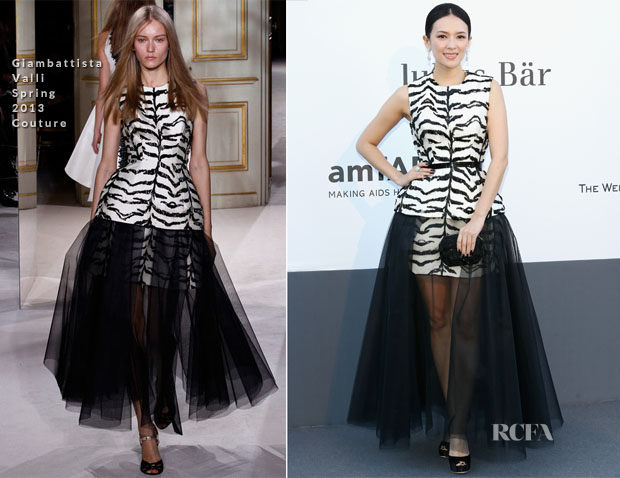
This year  Giambattista Valli's Spring 2013 Couture collection featured a zebra print dress with a tulle black skirt draping from the peplum-like detail.  That's actress Zhang Ziyi onthe red carpet on the right.

 Giambattista Valli Spring 2013 Couture zebra print dress

What do you think - would you wear a zebra print dress? If I could get that Cavelli dress in my size, I's think seriously about it!

Deb xx


Monday, 20 May 2013

Fashion in Art - 1935 Gown & Cape

Today's painting is Portrait of a Young Woman, painted in  1935 by Meredith Frampton.

Frampton, 1935
The sitter was Margaret Austin-Jones, then aged twenty three. Her dress was made up from a Vogue pattern by the artist's mother. The vase, made in mahogany, was designed by Frampton himself, and he said he made this painting as 'a relaxation from commissions, and to celebrate an assembly of objects... beautiful in their own right'.  

The dress is a little like this one (available on ebay).

1935 Vintage Sewing Pattern
But the fuller skirt is more like this one.

May 1935.
The caplet top maybe separate from the dress too.  Caplets and small capes to hip  length were popular in the 30s, like this Cape and Dress from about 1931 by Jean Patou.

Cape and Dress, c. 1931 Jean Patou
This is a sweet day dress pattern with a similar cape.

1930s Dress and cape pattern
I found a little black cape recently at the op shop ($3). I think it's going to be perfect next time I go out on a chilly autumn night!


You can see more of Meredith Frampton's work here.

Deb xx


Friday, 3 May 2013

Dress of the week - Chanel, 1932 & Diamonds

Gabrielle 'Coco' Chanel 1932

In 1931 Coco Chanel travelled to California for Samuel Goldwyn and a one million dollar contract, where she designed  some of the most beautiful outfits and gowns in Hollywood - for Gloria Swanson, in “Tonight or Never,” (1931) and for Ina Claire in “The Greeks Had A Word for Them,” (1932). She had come late into the production of Eddie Cantor’s Palmy Days (1931), and created only a few garments for the film. The the public loved her dresses and several celebrities become private clients, but she did not like Hollywood, "the capitol of bad taste" as she called it.  Some say her dresses weren't sensational enough, and that is why Goldwyn let her go.  I imagine this design from 1932 was inspired by her time in Hollywood. Pretty sensational wouldn't you say!

Chanel, evening dress, 1932
Bow detail, Chanel, 1932

This body hugging sheath of blue silk and sequins was designed to wrap the wearer, with the gored skirt flaring from the knees in front and from the waist at the back. Sleeveless with a  wide V-neck in the front, which dips to the waist at the back it was designed to show off the slim figure of the wear to it's best advantage.  A large bow of matching material is applied to the front bust, and another below the waist at the back, which is reminiscent of her famous 'Bow Sweater' of 1927.  

 
A Photoplay magazine article about Chanel’s gowns for Tonight or Never, January 1932

Chanel also designed a collection of diamond jewellery in 1932.  She had already built a business based on costume jewellery, and the men of International Diamond Guild hoped that her flair could revitalising the diamond industry, which had been slow since the crash of 1929. The star of her collection, pardon the pun, was no doubt this:

Comète necklace, 1932
The necklace, inspired by a comet, has a five-point star and round-cut diamonds that wrapped around the throat, finishing in a splashy tail.  Chanel told to one journalist how she glanced up at the sky one night while strolling the Champs-Élysées, contemplating how she would imbue fine jewellery with her singular aesthetic, and she found her answer among the stars: “I wanted to cover women in constellations,” she said.


Bijoux de Diamants was the first high-jewellery collection for Chanel — and the only for Coco — and in celebration of its 80th anniversary, last year the couture house is reinvented the series with “1932,” a new variation on the classic jewels originally designed by Mademoiselle Chanel. with 80 specially designed pieces. You can see the collection here. Doesn't hurt to look!

Deb xx

Friday, 29 March 2013

Schiaparelli Butterflies, 1937


The butterfly has always been a symbol for change, and metamorphosis - something particularly poignant at Easter.  This portrait of Princess Margaret in Ballgown featuring butterflies was taken in August 1930, when she became the Countess of Snowdon - changing from a gangly young woman into a beautiful princess.

Princess Margaret, 1930

In the 1920's and 30's the butterfly was also the symbol of change, from ugly to beautiful, of the Surrealists.

Vogue cover 1920s with butterflies

Italian Elsa Schiaparelli (1890-1973) was the most significant proponent of surrealism in fashion. She collaborated with many surrealist artists, but especially with Salvador Dali, Max Ernst and Man Ray, and shared many Surrealist views with these artists.  She was well-known for her whimsical and surrealist designs especially for evening wear, dinner jackets and accessories including jewellery, hats and shoes. In Summer 1937 she presented the Metamorphose collection.


Evening dress by Elsa Schiaparelli , 1937

Like an ugly caterpillar metamorphosing into a beautiful butterfly, so Schiaparelli's designs could transform an ordinary woman into an extraordinary one.  Like herself  many of Schiaparelli's client's were striking and chic, but not considered beautiful compared to the ideal of the time. This evening dress design from the summer 1937 collection features a lively butterfly print on silk fabric printed exclusively for her.


Schiaparelli featured the butterfly print on other pieces in her summer collection as well, including parasols and her new waltz-length evening dresses.


Portrait of Elsa Schiaparelli,1932
Perhaps the inspiration for this dress, worn by Paula Abdul in 2009. The Madame Butterfly dress is a silk chiffon hand pleated wrap dress in butterfly print by Lana Fuchs.

Paula Abdul in the Madame Butterfly Dress

Deb xxx

Sunday, 2 December 2012

A Vintage Wedding - 1990 & 1890 Style


I was married in December 1990. It was a strange fashion time, no longer the 80s but not quite anything else yet.  Neon and acid wash was still in, sadly, but I remember stirrup pants and body suits as the thing to wear.  Puffy, full skirted wedding dresses were quite popular still, thanks mainly to Charles and Diana’s wedding in 1981, as were  fishtail gowns.  Scott and Charlene's Neighbour's wedding in 1987 also spurned a movement, especially in gyp in bouquet and headpieces, and her dress was quite Victorian in style. Strapless gowns did make an appearance, but hadn't yet become the ultimate bridal dress, as they seem to be now.   Really anything went, but white and ivory were the colours to wear, with pastel bridesmaids.

Scott-and-Charlene-Wedding
Scott and Charlene (played by Jason Donovan and Kylie Minogue), 1987

What about 100 years earlier?  The Wedding Day was the most important event in a Victorian girl's life – she knew no other ambition.  Only women in  Wyoming (from 1869) and in Utah (from 1870) were allowed to vote.  Australian women would wait another four years.  Women has no rights – unless she were rich in her own right, she had to   marry, and marry well.

party
A New Zealand wedding party of 1890, all in white, except the groom source
Many brides chose to be married in June,  named after Juno, Roman goddess of marriage. June also signified the end of Lent and the arrival of warmer weather in the northern hemisphere, time to remove winter clothing and partake in one's annual bath – definitely a must before your wedding! April was favoured in Southern United Sates, as it was less hot, and April, November and December did not conflict with peak farm work months. October, the harvest month,  was considered auspicious but May was considered unlucky. "Marry in May and rue the day," an old proverb goes. But "Marry in September's shine, your living will be rich and fine."  In Australia it was similar, with British and European traditions followed, although March is now our most popular wedding season, being at the end of a hot summer.

victoria-and-prince-albert-wedding-1840
Illustration of Victoria and Alberts Wedding, 1840 (they rein acted it for film in 1853) source

The marriage of Queen Victoria to her cousin Albert of Saxe- Coburg in 1840 has had more influence on weddings than any other –the Queen wore white and set it as THE colour of choice for weddings.  Strangely though the men's’ breeches did not remain a tradition.  In 1890, Ladies Home Journal wrote: “That from times immemorial the bride’s gown has been white”. Although this statement was not true, it shows how deeply accepted it was that a wedding gown be white.   The style of wedding dresses of the 1890s closely resembles the fashions of the time,  with a fitted bodice, small waist, and full skirt over hoops and petticoats.  The fabric would be organdie, tulle, lace, gauze, silk, linen or cashmere, with the fine gauze veil in sheer cotton or lace.  Veils were attached to a coronet of flowers, often orange blossoms for the bride and roses or other in-season flowers for the attendants, who would also wear white. The bride's accessories included short white kid gloves, silk stockings embroidered up the front, and shoes decorated with bows or ribbons at the instep.

18901
1. Cuban American couple Jenny and Ygnacio Castaneda on their wedding day in Florida, 1890, source
The brides dress has a layered skirt and the fabric looks to be lace, and she wears a garland of flowers instead of a corsage or bouquet.  The groom wears tails and carries his gloves. I imagine his top hat is nearby.

18902
2. Unknown but smart wedding couple, 1890 source

Give him a hug, come on you’re allowed to now! The groom has his arm around his bride, unusual in wedding photos of the time,.  The brides dress has a short train, and the groom wears a long jacket with patent leather shoes, and a super moustache.

18906
3. Minne Cory marries Mr Kent, Chicago, 1890 source 
Minnie’s floor length skirt has a ruffled trim, and it looks like she is wearing a jacket over the skirt. She has a central corsage and some flowers in her hair with her long veil

18909
4. Sgt Major Nickel and his wife. Toowoomba, QLD 1890 source
Mrs Nichel's wedding gown shows a pin-tucked skirt, her simple veil is embroidered and trimmed with lace. She is carrying a bouquet and has a corsage pinned to her bodice, the flowers are repeated in her hair. The groom's dark suit is adorned with a corsage and fob chain.

18907
5. David and Clara Boyton on their wedding day, Wagga Wagga, Australia, 18 December 1890 source

The bride’s dress has frills at the hem and she wears her corsage at the centre rather than the side, and she carries a fan – a concession to a strong Australian summer no doubt! The groom wears lighter pants and boots with his dark jacket and waistcoat.

18903
6. Charles H. Castle and Alice Horton were married on Dec 25,1890 in New York source
Not all brides wore white. Some brides, especially those of the American frontier of the Australian outback, wore dresses that were more practical and could be worn after the wedding. This dress, or rather skirt and separate jacket, look to be ivory.

18904
7. Carl Ernst Miller and Wilhemina Caroline Abrahm 7 June 1890 source

The bride has a small corsage, and looks to have a ribbon draped across her, but no veil or bouquet.  The couple are not touching, either.  In this next photo the couple are almost touching, and the bride wears a long black jacket with a white bow over a black skirt, with no flowers to be seen.

18905
8. George Stahl and Amy Ann Brooks, wedding in Iowa, 1890 source

189010
9. The Swedish wedding of Brudparet Olinus and Berta Nilsson source

Her dark dress is accented with white lace and a large ribbon, and a long veil with an interesting head piece. A similar dress with larger headpiece  in another Swedish wedding.  And the dark gloves are interesting. I suppose it may be very cold!
189011
10. Brudparet Per Persson and Brita Eriksdotter , in Hälsingland. 1890. source

I think my favourite gown is number 9, what about you?  Oh, and please, if you know what the Swedish head pieces were made of, let me know. I’m sure it’s not gingerbread, although it does look a bit like it!

Deb xxx