Showing posts with label fashion. Show all posts

Friday, 26 June 2015

New in Store - Beautiful Beige

Beige is discreet, inviting, knowing, conveying an idea of naturalness (think raw wood and unbleached cotton) and nostalgia, with the patina of age. 

Vintage clothing has definite nostalgia! New in the Etsy shop this week are these beige beauties - 


VINTAGE 70s Boho Peasant Style Dress
VINTAGE 70s Peasant Style Dress 

Friday, 19 June 2015

New in Store - Pretty in Pink


Here are some of this weeks new listing available now in my Esty store!


For more pink vintage items, see here.

This week I am also starting to list vintage ads. They are great to frame to ad a bit of a retro feel to your home.  This one would be cute in the bathroom!

vintage Swan soap ad 1942
Swan soap 1942


Tuesday, 16 June 2015

Thrify on Tuesday - Rockin in Reds

I have finally worked out that Tuesday morning is the best day for thrift shopping (or op shopping as us Aussies call it) in my town. All the shops are actually open, and I can drop the kids at school and browse in peace....  

Today's finds -

From shop 1, some simple t-shirts with a rockabilly vibe and a cute Scotty dog tin for my collection (total $9.50).


Wednesday, 27 May 2015

The Latest in Hats, 1952

After having yet another skin cancer removed from my face, I have decided I really, REALLY, need to wear hats more - not just to the races and at the beach. Even a hat with a little brim can help keep the sun off your scalp, one plae where it is difficult to apply sunscreen! Today some hat inspiration from the 1950s.

In 1952 French designers  liked grey and white for daytime wear, and this included hats.  Dior had a grey straw hat swathed in matching grey silk.

Dior's grey straw and silk cap

Friday, 22 May 2015

Feeling blue? Put on your trench coat...

I love these blue suits from 1965, and in particular, the pale blue trench coat.  I don't have much use for coats here in North Queensland, but I think a pale blue cotton trench would see some use....

Blue Double Breasted Trench Coat

Thursday, 21 May 2015

Vintage Pattern - Cute Crochet Cap

Today a little crochet pattern for a winter beanie from May 1965 (Australian Women's Weekly).


I am pretty sure dc is double crochet, and there is a good tutorial here (which I may actually follow one day...)

Wednesday, 13 May 2015

Vintage Fashion - Mod Fashions still Rockin'

Sixty five years ago, straight from London, the look was MOD.

vintage 1960s mod fashions made in Australia

vintage 1960s mod fashions made in Australia


It's hard to believe it was half a century ago, as Mod fashion are still as MODern looking today.  Just take a look at Christian Dior Spring 2015 Couture Collection -

Wednesday, 28 January 2015

Vintage Fashion - A capsule Wardrobe 1942 style

I have capsule wardrobes on my mind!

Here is a nice little article from January 1942 ( Australian Women's Weekly), with a seven piece wardrobe in oatmeal linen, and over-checked linen with navy, blue, red and aqua. Perhaps like this colour scheme -

vintage colour scheme in oatmeal, navy, blue, red and aqua


vintage 1940s capsule wardrobe

I don't know about wearing the same blouse every day - may if there were two? Of course this would have been wartime, so fabric would have been rationed - maybe the oatmeal linen was from actual linen feed bags?!

Hmmm....

Monday, 28 July 2014

Vintage Fashion - Winter 1950

Some more beautiful suits today, this time from winter 1950, in a wonderful chic black and white check.


And look at these sleeves - I haven't seen the looped sleeve before (below right), but I love it!


There are some lovely suit patterns from around 1950 available on Etsy -

1950 McCalls Suit Pattern Vintage Size 15
It's also available here.  There is also a retro pattern from 1951 that is available in upto size 18.  You can find it here.


These suits are motivating me to lose a little weight.....

maybe.  

Wednesday, 23 July 2014

Vintage Fashion and Patterns - 1950s French Style

I just love the 1950s silhouette - the nipped in waists, the straight and slim below knee length skirts, and the loose flowing jackets.  These illustrations are  of Paris fashion of July 1952.  I would love that blue suit...


...and here is a super easy little blouse to sew (from The Australian Women's Weekly, July 1952) that would be perfect under one of those lovely suits.


It's on my list to do....

Friday, 23 May 2014

Vintage Fashion - Schiaparelli's Wardrobe Hints & Wool

In the 1940’s and 1950’s, wool was widely used to make everyday clothing. Not only was knitting hugely popular,  fashion designers loved wool fabrics versatility - it could be used for suits, and wool jersey could be draped beatifully for dresses. Many women had a tweed wool suit in their wardrobe  - a basic item that could be dressed up or down. 

1940's stylish tweedy ladies
Fashion designer Elsa Schiaparelli was famous for her wool suits in the late 1930s, including this slightly feminized version of a man's tweed suit.

Pantsuit, c. 1939 
Elsa Schiaparelli 

I love this navy suit with it's breast pockets incorporated into the bust form.


Suit, fall/winter 1938–39
 Elsa Schiaparelli 

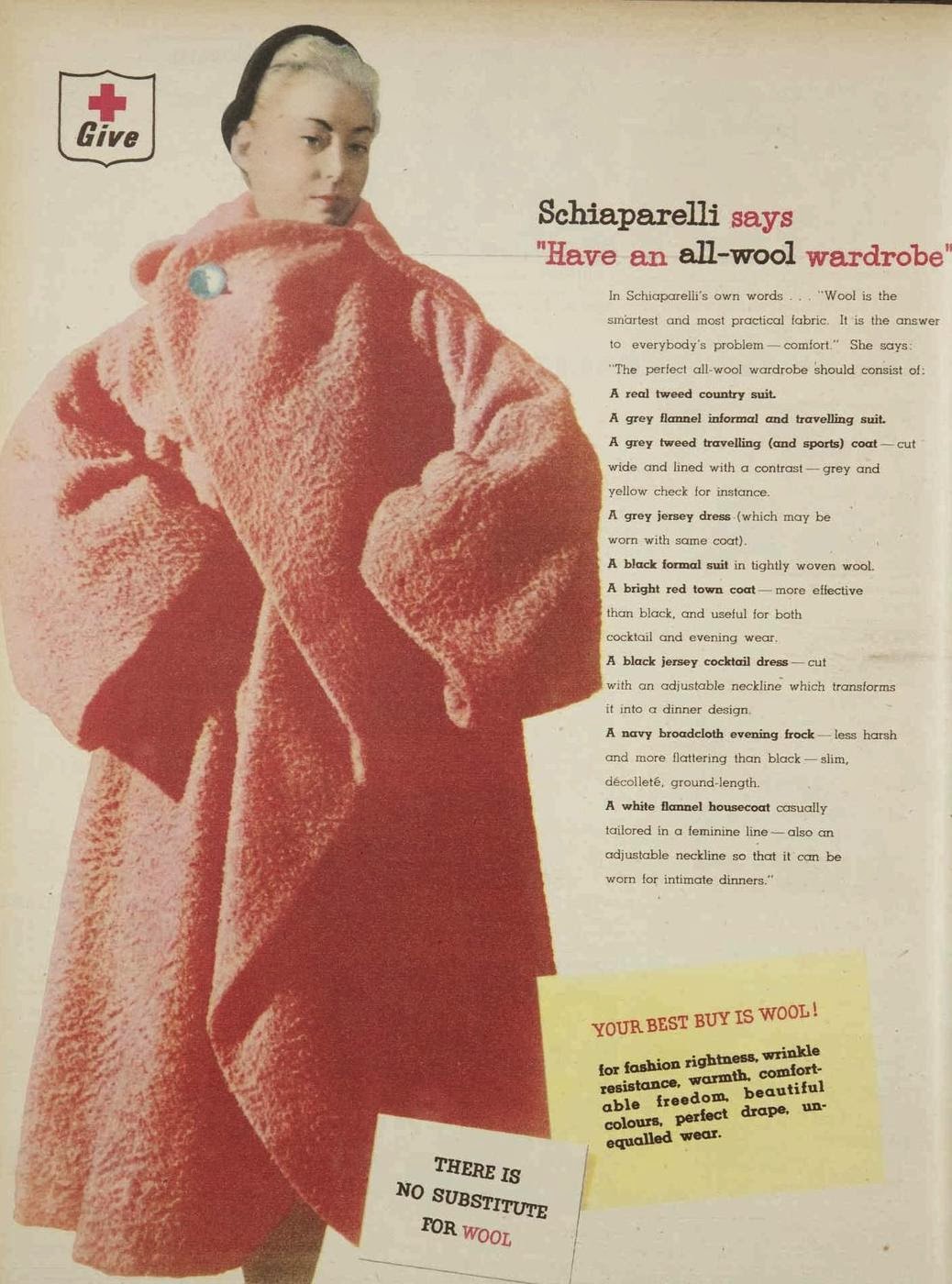
In this ad from 1952, Schiaparelli advocates 'an all-wool' wardrobe (for the Australian wool board).


Can we replicate that wardrobe today, still keeping a vintage feel?

1. A real tweed country suit

The Weekend in the Country Suit
The Weekend in the Country Suit by Puttin' on the Ritz, $385, a a wonderful 1930s feel.

2. A grey travel and informal suit

Selvedge: Baron Boutique Collection $399


Also available in other colors. I also love this suit with cape style jacket from Puttin' on the Ritz, $350 - available in a lighter grey than in the photo -  how cosy for travelling!

The walk in the park suit

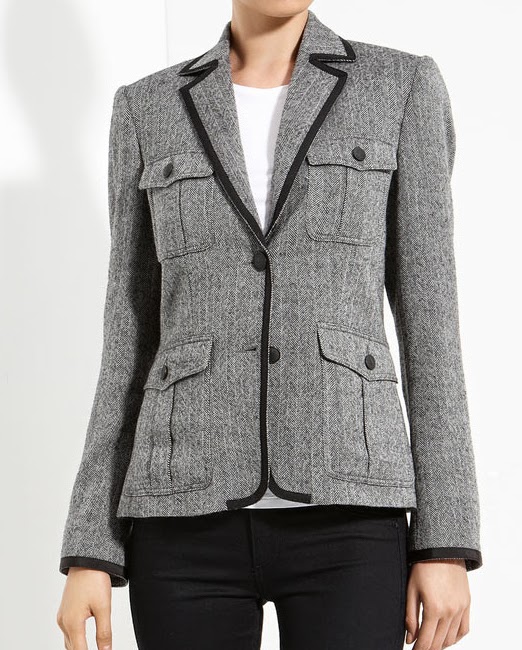
3. A grey tweed travelling sports coat

Womens Tweed Jacket
Not quite tweed, but with a cute 40s/50s look is this jacket from HeyDay Vintage.  Around $161, and there are matching pants available, so it could be the grey casual suit.

Mid 40s to 50s style cropped gab jacket 

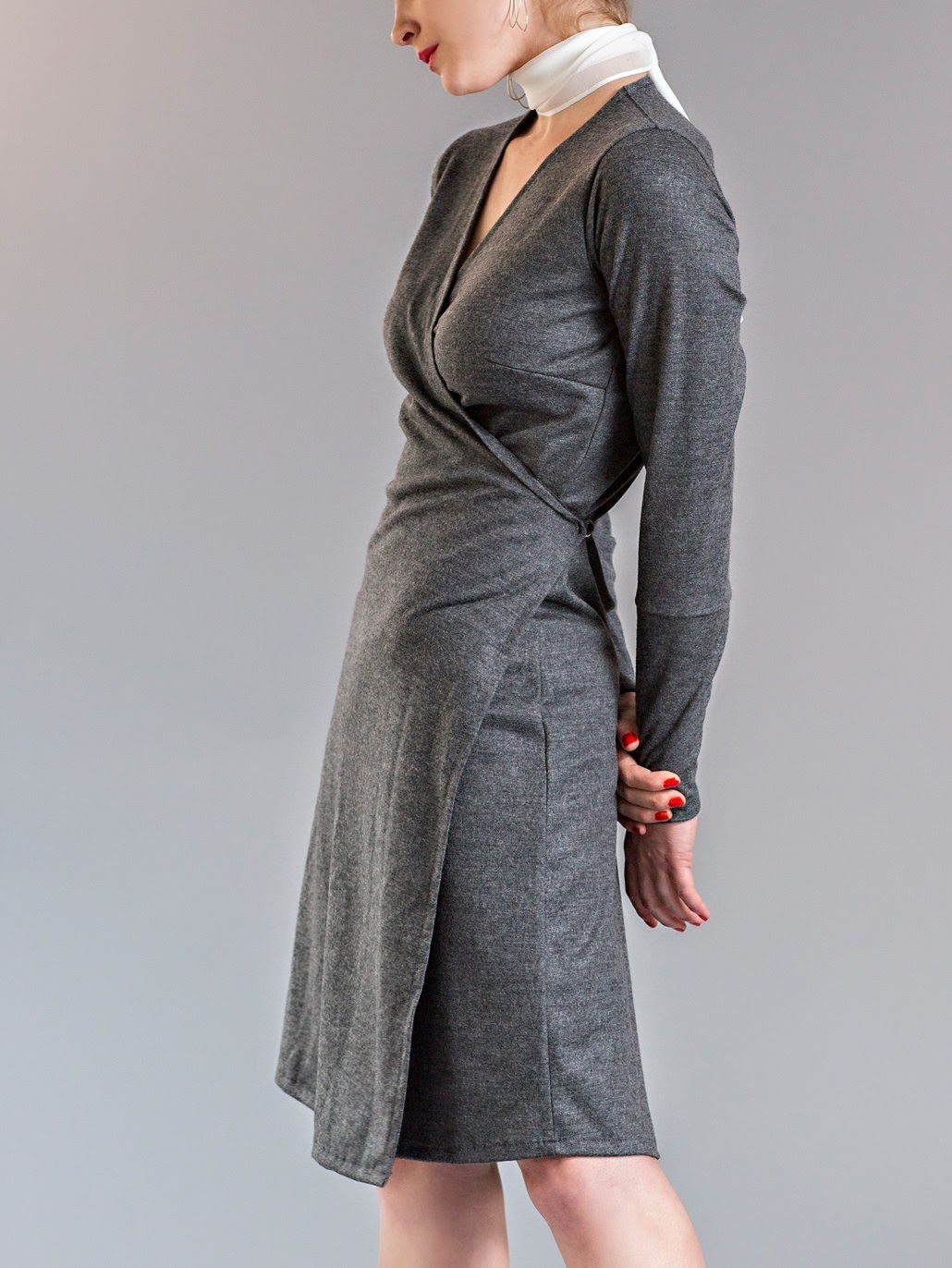
4. A grey jersey dress

A wool/lycra 'dance dress' by Stina Sayre $350

5. A black formal suit

Grace suit from Bombshell Vintage
Single breasted suit, with slight flare over the hips and pencil skirt. This suit is made to measure in a tweed like cotton blend fabric (available in black and many other colors) and available from Bombshell Vintage in Australia for $150. 

6. A bright red town coat
This one is in wool polyester, but I just love it!

5th Avenue Coat by Hey Day Vintage Clothing $450
7. A black jersey cocktail dress

Glamorous appliqués along the right shoulder and neckline of this dress make it a perfect 1940s style cocktail dress. It's made in a black crepe fabric, but a rayon/poly mix with a touch of spandex rather than wool. 

1940s style swing dress, about $250
I love this pencil dress, also available from Bombshell vintage, made to measure in your choice of fabric, including black, $150.

Retro Pencil dress from Bombshell Vintage
Pencil dress from Bombshell Vintage

8. A long navy evening dress

A navy wool evening dress is something that doesn't seem to exist - it would definitely be a made to order or make your self item today. I did find this lace/chiffon dress from the UK, which I quite like. It has a vintage feel, and doesn't show 'the girls' quite as much as some!

Lace Floor-length V-neck Sheath Dress
Schiaparelli herself designed this Navy Taffeta Two-Piece Evening Dress in about 1950, comprising of a skirt with asymmetrical side drape hem, strapless bodice with pleated stand away bust line and attached asymmetrical winged peplum over-skirt.

Schiaparelli Evening Dress, 1950
If you can find a copy, let me know!

9. A white flannel housecoat
So I am pretty sure that Elsa had no children, and didn't have to do her own dishes.  White? Really? Today housecoats have been replaced by terry-towelling robes. Not something you want to be wearing when the neighbours pop in. There are a few vintage patterns to be found for housecoats, this one is from Etsy.

1950's Vintage Pattern Lovely Wrap Housecoat
1950's Vintage Pattern Lovely Wrap Housecoat 

Now that red one looks glamorous enough to wear for cocktails!

It appears that unless you want to sew your own, it is fairly difficult to have a wardrobe made entirely of wool fabric. But then again, wool blends and look a likes are easier to launder, and less itchy!

Saturday, 17 May 2014

Regency Resources - Corsets and Stays

A few weeks ago I wrote of my plans to attend a Jane Austen festival in Canberra next April, and my preparations for same.  Well, I have begun!


I ordered the Regency Underthings Pattern (digital version) from Sense & Sensibility Patterns - a bargain at $9.95 as it includes patterns for a chemise, short stays, and two chemisettes. 


I bought 5m of fine white cotton sheeting fabric ($20) and have made my first (of three) chemises, and it is so comfortable I have been wearing it to bed! I have also made both version of the chemisettes (basically under-blouses with no sleeves) in the same fabric - they just need the ribbon draw string inserted at the bottom and perhaps a ribbon to the the frilled neck one - although I am thinking of just using a brooch. 

chemise and  chemisettes
chemise and  chemisettes
Now tackling the short stay.  My first attempt at the stay (a sort of regency bra or short corset) was too large, and I realized I had cut out the wrong size - sizes 8 to 26 are included - but now I think I have the right fit.  The stay consists of three layers, and is a bit more fiddly than the other under-things. The instructions recommend to start with the lining, which is what I have done.


Short stay - lining
Short stay - lining
I am a C cup, so hopefully the stay will hold mE in, or up, but apparently if you are a D cup or larger, a longer stay is better.

The Oregon Regency Society have some wonderful pointers about short stays -

Short Stays
I particularity love this advice -

"The rule of thumb is this, your gusset cups should not cover much more than the lower half/hemisphere of your breasts. The nipple should be just barely covered by the edge of your binding, or even half-covered.  The top half of your breasts should be pillowed in the cups.  What keeps them from falling out is the neckline of your shift. "

For some more wonderful advice, illustrations and history I have found these sites helpful and interesting -

A pair of transitional stays, from the Victoria and Albert Museum.
Another example of a cotton Regency corset (c. 1800-1825) – from the National Trust website
Achieving a proper fit with Regency stays – by Oregon Regency Society
Examples and pictures of Regency era underwear – Jessamyn’s Regency Costume Companion


Now to find a pattern for some pantaloons.....
Deb xx

Saturday, 26 April 2014

Jane Austen and a Brief History of the Regency Empire Style

I have just re-read Emma, by Jane Austen.  Now, as I am wont to do, I am obsessed with all things Emma and indeed Jane Austen. I've watched both 1996 versions of the movie, and the 2009 mini-series (forgive me if I sound a bit Austen-ish in my speech!), and I am trying to find a copy of the 1972 mini-series.

I have also been searching the the web and found, much to my delight, that there  there are thousands of Jane Austen fans out there, and even those who attend re-enactments and fairs, and dress in the period.  There is even a Jane Austen Fair here in Australia! It is held in Canberra, NSW each April, so I have just missed it - but that means I get 12 months to prepare for the next one!  I jokingly mentioned to my husband the other day and told him that the activities including dancing and a ball as well as concerts, a costumed promenade around the lake, theatre and archery, and he said it actually sounded like fun.  I couldn't believe it, as normally he is not too keen on my vintage obsessions, so we vowed then and there that we would attend. How exciting. Now to study the period and plan a wardrobe. For both of us....

Napolean and Josephine

The 2015 Jane Austen Festival will be celebrating the 200th Anniversary of The Battle of Waterloo, as well as Jane Austen’s Men, so I would like to make a wardrobe that could have been worn in 1815.  Napoleon of course was the instigator of the Empire Silhouette -  he admired the ancient Greco-Romans and their fighting style, and their draped, tubular, less-corsetted, high-waisted fashion became popular with a public wishing to differentiate themselves from the aristocracy with their powdered wigs, panierred skirts and extreme corsetry. Josephine did a lot to promote the style, as fashion was no longer dictated by the court at Versailles and the sometimes over-extravagant Marie Antoinette. Gentlemen also began to wear trousers, in the fashion of French peasants,  instead of the knee breeches and stockings that had been popular for centuries.
 
Rutger Jan Schimmelpenninck with his Wife and Children c. 1802
I find it interesting that even through Napoleon was an enemy of Britain, the Empire silhouette was taken up by the British, and her colonies, and most of Europe, except perhaps for Spain  - the British, often seen as straight laced and conservative, adopted a fashion that almost allowed the natural form of women to be shown, with only a few layers of fine muslin, cotton or silk fabric and the top of the breasts often actually visible! It is thought than 'Dandy' Beau Brummell introduced the male fashion of trousers to Britain, along with the cravat, and tailored linen jackets.  Linen jackets also became a trend in women's fashions - the shortened spencer to wear with high waisted dress - as did linen skirts.  Perhaps he was also partly responsible for the Empire dress craze for women, or maybe women were just eager to embrace practical fashion that actually allowed them some freedom of movement and routine. Or perhaps it was the British who started the trend and the fashion moved from Britain to France.

Even the Prussian aristocracy did not want to be aligned with the French royals - here is Louise of Mecklenburg-Strelitz, (1776-1810) the wife of king Friedrich Wilhelm III of Prussia, in 1798, before she was pursued across Europe by Napoleon. Her skin is so pale it'a little hard to see where the dress begins, but it is quite low cut with a little sheer fabric across the breasts and is obviously in the empire style with gathers under the bust. Is she wearing neck protections?!

Portrait by Nikolaus Lauer, 1798

It's as if women suddenly thought "let's just ditch the dress and wear our underwear!" In  the painting below you can see the young girl with her simple white chemise style dress, the older girl with her dress gathered under the bust, and her mothers similar but with an extra cross-over piece (probably for ease of breast-feeding). The father has his top-coat on so one would assume the women are not in their underwear.

Painting of a family game of checkers ("jeu des dames")c. 1803, Louis-Léopold Boilly

As the style progressed the skirts began to flatten at the front and gather just from the bodice at the centre back, as in this example from about 1810. Note the very sheer patterned muslin over a plain chemise.


1812

The Empire style did waiver a little in France, as it was said that many women were dying from cold because of lack of clothing.  However, when a newspaper report told of  Madam Hamelin, the first woman to run the Théâtre de Paris, adopting the style, it persisted.

Madam Hamelin
Other fabrics were used - thicker cottons and silks in patterns, florals, checks and brocades - and shawls and spencers did protect the wearer from chills (Mr Woodhouse would be happy).  The patterns, and a slightly shorter ankle length, also prevented the dress from becoming dirty so quickly.


There are examples of dresses from the period in bright blues and yellows, and even red and tartan. (You can see my pintrest board for more examples).

Silk tartan dress
I do love this period of fashion - it looks quite comfortable and easy to wear, and actually quite modern, especially  compared to what came twenty and even fifty years later. The style was sort of taken up again one hundred years later, in the 1910s, with the tea-dresses in the neo-classical style, although the breasts were not quite such a feature.  Maybe another 100 years on we are due for a resurgence? Not too far fetched an idea, as the maxi-dress is already popular!

Although it was a time when the distinction of styles among the classes was quite blurred, middle and upper-class women did distinguish between "morning dress" (worn at home in the afternoons as well as mornings) and evening attire — generally, both men and women changed clothes in preparation for the evening meal and possible entertainments to follow. There were also further gradations such as afternoon dress, walking or promenade dress, riding habits, travelling dress, dinner dress, etc.

Morning or domestic dress, 1811

According to "The English Lady's Costume", published in London in 1811, morning dresses were worn inside the house and were high-necked and long-sleeved, covering throat and wrists, generally plain and without decoration.  Evening gowns, on the other hand,  were often extravagantly trimmed and decorated with lace, ribbons, and netting. They were cut low and sported short sleeves, baring bosoms - not beyond the boundaries of decency, however, especially for those past the blush of girl-hood.

Carriage or promenade dress, 1811
So it appears, that at the very least, I need to sew a morning dress, a carriage or promenade dress and an evening dress for my self, and have accessories such as gloves and a shawl, and at least a sun-hat.  I plan to find some patterns and make a first dress in calico or muslin and experiment. I will look at each style of dress in more detail as I go.

In the meantime, I have a few more (free) books for my reading list -

the rest of   "The English Lady's Costume" - which can be read online here; and

"The Age of Napoleon: Costume from Revolution to Empire, 1789-1815" - online here.