Showing posts with label Melbourne. Show all posts

Saturday, 9 November 2013

Mid-Century Architecture -The Ampol Building

The  Ampol Building was designed by Bernard Evans & Associates and completed in 1958 on a site on the corner of Elizabeth and Grattan streets in Carlton..

The Ampol building, later Elizabeth Towers Hotel, Melbourne c 1960
The Ampol Building, c. 1960
The circular corner tower housed Melbourne's tallest concrete spiral stair - I love the blue tiles and the neon sign. There was also a petrol station at the ground level.

The building later became a hotel - my parents stayed there in the 1970s I think - Elizabeth Towers.

Elizabeth Towers Hotel Melbourne

The building was definitely better in it's natural brick state and pre-air-conditioners in the windows. Like many other mid-century buildings it's charm was ruined by paint and 'modernizing'

In 2008 Melbourne University bought the building for $20 million, and demolished it last year to make way for its new $186 million Peter Doherty Institute for Infectious Disease and Immunology.  While I am not saying that it's not a worthy cause, it seems a shame that at least the stair case couldn't be saved.

Some websites still list Elizabeth Towers hotel as being active - see here and here.

I for one will miss it next time I am in Melbourne. As a child I loved passing it on the tram on the way into the city - it was the landmark that told me we almost there.

Perhaps though the replacement of the Ampol Building by a University Building is karma - according to this ad from 1967 Ampol donated money to universities.............

Ampol vintage ad 1967
1967

Deb

Sunday, 7 July 2013

My Week in a Nutshell

This week I have been:

♥ Walking the kids around the Melbourne - City, Parks, Gardens, Museums 
♥ (Looking for my son when he got lost in the Botanical Gardens) 
♥ Planning to get a i-pad with wi-fi when next I travel
♥ Sleeping until 8.30 every morning, hoping it would get warmer
♥ Drinking hot chocolate at the Lindt shop at Southgate, Melbourne 
♥ Eating jam do-nuts at the Victoria Market 
♥ Celebrating my parents 70th birthdays and catching up with family 
♥ Watching the kids play with their cousins, who they haven't seen in years
♥ Sitting around a fire-pit talking, drinking red wine and watching the stars
♥ Un-Packing and re-packing, travelling from Melbourne to country Victoria to Melbourne     to home
♥ nominated for a blog award (thankyou!!)

♥ Deb


Saturday, 6 July 2013

The Block Arcade, Melbourne

One place I have to visit every time I am in Melbourne is the Block Arcade in the city.

The Block Arcade site was purchased for 18 pounds in 1891 and a small tea room was set-up for the Victorian Ladies Work Association.  If you are a Phryne Fisher fan, you will have heard of the Block Arcade - it's where she meets her ladies maid, Dot.  Phryne also likes to meet people at the  Tearooms - named after its founder Lady Hopetoun.

The Hopetoun Tea Rooms continues to be popular with locals and visitors alike - there is usually a queue to get in!

We were there a little early for morning tea, but my children were eager to look in the window at the amazing display of cakes.


This visit there was also a small vintage fashion display - here are some of my favourite outfits:

vintage Edwardian dress

vintage 1930s dresses

vintage 1950s dresses

I just love the butterfly dress!

More Melbourne photos soon.

Deb xx

Thursday, 7 February 2013

Small Australian stores in 1913

Yesterday I looked at Bon Marche, the grand French department store. Today a look at quite the opposite – small, mainly family run stores in rural Australia one hundred years ago.  Most of them sold a range of goods, and I can imagine myself lost inside, browsing for hours……..or maybe not, as the horse might be getting a bit restless waiting for me!
For some reasons some of the images aren't showing - please go here for the first image if that's the case for you.


Raymont's store was built in 1885 by Thomas Percival Raymont to sell groceries and produce.  He bought and sold – what a great system – and was also an insurance agent.   The store was in operation for 65 years and was later managed by Thomas' son, Bill. Thomas and his wife Eliza lived in a house next to the store and there raised eight children (five dying in infancy). Up until the early 1900s the store was an agent for the supply of rations to the Aborigines who lived in Enoggera. From 1888 the store included the Post Office for the area, although it has a separate door, so it may have been leased to someone else.

John Stewarts grocery store at Annerley around 1913
John Stewarts grocery store at Annerley  c. 1913 source

Staff and customers outside John Stewart's grocery and provisions store on the corner of Ipswich Road and Clive Street around 1913. Possibly the family lived above the store, which was quite common in those days.
Gearys Commonwealth Stores in Chinchilla around 1913
Shop assistants and customers pose outside Geary’s Commonwealth Stores in Chinchilla, QLD c. 1913 source

Mr D. Geary came to Chinchilla from Miles in 1904 and set up this shop to supply basically everything to the local farmers who grew mainly grain, and also ran cattle, sheep and pigs.  Timber was also felled nearby.  I love the way the store also has an ironmongery.  I doubt ‘iron’ goods were made in the store, as blacksmiths usually had separate premises because of fires risks, rather it is an alternate name for hardware store.  However, the store was destroyed by fire in 1922.

Music store in Morgan Street Mount Morgan 1913
Music store in Morgan Street Mount Morgan, QLD 1913, source


I don’t know much about this one, but it’s great to see people in country Queensland had access to instruments and sheet music.

Store belonging to R. Beckett in Mundubbera, Queensland, 1913
This image may not work either, so go here to see it.
Beckett's store was a tailor, drapery and shoemaker business, but also sold stationery. It looks to be situated right in the bush, with no road.  Another building is being constructed near by, so maybe this was the start of the town.  It has a very wild-west feel to it, don’t you think?

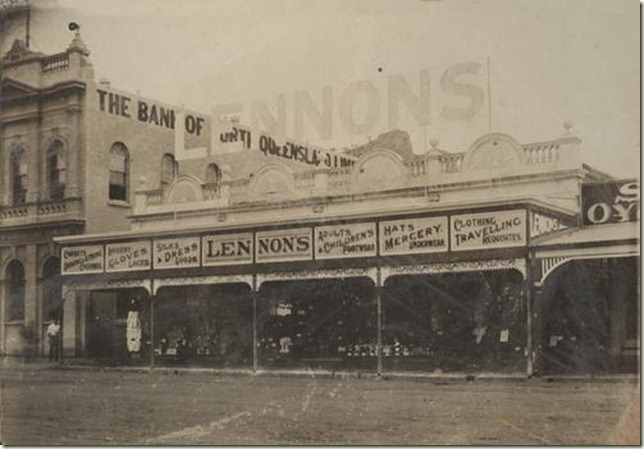
Lennons clothing store in Townsville 1913

Lennon’s clothing store in Townsville 1913.  By 1913 Townsville was fifty years old, and quite a large town.  The even had motorised buses! Lennon’s shop, positioned cleverly next to the bank, looks quite upmarket, and has a very large sign to attract customers – literally a sign of things to come.  A Mr William Lennon was involved in the Bank of Queensland in the 1880s, before opening his own stock agent store around 1900 – it’s possible this store is an off shoot of that.  Lennons’ sold footwear as well as clothing.  Here is the interior of their boot department.

Boot department inside Lennons Drapers

This last store is located in Oakleigh, Victoria, now a suburb of Melbourne but in 1913 it was more of its own town.  From the exterior is looks like the store was located near the railway line, and sold everything from cigarettes to groceries, and glassware to electrical goods. Like all of the other stores, it also has a generous veranda.

exterior oakly

I was happy to find an interior view of this same store. Definitely not a self service store – most goods are displayed behind the lovely wooden counters.

interior oakly

I love the old cash register and Dayton scales. Note the ‘ironmongery’ sign – probably more hardware.
Imagine being able to fit all available goods in one store today – no mega hardware or department stores, or supermarkets.  Shopping has certainly changed in 100 years.

More photos of stores on tumblr, including some overseas stores.

Deb xx


Thursday, 8 November 2012

The hat event of the year


The Melbourne Cup was all about hats.
Ok, so it was about horses too, but mainly about hats. And fascinators - those things that do little to keep out the strong Australian sun.
The Winner, Green Moon, source
Tall ones.
Mischa Barton wearing a Philip Treacy Hat 
Sideways ones.

Rebecca Judd
Royal ones.
Camilla, Duchess of Cornwall 


And lots of flowers.
Entrants in the 2012 “Fashion on the Field” competition

Delta Goodrem ain a headpiece by Kerrie Stanley 

Big flowers were very popular.
Ann Kooy, fashion winner at Clifford Park on Cup Day.


And flowers with feathers. I think this one is my favourite.

Nicky Buckley 
Maybe next year I could get something like this large satellite hat by Patrica Keech. 

Patricia Keech via Etsy

It has a bit of a Victorian feel, like this hat worn by Grace la Rue in 1903, and would keep the sun out at least!
 Isn't she stunning?
A Victorian feel too with this hat worn by Margaret Woods  in 1962, winner of the first Melbourne Cup Carnival “Fashions on the Field” competition.


Margaret Wood 1962
In the days when hats were compulsory, along with gloves, stockings, and dresses that reached to the knees.  The days before Jean Shrimpton appeared at Derby Day stocking-less, gloveless and hatless in 1965.

Jean Shrimpton 1965
Jean's outfit scandalised the ultra-conservative Melbourne establishment, for whom the Spring Racing Carnival was the social and fashion event of the year, and she was the target of catcalls from men and jeers from women.  She says in her memoirs:

"The day of the races was a hot one, so I didn't bother to wear any stockings. My legs were still brown from the summer, and as the dress was short it was hardly formal. I had no hat or gloves with me, for the very good reason that I owned neither. I went downstairs cheerfully from my hotel room, all regardless of what was to come."

Jean said in a statement: "I think you should dress to please yourself," but admitting that she had been disciplined by her sponsors dressed more conservatively three days later for the cup, in a three-piece grey suit with an ice-blue straw Breton hat, beige gloves and stockings, and a chocolate-brown handbag. 

Shrimpton at the cup 1965

Like Michael J Fox in Back to the Future she ruefully observed: "I feel Melbourne isn't ready for me yet." 

Did you don a hat for the Cup?

Deb xx


Wednesday, 7 November 2012

The Melbourne Cup


Yesterday the Melbourne Cup was run at Flemington Racecourse in Melbourne. None of the favourites won, which shocked a few people, and the race was won by Green Moon. The runner up was Fiorente, and third Jakkalberry. The Quinella was something like 500/1 and the Trifecta was 48545/1! If only......

The Melbourne Cup is Australia's major Thoroughbred horse race. Marketed as "the race that stops a nation",  which it really does.  Even here in Mackay, over 3000 km from Melbourne, offices shut at lunch time to enjoy cup day lunches and to watch to excitement on the big screen.  It’s a great excuse to wear a pretty dress and hat, and to drink champagne! 

Fashions at the Cup, late 1800's

Spring racing fashion  in Melbourne c. 1900

The race itself is long - 3,200m, or two miles, and it is one of the richest turf races in the world.
On Thursday, 7 November 1861, a crowd of 4000 gathered at Flemington to witness the first Melbourne Cup, which offered the largest purse for a race in Australia to that time - First prize was a gold watch and £170. The Victorian Turf Club announced that the Melbourne Cup was to be a fair contest in which the best horses would be handicapped, ie. weighted down, to make the race more equal. Older horses were given more weight than younger ones and weightings were adjusted according to the horse's previous results.
The betting ring, Melbourne Cup c 1886
The course itself was little more than a haphazard path cut out among tall grass on the rough river flats, although there were races there every year since 1840 when Melbourne as a town was barely five years old.  A track was marked out across the river flat using posts, and the jockeys had to make sure their horses ran around the outside of each one.  The name 'Flemington' was not used until the 1850s. It is believed that a man named Robert Fleming sailed down the Saltwater River (now the Maribyrnong) and stopped and built a house on the land that is now the racecourse. He and his wife had a family of four children and their livelihood was farming cattle and sheep, and he established a butchery on the site later taken by the racecourse. A butchery beside the Saltwater (Maribyrnong) River would have been in keeping with the river's later use for noxious outfalls, and the near by new market area was the site of an abattoir and saleyards until the 1980s (when I lived their in the late 80s the abattoir had closed, and the cattle-yards were empty - fox and rabbits abounded and it was a great place to walk the dog!) As time went on, the property became known as Fleming Town. The Flemings granted permission to Melbourne's racing administrators to conduct race meetings on their land and this is how the name 'Flemington' came about.
Racing card - 1861

There were 17 starters, and a fall during the race brought down three horses, killing two and breaking a jockey's arm, but the field kept going. Archer, a Sydney "outsider", won the race, beating a local favourite, Mormon .  Archer was trained at Terrara by Etienne de Mestre, who set up a stud, stable and race track where unofficial races were held.  He took Archer the 500 plus-miles to Melbourne by ship to run in the inaugural running of the Cup.  The next day he won the two mile Melbourne Town Plate, and  was back at Flemington the next year to win the Melbourne Cup again, a feat not repeated until Peter Pan won the race twice more than seventy years later.


Archer c. 1861
Flemington was fairly basic in the early days with little in the way of running rails or stands. But the Melbourne Cup quickly became popular as a carnival with picnic parties, sideshows, celebrations and people showing off their latest fashions. Socialites, politicians and Australia's rich and famous attended the Cup right from the earliest days, as they still do today.  In the 1860s Victoria was experiencing the gold rush and many people had flocked to Melbourne, Bendigo and Ballarat in the hope of finding gold. A few gold-diggers were fortunate and became wealthy, and they enjoyed splurging at Flemington.
Fashions at the Cup in 1875

In 1886 Flemington Racecourse was the site of Australia’s first cinematographic newsreel, and in 1875 race day changed to a Tuesday. It has since usualy been run on the first Tuesday in November each year, except during three of the five years during the Second World War (1942, 1943 and 1944) when it was held on a Saturday. In 1877, the first Tuesday in November was officially declared a public holiday in Melbourne which ensured crowds flocked to the track. By 1880, 100,000 people would make the journey from the country and other colonies to Flemington to attend the Cup, which boosted Melbourne’s population four-fold. 
The Lawn at Flemington, Melbourne cup day 1889, by  Carl Kahler
"There was barely standing room on the lawn and many ladies were unable to find a seat for the whole day. The Paddock was overcrowded to excess and the Hill was simply a mass of human beings. It has reached a stage now that almost everyone in Melbourne goes to the Spring racing." - Australasian Newspaper (1871)
  

Nothing much has changed – the lawn is still crowded and many people enjoy their picnics in the car park, never making into the race course itself. The Cup itself is now made up of 34 pieces of hand-beaten eighteen carat gold and a lathe-produced base, and is worth $150,000. Every year the Melbourne Cup trophy is awarded as a prize. There is also $6,200,000 to be divided by the winners.
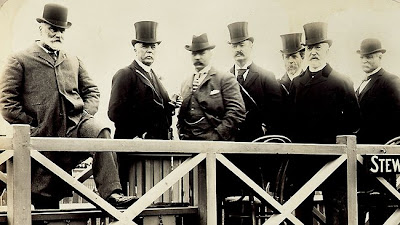
Racing stewards at the Melbourne Cup 1887 - all committee members wore morning suit

The Race That Stops a Nation by Vivienne McCredie

 But once a year at Flemington
A horse race stops us all
And we hold our breaths and listen
To the commentator’s call
For never has there been a race
That holds such fascination
Than the race they run at Flemington,
The Race that stops the nation
We Aussies are a funny lot,
The things we hold so dear -
Like Rosewall, Hoad, the Opera House,
A glass of Fosters beer
Let’s not forget the Great White Shark,
And Lillee – in full flight,
The Wallabies, the Kangaroos,
The Harbour Bridge at Night,
Of course it’s something special
When we say the name of ‘DON’,
Our Bradman was the best they’ve seen;
His legend carries on
On a Tuesday in November,
The first one to be sure,
As the winner flashes past the post,
You’ll hear the thousands roar.
For never has there been a race
To catch imagination
Than the race that’s run at Flemington
The race that stops the nation!
It’s called “the Cup” – the Melbourne Cup. Beginning naturally
When a horse called Archer walked
Into a place in history.
And since that year of ’61,
By the way, all these images can be found on tumblr, with the correct source.
deb xx