|
Ostrich Hunt, Etched by Stefano della
Bella c. 1654 source
|
Ostriches have been hunted and
farmed for their feathers, skin, oil and meat since Roman times. Ostrich feathers have been used in
fashion for thousands of years and were at one time worth more than their
weight in gold.
 |
| Golden Gate Ostrich Farm Certificate for 5 Shares of $10 each, issued 26th Nov
1912 source |
Ostriches are native to the African continent but are farmed worldwide. Ostriches are so adaptable that they can be farmed in climates ranging from
South Africa to
Alaska. It is thought that ostriches were domesticated at Oudtshoorn- a town on the southern most tip of Africa, where Ostriches roamed the plains for centuries. The modern domestic ostrich was bred from a cross between South Africa's indigenous bird, the South African Black, and the Evans-Lovemore strain of Barbary blue-necked ostriches (141 of which were secretly smuggled out of North Africa and brought to Oudtshoorn by a group of adventurers), and farming began in about 1860.
 |
| Silk dress with ostrich feather trim c. 1875 source |
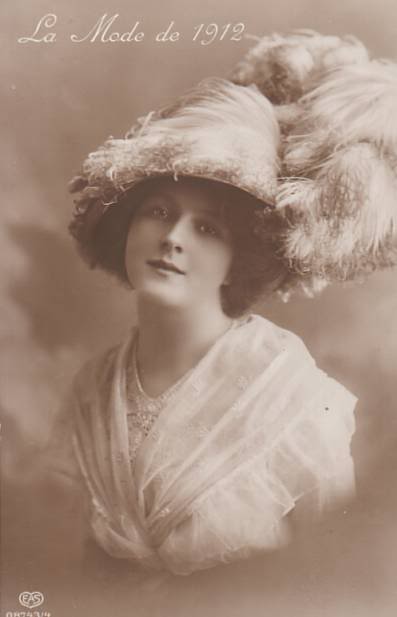
Ostrich feathers in ladies clothing and hats was the height of fashion in Victorian and Edwardian Europe where they were especially popular for use on the latest fashionable hats.
 |
| American silk and wool hat with ostrich feathers c.1910 source |
 |
A headline inThe
New York Times from 1912 read: OSTRICH FEATHERS ONCE MORE IN WIDE USE. The
article explained: “For hat trimming one plume, full and long, is considered
sufficient, and in almost every instance the tip of the plume is placed toward
the back of the hat, or resting at the back of the head.”
|
Between 1875 and 1880, ostrich prices reached up to £1000 per breeding pair, and farmers of the region, quickly realised that ostriches were far more profitable than any other activity. Numerous immigrants, particularly the Jews of Eastern Europe and Lithuania, moved to Oudtshoorn, so that it earned the nickname "Little Jerusalem" by 1890. By 1900 there were over 700,000 birds in captivity world wide, including in Australia and new Zealand
 |
"Ostrich
farming in Auckland District. Young Birds inspecting visitors, Helvetia Park,
Auckland," 1905,
|
The best plumes are from the male birds were carefully cut, with sharp scissor like tools, and used for women’s hats as well as capes, hand
fans, boas, muffs, and trimmings on a variety of clothing and accessories. At
the peak of their popularity during the “feather fashion craze” of the early
20th century, plumes were found in dozens of sizes, made into fantastic shapes
and amazing types.
 |
| Fan of mother of pearl & ostrich feathers c. 1900 source |
 |
| Fan dancer c. 1910 |
 |
| a Russian singer with Feather boa, c. 1900 |
South African ostrich feather dusters were developed in Johannesburg,
South Africa by missionary, broom factory manager, Harry S. Beckner in
1903. He felt that the Ostrich feathers made a convenient and most efficient
tool for cleaning up the machines at the broom factory. By 1905 the Ostrich Duster was the must have item in many a
household and were sold in ever increasing numbers which saw the introduction
of the feather duster salesman!
Ostriches were also valued for their
leather, which meant that in the 18th century they were almost hunted to extinction. It is claimed that ostriches
produce the strongest commercial leather, and it is highly prized for its strength and beauty and is still used today for shoes, purses, wallets, luggage and other small accessories.
Cawston Ostrich Farm, in South Pasadena,
California , just 5km north of downtown Los Angeles, was
opened in 1886 by Edwin Cawston as America's first ostrich farm,
after he imported fifty ostriches from South Africa (although less than half survived the journey). Ostrich farms soon became popular
tourist destinations. Guests could feed the birds and could be taken for ostrich
drawn carriage rides or ride on
the birds back, and women could buy leather products and feather hats in the
farm's shop.
 |
| Children in an ostrich pulled cart at the Cawston Ostrich Farm, South Pasadena c. 1925 |
 |
| A thrilling ride at Cawston's c. 1927 source |
It was primarily the invention of the motor car and the
advent of the First World War that brought the Ostrich Feather Boom Era to an
end. Faster open vehicles played havoc with the ladies’ splendid feather
decorated fashions and fashion trends in 1914 and onwards were generally more
sober and less flamboyant.
The burst of the 'feather bubble' wreaked havoc on thousands of people, particularly, argues Sarah Abrevaya Stein in her book Plumes: Ostrich Feathers, Jews, and a Lost World of Global Commerce,Jews, such as those of Oudtshoorn and their relatives elsewhere.
Ostrich feathers did pop up now again after WWI, and examples in fahsion can be found from every decade. Look at this stunning dress by Louiseboulanger, from 1928, with trim of individual filaments
of ostrich plume knotted together to form longer strands, each dyed a different tone for the effect of an ombré cascade.
 |
| Dress by Louiseboulanger, c.1928 source |
In about 1934 Chanel designed a gown and matching evening cape in black silk crêpe and
embellished with combed ostrich feathers, suitable for a 1930s dance hall or
a private cocktail party perhaps.
Ginger Rogers wore a similar ensemble in white in the musical "Top
Hat" with Fred Astaire in 1935.
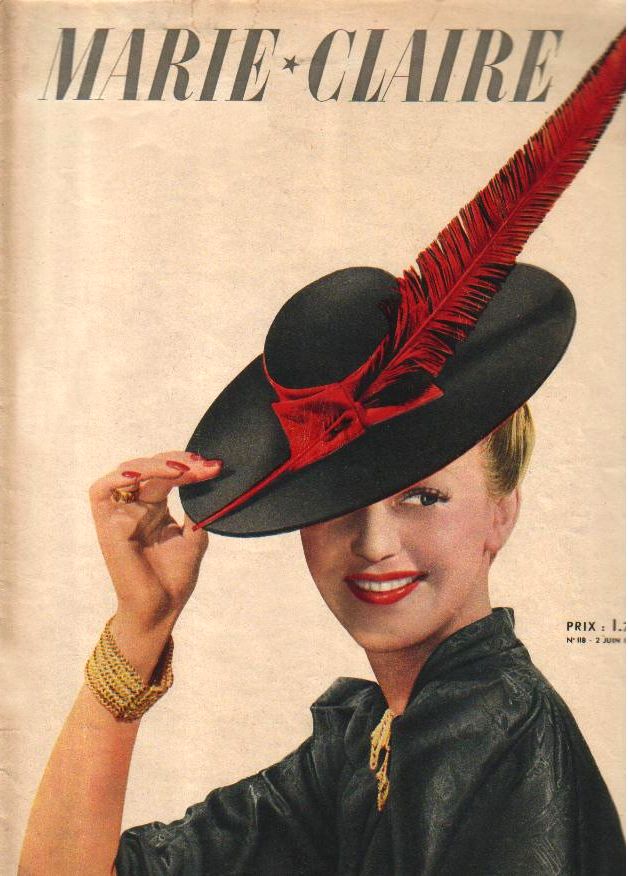
Ostrich feather hats, with smaller feathers, were also popular in the 1940s.
 |
| American dinner hat, wool with purple ostrich feathers. c. 1942, source |
And the fifites loved glamorous feather slippers!
The 1961 French film L'Année dernière à Marienbad (released in the USA as Last Year At Marienbad and
in the UK as Last Year in Marienbad) directed by Alain
Resnais heavily featured ostrich feathers, in costumes designed by Chanel.
 |
| Delphine Claire Beltiane Seyrig in L'Année dernière à Marienbad, source |
This dress is by the House of Dior, designed by Marc Bohan (French, born 1926), c. 1965–68,
in yellow silk, with black ostrich feathers, sequins and beads.
 |
| House of Dior c. 1960s, source |
Here's a stunning 1979 number by Bill Blass, silk with ostrich feathers.
 |
| Vintage Ostrich feather Dress with paisley pattern, by James Galanos, c. 1980s source |
Strangely enough, it is now the car industry that uses the
most feathers. According to BMW's Munich Factory in Germany,
the most important part of a cars finish is the paint shop, the cleanest
section of the factory. The workers wear dust-free, lint-free overalls from head
to toe, and to get the best finish each car's shell is dusted
down by an amazing machine that gently strokes it all over with Ostrich
feathers before painting.
There are still many uses for ostrich feathers in fashion around the world. When I think 'feathers' the Rio Carnival springs to mind, as do Las Vegas showgirls with thier giant feather fans. Feather boas are still popular, and feather trimmings and plumes are still used as accessories in the millinery
industry, and on ladies evening gowns.
Here is a lovely
ensemble from Oscar de la Renta's winter collection 2004/2005, with a subtle ostrich feather hemline.
 |
| Oscar de la Renta 2004/5 source |
Hilary Swank's Gucci gown at the 2011 Oscars is a lovely example of elegant ostrich feathers.
And subtle feather use on this cute modern fascinator.
Of course there are always traditional feather fashion, such as the Order of the Thistle with their black velvet hat trimmed with white ostrich feathers and a black egret or heron feather.
 |
Prince William, Earl of
Strathearn, after becoming a Knight of the most ancient and most noble Order of
the Thistle
source |
Do you like feathers?
Deb xx


.jpg)