Showing posts with label ladies. Show all posts

Saturday, 2 February 2013

Vintage Bathing Costumes & Swimwear

French postcard, 1913

More on a summer theme today - a look at swimwear one hundred years ago.  I thought it best to look at the years leading up to 1913, though, just to see the difference, if any.

In the 18th century women wore "bathing gowns" to 'swim', or bathe - long dresses of fabrics that would not become see-through when wet, with weights sewn into the hems so that they would not rise up in the water. Men wore a form-fitting wool garment with long sleeves and legs, like long underwear, which changed a little over the next century.  Not only were they modest, but they protected the wearer from the sun, as suntans were definitely considered unattractive at the time.

Victorian bathing wear
In the 19th century, the woman's two piece suit became common—the two pieces being a gown from shoulder to knees plus a set of trousers with leggings going down to the ankles. Despite this covering, and thanks to Queen Victoria’s example, popular beach resorts often had bathing machines, small wooden sheds on wheels which were pulled by horses into the sea. The ideas was to avoid the exposure of people in swimsuits to the opposite sex, as it was not considered ‘proper to be observed in a bathing costume, and allowed women, to change into their swimming costumes and enter and exit the water discreetly. Often a swimming costume was hired with the machine – usually a "one size fits all" design made from a sturdy fabric, with a loose wrap tunic with tie belt and baggy drawers. Impractical for swimming, they were really just for bathing, or splashing around and getting wet. Large bathing caps were also worn to keep the elaborate bulky hairstyles of the day dry.


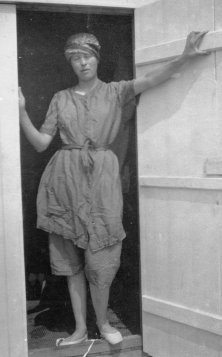
Do I look good in this? c, 1900

Costumes were hired as many people only went bathing occasionally, maybe on holiday to the coast.  Other couldn't afford special bathing wear, so would wear old nightdresses or long underwear, such as some of the girls in the photo below, taken at the Coolgardie baths in Western Australia in about 1900.

The Coolgardie Baths, c. 1900

It was also considered of vital importance that men and women bathers swam apart, as mixed bathing was frowned upon or banned on most beaches, however in reality many rules were broken. Mixed swimming contests were against the law until 1913, and therefore women swimmers could not compete in the 1908 London Olympics.

Men and a woman with bathing machines in shallow water at a Ostend, 1913, source

With newly fought freedoms for women and dress reform in the early part of the new century, it was not long the question of the standards of dress on beaches was questioned. The accepted attire for lady swimmers in 1895 was a tunic and short knickers, but many women were criticised for being immodestly dress. Stripes were very popular for men and children

Aussie kids ready for a dip, c. 1905
In 1907, Australian swimming athlete Annette Kellerman was arrested for wearing a fitted one-piece swimsuit on the beach in Poland. Annette Kellerman has designed her famous swimsuit to allow for serious athletic swimming, unlike conventional women's swimwear of the period, but it’s form fitting appearance was considered indecent by some, and it also showed her arms, legs and neck. She changed the suit to have long arms and legs and a collar, but still kept the close fit that revealed the shapes underneath. She later starred in several movies, including one about her life, and marketed a line of bathing suits - known as "the Annette Kellerman," considered the most offensive style of swimsuit in the 1920s and the focus of censorship efforts.


Annette Kellerman in her one-piece bathing suit, source
Also in 1907 men’s bathing attire was called into question, with beaches in Sydney calling for men to wear skirts or pants down to their knees for swimming. A protest resulted and men were allowed to wear shorter outfits, as worn by the Surf Lifesaving Clubs throughout Australia.

Bondi Surf Life Saving Club, December 1906


Despite opposition from some groups, the form-fitting style proved popular. It was not long before swimwear started to shrink further. At first arms were exposed and then legs up to mid-thigh. Necklines receded from around the neck down to around the top of the bosom. By 1910 bathing suits no longer camouflaged the contours of the female body. The yards of fabric used in Victorian bathing skirts and bloomers were reduced to show a little more of the figure and to allow for exposure to the sun. New York, as usual, was a step ahead of Australia.

Swimwear from New York, 1906


Women in bathing suits on Collaroy Beach in 1908
 Australia's first women Olympians, swimmers Fanny Durack and Mina Wylie, wore costumes very like those of Annette Kellerman at the Olympics in 1912.

 Fanny Durack and Mina Wylie, 1912
Mina Wylie in 1913

Female surf riders and prone board, circa 1913, Coolangatta, Queensland.

Women in bathing costumes in Pacific Ocean at Moclips, WA on August 23, 1913


Summer 1916

Bathers in New Zealand, 1918
By the 1920s women’s bathing suits were usually still a two-piece garment with a long singlet style top than could be worn over shorts, or tucked in. Fabrics now were finer jersey and flannel, with rubberized silk and satin began to be used. By the mid-1920s Vogue magazine was telling its readers that “the newest thing for the sea is a jersey bathing suit as near a maillot as the unwritten law will permit.”

A mix of styles in 1920
In the early 1920s swimsuits still had to be of a suitable length - and you did get measured!


By the end of the 20s swimsuits, like dresses, were getting shorter and smaller, although still with a lot more fabric than many people wear today.

late 1920s style
Here in North Queensland the only safe way to swim in summer is to wear stinger suits - swimwear that covers your whole body – much like Annettes Kellerman’s suit. Of course new materials, such as lycra, make these much more comfortable than Annette's suit would have been. The bonus is that they also protect you from the sun!

We tend not to wear them, but don't swim if stingers have been found at the beach, but if you are diving off shore from a boat, they are a must.  Just remember, if you do come swimming in North Queensland, they look best in black......but that's just my opinion!

Stinger suits for a Fantasea cruise, Whitsundays

Deb xxx


Friday, 1 February 2013

Summer Fashions of 1913

Here in Australia we officially have one more month of Summer, so today some summer fashions of 1913. Following on from yesterdays paintings, first some art. I love this simple look - an unlike me today, she wouldn't get sunburnt. Mind you, I don't how how practical it would be for mowing the lawn!

Summer on the dunes. Signed and dated N.F.SCHIOTTZ=JENSEN.1913 source
The light coloured fabric is also seen here in a shot from Downton abbey. Sybil's dress on the left is an original from the period.

The girls of Downton Abbey, source

Here are some summer suits for 1913, from New York. You can download the complete e-catalogue here.


These lovely pink dresses, with matching parasols, are for the American summer of 1913.
Dresses from the Deliniator, May 1913, source
And another pink day dress from England, at the Victoria and Albert Museum, London.
Day dress, 1913, source
And dresses for visiting, or the seaside 

source
The sheer dress in the middle may be something like this one of sheer lawn.

1913 lawn "crochet" dress, on Etsy

During the early years of the 1910s the fashionable silhouette became much more lithe, fluid and soft than in the 1900s. When the Ballets Russes performed Scheherazade, based on the Arabian Nights, in Paris in 1910, a craze for all things oriental began. The couturier and artist Paul Poiret was one of the first designers to translate this vogue into the fashion world, with flowing genie like pantaloons, turbans, and vivid colors and geisha style kimonos. Styles became looser and more fluid, and many caused quite a stir..

magazine print from 1913, illustrated by Abby Underwood

Poiret dress from 1912, in natural & blue striped
woven linen, blue silk, and faux abalone buttons, source
Lovely Lady Sybil shocked all in Downton Abbey with her avant-garde harem pants, based perhaps on Poiret's harem pant collection of 1911.

Lady Sybil, source

Looks quite comfortable, don't you think?  I would probably have worn somehting like these, though - 
Summer costumes for the Middle-aged Woman, from the April 1913 Good Housekeeping magazine.

source
They are very elegant, aren't they?  Can you imagine wearing clothes like these everyday?

Deb xx

Tuesday, 4 December 2012

Motorcycle Despatch Riders of WWI

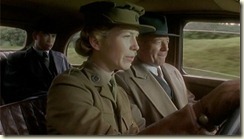
One of my favourite TV shows is Doyle’s War, a crime show set in England during WW2, where Michael Kitchen's Detective Foyle unravels diabolical crimes in the British coastal hamlet of Hastings, aided by his loyal driver, Samantha Stewart (played by Honeysuckle Weeks), an enthusiastic young woman who is eager to assist in the detective work.  I so would have loved her job!
sam
Sam driving Detective Foyle source

Women were also used as drivers during WWI, freeing up men for other tasks such as fighting on the front, where women were not allowed.  Car’s weren’t common in 1914, but motorcycles were gaining popularity and cheaper to buy, so more people know how to ride them.  The motorcycle had evolved from the earlier bicycle, which was loved by women the world over for the mobility and freedom it allowed. In fact, as I have mentioned in an earlier post, Susan B. Anthony said, "The bicycle has done more for the emancipation of women than anything else in the world." Women enjoyed motorcycles as much as they had enjoyed bicycles, and early riders were seen as adventuresome, not as outlaws as motorbike riders would later become.
harley1
A lady on an early Harley motorcycle, c. 1900
Motorcycles began to replace the horse as a method of delivering messages , both in battle and on the home front, and WWI was the first war in which the motorcycle was used for combat service. They were also perfect for transporting important staff around on the terrible roads near the front, as well as in the cities where petrol was limited and rationed.

wraf
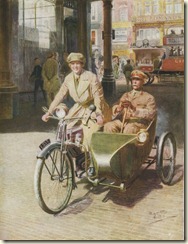
WRAF & RAF officer on a Phelon & Moore motorcycle and sidecar combination, source

Motorcycle despatch riders were first used in WWI by the British Army Royal Engineers Signal Service. They were also used by the Royal Air Force and the Royal Navy, where they maintained contact with land bases and some of the riders were members of the Womens Royal Naval Service (WRAF). The first WRAF was an auxiliary organization of the Royal Air Force which was founded in 1918. The original intent of the WRAF was to provide female mechanics in order to free up men for service but so many women volunteered they also filled  positions as drivers.

woman
A despatch rider in WRAF  seated on her Phelon & Moore 500cc single cylinder motorcycle circa 1918. source

large
The same WRAF enjoying a tea break source

The British military often used Douglas or Triumph Motorcycles but some riders brought their own machines, especially the first riders who were mostly volunteers. Until WWI the largest motorcycle manufacturer in the world was Indian, producing over 20,000 bikes per year. During the war, Douglas, based in Kingswood, Bristol, produced over 70,000 motorcycles for the military.

motor2
Army Service Corps Douglas Motorcycle WW1.

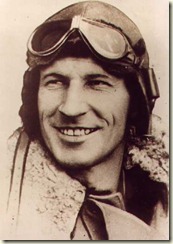
The Australian Army used motorcycle despatch riders at Gallipoli.  One of these was 18 year old (Sir)Charles Kingsford Smith, who joined the army in 1914.  He transferred to the British Royal Flying Corps, earning his pilot's wings in 1917.  He went on to become Australia's most famous aviator in 1928, when he made the first trans-Pacific flight from the United States to Australia.
CEKSmith (1)
Kingsford smith in his flying gear – just like motorcycle gear really, source


aussie
The motorcycle corps of the Australian army in Palestine, February 1918. source

(Sir) Charles Putnam Symonds was 24 at the outbreak of WWI and left his medical studies to joined the British Army.  He also served as a despatch rider, but on the Western Front in the motorcycle section of the Royal Engineers.  He saw action at the Retreat from Mons, then in the battles of Marne and Aisne. He was badly wounded in September 1914, and was sent back to the UK, where he was awarded the médaille militaire, and allowed to return to his medical studies.  After completing his basic medical training he returned  to service as a medical officer, both on the front lines, and attached to the Royal Flying Corps at Farnborough.   After the war he did specialised training in Neurology and  make discoveries in the fields of haemorrhage and hypertension.

A civilian Douglas motorcycle rerouted for war work, c, 1914 source


WHL Watson was also a despatch rider at the Battle of Mons.  In his book Adventures of a Motorcycle Despatch Rider During the First World War, he describes one instance of his time in Dour as follows:
About ten o'clock on the morning of August 23rd I was sent out to find General Gleichen, who was reported somewhere near Waasmes. I went over nightmare roads, uneven cobbles with great pits in them. I found him, and was told by him to tell the General that the position was unfortunate owing to a weak salient. We had already heard guns, but on my way back I heard a distant crash, and looked round to find that a shell had burst half a mile away on a slag-heap, between Dour and myself. With my heart thumping against my ribs I opened the throttle, until I was jumping at 40 m.p.h. from cobble to cobble. Then, realising that I was in far greater danger of breaking my neck than of being shot, I pulled myself together and slowed down to proceed sedately home.
The second time I went out to General Gleichen I found him a little farther back from his former position. This time he was on the railway. While I was waiting for a reply we had an excellent view of German guns endeavouring to bring down one of our aeroplanes. …. I shall never forget the captain reading my despatch by the light of my lamp, the wagons guarded by Dorsets with fixed bayonets appearing to disappear shadowy in the darkness.
motor1
A Despatch rider on a Douglas 2 3/4hp machine, 350cc,  c. 1916. 

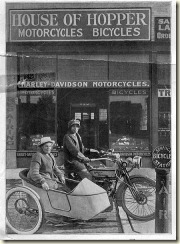
Meanwhile in America women were still riding motorcycles for adventure. Mother and daughter team Avis and Effie Hotchkiss, from  New York, completed a 9,000-mile (14,000 km) round trip ride from New York to San Francisco and back on a Harley-Davidson motorcycle-sidecar combination in 1915, becoming the first transcontinental female motorcyclists.  Effie, the driver and mechanic,  was going to go alone, but her mother wouldn’t allow it, so she went to.  Effie remarked, “I just wanted to see America and considered that the three-speed Harley-Davidson for myself and sidecar for mother and luggage was the best suited for the job.” What a great ad!
Hotchkiss_Salt_Lake_City
Avis & Effie Hotchkiss outside Harley Davidson dealer in Salt Lake City, UT, in 1915. source

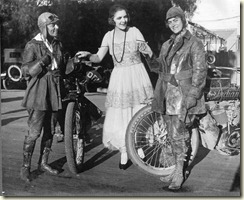
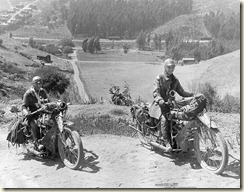
In 1916 society girls and sister Augusta and Adeline Van Buren each rode their own motorcycle across the US,  5,500 miles in 60 days, over hazardous roads.  They were active in the national Preparedness Movement , gearing up for America’s entry into the war, and wanted to prove that women could ride as well as men,  and were indeed able to serve as military despatch riders.  They dressed in military-style leggings and leather riding breeches for their ride, a fashion a taboo at that time. During the ride, they were arrested numerous times, not for speeding but for wearing men's clothes. 
vanburen3
The Van Buren’s in Hollywood, 1916 source

They rode 1,000 cc Indian Power Plus motorcycles equipped with gas headlights, and despite succeeding, the sister's application to the military as a dispatch rider was rejected.  Reports of the day praised the bike, but not the sisters and described the journey as a "vacation", that was an excellent excuse to escape their roles as housewives and "display their feminine counters in nifty khaki and leather uniforms". You can read more about them at the motorcycle hall of fame, where they were inducted in 2002.
Van_Buren_journey
Adeline and Augusta Van Buren in 1916 source

By the end of 1917 America was in the War, and Harley-Davidson provided about 15,000 machines for the war effort. The 1918 Harley-Davidson 18-J was Harley's most powerful motorcycle for that year, and with the luxurious matching sidecar, was perfect for driving around VIPs.

1918-harley-davidson-18-j-1

Generals perhaps!
general
 source
By 1920, Harley-Davidson was the largest motorcycle manufacturer in the world, selling their machines in 67 countries.  As motorcycle popularity grew, it was only natural that some people became highly skilled in its use.  During the 1920s not only were motorcycle races reinstated, motordromes, or the  “Wall of Death," a scaled-up version of a bicycling velodrome,became popular.
mgast
Margaret Gast, "The Mile a Minute Gal." c. 1920


By 1940, the United States had its first women's motorcycle club,The Motormaids, and by WWII there were many female motorbike despatch riders from all countries.
In 1950 Louise Scherbyn, a pioneering woman motorcyclist founded the Women’s International Motorcycle Association (WIMA) in the USA in 1950 and divisions around the world, including Australia, were formed shortly after.  Women never looked back, and now one in four motorcyclists is female!

nu-da-check-pioneering-women-motorcyclists-14645_9
Louise Scherbyn source


Do you ride?  I have a girlfriend who does, and goes to Phillip Island for the Australian Motorcycle Grand Prix each year.  Me? I’m married to a personal injury lawyer, so no.  My horse riding drives him crazy enough!

For more photos, please go to tumbler.

Deb xxx


Tuesday, 23 October 2012

Bicycling 1890's Style for Ladies


Bicycling became almost a cult in the 1890s.  The development of the pneumatic tyre and the mass production of machines meant that cycling was now comfortable and affordable, and as Queen Victoria Herself had purchased tricycles for her daughters (Starley's), it also became acceptable.  As hundreds of young bicycle manufacturers competed for sales, prices dropped from over $100 to as low as $20 for a new cycle, making them in the reach of just about anyone.

True or not?!
The Pope Manufacturing Company in Hartford, Connecticut  had been making bicycles since 1878, and at the height of the bicycle craze in the 1890's, Pope was the city’s largest employer, with 4,000 workers producing 600 bicycles a day.  It is estimated that in 1897 between 1 1/2 and 2 million bicycles were manufactured n the US, and that by 1900 there were about 10 million bicycles in use (from a population of 75 million).
Ladies Cycle Club of Hartford, 1890. 

By 1896 the Raleigh Cycle Company in Nottingham, England was making 30,000 cycles a year in the largest factory in the world, and produced more cycles globally than any other company. I don't think this was considered normal bicycle riding attire, however!

1896 ad source 
The bicycle was considered the freedom machine.  People from all walks of life could afford not only to buy one, but to store it and learn to ride it - a bit different from horse riding. The bicycle was the instrument of social change in many ways, including allowing Victorian women mobility and independence.


"Let me tell you what I think about bicycling. It has done more to emancipate women than anything else in this world. It gives her a feeling of self-reliance and independence the moment she takes her seat; and away she goes, the picture of untrammelled womanhood. I stand and rejoice every time I see a woman on a wheel . . ."
-- Suffragette Susan B. Anthony in a Feb 2, 1896 speech, quoted in the New York World

I love this ad from 1896 - finally a woman's word is taken seriously!

Trust a woman for buying the right thing (finally, we are being taken seriously!)


Although many women still wore their everyday dresses for cycling, special outfits did develop, and the  rational dress movement gained momentum, helping liberate women from corsets and ankle-length skirts. This Punch cartoon illustrates the point that many women enjoyed the freedom of the new fashion.

My Dear Jennie, what on earth is that bicycle suit for.  Why to wear of course.  But you haven't got a bicycle. No, but I've got a sewing machine!

Some outfits kept the look of the longer dress or jacket, but hid bloomers underneath - much like the riding habits of the time. This one is French, circa 1895 (source). Stunning, don't you think?


Ensemble, Cycling  Ensemble, Cycling


The other popular development in cycling fashion was the bifurcated skirt in about 1892, that was like pants at the back with the modest appearance of a skirt at front. This American suit of wool, linen, leather and silk also includes a pair of gaiters, which would provide protection for the legs. (source)

Suit, Cycling  Suit, Cycling
Bloomers and knickerbockers made bicycle riding even easier for women, but the style was still ridiculed by many as being unfeminine and unattractive. These outfits are from about 1895.  What do you think?
  

There was even music written about these intrepid women cyclists (source): 
Oh, the bicycle girl, when she gets on the road, Is bound neck or nothing to go!


  Web image of Box 061, Item 061.092, Page 000
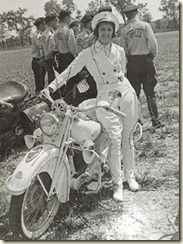
Myself I love the calf length skirt, and I adore the hats!  So much nicer than today's regulation helmets.
Catalogue. c. 1897
In warm climates, like Australia, a blouse was often worn instead of the jacket, and a sensible straw hat for protection from the sum.
Lady cyclist, Brisbane, Australia c. 1895
An american version in linen -  source

Separate skirts and bloomer continued into the 1900's, such as this wool and linen American pairing (source).


Ensemble, Cycling  Ensemble, Cycling
Although bloomers did also remain popular, and began to be manufactured by reputable companies, such as this suit (below left) by A.G. Spalding and Bros. from 1902.  It looks remarkably like the charcoal gym suit of a few years earlier by the Columbia Gymnasium Suit, Boston, Mass. (below centre source). 
Suit, Cycling   Gym Suit  

In addition to the cycling outfit, the well-dressed woman also wore leggings or gaiters, a hat, doeskin gloves and perhaps gauntlets, and a pair of the broad, low, rubber-soled cycling shoes which had first come on the marker in 1891. A bicycle belt, from which hung a small leather purse, completed the outfit. 
Cycling Outfit 1895-1900
Manchester Galleries by kimberley
 cycling outfit c. 1895  source
Those undertaking a bicycling expedition (defined as any trip over an hour in length) were also recommended to outfit their bicycle with a lamp, and to pack matches, tools, a repair kit, sewing materials, and first-aid supplies (and baby?!).

Cycling in Sn Francisco 1890s  source

You'll notice that many of the costumes are sombre colours,  much like the riding habits that had been made by men's tailor's rather than seamstresses. Apparently the stylish women would dress to match her male companion, so grey, brown, dark green, or navy were the most popular colors.

What ever we may think about bloomers, cycling and bicycles really did change the face of fashion - and not just for women.  Men's cycling fashions are next!
Deb xx