Monday, 31 December 2012

New Years Eve Vintage Style & Resolutions

I have a few new year’s resolutions, do you?
Like every year, I aim to lose weight, but unlike every year I want to do this by simply getting healthier – drinking less, exercising more, rather than giving up everything I love.
This would have been easier one hundred years ago in the United States, as over half of the population  were living under some sort of prohibition. At the end of 1913, five thousand supporters of prohibition paraded from the White House to the Capitol calling for national prohibition by 1920. America went from a culture where everyone drank, including children, to one where no one was legally allowed to – and we all know how well that went.  It makes me wonder if they are headed the same way with gun control laws…..
6684754074b5c6eda98047ce6f60e132_1M
Marching for prohibition 1913

Life one hundred years ago fascinates me – and it is my other new years resolution.  I want to look at 1913 in detail and get an idea of what people wanted and what they went through, as well as the fashions, inventions, movies and any interesting facts.  1913 sat between the world shattering events of the sinking of the Titanic in 1912, and the start of the great War in 1914.  It is sometime classed in the Edwardian Era, although Kind Edward died in 1910, and sometimes as part of the Titanic era.  1913 also falls in the Progressive Era of  history (basically 1890 to 1920), a period of social and political reform in the US and around the world.  It must have been a fascinating, and perhaps frightening, time to be alive.
Titanic-01

My aim on this blog will be to look at events of each day 100 years ago, to watch or find out about a movie each week, to look at the fashions and their influences, find and share vintage photos and ads, read books and magazines of the time, and delve more deeply into events if I can.  I am still researching steampunk as well, and hope by the middle of the year to be ready to put together a steampunk outfit based on my 1913 fashion research.

Please share if you have anything to ad or any special requests.

Meanwhile, here’s a quick look at New Years Eve 1912 style. If you were dining out, the scene may have looked like this:
dining

New Years Eve in a restaurant, Illustration from La Vie Heureuse Magazine, December  1912 source


And maybe you would have eaten this:
menu
source

This next photo was taken in New York between 1910 and 1915.  I like to think it was New Year eve 1912,  100 years ago today.
drinking

Have a great New Year’s Eve, what ever you may be doing!


Deb xx

Friday, 28 December 2012

Never Smile at a (Vintage) Crocodile

crocodile-and-butterfly

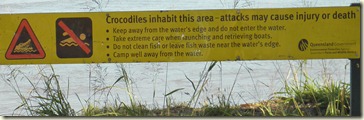
Living in north Queensland, we are used to crocodiles.  Here, for instance, is the sign at our local beach, just a block away from our house.

010  010 - Copy
Cheery, no? And these are salt water crocs, big scary things usually 3 to 5m long, that often take a dog or bird from along the shore.  Australia has fresh water crocs too, which are much smaller and tend to eat only fish.  I last saw some in the badly named East Alligator River in the Northern Territory.  Australia even has crocodile farms – there is one just four hours south of me at Rockhampton.  Most Crocodile farms in Australia have been operating since the 1980s, but Hartley’s near Cairns in far north Queensland began in the mid 1930s, starting as a rest stop and kiosk and gradually adding a crocodile show and zoo.
bus
The bus, with mail service, stopped at Hartleys’ halfway kiosk c. 1933. source

Crocodiles and alligators also featured in circuses at the turn of the century.
1895
Circus alligator lady, c. 1895 source

Although crocodiles are big attractions now in Australia, in the past Aussie croc farms never seemed to go into the whole tourist thing very much  - not like the Americans . For instance, I haven’t found any Australian photos or postcards like this:

vintage kids gator farm
Girl riding alligator c. 1900 source

I mean really, would you let your child do this?!
alligator (1)
source

10-16-alligator-farm
riding in an Alligator cart, c. 1915

Obviously they did at the LA Alligator farm at the turn of the century.  Alligators must have been a real statement – in these next photos the alligator is at least stuffed.
Girl & Alligator

girl-on-alligator

Mind you things haven't’ really changed that much in America it seems, as a quick visit to youtube will show. And there also seems to have been a craze for grown women sitting on alligators.
lady_gator
vintage salt and pepper set, source

Or even trying to brush their teeth.
teeth
c. 1950s source

Personally I like my crocodiles like this, and being vintage I don’t feel so guilty – it’s really preservation to buy these!:
shoes
1940's natural alligator sling back peep toe platform shoes Etsy

Or even this:
bag
1950s alligator satchel bag etsy


What about you?
Deb xxx

Tuesday, 25 December 2012

Twelve Vintage Christmas Trees & ours

Christmas is one of my favourite times of the year –  lazy sun filled days, reading by the pool, walks on the beach, watching movies in air-conditioned comfort during the heat of the day  and cooking and crafts with the kids. And of course decorating the tree.  This year our Christmas decorations have disappeared – hopefully they are somewhere in a box awaiting rescue when we finally move one day.  So this year our tree is simple (and cheap, I spent about $10) – red, blue and gold balls and wooden decorations from the thrift shop, icicle lights that usually go on the front deck, and a bit of silver tinsel.  Our  special touch this year is the star, made by seven year old Olivia, seen here with her siblings this morning, still in their PJs before opening their presents. They really love having their photos taken, especially before they have brushed their hair!.


In Australia, and especially where I am in north Queensland, real Christmas trees are rare – if they can be found they are either scraggly radiata pine trees of native pines in pots.  So most people here have artificial trees.  They are easy, have the nice traditional shape and can be used year after year.  We don’t have to worry about what to do with our Christmas trees come January 13.

Artificial trees have been around for at least fifty years, and when you look at this selection of  vintage Christmas pictures from the 1960s back to 1900 you will see some pop up now and again.

Merry Christmas, and thank you for visiting, whether you are a regular or have just popped in!

As usual there are more photos on tumblr.


xmas late 50s
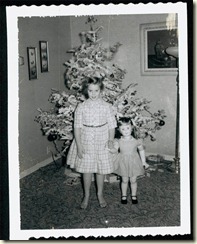
Girl with large walking doll, 1960s source
I always wanted one of these dolls.  When I went with my grandmother to get one for my 5th birthday in the mid 70s however, I changed my mind and got the smallest doll I could find. Hmmm


xmas 1940
Sarah Hall and her daughter Barbara at home in Miami Shores, Christmas 1954 source
The above photo is so stylish, with an artificial white tree, but I love this next photo - how cute are they?
cute 1953
A cowboy Christmas, 1953 source

xmas 1950
Christmas tree decorating 1950 


xmas 1950b
Christmas tree by the TV 1950 source


tree30s-1
Decorating the tree . 1939 source

vintage-christmas-tree2 (1)
A 1930s tree with train at the base, source


Vintage-Christmas-Snapshot-20111223_8
The Dickey family in the 1920s source
If you look carefully around the net you can find photos of this family from around 1900 to 1930.  I might do that next year, although there is one of them below in 1913.

VintageChristmasTreeBaja
Christmas 1920s style source


Dickeys1913
The Dickey Family in 1913 source


xmas 1905
Happy German children with their Christmas tree c. 1905 source

Frontier-Christmas-1900.preview
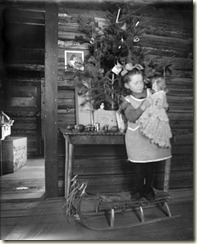
Frontier Christmas c. 1900 source
Deb xxx

Saturday, 22 December 2012

Agatha Christie's Poirot

I am currently on a mission.  A mission to watch every Poirot episode - the ones with David Suchet as Poirot. Not only is Poirot my favourite Christie detective, Suchet is by far and way the best Poirot ever.

The shows are wonderful - clever, well acted, with beautiful set decoration, costumes and cars.  The kids love to with them with me, as they are more psychological than gruesome  and we all try and guess the murderer.  Of course I love the books too, but this way I can share, and slightly indoctrinate, with my children.

Poirot breakfasts in his apartment, with wonderful crockery

The list of all 13 series, from 1989 to 2013, can be found here. We have just watched Dumb Witness, the last episode of series 6, which I had never seen before.  It was based on a short story that Ms Christies daughter found in her mother's possessions after her death, and it features a rather cute little dog, that Hercule Poirot ends up owning, if only for a short time.

Poirot and Bob
The episode, or movie as it is feature length, also features a rather amazing speed boat, that one man is hoping to race and beat the world water speed record. The way they time this is quite interesting too.

Timing the water speed event

If you can't find DVDs of the series, most can be found on youtube (you can see Dumb Witness here).  Great holiday viewing! I have also found a fantastic blog with the entire chronology of Hercule Poirot and his assistant, Captain Hastings, which you can find here.

A young Agatha Christie

We are off to watch The Murder of Roger Ackroyd, one of Christies early novels, written in 1926 - the same year her husband asked her for a divorce and she mysteriously disappeared for eleven days.  Luckily for us she returned, and continued to write incredible novels until her death, fifty years later.

Watch some if you can,

Enjoy,

Deb xxx

Friday, 21 December 2012

I want an Elephant for Christmas!


I love elephants. I mean, what’s not to love? They’re majestic, clever, vegetarian, musical (they can trumpet), brave and happy with their wrinkles. Elephants are a symbol of wisdom in Asian cultures and are famed for their memory and intelligence.  Aristotle once said the elephant was "the beast which passeth all others in wit and mind".  They are also a lot like us:

·         Elephants live in a strong family unit. The mothers are protective of their babies and spend all day teaching and loving them. They band together to shield their young if they feel danger is present, and will even chase away lions
·         Elephants are sensitive fellow animals where if a baby complains, the entire family will rumble and go over to touch and caress the little one.


·         Elephants have the largest brains in the animal kingdom.  They have an  incredible memory, hence the saying “Elephants never forget.”
·         Elephants can live to be 80 years old.
·         Elephants  are highly social animals and in the wild will meet every day, often to roll around in a mud pool or play together.
·         Elephants  cry when a family member dies and they mourn their death every year on their anniversary,  returning to the exact spot of the death on the exact day.

Anton, male elephant at the Hamburg zoo in the 1890’s

I have been looking at a LOT of vintage elephant photos – zoos and circuses mainly – for research, and you can see more of them on tumblr if you’re interested.

I don't really want a pet elephant.  Could you imagine?  In 2008 the British government received a petition calling for UK pet shops to be allowed to sell elephants to the public. Thankfully they ruled out the possibility stating that “the government does not think elephants would make good pets. They are very large animals that are not used to being kept as pets, and have welfare needs that would be impossible to meet in pet shops or people's homes.” 

During WW2, a Belfast zoo keeper, Denise Austin, kept an elephant calf, called Shiela, at her home on the Whitewell Road when Belfast was being bombed in the blitz of 1941. The Ministry of Public Security had ordered keepers to euthanise some of the most dangerous animals if the city was attacked, so Ms Austin, one of the first female zoo keepers, adopted her.  Every evening the animal was walked the short distance from her enclosure to Ms Austin’s house in north Belfast, and every morning she was returned to the zoo. Her story is now being made into a book.

Baby elephant Sheila with Denise Austin at her home in Belfast, 1941
Apart from that act of kindness, I think Elephants belong with their families in the wild, not in cages or small yards, or in circuses, where not only do they not have family groups or the freedom to be elephants, they are often  abused, beaten and shocked to perform unnatural “tricks.  Zoos, with wide open spaces, not the cramped enclosures of the past, are better,  and allow everyone to be able to see elephants.  There are also elephant sanctuary’s, including some in the United States that have rescued circus elephants and those bought as pets (yes, there are some crazy people out. there). The sanctuary in Tennessee looks wonderful, with separate Asian and African areas for elephants, and they have a great website with an ‘elephant’ cam that is definitely worth checking out.  

In some Asian countries, like Thailand, elephants work.  If they were allowed a childhood and then trained,  able to live like elephants when not working and then allowed to retire, like we do, and live out their lives as elephants, it could be acceptable.  Unfortunately though, not all working elephants have a good life, and even those in elephant tourist parks can have a hard life and suffer abuse. Fifty to 100 elephant calves are still being taken from the forests of Burma every year to supply the tourist camps in Thailand, and  it is estimated that for every calf smuggled across the country’s 1,200-mile border with Thailand, up to five adult female and adolescent elephants from the calf’s immediate family group are gunned down in cold blood. You can read more about it here, or donate to help here. If you are planning a trip to Asia, visit elephants at a sanctuary, rather than riding them at a tourist park, where they may have suffered terrible abuse during their capture or 'breaking in' process, as shown in this video.


The Melbourne Zoo has a wonderful Asian elephant trail, which opened in 2003, at a cost of $15 million, the result of preparations for building a regional captive elephant breeding program, one of the first in Australia.  The Asian elephant has lost up to 90 per cent of its population in the past 100 years and is facing extinction, with only an estimated 25,000 to 35,000 left in the wild.  Happily three pregnancies have been achieved since Melbourne Zoo established the Cooperative Conservation Breeding Program upon the arrival of three young elephant cows from Thailand in November 2006, and they aim to create an insurance population of this endangered species.  I have just booked tickets to Melbourne for late January, so I will be able to take the kids to see them!
Elephants at the Melbourne Zoo

At the rate elephants  are being killed by poachers in the wild, zoos and sanctuary's may be the only way elephants survive. 


On October 27 2012, Nick Brandt took the photo above, of Qumquat and her family.
24 hours later, they were gunned down by poachers.

If you want to help fight the elephant slaughter, please check out http://www.biglifeafrica.org/
(where this photo is from) a non-profit organization dedicated to the conservation of Africa’s wildlife and ecosystems.


Or if you need a last minute Christmas gift for the person who has everything, you can adopt an elephant. Check out the World Wildlife Fund. I think I may yet get my elephant for Christmas!


 Deb xxx

Monday, 10 December 2012

Vintage Exaggeration Postcards

My search for images for tumblr has steered me towards something I had never heard of before - exaggeration postcards. And I am in love!  Long before computers and photoshop, many photographers were experimenting with altered images.

The main themes were usually fish, fruit or vegetables but almost any subject was used. Many were produced to advertise a particular state or area with captions such as "that's the way we grow them in Maine" or "bigger and better in Texas."


William  Martin of Ottawa, Kansas, was considered one of the best at producing exaggerated or "tall tale" postcards. His work featured huge ears of corn and peaches and  giant rabbits.

William H. Martin, [Lassoing a rabbit], 1909 source

cabbages
source
Martin's photography studio began experimenting with trick photography around 1908. He was so successful that he established the Martin Post Card Company in 1909 and reportedly produced seven million cards the next year.

potatoes
source


There were several techniques used to produce the images. One way was to use a photo-montage, another was to use a mixture of artistry and photography. A photographer took two black-and-white pictures: a wide shot and a close-up. The enlarged image would be cut, placed, and glued over the wide shot to create the exaggeration. Headlines such as "Shipping a Few of Our Peaches" and "Harvesting a profitable crop of onions in Kansas" helped further the flight of fancy. I love this one by Martin  too -' the modern farmer.'


Martin was the king, but there were other photographers experimenting with the genre as well. iIn Washington state there was a national apple festival each year, and this postcard is typical of the kind produced, by H M Brown.

Exaggeration--Apples--Washington--byBrown2
A load of apples in Gilmer Valley
H. M. Brown, Photographer - Gilmer, Washington 1909 source


They also grew cherries!This real photograph postcard shows a charming young boy, with a great hair style, carrying a stem of large cherries over his shoulder. The  image was created by J. H. White in 1910.  Isn’t it lovely?

PC-Exag-Washington-Cherries
Washington Cheries By J. H. White 1910 source

Edward H. Mitchell's scenes, produced mostly circa 1909-1910, primarily involve train cars bearing huge, colourful produce. Unlike many postcard creators who used four-colour palettes, Mitchell worked with up to six colours. He made his work available to larger audiences by producing postcards with blanks which sellers could fill in with their locations.


In Alberta Lea, a series manipulated scenes were custom printed for sales in various communities in the region by A.S. Johnson Jr. from Waupun, Wis. (near Fond Du Lac). The copyright dates on the cards range from 1910 to 1913.

strawberries
Yummy strawberries!
J. Herman's few cards were mostly published by the Midland (New York) Publishing Company around 1912-1913, and were mostly images of produce on railroad cars or giant fish being caught.
source

Alfred Stanley Johnson was active in Waupun, Wisconsin from 1909-1935, and produced highly-realistic but humorous black and white images.

One of the Squash, by Alfred Stanley Johnson c. 1910 source
An artist known only as Leigh made a series of images in Florida in 1909, mainly of large fruit on horse and carts.


In the 1930s F.D. Conard, of Garden City, Kansas, was known for his postcards of giant grasshoppers, inspired by Kansas plague of the time.
Giant grasshopper on top of Santa Fe Trailways bus "Saving His Wings" Photo by F D Conard source

Another postcard,not sure of the artist but it's a Kodak print from the 1940s.

A postcard from Hawaii, c. 1941. source

Exaggeration postcards didn't seem to be big in Australia.   We just built big things and took photos of them instead, like the Big Pineapple near Nambour, Queensland, built in 1971.

Big Plantation steam train Queensland
source

We also have giant cows, bananas, mangoes, sheep, koalas, in fact you name it, we probably have it.

If you wish to look at more exaggeration postcards, or even buy a few, try out these sites, as well as ebay, etsy and ruby lane:

http://www.oldpostcards.com/exaggeration.html
http://www.kshs.org/kansapedia/cool-things-exaggerated-postcards/10137
http://drfong.blogspot.com.au/2006/12/amazing-bw-fantasy-photo-exaggeration.html

Enjoy, Deb xxx