Wednesday, 23 May 2012

May 18-22 1942–I was Rude but I love Cotton

So I have been a little slack lately with blogging.

I have been working hard, and have had two work experience students in three weeks.  That means I have to do work instead of going on the internet!  We are also getting the house ready to sell, which means that every spare moment at home is devoted to painting, cleaning etc.  In my spare time I have been visiting my horse and started her training – and  have another blog devoted to all that.  So I have decided to go to weekly instead of daily blogging here.  I am a bit over daily accounts of plane crashes and deaths, so I will just post interesting things form the week and things that happened near where I live now.  And of course great vintage ads and articles from my magazine collection.

My husband saw this ad and thought it was so me – not a compliment I think! But I love it anyway.

cannon sheets

And finally the last two parts of the cotton dress series from Good Housekeeping May 1942:

dresses 54 (2)

dresses p 55

And if you’d like some news, you can read the front page of the Melbourne Argus for 21 May 1942 here.

Deb xx

Friday, 18 May 2012

17 May 1942 - Furious, Terrible & Internment

On 17 May 1942 the British Prime Minister, Mr. Winston Churchill, asked the Admiralty to report on the transfer of HMS FURIOUS to the Royal Australian Navy.  The Admiralty reported the vessel could not be spared.  Furious, an aircraft carrier, had also been used as an aircraft carrier in WWI.
The deck of the Furious, 1918  Source

The Fremantle bound USS TAUTOG, (submarine), sank the Japanese submarine I-28, carrying a midget submarine, in the Caroline Islands.  I-28 was one of the flotillas of six submarines ordered to attack shipping in Sydney Harbour in May 1942.  One of the most successful submarines of WWII Tautog was credited with sinking 26 Japanese ships earning her the nickname "The Terrible T."

 
In May 1942, Allied forces established Cape York Peninsula as their base to repel the advancing Japanese in the Battle of the Coral Sea.  Air strips were built at Iron Range (Lockhart River) and Cooktown, which also got a prisoner of war camp. 
Cape Bedford Mission (Hope Vale) the first mission on Cape York Peninsula, was initiated by Lutheran staff from Cooper Creek (South Australia) in the 1880s, and was the home base of many local aborigines. George Schwarz, a German-born Lutheran pastor had arrived at the mission in 1887, and  Schwarz and his wife owned a farm nearby at Eight Mile, which produced food for the mission population, with assistance by the Aboriginal men.
Because Pastor Schwarz was of German descent, and the mission also had connections with Japanese luggers, Army Intelligence regarded the mission as a potential security problem. Local people also claimed the mission Aborigines were disloyal, which didn’t help.  
At dawn on 17 May 1942 the army and local police arrived with a convoy of trucks to arrest Pastor Schwarz and remove the Aboriginal people. They removed 254 Aborigines, mainly Guugu Yimidhirr people from the Eight Mile and Spring Hill, taking them to Cooktown, then onward to Cairns. The elderly were sent to Palm Island, and 200 or more were dispatched to Woorabinda near Rockhampton.  The people found Woorabinda cold and inhospitable, and twenty-eight people died in the first month.  By March 1943, 60 had lost their lives. Within weeks of their removal, construction of a RAAF airfield was underway at Schwarz’s Eight Mile farm. You can read more about it here.
In 1949 a group of missionaries returned to Hope Vale, but not much was left of the old site after years of war, neglect, a cyclone, and white ant attacks. As well as building the airstrip the army had used some of the buildings for target practice.  A new mission was built on the Endeavour River, 25 km from the old mission on land that had been owned by the Cooktown Plantations company.  Eventually the surviving Guugu Yimidhirr people, were ‘allowed to return’ , by their own means, as no transport was organised. 

The population of the Guugu Yimidhirr people at Hopevale today is about 800.  Guugu Yimithirr is also the name of the language of the  Guugu Yimidhirr people.  It is one of the more famous Australian languages because it is the source of the word kangaroo.  You can read more about the language here.

Deb xx

Thursday, 17 May 2012

16 May 1942 - Cotton Frocks, Summer Shoes & Football

Part 6 of the cotton frock series from Good Housekeeping, May 1942:


"Cotton clothes mean more clothes" - the start of soemthing don't you think?!

Here is an ad for shoes, similar to those in the photo above, and one for slips.  Slips were often worn with even cotton summer dresses:


On 16 May 1942, a Saturday, St Kilda beat Hawthorn in a Victorian Football league match at Toorak park in Melbourne. The Hawthorn Football Club, nicknamed the Hawks, is a professional Australian rules football club in the Australian Football League (AFL). The club, founded in 1902, is the youngest of the Victorian-based teams in the AFL. It is also the club my husband follows, even though we have been in Queensland for 10 years!

Football continued mainly as amoral booster during the war, and although  scratch matches were played by Australian "diggers" in war torn locations around the world, the game lost many of its great players to wartime service. In Queensland, the state league went into recess for the duration of the war, and has only recently restarted.   The ANZAC Day clash between Essendon and Collingwood is one example of how the war continues to be remembered in the football community

Roy Cazaly was the non-playing coach of Hawthorn in 1942, and was reported to have given the club its nickname the "Hawks".  Thank goodness, as the  original nickname was the "Mayblooms", and it worked, as  1943 was the club's best season since joining the VFL in 1902.

The premiers in 1942 were Essendon (the club my Dad barracks for, and the one I grew up near).  Their nickname is the bombers, by the way!


Deb xx

Wednesday, 16 May 2012

15 May 1942 - Advance Australia Fair

The Brisbane Courier mail reported on 15 May 1942 that the search for the identity of the writer and composer of "Advance Australia Fair", Australia’s official National Anthem since 1984, was at last answered:
“ by the claim of Mrs. M. G. Mercer of Station House, Chidlow, that the words were written by her father, William Maxwell McEwen, son of Sgt.-Major McEwen, who was in charge of Fort Denison in Sydney Harbour. He wrote them, she said, at the request of a Mr. Hermes, who composed the music. Mrs. Mercer's father, who died in Perth four years ago, aged 78, was born in Sydney, and was a teacher of art on the staff of Perth Technical College for 25 years. "If the lady in New South Wales, whose claim now is being investigated, is a daughter of Mr. Hermes, or more likely a granddaughter, it will prove the correctness of my statements,"' declared Mrs. Mercer.”
It is now recognized that Advance Australia Fair was created by the Scottish-born composer, Peter Dodds McCormick, under the pen-name 'Amicus' (which means 'friend' in Latin), and first performed in 1878.  The earliest known sound recording of Advance Australia Fair appears in "The Landing of the Australian Troops in Egypt", circa 1916, a short commercial recording dramatizing arrival of the Australian troops in Egypt on the way to Gallipoli.

Earlier in May, according to the Townsville Bulletin of  4 May 1942, six people had claimed kinship with Peter Dodd McCormick, to obtain a share in recently accrued royal ties from 'Advance Australia Fair.'  
“If their Claims are proved they get equal shares of the money. Mr. Matthews, of Paling and Co. who bought the rights of the song from McCormick in 1914,  outlined the strange story of what is now accepted popularly, if not officially, as our National Anthem.  He said royalties from the song were no more than a few pounds a year until recently, so the question or distribution of profits did not arise.  When broadcasting companies took up the song and its national character began to be generally recognized, a substantial sum accrued.  Although Paling's copyright does not expire until 1966, there has always been a tradition that where contracts were made before the days of broad casting, worthwhile companies voluntarily give heirs of composers a share in profits. 'We have been printing the song since 1880.' Mr. Matthews said, 'several copies are about, autographed by Mr. McCormick, as the composer. It would be impossible to estimate the amount of royalties.' Two nieces of the composer to … Mr McCormick, who live in Sydney, recalled today the pleasure that their uncle had derived from composing it and hearing it sung for the first time by 1000 voices at the Exhibition Build ins; in the Palace Gardens, Sydney, in 1880.  Later it was sung by a choir of 10,000 voices at the inauguration of the Commonwealth in Centennial Park Sydney, on January 1, 1901.  It was played by massed bands and sung as the Australian National Anthem at the naming of Canberra on March 12, 1913.  The first edition of 'Advance Australia Fair.' having been written some years before Federation, contained no references to the Commonwealth, but the third verse in the second edition was altered In I900 to include the Commonwealth, and the fourth verse in the third edition was altered at the suggestion of Professor Stuart Blackle, of Edinburgh. Mr. McCormick, who was in the Education Department and was once a teacher at Fort Street School and at the Palmer Street School, Sydney, died In 1918.   Mrs. A. E. Morroe, of Summer Hill, said she was a niece of Mr. McCormick, and as a young girl used to play 'Advance Australia Fair' over for him when he was composing.  She was sure Mr. McCormick would be the happiest man in the world today if he could know how it had come to the fore.  Mrs. Douglas Stewart, of Elizabeth Bay, said that she also was n, niece of the composer. She had lived for many years with Mr. and Mrs. McCormick at Darlinghurst, and Iater at Waverley.  They had no family of their own and had adopted her as their daughter. “One of the last things Mr. McCormick said to me before his death,' said Mrs. Stewart, 'was 'Well, I hope the old song will live,' and it certainly has lived.' Mr. McCormick composed both the words and music of the song, and it was adopted by one of the Governments some years ago as the National Anthem for Australia. The Government paid him £100 to have the right to use the song at Government functions. He held the copyright, but sold it to Palings two or three years before he died.”
You can read more about the song and  the changes made over the years here,  and see the 1942 sheet music here
Olivia Newton John singing Advance Australia Fair at the Melbourne Cup Carnival in 2009:

Deb xx

Tuesday, 15 May 2012

14 May 1942 - Attitudes to War, Flying & Ric Rac


On 14 May 1942 the Cairns Post reported the kamikaze attitude of the Japanese airmen who had attacked Pearl Harbor the previous December:
THE HUMAN TORPEDO.
Japanese newspapers are claiming that the airmen who attacked Pearl Harbor and other Pacific bases never expected to return - that they treated themselves and their machines as the same aerial torpedo, which was to be launched straight at the objective. ......The Germans, too, from the earliest days of their attack on Poland, used the dive-bombers as a form of artillery to support ground troops, but their theory never included the deliberate loss of pilot and machine as part of the process. In spite of the Japanese news- papers, it need not necessarily be assumed that the far Eastern enemy .is steadfastly committed to the plan of treating men and machines as irrecoverable projectiles; and if they did, it is by no means certain that they could hit the mark in a serviceable proportion of attacks.

The same paper published results of a survey by Fortune Magazine in America that showed the general populations attitude to the war:
The U.S. people have an astoundingly uniform belief about the prospects of the war, and their willingness to fight it to a finish.
67.8 % believe the war will last more than 3 years.
80.6 %, though absolutely confident of winning," believe it is going to be "a very tough job."
70 % of the public are" willing to have the Government register all male civilians: for work in defense industries "wherever they are needed": strictly ration all food or materials "that might become scarce"; make war workers who strike join the Army or Navy.
68.4 % believe the Government should register "more able-bodied woman" for full-time, war-¿me jobs (unless they have' children).
86.3 % believe that Mr Roosevelt is the best man to have as President now, “though he has made some mistakes on the whole, he is doing a pretty good job.”
Also on this day in 1942, about a week after two American Kittyhawks had flown under the Sydney Harbour Bridge, the Dutch thought they would go one better.
The Dutch had evacuated 11 aircraft to Australia comprising two DC-2's, two DC-3's, three DC-5's and four Lockheed 14 aircraft and were coerced into selling their aircraft to the USAAF. As part of the sale they were required to test fly all their aircraft before the handover to the Americans.
To display their unhappiness with the forced sale of these aircraft, the KNILM staff decided to have all aircraft ready for a spectacular test flight over Sydney Harbour on 14 May 1942. They had over 50 passengers on board comprising ground staff, waiters and waitresses and kitchen staff from the restaurant at the airport.
After several aircraft buzzed the Dutch destroyer Tromp, a DC-2, a DC-3 and a DC-5 lined up another target - the Sydney Harbour Bridge. Approaching the bridge from Sydney Heads they flew in line astern under the Bridge, pulled up, made a wide turn and then flew in single line again under the bridge and then returned to Kingsford Smith Airport.

 source

The Dutch aircraft that flew under the Sydney Harbour bridge were as follows:-
·         DC-2, PK-AFK, piloted by Captain Frans Van Breemen
·         DC-3, PK-ALW, piloted by Capt Peter Deenik
·         DC-5, PK-ADC, piloted by Captain Dirk Rab with John Gyzemyter as Flight Engineer
DC-3 PK-ALW went on to become a part of General Douglas MacArthur's private fleet of aircraft. The aircraft is now located at the Queensland Air Museum at Caloundra on the Sunshine Coast in Queensland.  You can read an account of one of the crew here.

A few weeks ago I posted a series of cotton fashion from the may 1942 Good Housekeeping Magazine. I got to part 4, and then got distracted and forgot the rest, sorry! Here is part 5 - pretty dresses with ric rac trim:


If you want to try and ad some ric rac to your next vintage style project, here is a little tutorial.  It suggests sewing a straight line down the centre of the ric rac.  I have also used a zig zag stitch when sewing it onto a quilt, as it gives a bit more strength over the seams.  New ric rac is not cheap to buy, but if you keep your eyes open at the op shop or thrift shop, you can often find unopened vintage packets for around a dollar.  the color may not be what you are looking for, but it can be dyed.

 
You can even make cute rose embellishments for rings, pins or hair clips. You can see a tutorial at the Ribbon Retreat Blog. 


Deb xx

Monday, 14 May 2012

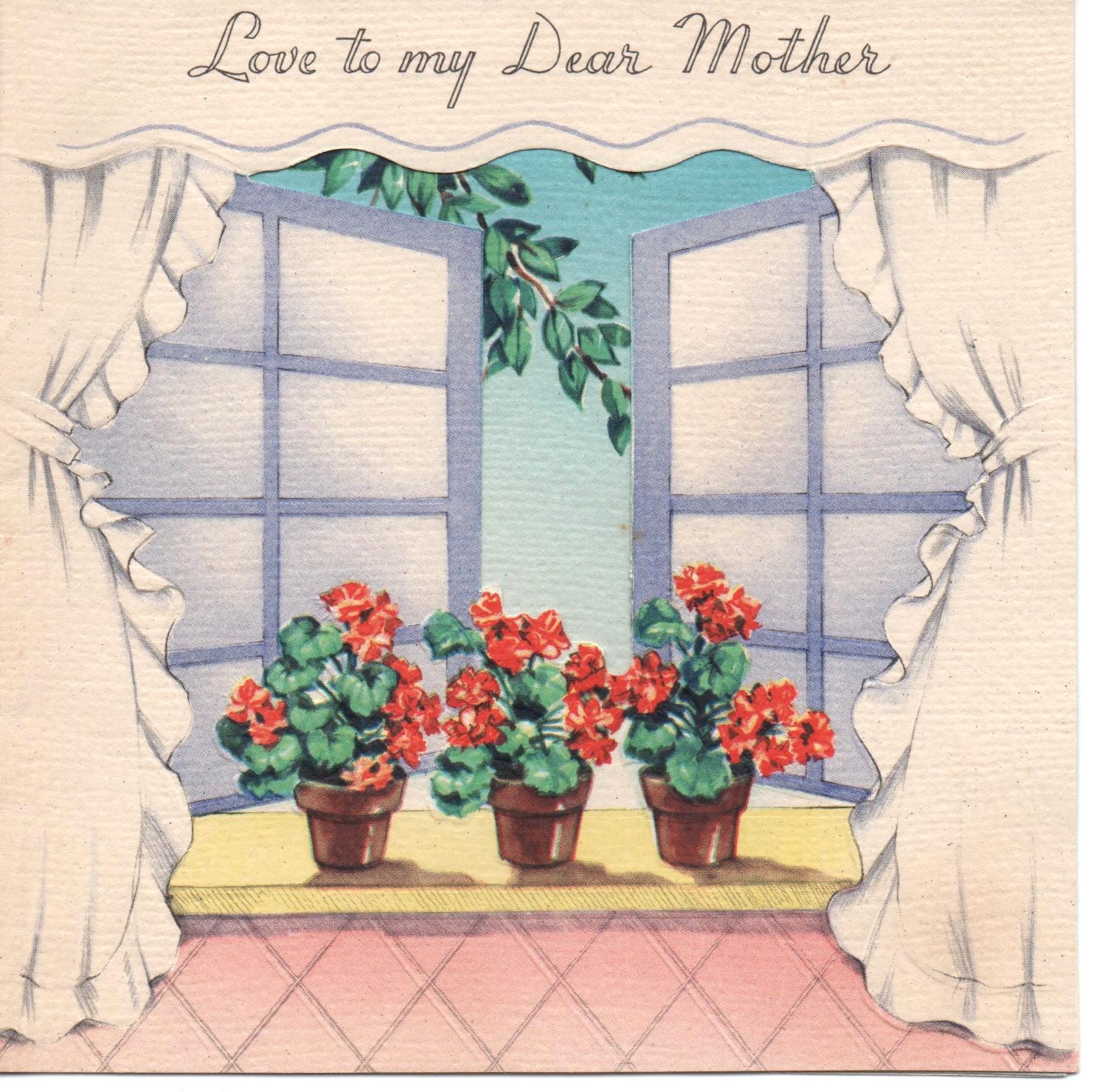
Mothers Day 1942 Style

VINTAGE Greeting Card MOTHER'S Day 1942 "Love to my Dear Mother"

VINTAGE Greeting Card MOTHER'S Day 1942 available at etsy


I had the most lovely mother's day today.  Breakfast in bed and gifts that I actually wanted - red gumboots, slippers, Chanel No 5 and pearls - and extras from the little two including hand painted mugs and cards.  We had sushi for lunch, out on the deck, very relaxed and not at all formal as in this little movie from 1942:


After a screening of Jurassic Park with the kids, we had a great walk on the beach, and then back for a Dinner of steak and steamed greens with a glass of red.  And I didn't have to cook or clean all day - heaven!
Here is a short story from Good Housekeeping Magazine  - May 1942.  Happy Mother's Day all!

Deb xxx

Saturday, 12 May 2012

12 May 1942–The Australian Woman’s Mirror


Here is the cover and some of my favourite articles and ads from the Australian Woman’s Mirror Magazine from Tuesday, 12 May 1942 :

12 may - cover

12 may - cold ad

My mum used to use vicks on us when we were young, and now I use it on my kids when they have a cold – you just rub in on the chest.  Still going strong after 70 years! 

Here is a classic jumper pattern, similar to one I wore to school in the 80s.  One day I might knit!

12 may - pull over

And here is a description of how to use cold crème and vanishing cream.

12 may - ponds ad

12 may - pyrex ad

I have a pie dish just like this one, and I found a similar cake slice at the op shop this morning ($1!)

I think I have published the following two pages before, but I have enlarged them a bit so you can actually read them (I hope).  I love the nightie to undies demo.

12 may - SEWING ROOM

12 may - fashion

Deb xxx

Friday, 11 May 2012

10 May 1942 and Soap and Rationing

In 1942 soap was used in different forms for cleaning everything from faces and babies to clothes and floors. Sometimes there was just the one soap for everything, as this 1943 ad for Swan soap shows:

swan saop

Soap was rationed in the UK during the war, because of the shortage of oils and fats, and many brands  stopped production.  The Pears factory was closed by the Ministry of Supply in 1942. The British soap industry decided that certain brands had to be sacrificed in order to make other brands more appealing to consumers (despite higher prices) as well as to simplify the sales structure. During the war the staff at soap factories, as well as soap salesmen, decreased to around 40% of pre-war figures.

In the Netherlands, soap was rationed immediately after the German occupation in 1939.  Some companies actually did well out of rationing.  Unileaver, for example, actually increased it’s sales in the Netherlands in 1939 (by about 5 tons since 1934), and by 1940 they had 45% of the soap market covered, with product's such as Lux, sunlight, radiance, rinso and Vim.  You can read more about soap rationing during the war here.

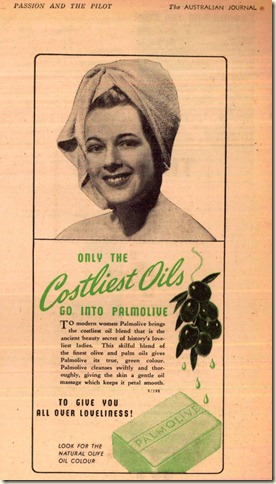
Here are some more 1942 ads for face and body soap – brands we know:

lux soap

ivory soap

palmolive soap

It used to be green – makes sense now!

guardian soap

And a brand we may not be familiar with:
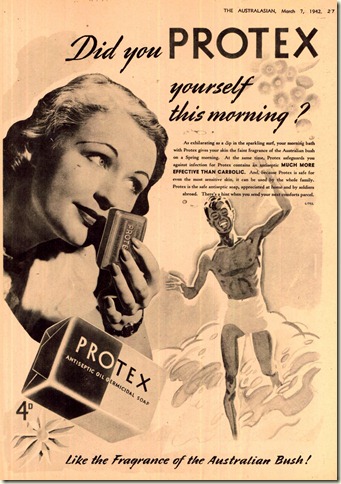
soap ad

A newspaper article from the Sydney Sun of 10 May 1942 revealed that the Australian Prime Minister, John Curtin, a heavy smoker like may at the time, was affected by war time tobacco shortages just like any other smoker:

Finding it just as difficult as any other Australian to make his cigarette-ends meet is chain-smoking Prime Minister John Curtin. Yet at a Press conference last week with a burst of generosity, pure Socialism, or what-you-will, he produced from a locked drawer his 'hoard' - three small packets of a popular brand and offered to 'loan' a packet to anybody left without cigarettes for the weekend. The Prime Minister's Press secretary, Don Rodgers, promptly borrowed two packets, then spent all his spare time scouring cigarette starved Canberra to replace them.
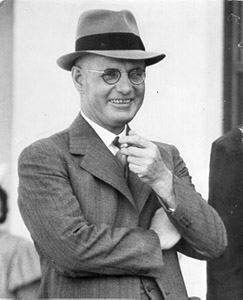
John Curtin at garden party for Canberra Hospital Auxilliary, 29 November 1941.

John Curtin at garden party for Canberra Hospital Auxiliary, 29 November 1941.

Curtin's generosity prompted an anonymous reader of the Sunday Sun to send two packets of cigarettes to the prime minister.  Mr Curtin was cut down to 12 cigarettes a day during a hospital stay in 1942, and by 1944 had given up smoking entirely due to a heart condition.

Deb xxx

Wednesday, 9 May 2012

9 May 1942- A Battle and a Great Love

The Battle of the Coral Sea was over. The Japanese fleet had been repulsed by Allied forces off Australia with heavy losses, with the Japanese navy suffering the greatest setback of its history. The diversion of Japanese resources represented by the Coral Sea battle would also have huge consequences a month later, at the Battle of Midway.

Today is my hubby’s birthday. We have been married now for more than half of our lives, which seems amazing to me.  This poster from 1942 says it all.

a great love

Love you baby! Happy Birthday.

Deb xx

Saturday, 5 May 2012

4 May 1942 - Battle of the Coral Sea & Kellogg’s

Between 4 and 8 May 1942  a series of naval engagements occurred off the north-east coast of Australia between Allied (United States and Australian) and Japanese aircraft against four different major groups of warships.  This was the Battle of the Coral Sea .

Some of the aircraft involved were land-based, but most were from aircraft carriers, making it the first aircraft carrier battle ever fought.  It was also the first naval battle in which the opposing forces of surface ships at no stage sighted or fired at each other, as all attacks were carried out by aeroplanes, and it was the largest naval battle fought off Australia’s shores.

This battle saw the Japanese fail in a major operation for the first time in WWII, and it stopped the Japanese sea-borne invasion of Port Moresby.  Many people believe it was the ‘battle that saved Australia’, and there is evidence that it, along with the Doolittle raid in March, did indeed stop Australia being invaded at Townsville.

I have been framing more vintage ads to go in my dining/kitchen area.  One I haven’t yet framed is this Kellogg’s Ad from Good Housekeeping Magazine May 1942, which is a half vertical page and therefore hard to find a frame that  fits. I do love it though, as it is horse themed.  The poor horse doesn't look very happy though.

kellogs horse ad

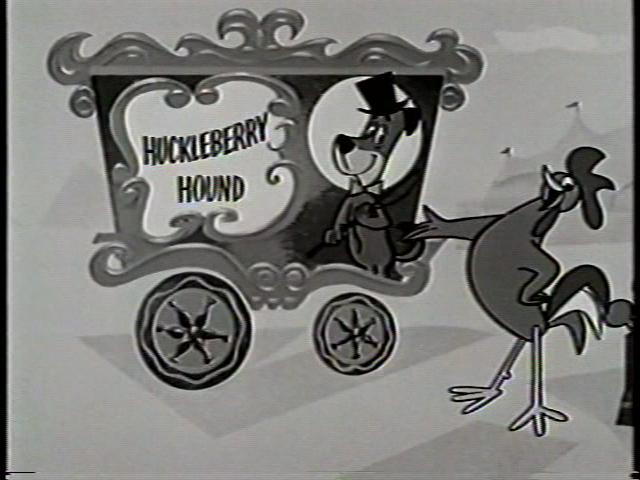
My kid’s had cornflakes for breakfast this morning -  they love eating a ‘vintage cereal’.  Cornflakes were actually invented (by accident) in 1894.  There have been many mascots of Kellogg's Cornflakes. The most popular and present one  is a red and green rooster named Cornelius (Corny) Rooster who has been the mascot since his debut in1957, when he  was created by the Leo Burnett Advertising Agency (a rival firm in Mad Men).  He was voiced by Dallas McKennon in early commercials, with the catchphrase  "Wake up, up, up to Kellogg's Cornflakes!" Dallas was a big voice man in cartoon movies, such Disney’s 101 Dalmatians, and he married his childhood sweetheart Betty in 1942.

 Cornelius was on the Huckleberry Hound show in the 1960s – clever advertising tie in

Cute cowgirl ad from 1965

You can read more about the cornflakes story here, and buy original vintage ads here.  I might need a bowl tomorrow, as I have a big day lined up!

Deb xx

Friday, 4 May 2012

3 May 1942–Battle of Tulagi & Marie Claire


The invasion of Tulagi, on 3–4 May 1942, was part of Operation Mo, the Japan's strategy ( in the South Pacific and South West Pacific Area in 1942. The plan called for Imperial Japanese Navy troops to capture Tulagi and nearby islands of the Solomon group. The occupation was intended to provide support for Japanese forces that were advancing on Port Moresby in New Guinea, the major Japanese base at Rabaul, and serve as a base for Japanese forces to threaten supply and communication routes between the US, Australia and New Zealand. You can read more about it here.

I received a ‘new’ magazine in the post today.  Marie Claire from March 1942 – incredibly produced in German occupied France at Lyon.   I am going to frame the whole magazine, so I have scanned it all.  I’ll post some pages  to day, and some tomorrow, but he ones with just writing I’ll leave, as they are in French.

marie claire cover

marie claire 1  marie claire 2

I have a photo of my mum from about 1949 with a similar hairstyle to this little girl.  Sweet! And here is some lovely French fashion.

marie claire 3  marie claire 4

I think the girl sitting down looks more 50s than 40s, don’t you?! – maybe it’s the hat.

Due to my new, or reignited,  obsession with horses, I have also started another blog to document my horsey loves and journey of horse ownership.  If you are interested you can see it here.

Hope you are having a lovely day

Deb xxx
Thursday, 3 May 2012

2 May 1942–MacArthur, War & Ponies

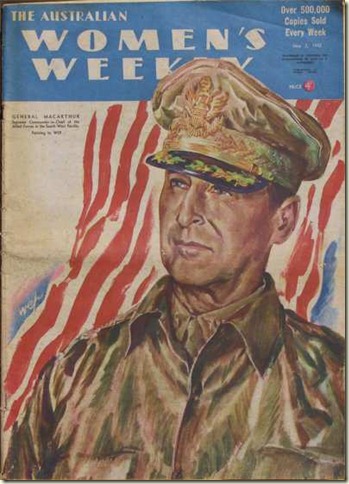
  2 may 1942 cover

A portrait of General MacArthur on the Australians Women Weekly, 2 May 1942’

On this day in 1942 a Japanese submarine was unsuccessfully attacked by USN aircraft from carrier Yorktown in the Coral Sea - The battle of the Coral Sea is not far away.   Meanwhile, in the Solomon islands, Japanese aircraft bomb the Australian base at Tulagi Island, in preparation for the invasion of Tulagi on 3 May, and the Australian detachment evacuates by a small boat.

Cute vintage horse photo of the day, from the Australasian Magazine, March 1942:

horse

And another vintage horse ad – featuring wild horses for once:

1942 great colorful wild horse art Adel print ad

Horses on the brain, sorry!

Deb xxx

Wednesday, 2 May 2012

1 May 1942–girls on duty, war & a horse

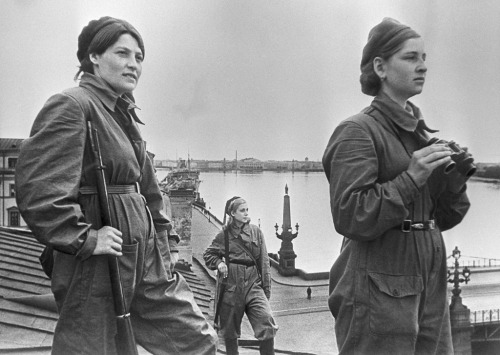
<br /><br />Boris Kudoyarov<br />“Girls on duty”. Girls on duty on the roof in besieged Leningrad. Air defense.<br />1 May 1942<br /><br />

“Girls on duty”. on the roof in besieged Leningrad. Air defense by Boris Kudoyarov 1 May 1942

On 1 May 1942 six airacobras crash landed on Ape York Peninsula, Queensland. You can read about it here.

Meanwhile in Sydney the RAN cruisers Hobart and Australia depart to join the USN task force in the Coral Sea, and USN Task Force 17 with carrier Yorktown joins Task Force 11 with carrier Lexington. The battle of the coral sea would begin in a few days time.

Also on this day Gauleiter Arthur Greiser, head of the district known as the Warthegau in the former Polish territories annexed to Germany after 1939, wrote a letter to Reichsführer SS Heinrich Himmler. Basically it spoke of murdering 100,000 polish jews over a three month period, as they were infected with tuberculosis. You can read the letter here.

No horses, but a little bit Western from 1942, because……

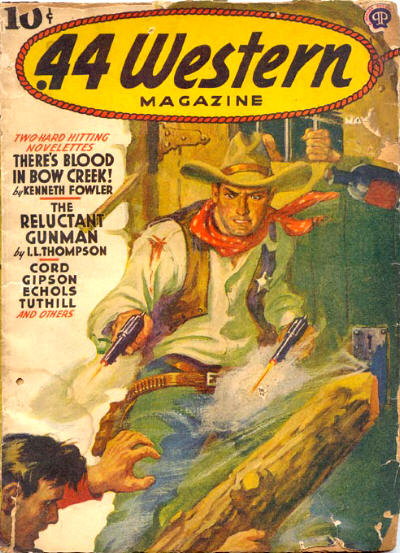
Cover of .44 Western Magazine [v 8 #1, May 1942]

I think I have found my horse! 

Isn’t she pretty?!

She arrives Sunday.  And no, I haven’t trialled her.  She is about 1000km form where I live.  My riding instructor asked me if I’d buy a car without driving it first.  Well, no I wouldn't.  But my husband has – three times.  Only one was a lemon, so I think  I am allowed a possible mistake.  Not that I will make one. I hope.  But I’ll let you know.

Deb xxx